
Press-On Nail Wholesale Pricing: The Five Levers That Move Your Per-Set Price
A buyer's framework for press-on nail wholesale pricing: the five levers that move price per set, how the three sales channels price differently, and how to normalize two quotes on the same basis.

Two buyers can order the same quantity of press-on nails and pay per-set prices that differ by a factor of three, and both can be right. The difference is rarely bargaining skill; it is what each buyer actually ordered, construction, decoration, packaging and design ownership change what a set costs to produce long before anyone discusses the number.
Wholesale press-on nail pricing moves on five levers: construction, decoration depth, order tier, packaging scope and design ownership. Ready stock, mass-market multipacks and handmade retail price by different rules, so knowing which lever a quote pulls, and which channel it comes from, matters more than any single figure.
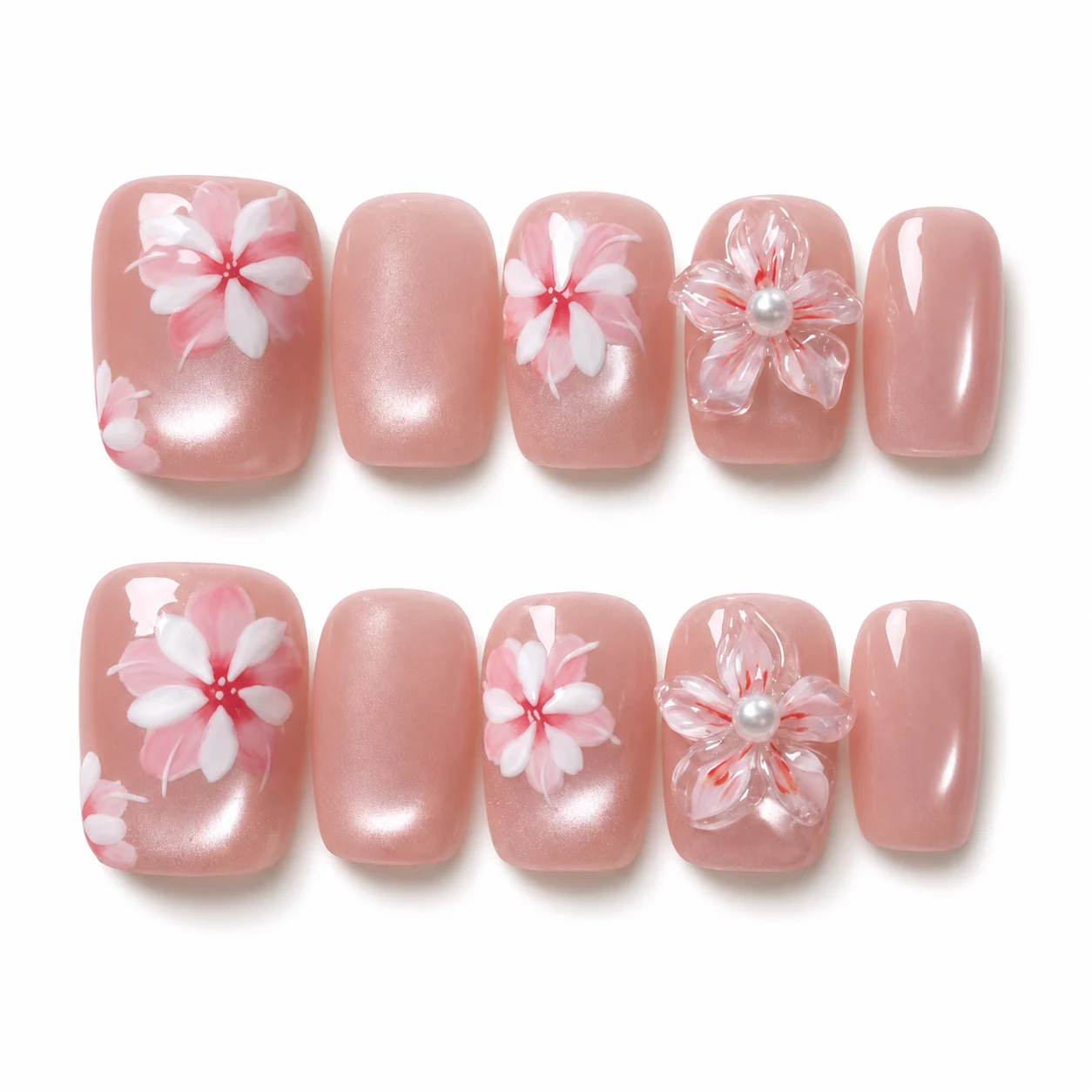
This is a buyer's framework, not a price list. The market references below were re-verified in October 2026 with sources attached; your own quotes will move with stock conditions and season. What should not move is the method: identify which lever a quote is pulling, then compare suppliers on the same basis.
How do the three sales channels price differently?
Three sales channels define the pricing structure: supplier-direct ready stock, mass-market retail multipacks and handmade retail sets. Each channel prices by different rules and answers a different buyer question.
| Channel | How it prices | What it means for your quote |
|---|---|---|
| Supplier-direct ready stock | Per-set price with tiered quantity breaks; entry minimums from about 20 mixed sets | The cost floor for unmodified stock designs1 |
| Mass-market retail multipacks | Fixed-price kits at big-box and marketplace retail | The shelf your retail customer compares against |
| Handmade retail sets | Per-set decoration labor priced into every unit | The premium segment a handmade or private label line is built for |
Read the table as three different businesses, not one. The ready-stock channel is your cost side, and its published numbers are openers: tiers move with quantity by design, and the wholesale programs that publish them state that prices are starting points1. The retail rows are your revenue side, and the gap between them is the margin space a private label line lives in. A buyer who knows only the wholesale floor leaves the second row unread; a buyer who knows only the retail rows cannot tell a good wholesale quote from a bad one. Both retail rows also move through the year, stretching upward in gift season and compressing in clearance weeks, which is why any anchor you collect should carry its date, and why the comparison is re-run before every negotiation rather than once a year.
Which levers actually move the per-set price?
Five levers do almost all the work: construction, decoration depth, order tier, packaging scope and design ownership. When two quotes differ by more than about thirty percent, the difference is almost always one of these, stated or hidden.
Construction is the first fork. Machine-made sets produce in molds at speeds handmade work cannot match, which is why they anchor the mass-market row; handmade sets carry per-set labor that shows up directly in price, as the handmade versus machine-made sourcing guide details. Decoration depth is the second lever: a printed French tip costs one price, a hand-placed 3D charm another, and chrome or layered hand-paint another again. Order tier is the lever buyers control most easily, since published programs step their per-set pricing down as quantities rise from trial tiers into the hundreds1. Packaging scope is the lever with its own minimums, separate from the nail MOQ, so a custom retail box can move the blended per-set cost more than an extra twenty sets would; the packaging MOQ guide covers the split. Design ownership is the quiet lever: ready stock, a modified stock mold, or a fully custom design sit at different price points, which the stock versus custom mold comparison lays out.
A practical way to use the levers is to score every quote against them in one pass. Write the five lever names down the left side of a page, ask the supplier one question per lever, and fill in the answers before looking at the number on the right. A quote that answers all five precisely can be compared line by line with any other quote that does the same, and the per-set figures become meaningful the moment the structure behind them matches. A quote that leaves two or three levers vague is not yet a price; it is an estimate wrapped around assumptions, usually optimistic ones about what you will accept. Buyers who run this pass once report the same surprise: the questions themselves, tier, mix, packaging, sampling and freight basis, surface more about a supplier's operation than any reference check, because a supplier who has answers ready runs the kind of operation that produces consistent batches. The questions are collected for reuse in the supplier questions worth real answers and the RFQ checklist.
Why does handmade cost more, and when is it worth it?
Handmade pricing is labor arithmetic: hours of skilled decoration per set, priced into every unit. It is worth it exactly where your customer can see the difference on the hand, and not worth it in the back rows of a discount shelf.
The channel structure explains the economics: the buyer of a handmade set is paying for decoration work a machine mold cannot reproduce, and that labor is why handmade retail sits clearly above the mass-market shelf. That premium is the private label opportunity: a branded line that buys ready-stock wholesale competes on price, while a line built on handmade 3D work competes on design and takes the handmade margin instead. The honest caveat is that the premium only holds where quality survives wear, which returns us to construction and QC; seasonality moves both rows too, and the holiday pricing guide shows how far the retail side stretches in peak weeks.
How do you compare two supplier quotes on the same basis?
Normalize five fields before comparing numbers: what tier the quote assumes, how many designs it allows, whether packaging is included, what sampling costs, and which freight terms apply. Only then does the per-set figure mean anything.
A quote at a higher per-set price with packaging included can beat a lower one with a separate packaging MOQ behind it, and the packaging MOQ split is where that comparison usually flips. Sampling terms belong in the same normalization: paid samples that reflect real production conditions are worth more than free showroom pieces. Two more fields finish the normalization. Lead time belongs on the same line as price, because a cheap quote that lands after your selling window is the most expensive quote on the table, and reorder terms deserve one question: whether repeat orders reprice automatically or hold the agreed tier for a season. Freight terms decide whether duties land on your side of the invoice, and deposit percentage sets how much cash you risk before the batch ships, as the deposit guide details. When a supplier's answers to these fields are precise, the per-set number they attach to them is usually honest too; when the answers are vague, no discount makes the quote cheap. The questions that surface this quickly are collected in the supplier questions worth real answers.

Frequently asked questions
What is a good wholesale price for press-on nails? There is no honest one-number answer. Ready-stock programs publish tiered per-set pricing that steps down with quantity1, while handmade wholesale follows decoration depth and construction instead of a published floor. Two quotes far apart usually mean a different lever somewhere, thinner decoration, machine construction or a stock mix you did not choose, so check which lever is being pulled before celebrating.
Why is the same design quoted at different prices by different suppliers? Because the quotes rarely describe the same set. Construction, decoration depth, size range, packaging scope and sample terms all move the number; normalize the five fields first and the gap usually explains itself.
Does a bigger order always get a better per-set price? On stock tiers, generally yes, and published programs reflect it openly1. But the blended cost includes packaging and the inventory risk of unsold designs, so the cheapest per-set price is not automatically the cheapest order, as the bulk versus small-batch guide shows.
Send your target quantity, market and the designs you like. ZONO quotes with the five fields stated: tier, mix rules, packaging scope, sample terms and freight basis, with every number confirmed per project.
Start the conversation For the catalog view, see wholesale press-on nails and OEM sourcing.Conclusion
Price per set is an output, not an input. The three channels tell you where the money sits: ready stock sets the cost floor, mass-market kits set the comparison shelf, and handmade decoration sets the premium. The five levers tell you why your quote landed where it did. Buyers who normalize quotes on tier, mix, packaging, sampling and freight stop comparing apples to assembly kits and start negotiating the only thing that matters: which levers they are willing to pay for, and which they are not.
Footnotes
Nailystal wholesale program page: published tiered per-set pricing with quantity breaks from 20 mixed sets; price figures intentionally omitted here, so request current quotes when comparing suppliers. Observed October 2026. nailystal.com ↩︎