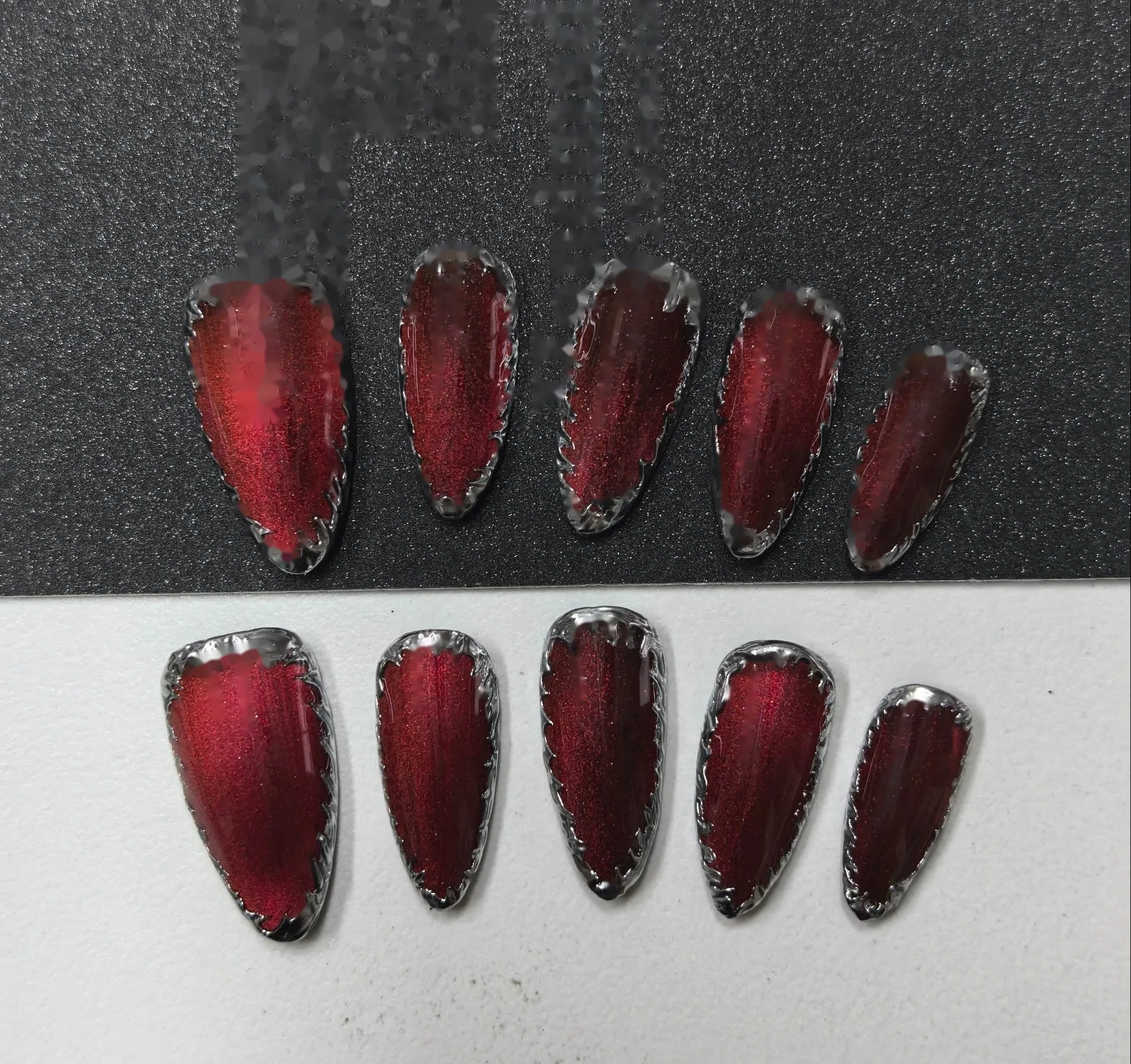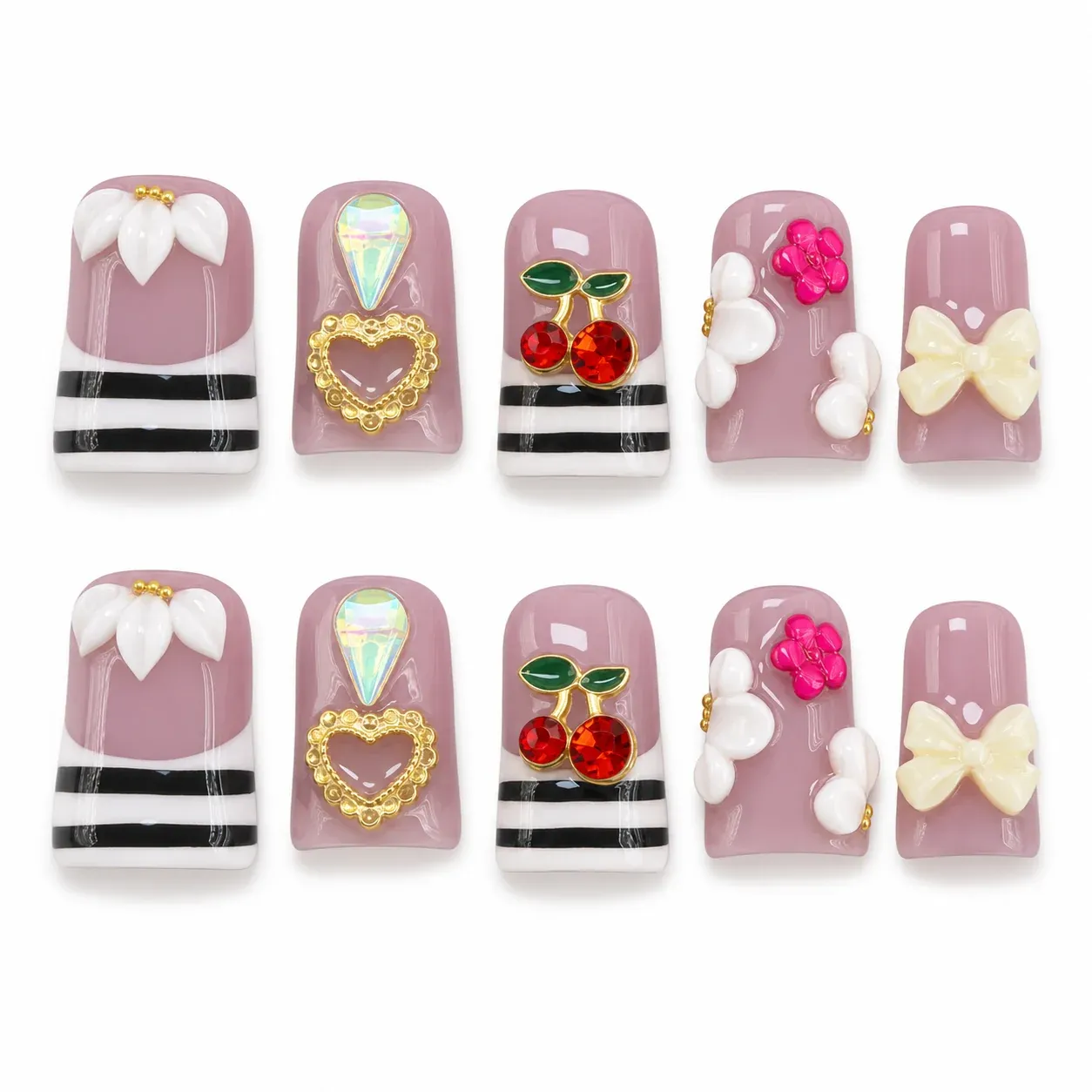
Sep 24, 2026Press-On Nails Guides
Handmade vs Machine-Made Press-On Nails: A Wholesale Buyer’s Sourcing Guide
A practical sourcing guide for wholesale buyers: compare press-on nail production routes through process disclosure, SKU role, approved samples, fit, packaging, and quality controls.
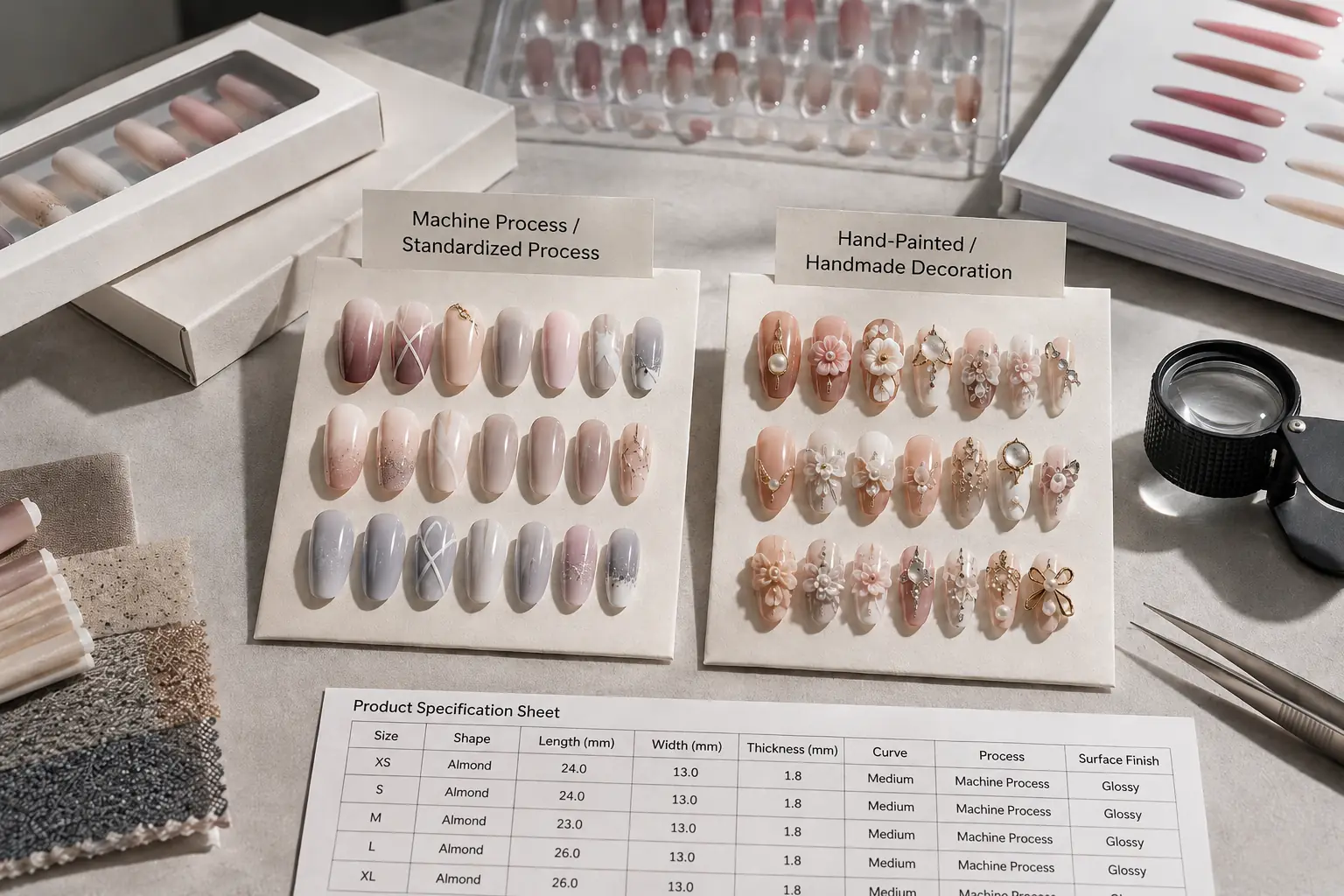
Wholesale buyers should not buy the word handmade. They should buy a clear process definition, an approved reference sample, and a quality standard that can be repeated in bulk production.
Handmade and machine-made press-on nails are often presented as a simple premium-versus-budget choice. That is too narrow for a sourcing decision. A standardized process may suit a repeatable core SKU; manual painting or decoration may be relevant where a collection needs a more distinctive visual result. Neither route automatically guarantees fit, durability, consistency, or retail success.
Compare the defined production routes against the same product brief.
ZONO Buyer Insight: Do not treat handmade and machine-made press-on nails as a simple premium-versus-budget ladder. First decide what each SKU must do for the collection: provide dependable replenishment, meet a target landed cost, create design differentiation, support social content, or earn a premium margin. Then ask which production steps are actually required to deliver that role.
Start with the buyer job, then choose the process route
A useful sourcing decision follows a simple sequence. First, define the job of the SKU. Next, identify the production steps needed for that job. Finally, approve a sample and inspection standard that proves the selected route can be repeated. This keeps the conversation focused on the product outcome, rather than on an undefined production label.
- Replenishment-first: begin with the required shape, size system, colour reference, finish, and pack-out. Ask which parts of the design are standardized and how the approved version will be controlled on a repeat order.
- Design-differentiation-first: identify the visual feature that must remain distinctive—such as artwork, placement, texture, or dimensional detail—then define the acceptable variation and how it will be protected in the retail pack.
- Hybrid route: where a standardized base and manual detail are both relevant, document the hand-off between those steps. The buyer should be able to see which parts are controlled by the base specification and which require manual visual review.
This is not a hierarchy of “better” and “worse” manufacturing. It is a way to choose the amount and location of manual work that the exact SKU requires.
Why the production label is not enough
The same word can describe very different work. One supplier may use handmade to mean hand-painted artwork. Another may mean hand-applied charms, manual gel building, final assembly, or a combination of these steps. A set can also combine standardized and manual work: a formed base nail may receive a printed colour layer, hand-fixed decorations, and manual packing.
That is not inherently a problem. The risk appears when the buyer approves a visually impressive sample without knowing which steps created the result, then expects bulk production to match it without a written process and quality reference. The more useful question is: Which steps are molded, printed, finished, painted, decorated, or assembled by hand for this exact SKU?
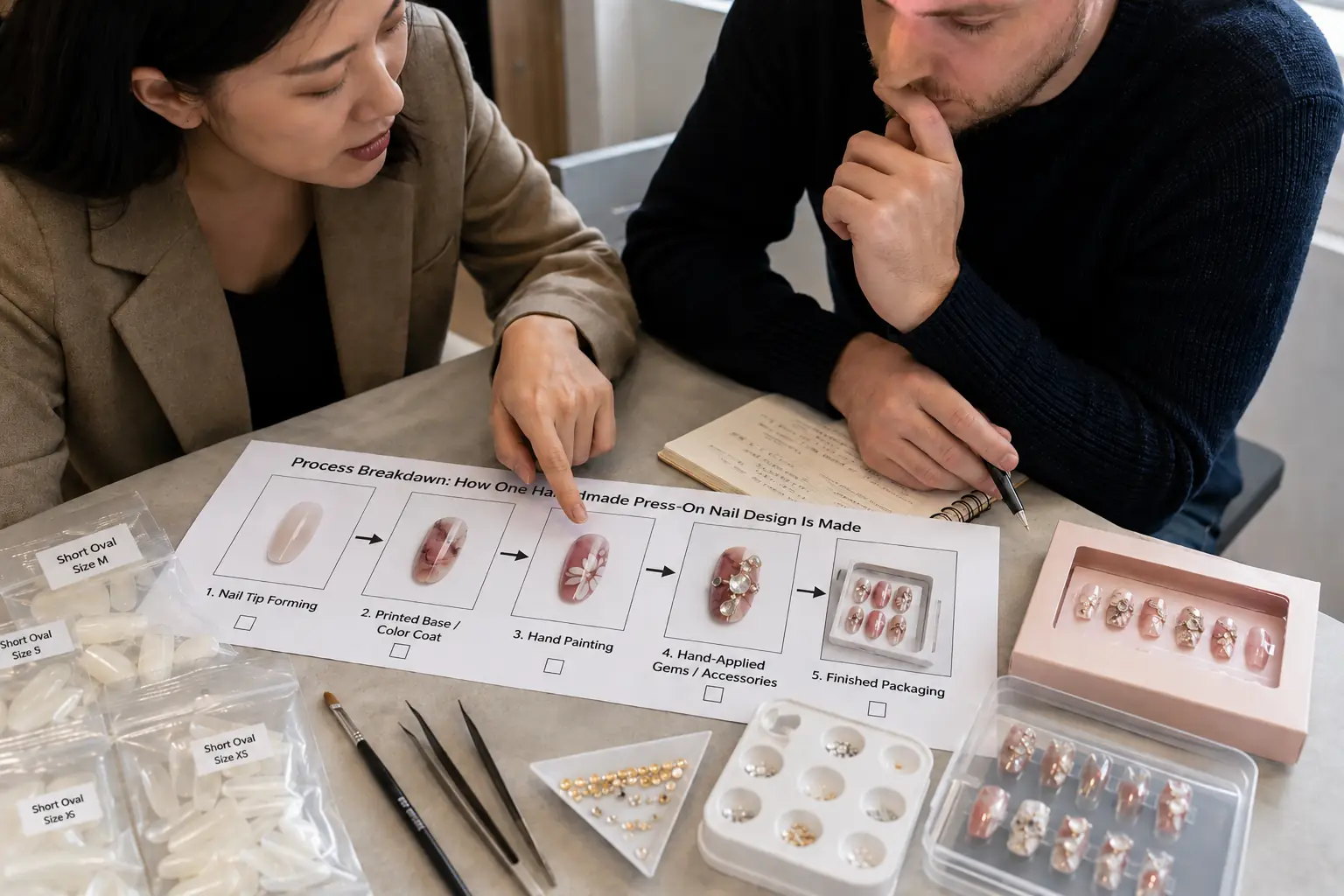
Record the production steps that apply to the exact SKU—not only the sales label.
Use a four-level process description
A four-level description is clearer than a loose “pure handmade” or “machine-made” label. It also gives the buyer a more practical basis for sampling, quoting, and inspection.
Process type | What it describes | Buyer focus during sampling |
|---|---|---|
Machine-Printed / Factory-Finished | Standardized printing, spraying, coating, or surface finishing on a defined nail base. | Artwork version, colour and finish consistency, registration, surface defects, and repeat-order control. |
Hand-Decorated | A standardized base or design with manually applied charms, stones, decals, or other details. | Decoration position, attachment security, variation limits, and protection inside the retail pack. |
Hand-Painted | The principal artwork is painted manually on the nail surface. | Visual balance across the set, colour family, artwork placement zone, and acceptable set-to-set variation. |
Hand-Built / Sculpted | Manual gel building, sculpted elements, or complex three-dimensional work. | Profile, thickness distribution, decoration retention, finish, and the visual standard for the full set. |
A supplier can use more than one category for the same design. The point is transparency: the quotation, sample record, and inspection instructions should describe the relevant steps rather than relying on an undefined label.
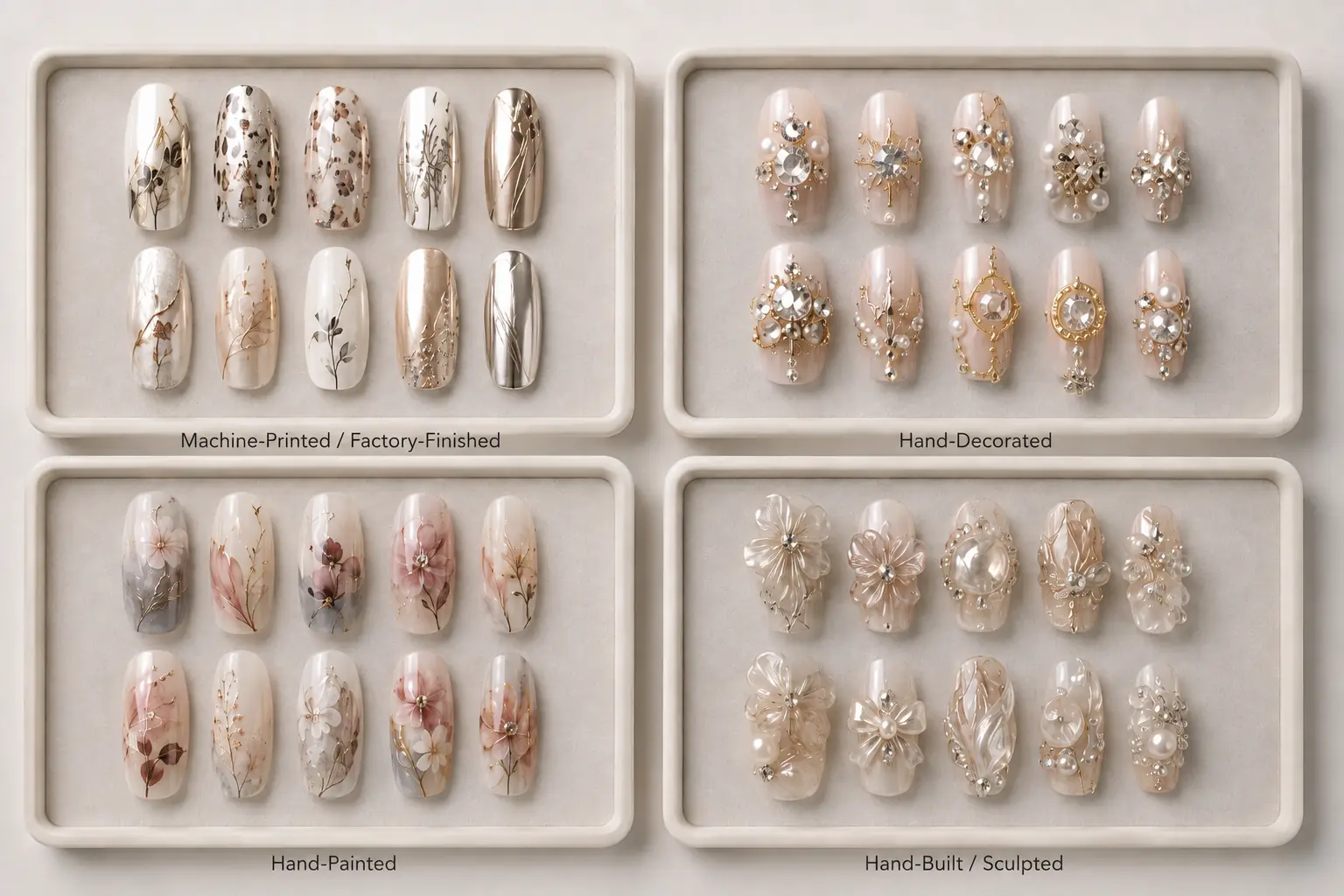
Use process definitions that a buyer, supplier, and inspector can all understand.
Choose the route by SKU role, not by prestige
Start with the commercial role of the SKU. A replenishable neutral design, a quick-change event set, a seasonal trend style, and a high-impact social-media piece do not need to be sourced in the same way. The table below is a planning tool, not a rule that assigns one production route to every SKU.
SKU role | Typical buyer objective | Process question to ask |
|---|---|---|
Core Repeat | Support a recognizable everyday offer and future replenishment. | Can the supplier reproduce the approved design, shape, size configuration, and pack-out consistently on a later order? |
Quick Change | Offer a temporary or occasion-led style change with clear use expectations. | Does the accessory and instruction system match the intended use position, without making unsupported wear claims? |
Trend Layer | Refresh the assortment with colour, finish, seasonal direction, or a timely visual idea. | Which design elements are standardized, and which elements need close sample review before approval? |
Halo / Social | Create attention and a distinctive brand point of view. | Are the manual details, dimensional elements, and packaging protection defined tightly enough to be repeated as intended? |
There is no universal mix of core, trend, and halo styles. Start with a collection hypothesis, then adjust it using sell-through, size usage, return reasons, repeat orders, and customer feedback. Personal taste can inspire the range, but it should not be the only basis for replenishment decisions.
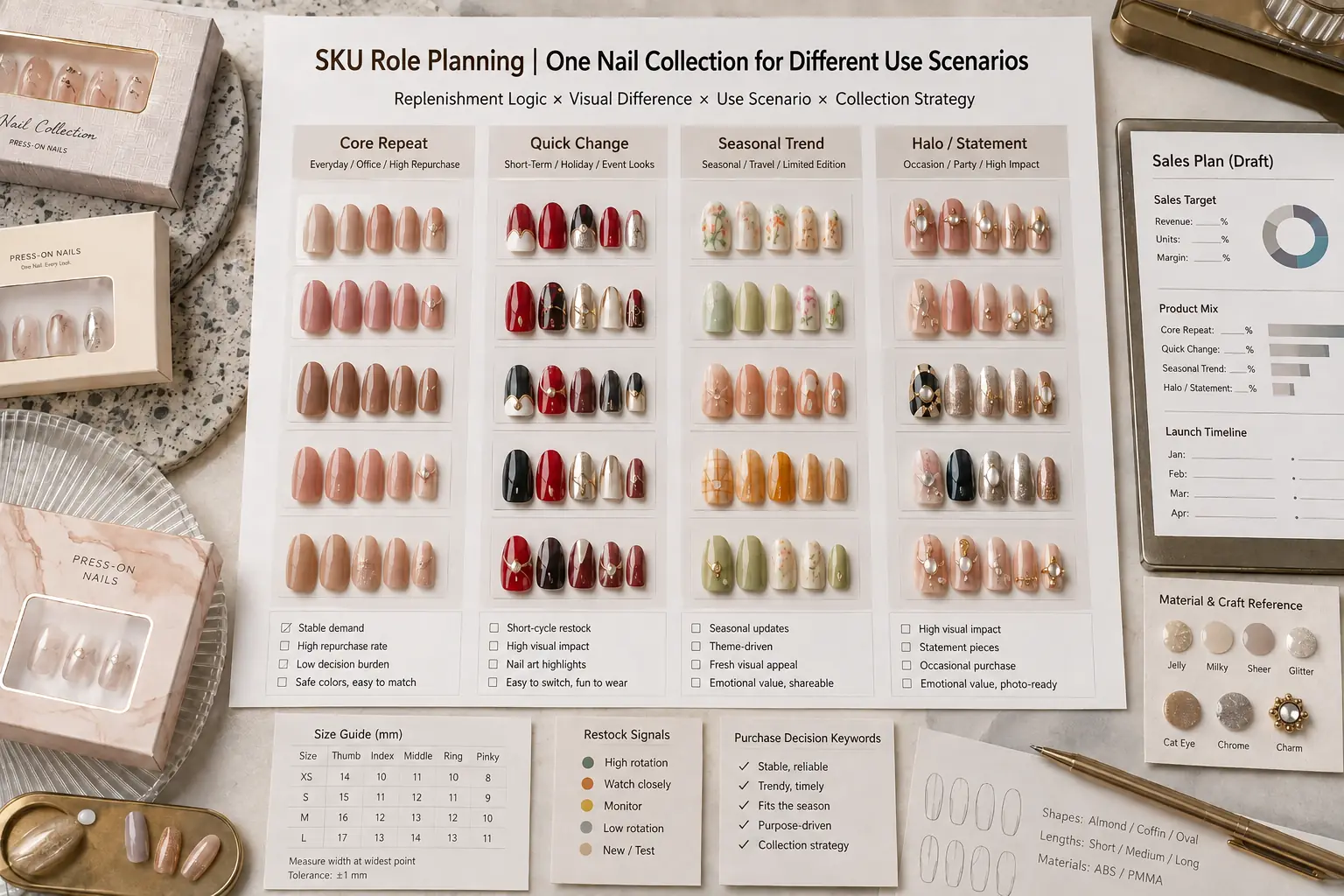
Plan the collection around distinct buyer and customer jobs, not one generic production route.
Fit is a product-system question
Neither a manual process nor a standardized process automatically produces a better fit. Fit can be influenced by size coverage, curvature profile, sidewall contour, thickness distribution, rear-edge profile, surface finish, and how the customer selects a size. The relevant question is whether the selected system matches the target customer and has been evaluated with suitable users or market feedback.
A buyer should avoid broad assumptions about regional nail beds or customer groups. Instead, record size usage, common fit comments, return reasons, and demand for particular shape or curve families. Use this evidence to decide whether to expand, narrow, or adjust a sizing system on the next collection.
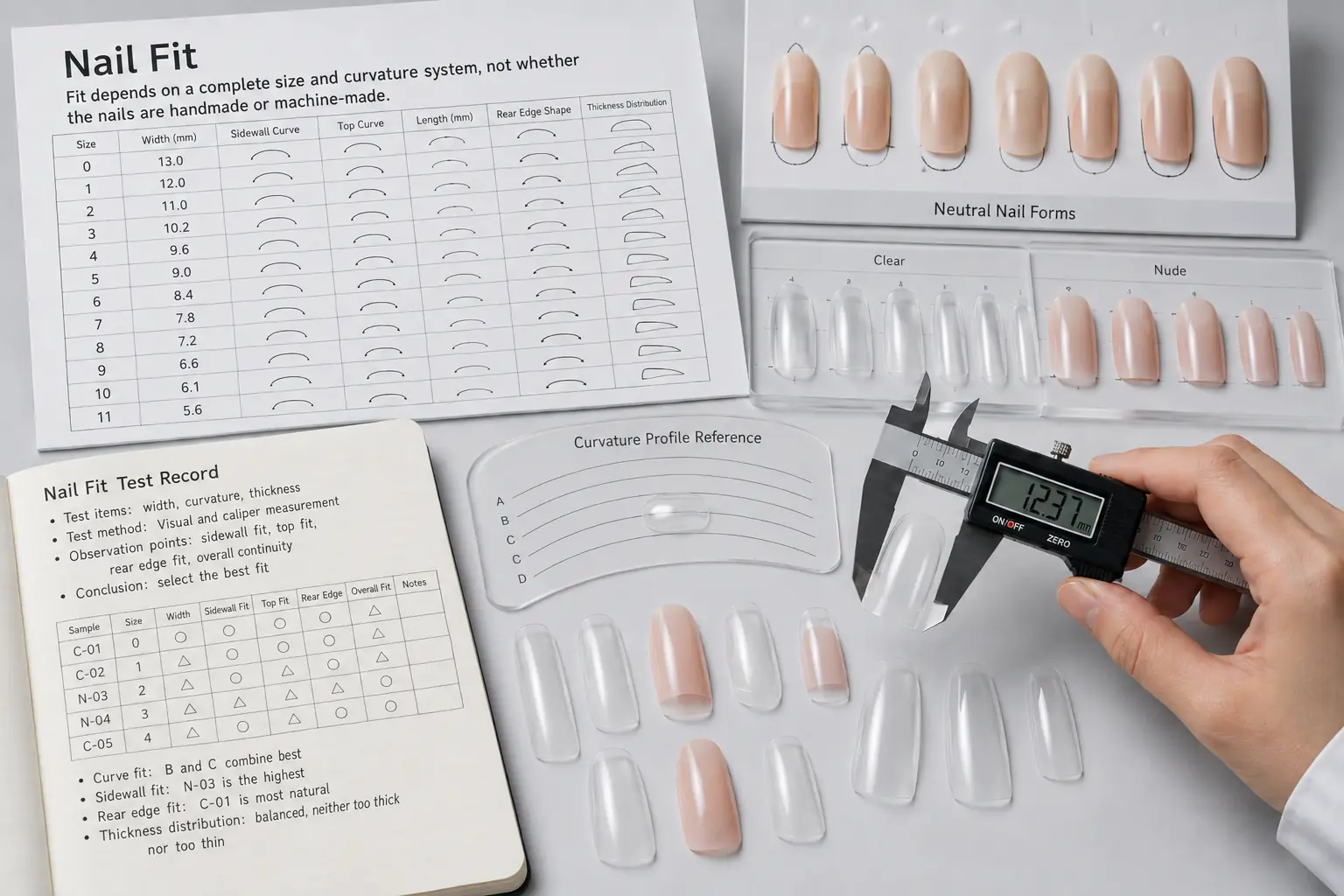
Evaluate the complete fit system rather than assuming a process label determines fit.
Make the sample brief specific enough to reproduce
A reference image communicates the intended appearance. It does not explain how the product should be made or how the finished result will be accepted. A production-ready sample brief should state the features that matter to the buyer and distinguish non-negotiable requirements from areas where the supplier may recommend an option.
- Nail shape, measured length, profile, and size configuration
- Base-material declaration, opacity, colour, and finish direction
- Artwork placement, layer build, and decoration attachment method where relevant
- Accessory and adhesive system, including what is or is not included in the retail unit
- Tray, insert, outer packaging, and complete pack-out configuration
- Approved artwork and packaging file versions
- Agreed checks, measurement methods, and pass/fail criteria for critical features
For sheer, jelly, nude, and French designs, add an adhesive-visibility review. The buyer should assess whether tab edges, bubbles, glue lines, or other application details remain visible through the chosen opacity and curve. This is a product-review point, not a promise that every adhesive system will be invisible.
For vacation, shower, pool, or water-related positioning, evaluate the complete nail, adhesive, preparation, and use system under agreed conditions. Do not turn a limited review into a blanket waterproof claim. Consumer discussions are useful for identifying the questions customers ask; they do not prove a specific product’s performance.
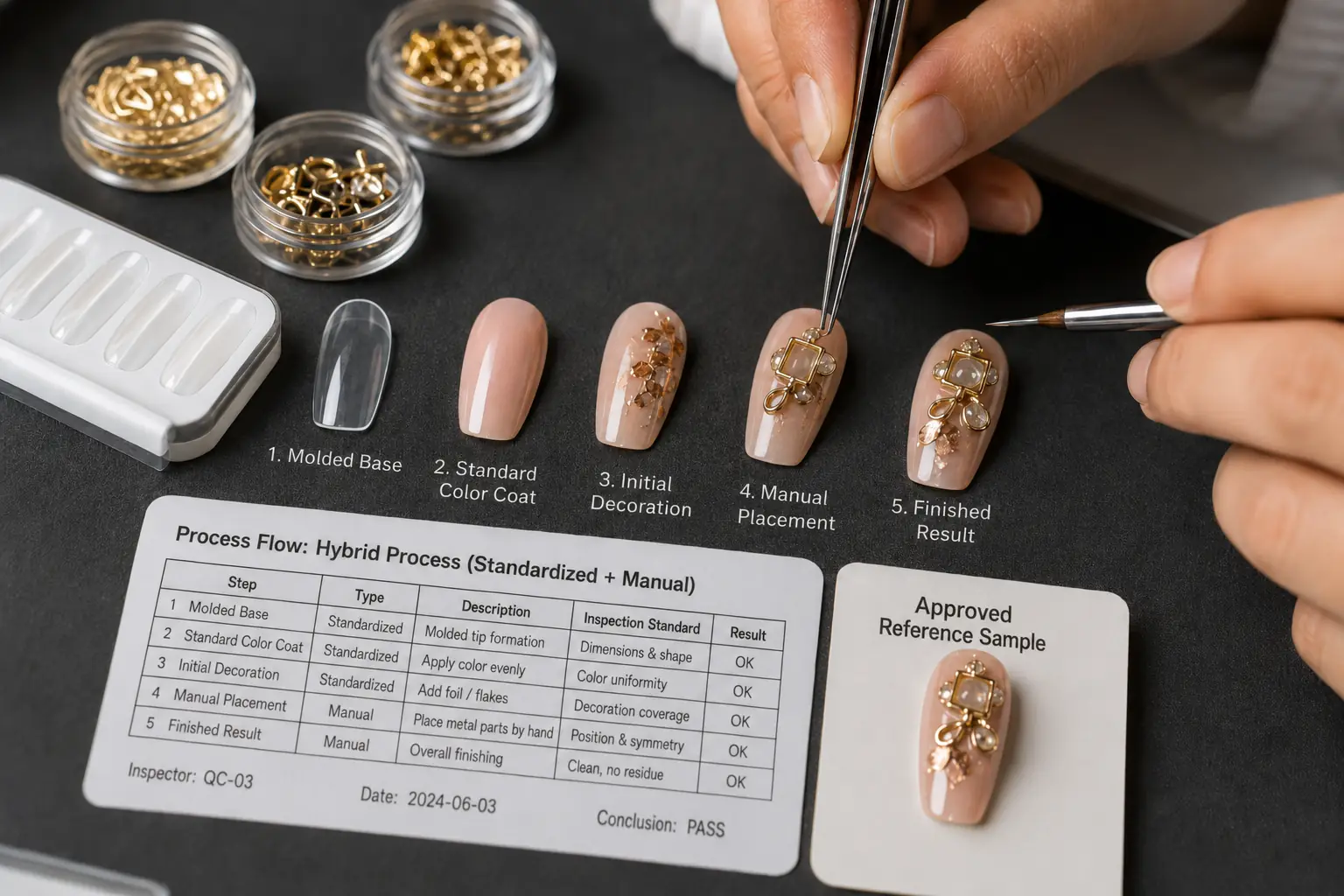
Use a dated approved reference sample to connect the process description with bulk inspection.
Turn an approved sample into a production standard
A pre-production sample is useful only when it becomes a shared reference. Keep a dated golden sample or production standard, complete photos, artwork versions, packaging versions, and written approval notes. Record the inspection points and escalation path before bulk production starts.
The checklist should convert expectations into critical-to-quality fields. The exact method and tolerance should be agreed for the particular product; do not treat a generic test name as a universal requirement.
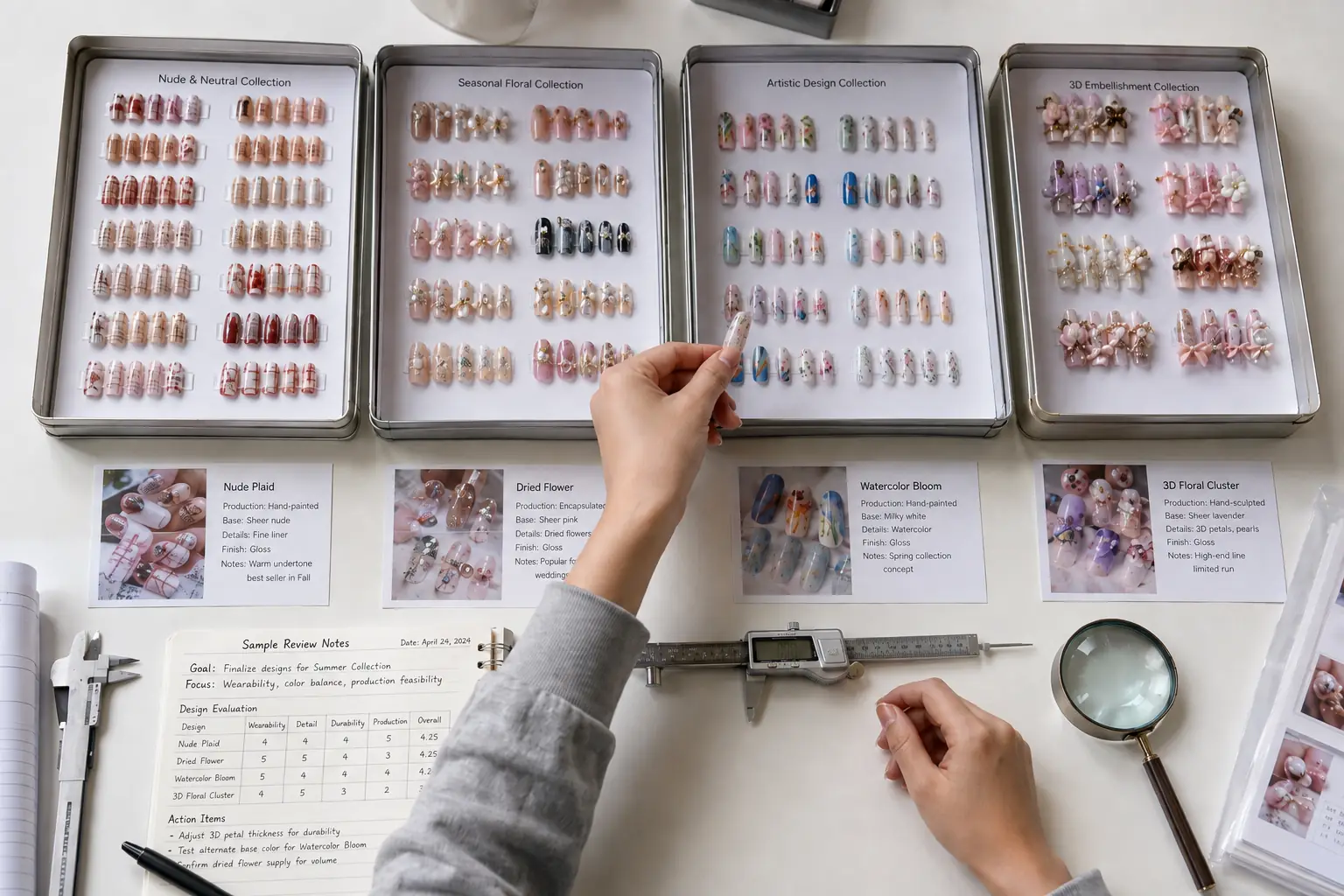
Review representative samples across the collection before locking the production standard.
Critical-to-quality field | Example status options | What the record should clarify |
|---|---|---|
Size consistency and curve profile | Pass / Marginal / Fail | The target shape, size arrangement, curve family, and agreed measurement or comparison method. |
Surface, colour, and finish | Pass / Marginal / Fail | The approved colour reference, visible-defect boundary, and finish expectation. |
Decoration retention | Pass / Fail / Not applicable | The intended placement, secure-attachment requirement, and agreed evaluation method. |
Adhesive visibility | Pass / Marginal / Fail / Not tested | The nail opacity, curve, adhesive configuration, and viewing condition used for the review. |
Water exposure | Pass / Marginal / Fail / Not tested | The complete system, exposure condition, and limited conclusion that the agreed review supports. |
Tray retention and pack-out accuracy | Pass / Fail | The filled retail unit, accessory placement, and agreed distribution or handling evaluation. |
A tape or cross-cut adhesion method may be useful only when it suits the coating thickness, substrate, and agreed application. ASTM D3359 itself specifies conditions and method selection for rating adhesion by tape test; it is not a one-size-fits-all requirement for every press-on nail design. [ASTM D3359]
Do not simplify packaging or adhesive documentation
Packaging is not merely a final decoration. It is the protection, instruction, and after-sales-prevention system for the product. Review tray retention, accessory separation, pack-out accuracy, label space, application and removal instructions, barcode placement, and the protection required for any raised decoration.
Do not specify one fixed drop height as a universal press-on nail rule. The appropriate test depends on the retail pack, product weight, shipment route, handling environment, and acceptance objective. ISTA publishes multiple testing series for different uses, from early integrity screening to shipment simulations, and emphasizes selecting the procedure for the intended outcome. [ISTA test procedures]
Where an adhesive product requires safety or hazard documentation, ask for a current Safety Data Sheet (SDS), where applicable, rather than an “MSDS certificate.” OSHA describes SDSs as a standardized format for communicating chemical hazard information; the required product, transport, and label documentation remains market- and channel-specific. [OSHA Hazard Communication]
Five supplier questions that make the comparison useful
- For this SKU, which steps are molded, printed, factory-finished, hand-painted, hand-decorated, or manually assembled?
- Which dated sample, artwork file, packaging file, and approved specification will bulk production follow?
- Which product features may vary, and which features have a defined tolerance or pass/fail standard?
- How will the supplier inspect size, curve, surface finish, decoration retention, and complete pack-out?
- What must be reconfirmed before a repeat order so the next run matches the approved reference?
Before you request a quote
Send a supplier the same decision package you would use internally: reference images, the SKU role, target market and sales channel, desired size and shape system, pack-out concept, quantity range, and a short list of non-negotiable visual or functional requirements. Ask the supplier to respond with a process map, a sampling recommendation, known variables, and the points that need approval before bulk production.
A quote is more comparable when it is linked to that package. Without it, two suppliers may both quote “handmade press-on nails” while assuming different base materials, decoration steps, size assortments, adhesives, packaging, and inspection standards.
Conclusion: buy a controlled process, not a label
A standardized production route can support a repeatable core product. Hand-painted or hand-decorated elements can support a differentiated design direction. A collection may use both. The sourcing decision becomes stronger when every SKU has a clear commercial role and every approved process is documented well enough to inspect and reproduce.
Talk to ZONO about your press-on nail project: send your reference images, target market, sales channel, expected quantity range, and the features that must stay consistent. We can help structure the sample brief, process disclosure questions, and quality points to resolve before bulk production. To start your shortlist, browse the press-on nail range.
This article is a B2B sourcing guide, not legal, chemical-safety, product-performance, or market-compliance advice. Confirm product classification, label requirements, safety documentation, testing scope, and claims for the specific product and destination market.