Sep 14, 2026Press-On Nails
Private-Label Stock or Custom Molds: Which Suits Your Brand Stage When Sourcing Press-On Nails?
Private-label stock or custom molds for press-on nails? Compare MOQs, lead times, and readiness signals to pick the right sourcing path for your brand stage.
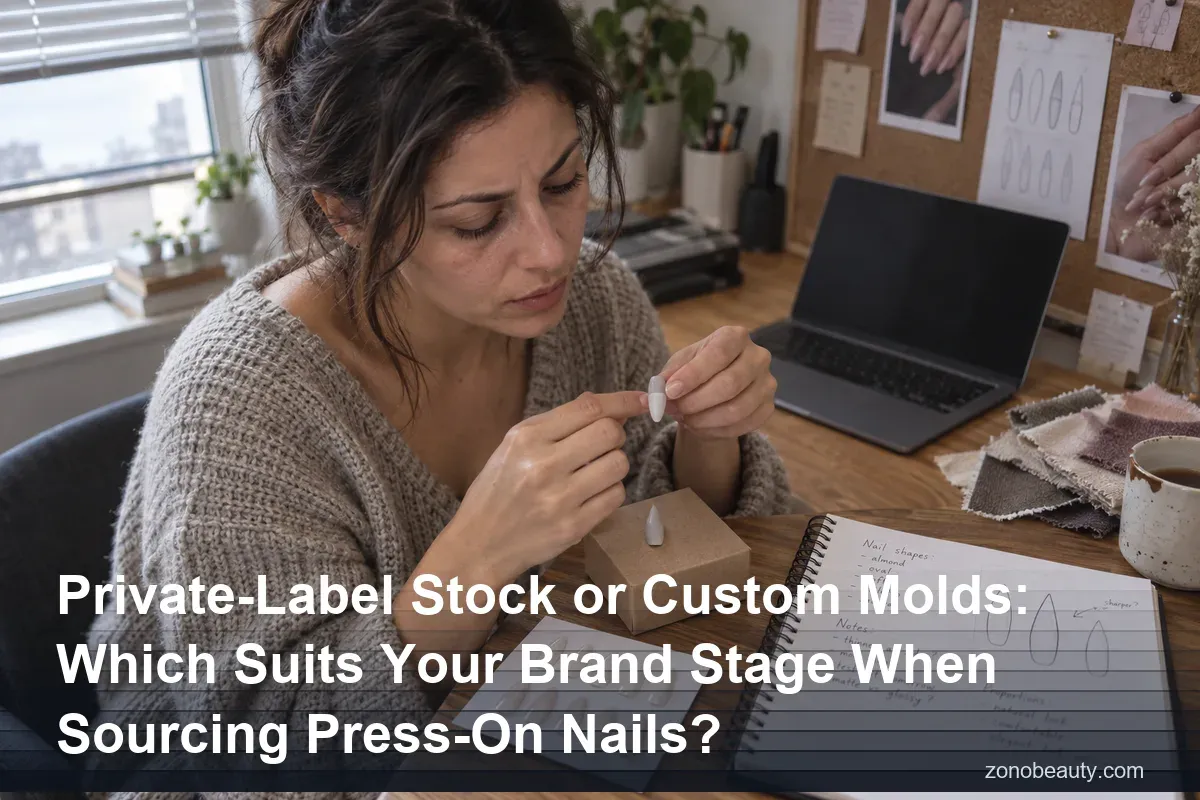
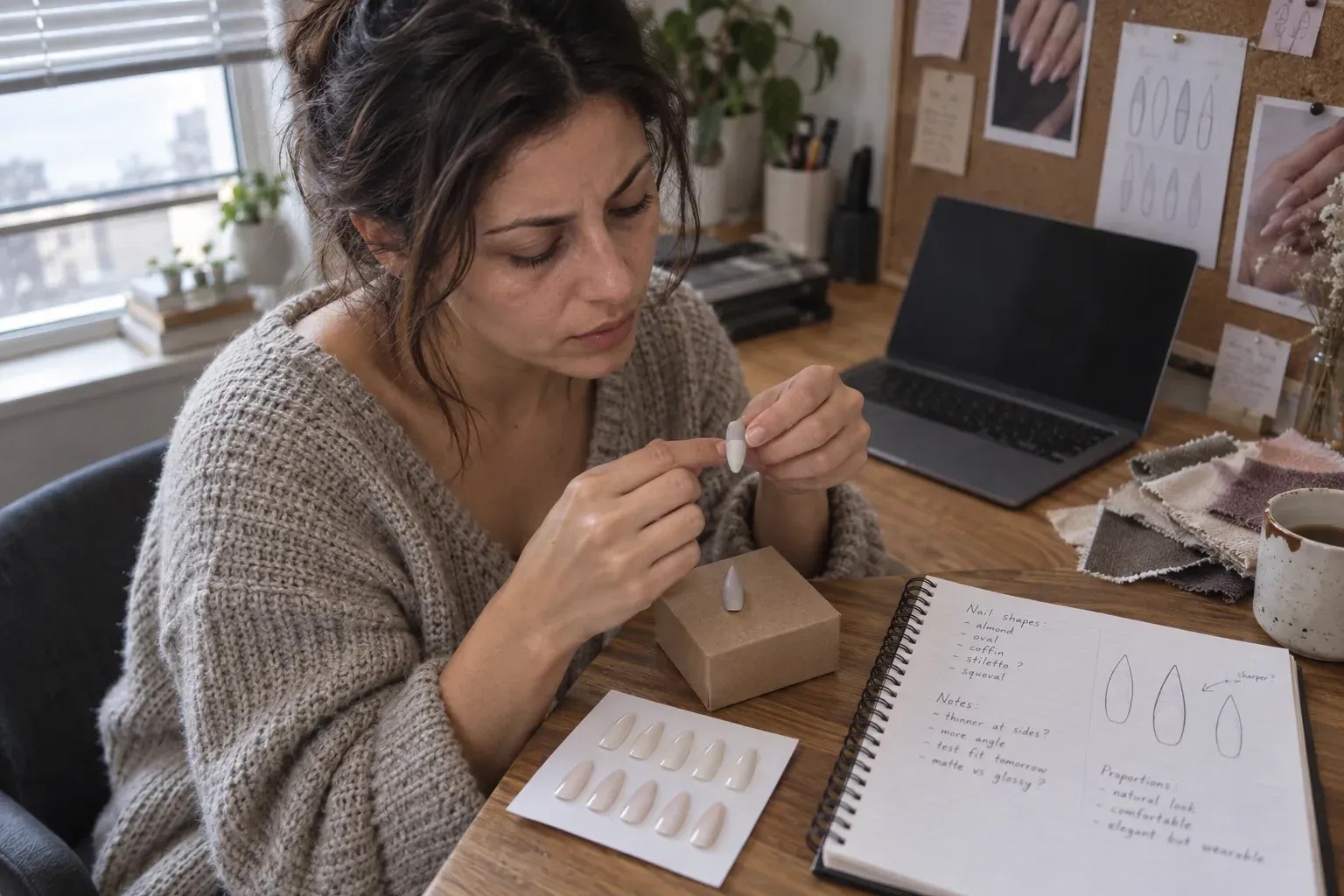
Choosing between private-label stock 1 and custom molds for press-on nails can stall a launch for months. I have watched founders freeze at this exact fork while coordinating nail sourcing projects from Shantou.
Private-label stock press-on nails suit early-stage brands testing demand, with low per-design MOQs — 50 sets per design at ZONO — and short production windows. Custom molds suit validated brands needing signature shapes, usually requiring 500–2,500+ sets and 6–8 week lead times. Most new brands should start with stock.
The right answer depends on your stage, not your ambition product-market fit 2. Below, I break down readiness signals, real budget and MOQ gaps, sample-to-bulk risks, and the moment to switch paths.
ZONO confirmed terms (for reference)
- Sample sets: US$15 per set, credited against your first bulk order.
- Bulk production: around US$7 per set, quoted per design.
- Minimum order quantity: 50 sets per design.
- Compliance documentation: available upon request; final compliance responsibility rests with the brand owner.
- Markets served: Southeast Asia, North America, and South America.
Any other figures in this article are general industry context, not a ZONO quotation. Confirm current terms in writing before ordering.
How do I know if my brand is ready for custom press-on nail molds instead of private-label stock?
A US founder once asked our sourcing team for a fully custom mold before her first sale. We talked her back to white label manufacturing, and her launch happened months sooner.
You are ready for custom molds when you have validated product-market fit, repeat customers, a clear signature aesthetic, and enough cash to absorb 500–2,500+ set minimums plus a 6–8 week development cycle. If any of those are missing, private-label stock remains the safer path.
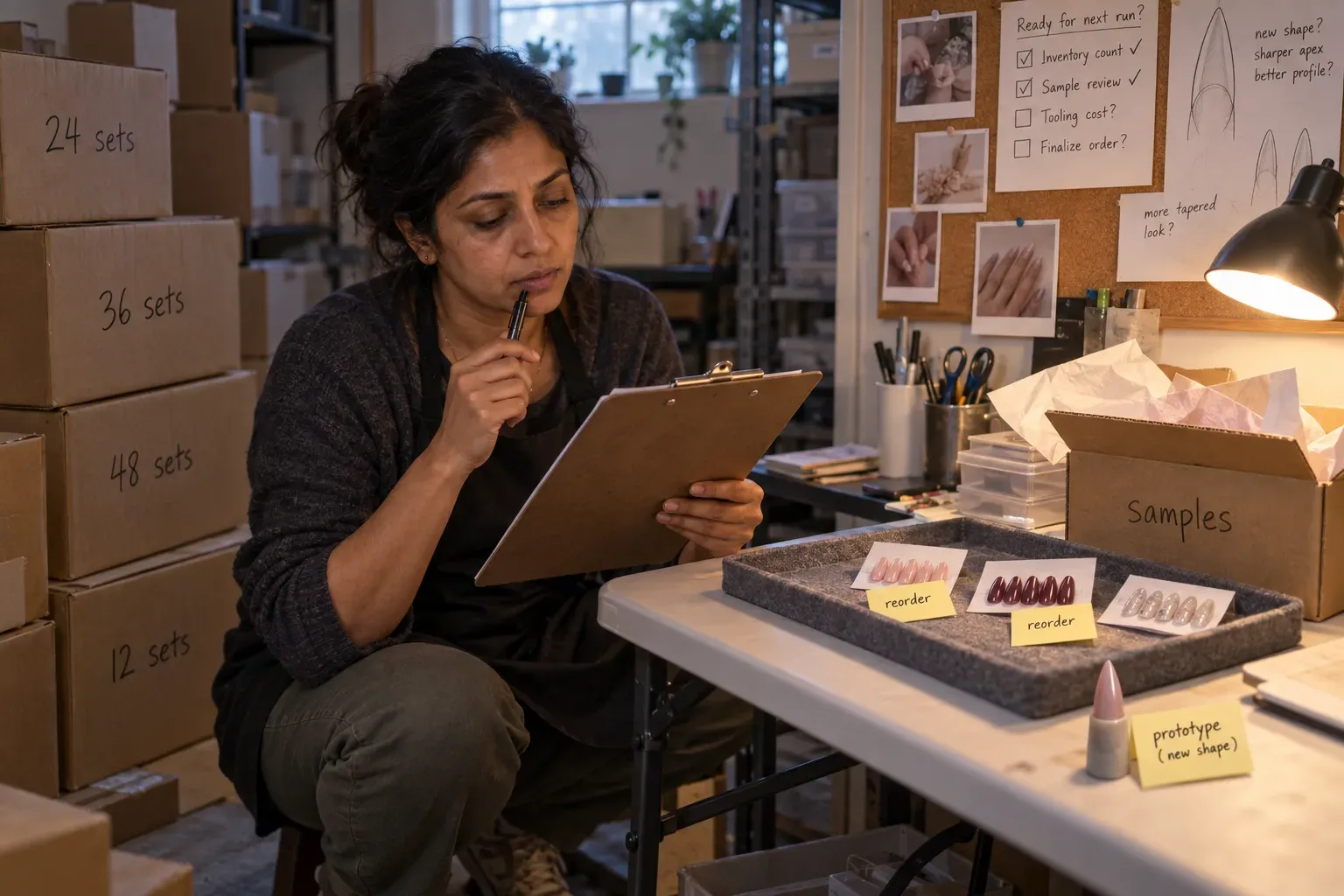
Readiness is not a feeling. It is a set of concrete conditions. In the projects we coordinate, brands that jump to custom molds too early usually share one trait: they are guessing at demand instead of measuring it. Custom tooling only pays off after you know exactly which shape, curve, and fit your customers reorder.
What custom molds actually control
Custom molds give you full authority over nail geometry, thickness, curvature, and apex placement. That level of control matters for a premium or professional-grade positioning. It also unlocks underserved niches, such as inclusive sizing for flat nail beds or extra-wide thumb plates, which standard stock catalogs <sup id="ref-3"><a href="#footnote-3" class="footnote-ref">3</a></sup> simply ignore. On top of fit, custom work creates proprietary design rights. A stock mold can be ordered by any competitor tomorrow. A proprietary shape becomes part of your product differentiation strategy and builds a moat that copycats cannot replicate overnight.
A quick readiness check
Readiness signal | Stick with private-label stock | Move toward custom molds |
|---|---|---|
Sales history | Pre-launch or testing trends | One or two proven winning SKUs |
Customer base | First-time buyers only | Repeat purchases and reviews on fit |
Design identity | Following current trends | Clear signature shape or fit need |
Cash position | Cannot tie up capital in inventory | Can fund tooling plus 500+ set runs |
Timeline pressure | Need to launch in weeks | Can wait 6–8 weeks or longer |
If your honest answers land mostly in the left column, stay with stock designs. You lose nothing by waiting, and you keep your market entry strategy fast and reversible.
✔ Custom molds create a proprietary shape that competitors cannot easily replicate TrueBecause the tooling belongs to your project, the exact geometry, curve, and apex placement stay exclusive, while stock molds remain open to any buyer.✘ A brand needs custom molds from day one to look professional FalseWell-executed private-label stock with branded packaging can look fully professional; many established nail brands launched on stock shapes and only tooled custom molds after demand was proven.
What budget and MOQ differences should I expect between stock designs and custom nail molds?
The trade-off I weigh on every quote is simple: stock keeps cash free, custom buys uniqueness. When we match clients to vetted production network, Minimum Order Quantity is usually the first number that decides the path.
Private-label stock runs start at a low per-design minimum — at ZONO that is 50 sets per design — while custom molds carry a much higher minimum, upfront tooling fees, and longer lead times.
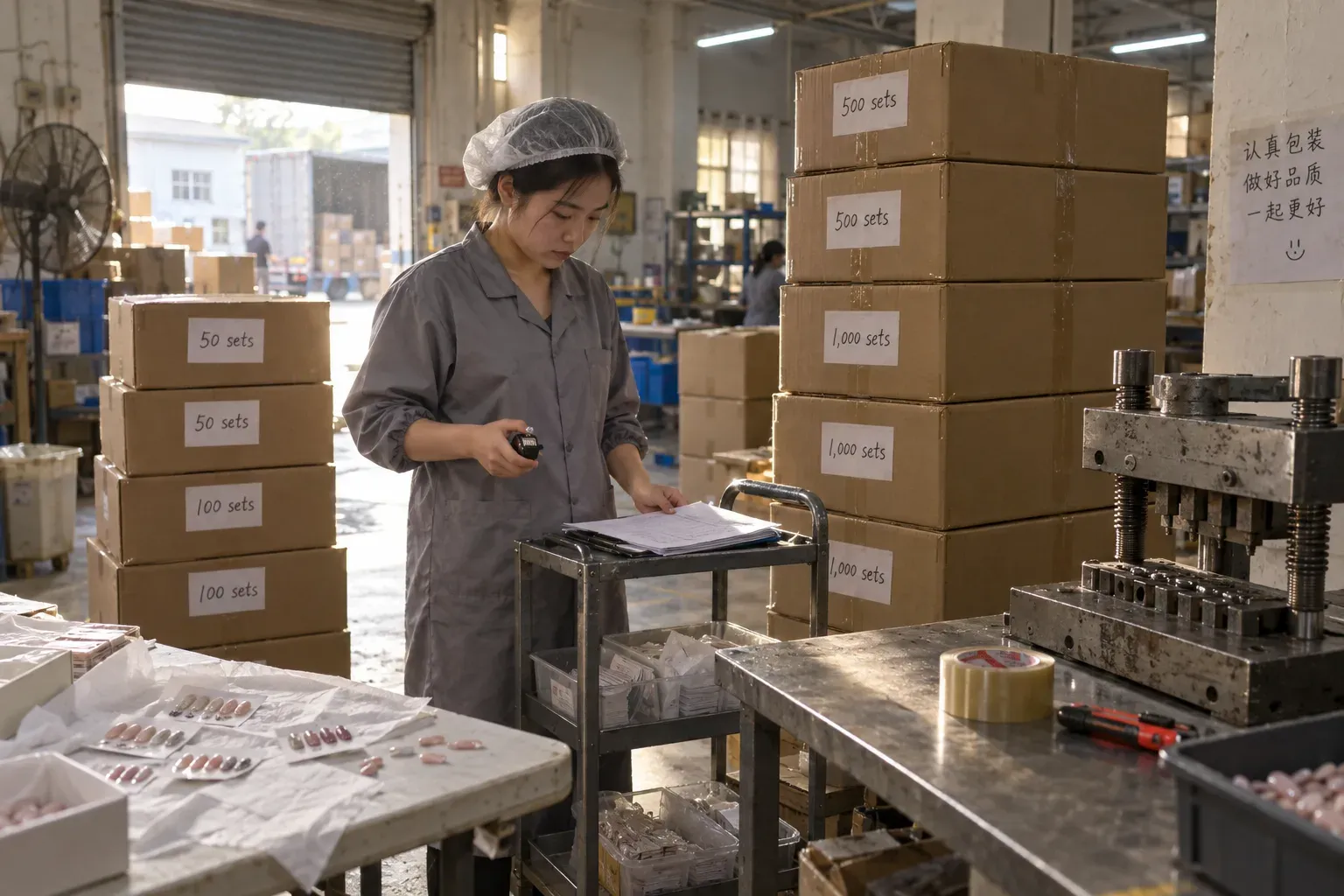
Here is how the two paths compare on the numbers that actually move your budget:
Factor | Private-label stock | Custom molds |
|---|---|---|
Typical MOQ | From 50 sets per design (ZONO stock designs) | a much higher per-design minimum — confirm tooling quote |
Sample time | 3–7 days for standard items | 10–20 days for complex custom work |
Production lead time | 7–14 days for supported configurations | 6–8 weeks; 10–12+ weeks if complex |
Upfront tooling | None | Tooling and molding costs paid before production |
<a href="https://en.wikipedia.org/wiki/Unit_cost" target="_blank" rel="noopener noreferrer">Unit production cost</a> <sup id="ref-4"><a href="#footnote-4" class="footnote-ref">4</a></sup> | Higher per set at small volume | Lower per set once volume scales |
Packaging customization | Available, sometimes at 2,000-set thresholds | Fully flexible |
Tooling and molding costs change the math
Custom work front-loads your spend. You pay engineering and tooling fees before a single set ships. That investment only becomes cost-effective with high-volume projections and stable cash flow, because the unit production cost drops as the mold amortizes across more sets. Boutique suppliers may accept 50–500 sets with 7–21 day timelines, while mid-size OEMs often require 200–5,000 sets. The spread is wide, which is exactly why we explain every quote line by line when we present supplier options.
The hidden costs beyond MOQ
The sticker MOQ is not the full bill. Budget for sample rounds, revision cycles, custom packaging minimums, and the time-to-cash gap while inventory sits in transit. A brand waiting several weeks for goods is also waiting 10 weeks to recover cash. Packaging can be a smart middle path here: several suppliers let you pair stock nail designs with branded boxes and inserts, so you build perceived value without paying for structural tooling.
How can I avoid sample-to-bulk mismatches when choosing between private-label stock and custom molds?
During one pre-shipment inspection, our team caught a bulk run whose C-curve had drifted from the approved sample. Catching it before loading saved that client an expensive relaunch.
Prevent mismatches by locking a golden sample, documenting exact specs in writing, confirming bulk runs at the same production team that sampled, and inspecting pre-production and pre-shipment against the retained sample. Custom molds need extra checks because sample tools and production tools can differ.
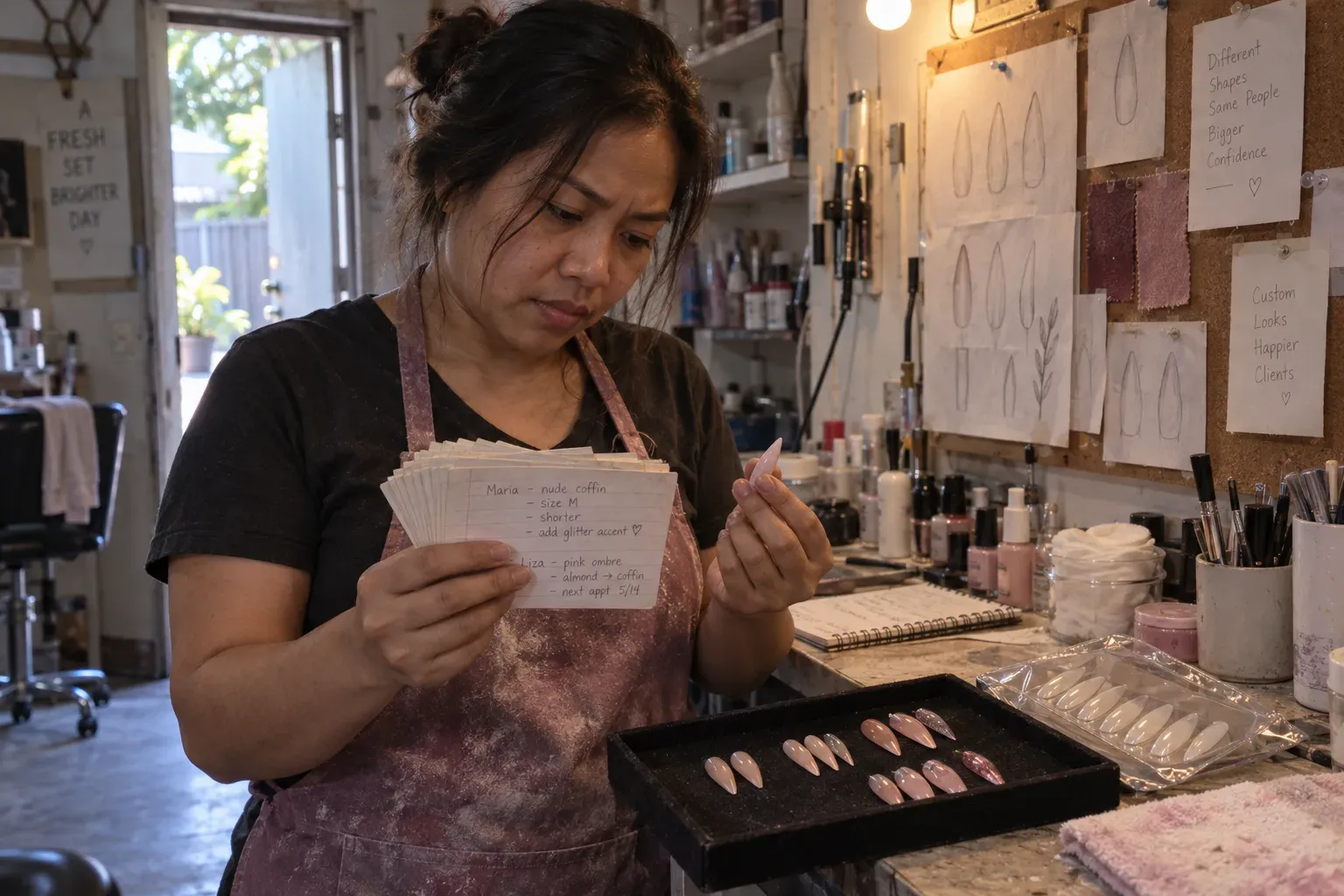
Sample-to-bulk drift is the single most common complaint I hear from buyers who were burned by previous vendors. Color shifts, thinner tips, looser fit, packaging that no longer holds the nails securely. The fix is process, not luck. Here is the sequence we run when coordinating orders through audited manufacturers:
- Lock a golden sample. Approve one physical reference set. Keep one copy, and make sure the factory retains an identical sealed copy.
- Document every spec. Shape, length, thickness, curvature, finish, adhesive type, sizing run, and packaging fit all go into a written spec sheet. Verbal approvals disappear; documents do not.
- Confirm the same production source. Bulk goods should come from the factory that made your sample. A quote passed to a cheaper subcontractor is where drift usually begins.
- Request a pre-production sample. For custom molds especially, ask for output from the actual production tool, not the prototype tool. Standard samples take only days; complex custom samples can take 10–20 days, and that patience is worth it.
- Inspect during and after production. Inline checks catch drift early. A final pre-shipment inspection compares bulk goods directly against the retained golden sample before anything ships.
- Check packaging compatibility. Nails, trays, and boxes must be verified together, since a perfect nail in a wrong-fit tray still arrives damaged.
Stock orders carry less mismatch risk because the design already exists in repeated production. Custom orders deserve every step above, plus lead time optimization built into your calendar so inspections never get skipped under deadline pressure.
✔ A pre-production sample from the actual production mold is the strongest defense against bulk drift TruePrototype tools and production tools can produce different curvature and thickness, so approving output from the real production mold closes the most common gap.✘ Once a sample is approved, the bulk order will automatically match it FalseWithout documented specs, retained reference samples, and pre-shipment inspection, bulk runs can drift in color, thickness, or fit, especially when production is quietly subcontracted.
When should I transition from private-label stock nails to custom molds as my brand grows?
A lesson from ten years in cosmetics supply chain work: brands rarely fail by switching to custom molds too late. They fail by switching too early, with cash buried in unsold tooling.
Transition when one or two SKUs show consistent reorders, your margins support higher per-design minimums, and you can plan around longer OEM lead times. Until then, use stock designs with custom packaging, then tool a single signature hero shape first.
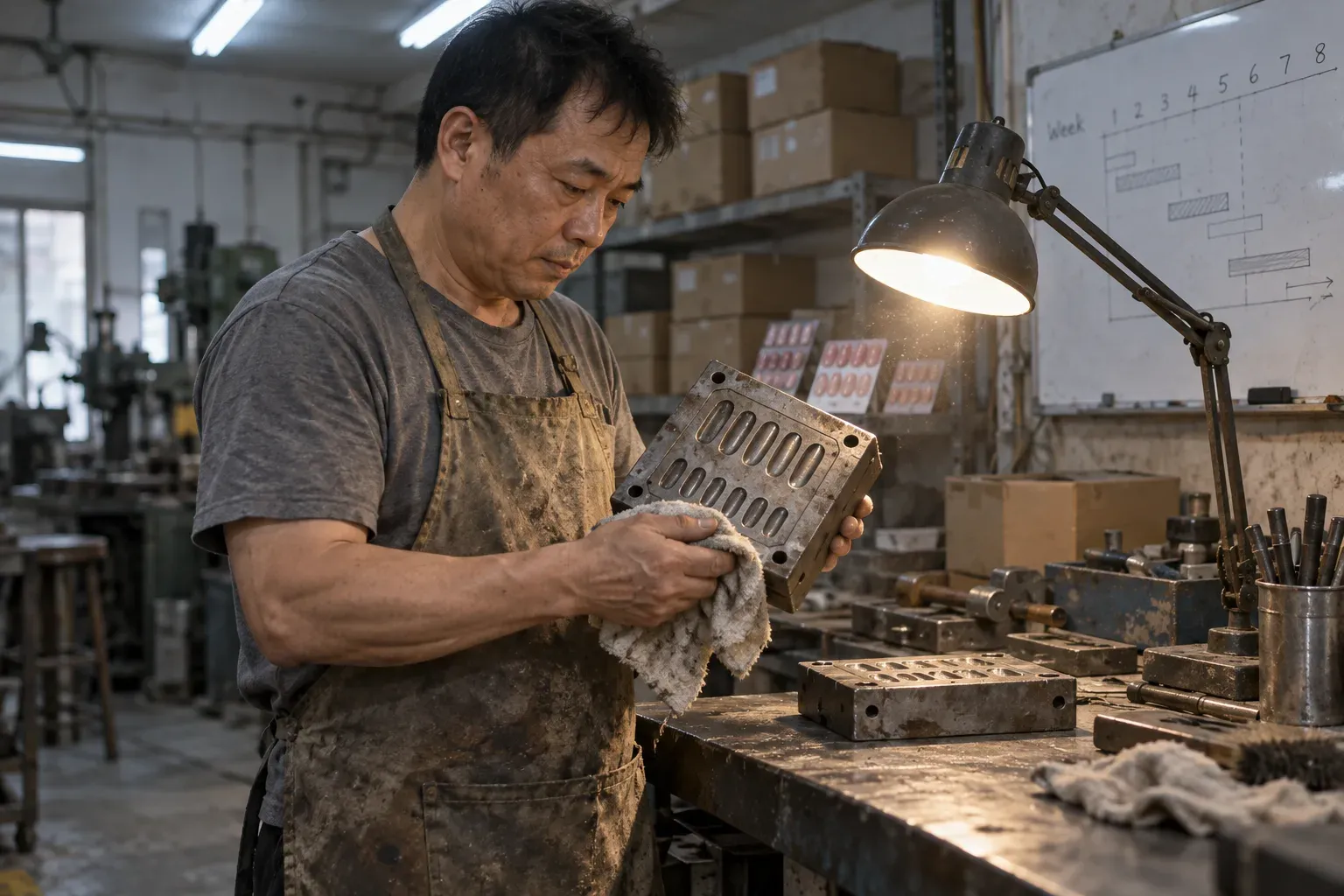
The transition is a staged decision, not a single leap. When we scope projects, we map the sourcing path to the growth stage first, because supply chain scalability depends on matching commitment to proven demand.
A stage-by-stage sourcing map
Brand stage | Recommended path | Typical commitment |
|---|---|---|
Idea testing | Private-label stock, small runs | 50–500 sets, 7–21 day timelines |
First launch | Stock designs plus branded packaging | In-stock styles from 50 sets per design (ZONO) |
Scaling winners | Hybrid: custom hero shape, stock for trends | 1,000+ sets for the custom design |
Premium differentiation | Full OEM custom molds and packaging | 6–8 weeks standard; 10–12+ weeks complex; 5,000+ set orders around 2 months |
The hybrid sourcing strategy
The strongest pattern I see among growing brands is hybrid. Tool one custom mold for your signature hero shape, the fit customers associate with your name, while keeping stock molds for fast, trend-driven collections. This is also where the OEM vs ODM production distinction matters: ODM adapts existing designs quickly, while OEM builds your exact specification from scratch. Hybrid lets you hold both. Advanced brands push custom tooling further, engineering thinner biomimetic reinforcement structures for flexible resins, or surfaces optimized for AR try-on filters so the physical nail matches the digital overlay. Those moves make sense only after demand is proven. Custom packaging, often accessible around 2,000-set thresholds, remains the earlier and cheaper differentiation lever on the way there.
✔ A hybrid approach of one custom hero shape plus stock trend collections balances distinction and agility TrueThe custom mold anchors brand identity while stock molds let the brand chase fast-moving trends without new tooling investment for every collection.✘ Switching to custom molds means abandoning stock designs entirely FalseMost scaled brands keep stock molds for seasonal and trend lines because custom tooling for every SKU would destroy speed-to-market and tie up excessive capital.
Conclusion
Picking wrong here wastes cash or blunts your brand. Start with private-label stock to prove demand, then tool custom molds for validated winners. Stage the decision, and both paths pay.
Sourcing handmade press-on nails and need to check MOQ against your order plan? Browse the ZONO press-on nail range for finished sets, shapes, and private-label options.
Footnotes
1. Official resource for businesses exploring international trade models and sourcing solutions. ↩︎ 2. Defines the business concept of satisfying market demand with a suitable product. ↩︎ 3. Offers trade resources and publications for small businesses navigating global markets. ↩︎ 4. Explains the calculation and significance of production costs in manufacturing. ↩︎