Sep 14, 2026Press-On Nails
What Deposit Percentage Balances Risk and Production When Sourcing Handmade Press-On Nails?
30% to 50% deposits protect handmade press-on nail production—here's how to calculate the right rate by order type and avoid costly cancellation risk.
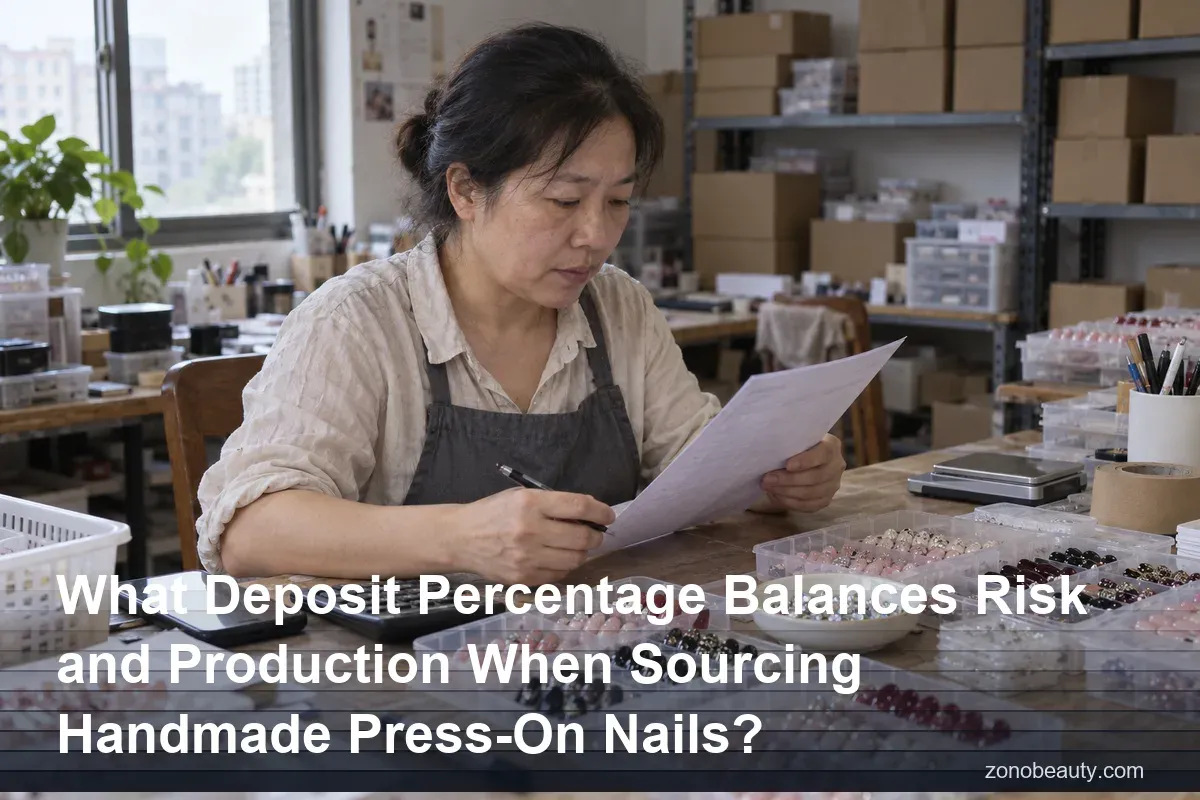
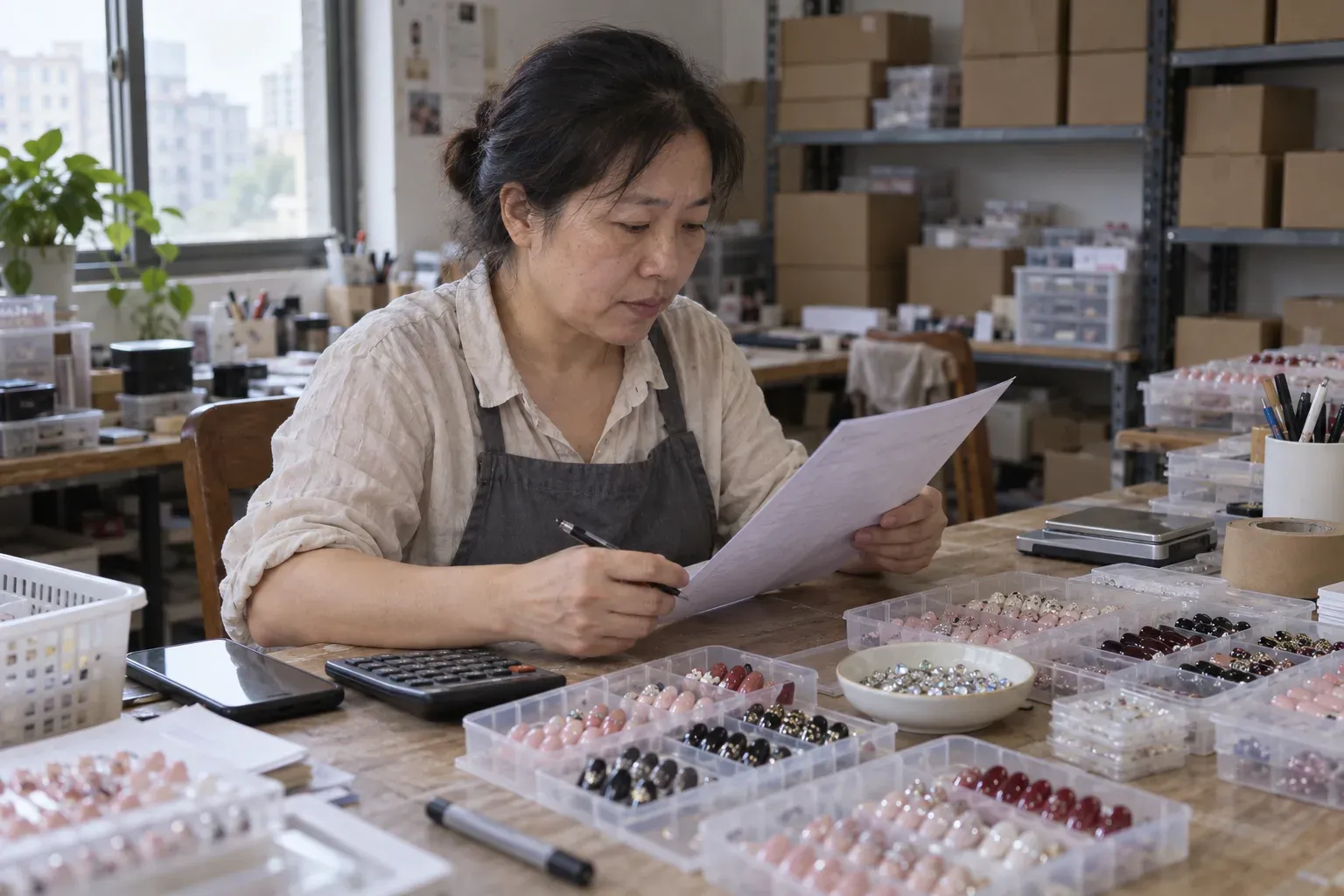
Deposit percentage confusion stalls more handmade press-on nail orders than pricing does. In our coordination work, buyers freeze mid-negotiation, unsure whether 30% or 50% protects them or exposes them.
A 30% to 50% deposit balances risk and production for handmade press-on nails. Pay 30% for standard, repeatable wholesale designs, 40% for semi-custom private label work, and 50% when heavy design labor and non-reusable materials make cancellation costly for the maker.
That range is not a tradition. It is a risk calculation. This article breaks down how the number is built, what terms protect you after paying, how order size shifts the math, and what to verify before the final balance leaves your account.
ZONO confirmed terms (for reference)
- Sample sets: US$15 per set, credited against your first bulk order.
- Bulk production: around US$7 per set, quoted per design.
- Minimum order quantity: 50 sets per design.
- Compliance documentation: available upon request; final compliance responsibility rests with the brand owner.
- Markets served: Southeast Asia, North America, and South America.
Any other figures in this article are general industry context, not a ZONO quotation. Confirm current terms in writing before ordering.
How much deposit should I pay before my press-on nail order goes into production?
A buyer in the US once asked me why one quote demanded 50% while another accepted 30% for the same set count. The difference was not greed. It was hand-finishing hours.
Pay a 30% deposit for repeat, standard-design wholesale orders; 40% for mixed custom and repeatable work; and 50% for fully handmade, design-specific sets. The deposit should at minimum cover the supplier's at-risk cash: materials, committed labor, and setup that cannot be reused if you cancel.
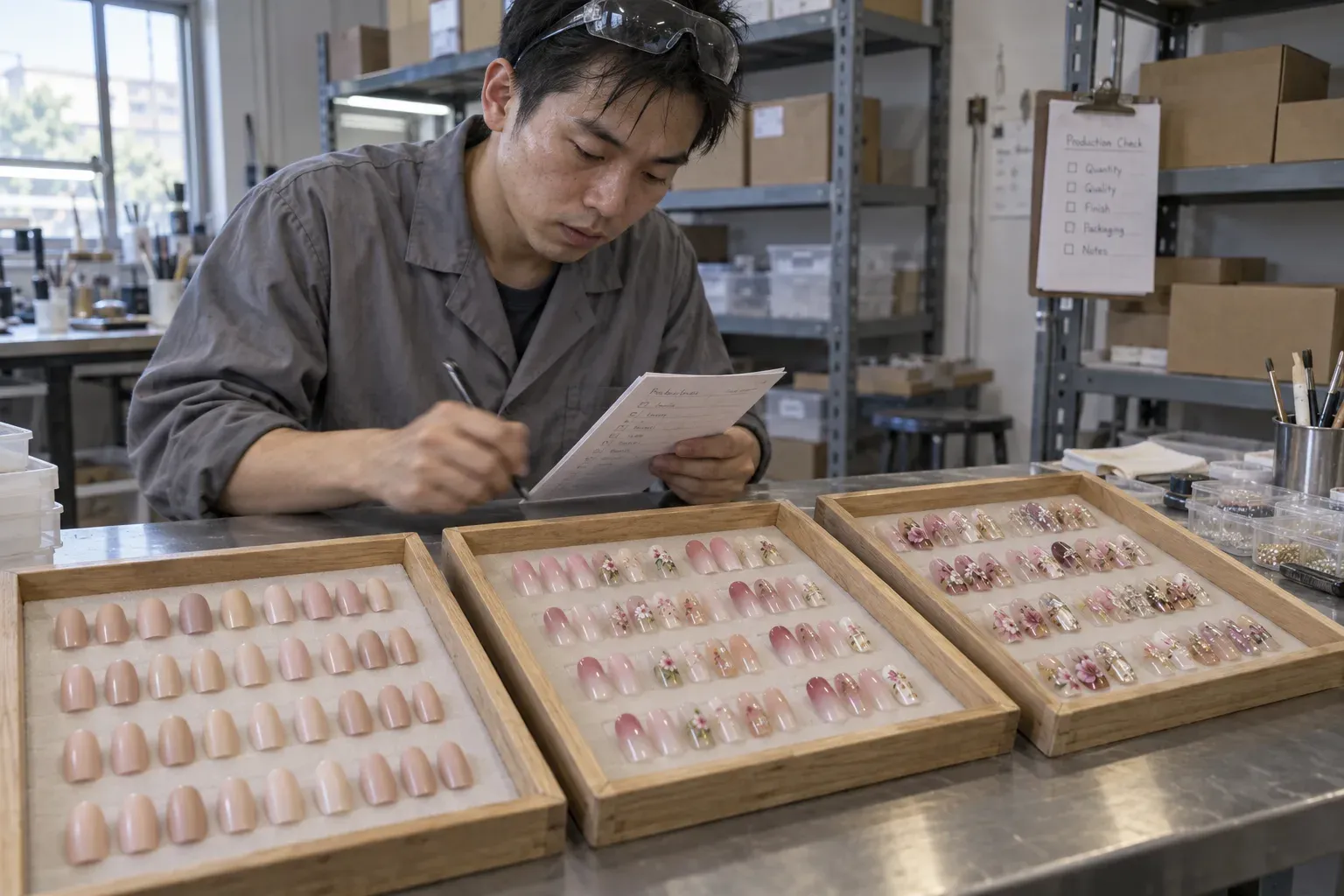
The fastest way to sanity-check a deposit request is to compare it against order type. Here is the pattern we see across the handmade press-on nail market:
Order type | Typical deposit | Why this level |
|---|---|---|
Ready-made wholesale designs | 30% | Unsold stock can be resold to other buyers |
Semi-custom / private label | 40% | Some elements reusable, branding is not |
Fully handmade custom sets | 50% | Design labor and finished sets are hard to resell |
3D or extreme nail art | 60–70% | Charms, crystals, and sculpting cannot be repurposed |
Rush orders | Up to 100% | Displaces other clients and requires overtime labor |
Match the deposit to the at-risk cash
The soundest framework in custom manufacturing says the minimum deposit should roughly equal the seller's at-risk cash plus irrecoverable setup, then round up for cancellation risk. For handmade nails, that at-risk cash builds up fast. Materials and committed <a href="https://www.bls.gov/iag/tgs/iag31-33.htm" target="_blank" rel="noopener noreferrer">manufacturing labor</a> <sup id="ref-1"><a href="#footnote-1" class="footnote-ref">1</a></sup> together make up the largest share of order value on labor-heavy handmade sets, which is why a low deposit on a fully custom run leaves the maker exposed if you cancel. That is why a 30% deposit on a fully custom run leaves the maker underwater if you cancel, and why they will either refuse the terms or quietly deprioritize your order.
The deposit starts the clock
The <a href="https://en.wikipedia.org/wiki/Lead_time" target="_blank" rel="noopener noreferrer">production lead time</a> <sup id="ref-2"><a href="#footnote-2" class="footnote-ref">2</a></sup> officially begins only after the deposit clears, not after the design consultation. Custom orders in this market commonly quote lead times that start from the deposit. Some artists also charge for a physical sizing kit first. That functions as a micro-deposit: it confirms production accuracy and filters out low-intent buyers before hand labor begins. In our experience coordinating handmade press-on nail production out of Shantou, buyers who pay for sizing kits almost never dispute fit later.
✔ The production clock on a handmade press-on nail order starts only after the deposit clears, not after design approval. TrueSuppliers treat the cleared deposit as the trigger for buying materials and booking hand-labor hours, which protects them from buyers who disappear after the consultation stage.✘ A deposit is just a symbolic commitment fee, so the percentage does not really matter. FalseThe deposit is meant to cover real at-risk cash — materials, committed labor, and unique setup — so a percentage that falls short of that spend shifts genuine financial risk onto the maker and often degrades your order's priority.
What payment terms protect me if my supplier delays or changes the order after I've paid a deposit?
Years back, I watched a client's glitter density drift mid-run because the workshop switched material batches without notice. The deposit was already paid. What saved the order was the paperwork, not the goodwill.
Protect yourself with written manufacturing contract terms: tie payment milestones to sample approval, mid-production proof, and pre-shipment quality control inspection; state that design changes after approval require written sign-off; and require deposit refunds or credits if the supplier misses the agreed production lead time.

A deposit without contract language is just hope with a receipt attached. The protection comes from structuring when money moves and what triggers each release.
Milestone billing beats a single lump deposit
For larger runs, an emerging structure in this space is the progressive deposit model: 30% to start, 40% at a mid-production proof, and 30% before shipment. We have seen this used for high-volume influencer collaborations, where a single 50% upfront payment would concentrate too much risk on one side. Milestone billing means neither party is ever exposed for more than one production stage at a time. It also forces communication, because each payment requires the supplier to show something.
What the wholesale supplier agreement must spell out
Before you wire anything, your wholesale supplier agreement should answer these questions in writing:
- Is the deposit refundable, and under exactly which conditions? Many contracts state the deposit is forfeited only if the buyer cancels after the design approval phase, which compensates the maker for lost calendar time.
- Does the deposit apply toward the final invoice, or sit separately?
- What happens if the supplier misses the agreed production lead time? A fair clause converts delay into a partial credit or a refund option.
- What happens if either side changes the design after production starts? Changes should require written approval and a documented cost adjustment.
- What proof accompanies each payment milestone — photos, video, or a third-party quality control inspection report?
For high-value or artist-signed collector sets, a third-party escrow arrangement or platform trade assurance adds another layer: your money is protected until proof of craftsmanship is delivered, and the artist is guaranteed payment once it is. When we set up projects between overseas nail brands and our vetted production network, this milestone-plus-proof structure is the single point that prevents most disputes.
Does the deposit percentage change based on my order size or MOQ for handmade press-on nails?
Every quote we prepare involves the same trade-off: a lower deposit wins the buyer's trust faster, but it only works when the order itself carries lower cancellation risk.
Yes. Deposit percentages typically soften as order value, repeat history, and design standardization rise. Larger orders above the minimum order quantity often qualify for 30% terms, while small first-time custom runs stay at 50%, because per-set setup risk is concentrated and buyer history is unproven.

Order size changes the deposit math, but not in the simple direction most buyers assume. The variables interact, and it helps to see which ones pull the number in each direction.
Factor | Pushes deposit lower | Pushes deposit higher |
|---|---|---|
Order history | Repeat buyer with clean payment record | First-time buyer, no references |
Design type | Standard catalog designs | Unique artwork, hand-sculpted 3D elements |
Order size | High volume of repeatable sets | Small run of one-off custom sets |
Timeline | Normal production lead time | Rush order displacing other clients |
Resale risk | Generic sets resellable to others | Branded <a href="https://www.statista.com/topics/1081/private-label/" target="_blank" rel="noopener noreferrer">private label manufacturing</a> <sup id="ref-3"><a href="#footnote-3" class="footnote-ref">3</a></sup> runs |
Why bigger is not automatically cheaper on deposits
Wholesale suppliers in this category increasingly advertise tiered pricing and volume discounts, and deposit terms do tend to soften alongside them for repeat, high-volume clients. But there is a catch buyers miss. A large fully custom order concentrates risk rather than diluting it. If a buyer cancels a 5,000-set run of branded, hand-finished designs, the supplier is holding a mountain of goods nobody else can buy. In those cases, we often see suppliers hold firm at 50% or propose the progressive 30/40/30 model instead of dropping to 30%. The honest logic is this: standardization lowers deposits, volume alone does not.
How to negotiate the number down
Your strongest levers are repeatability and history. Offer standard curve shapes and catalog-adjacent designs on your first order, then push for 30% terms on reorders once your payment record exists. First orders in private label manufacturing almost always sit at 40% to 50%, and that is reasonable. Sound supply chain risk management on the seller's side is what keeps your supplier solvent enough to deliver your next order on time.
✔ Repeat buyers with a clean payment history can usually negotiate handmade press-on nail deposits down toward 30%. TrueEstablished history lowers the supplier's cancellation risk, and suppliers competing in a crowded wholesale market use softer deposit terms to retain proven, high-volume clients.✘ A larger order automatically qualifies for a lower deposit percentage. FalseA big fully custom run concentrates unrecoverable materials and labor in goods no one else can buy, so suppliers often keep 50% terms or shift to milestone billing rather than reduce the deposit.
What should I confirm before releasing the final balance on my press-on nails production run?
During a <a href="https://www.wto.org/english/tratop_e/preship_e/preship_e.htm" target="_blank" rel="noopener noreferrer">pre-shipment inspection</a> <sup id="ref-4"><a href="#footnote-4" class="footnote-ref">4</a></sup> last year, our QC coordinator caught a curve-fit deviation on one size across an entire batch. The balance had not been paid yet. That timing was everything.
Before paying the balance, confirm a passed quality control inspection against the approved sample, verified sizing and curve fit, correct packaging and labeling, complete export documents, agreed shipping terms, and photo or video proof of the finished run. Release payment only after these checks are documented.
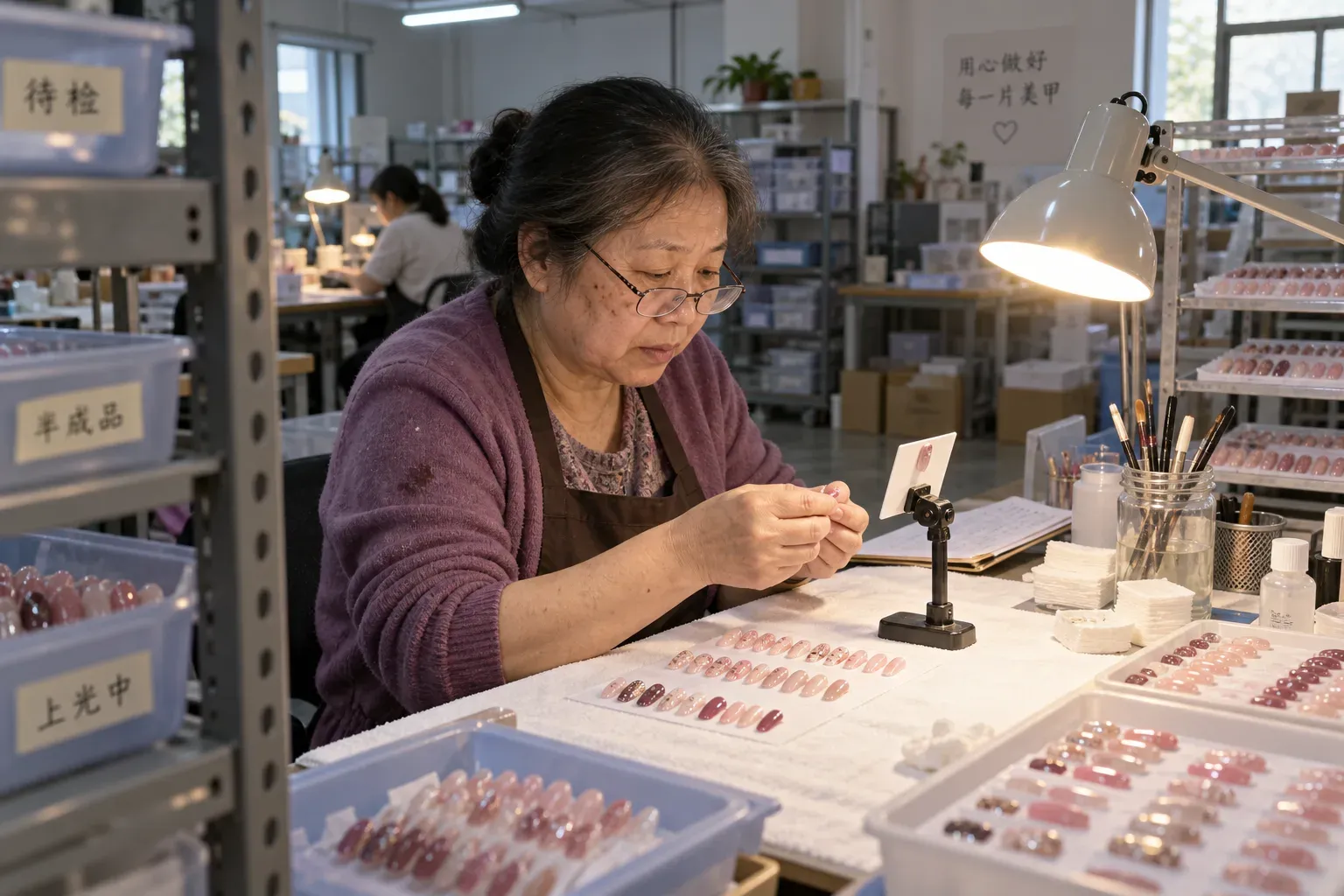
The standard structure in this market is 30% or 50% deposit with the balance due before shipment. That sequencing exists for a reason: the balance is your last point of leverage. Once it is paid, fixing problems depends entirely on the supplier's goodwill.
The pre-balance checklist
Check | What to verify | How to verify it |
|---|---|---|
Sample match | Color, glitter density, finish, shape | Side-by-side photos against the golden sample from your sample approval process |
Sizing accuracy | Curve fit and size distribution per set | Random-pull measurements from multiple cartons |
Packaging | Branding, labeling, insert accuracy | Photos of sealed retail units and master cartons |
Quantity | Set counts match the invoice | Carton count with packing list reconciliation |
Documentation | Invoice, packing list, certificates of origin | Copies sent before payment, originals with shipment |
Damage risk | Carton strength, void fill, moisture protection | Drop-test evidence or inspection footage |
What proof of craftsmanship looks like
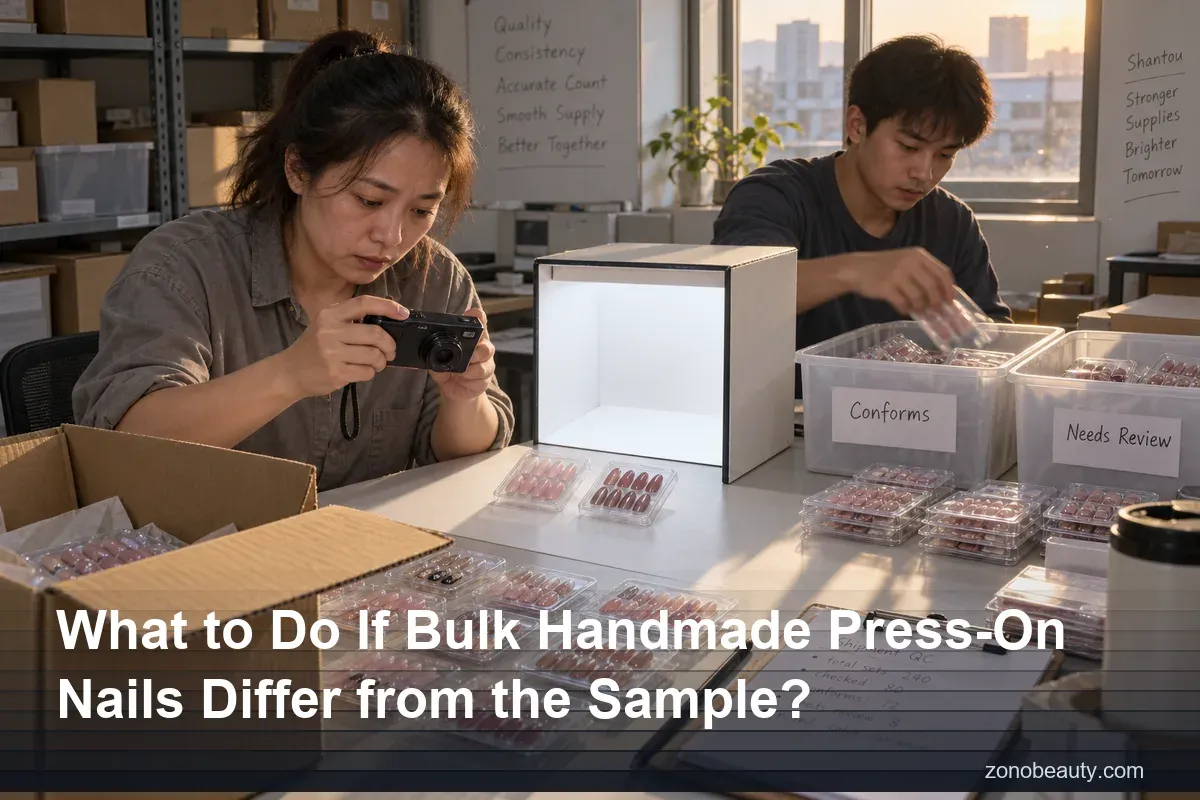
For handmade sets, generic factory photos are not enough. Ask for close-up video of finished sets from the actual run, under natural light, next to your approved sample. Hand-finished work varies slightly by nature, so agree in advance on acceptable tolerance — for example, minor charm placement variance is normal, but color deviation from the approved sample is not. When we run the coordination window between overseas nail brands and vetted production network, the balance release always follows a documented inspection report, never a verbal confirmation. If your supplier resists showing proof before balance payment, treat that as the warning it is. A supplier confident in the run has nothing to hide.
✔ The final balance on a press-on nail production run is normally due after a documented pre-shipment inspection but before goods ship. TrueThis sequencing is standard because the unpaid balance is the buyer's last real leverage to get defects corrected before the goods leave the supplier's control.✘ Paying the final balance early speeds up your shipment. FalseShipping speed depends on production completion and logistics booking, not payment timing, so early payment only removes your leverage without moving the delivery date.
Conclusion
Set your deposit by risk, not habit. Thirty percent fits repeatable wholesale, forty covers mixed work, fifty protects handmade custom runs. Tie every payment to a verified milestone.
Sourcing handmade press-on nails and need to check MOQ against your order plan? Browse the ZONO press-on nail range for finished sets, shapes, and private-label options.
Footnotes
1. Authoritative government source for labor statistics and economic data within the global manufacturing sector. ↩︎ 2. Comprehensive overview of lead time concepts in supply chain management and manufacturing production cycles. ↩︎ 3. Provides industry data and market insights into the growth and financial structure of private label manufacturing. ↩︎ 4. Official WTO agreement detailing the international standards and obligations for pre-shipment inspections in trade. ↩︎