Sep 14, 2026Products, Packaging & Formula
What to Do If Bulk Handmade Press-On Nails Differ from the Sample?
Learn how to handle bulk handmade press-on nails that differ from your approved sample, with inspection steps and negotiation tactics to secure a fix.
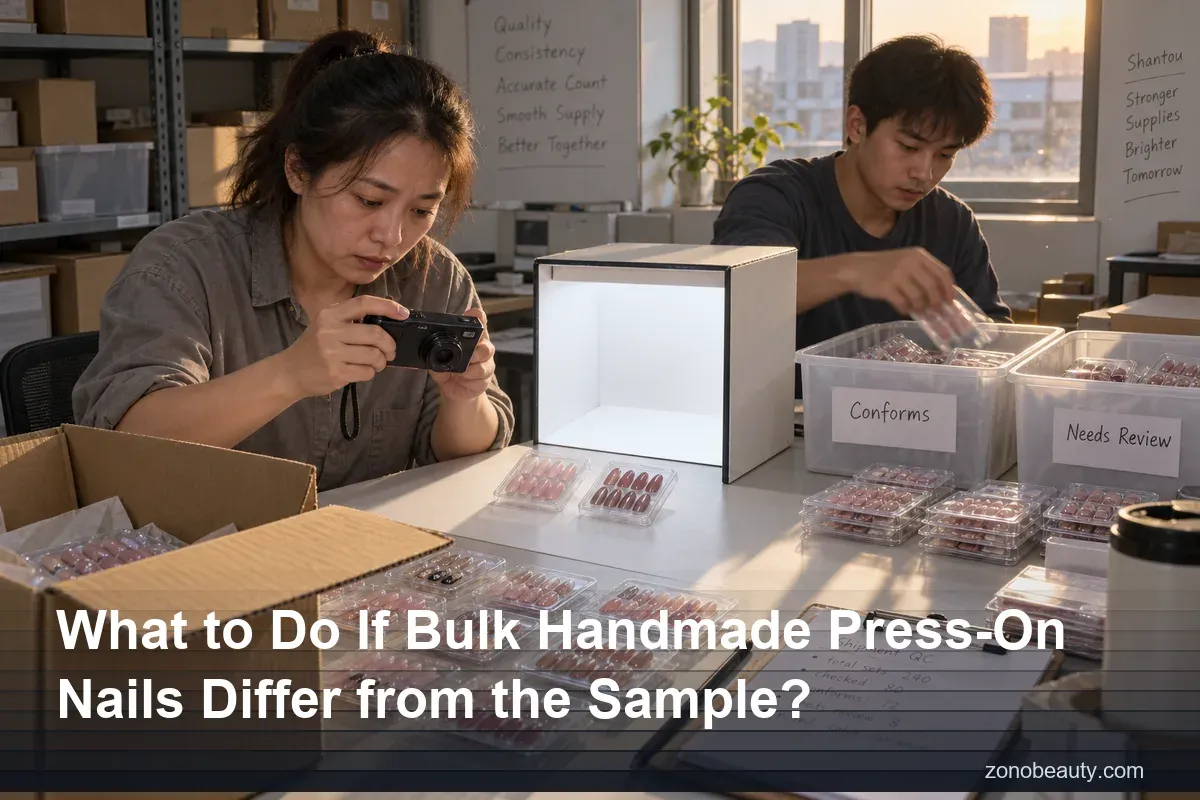
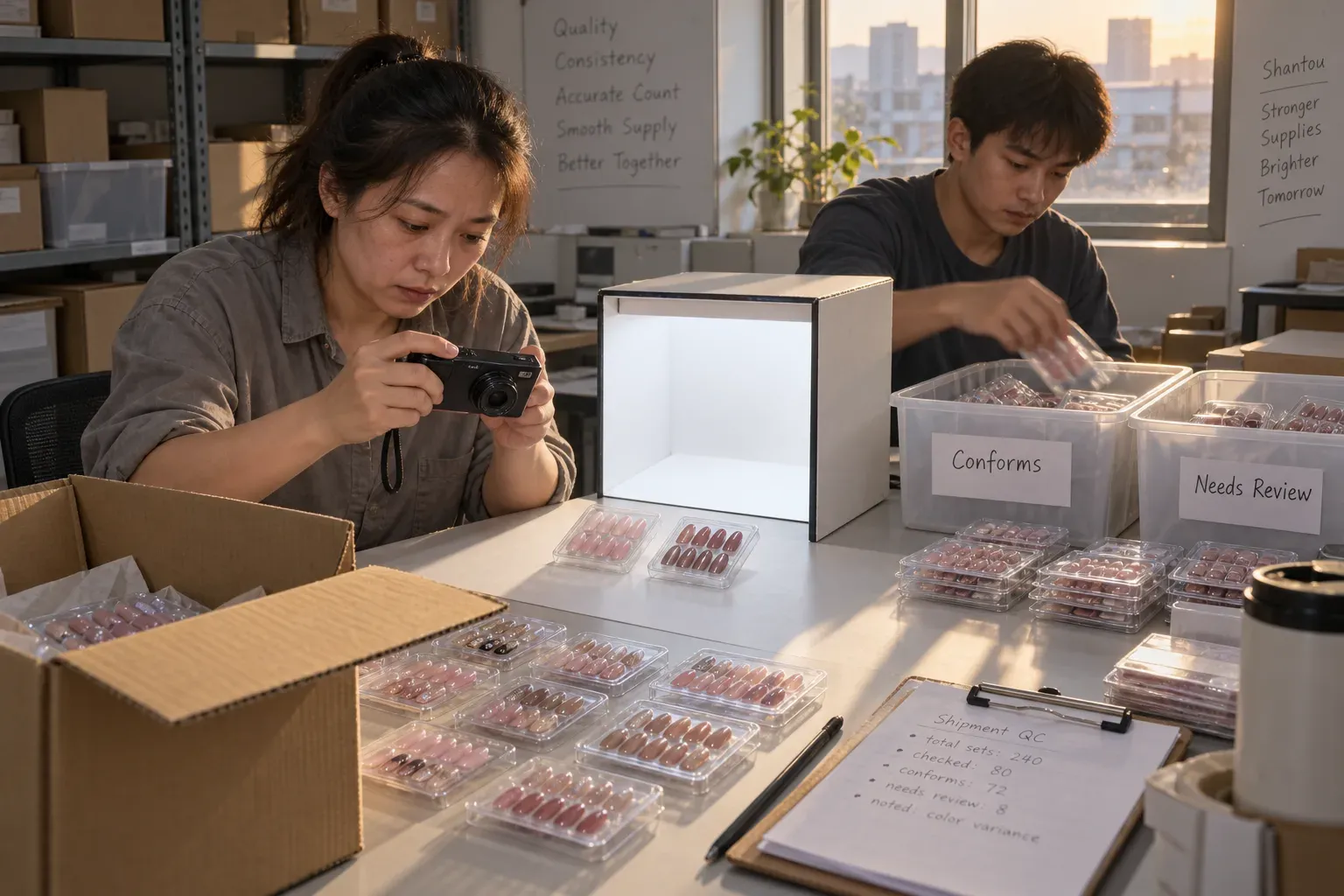
The carton opens, and your bulk handmade press-on nails look nothing like the sample you approved. Our coordination team in Shantou fields this exact panic call every few months.
If bulk handmade press-on nails differ from the approved sample, document the differences with side-by-side photos, compare them against your written specifications, sort the lot into usable and unacceptable stock, then send the supplier a formal written claim requesting rework, replacement, or a partial refund.
That answer sounds simple. In practice, each step has traps. Below, I walk through why mismatches happen, how to prevent them, what to inspect for, and how to negotiate a fix without burning the supplier relationship.
ZONO confirmed terms (for reference)
- Sample sets: US$15 per set, credited against your first bulk order.
- Bulk production: around US$7 per set, quoted per design.
- Minimum order quantity: 50 sets per design.
- Compliance documentation: available upon request; final compliance responsibility rests with the brand owner.
- Markets served: Southeast Asia, North America, and South America.
Any other figures in this article are general industry context, not a ZONO quotation. Confirm current terms in writing before ordering.
Why Do My Bulk Press-On Nails Look Different from the Approved Sample?
Last year, we inspected a client's cat-eye press-on order and found three shades of grey across one design. The production team had switched magnetic gel batches mid-run.
Bulk press-on nails usually differ from the approved sample because different artisans painted the run, a raw material batch changed, curing conditions shifted, or production was rushed. Some variation is normal for handmade goods; deviations in size, color, or structure beyond agreed tolerances are true nonconformities.
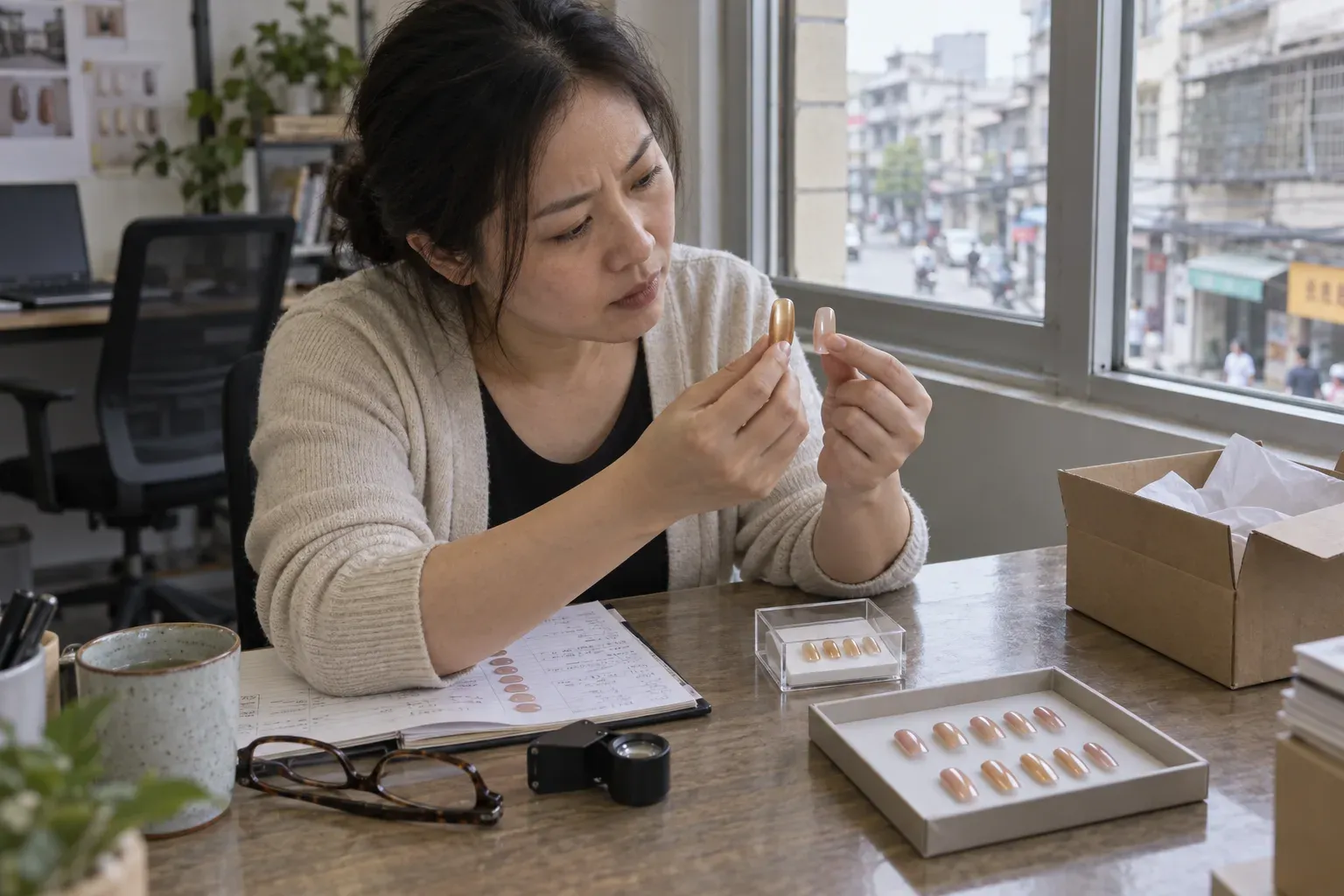
Handmade press-on nails sell on artisanal detail, custom sizing, and richer visual quality than machine-made nails. Those same traits make consistency harder to hold across a large run. A sample is often painted by one senior artisan under ideal conditions. The bulk order may pass through five or six sets of hands over several weeks. That gap is where batch production discrepancies are born.
Variation or Defect? A Quick Decision Tree
Before you write an angry email, run the lot through four questions:
- Is the difference cosmetic but within an agreed handmade tolerance?
- Is the bulk run materially different from the approved sample?
- Does the issue affect fit, wearability, packaging, or retail presentation?
- Can the supplier correct it quickly, or is a formal claim needed?
If only question one applies, you are looking at normal hand-painted nail consistency limits. If questions two or three apply, you have a nonconformity worth a claim.
Common Root Causes We See at Inspection
Root cause | How it shows up | Variation or defect? |
|---|---|---|
Different artisans on the run | Line weight, gem placement, art detail drift | Variation, unless placement was specified |
New raw material batch | Color variance in manufacturing, shade shift | Defect if outside agreed color tolerance |
Curing environment change | Cloudy or dull topcoat, soft finish | Defect — affects durability |
Degraded UV lamps or high humidity | Uneven gloss, tacky spots on resin | Defect — a process control failure |
Rushed production timeline | Rough edges, thin tips, skipped topcoat | Defect — craftsmanship failure |
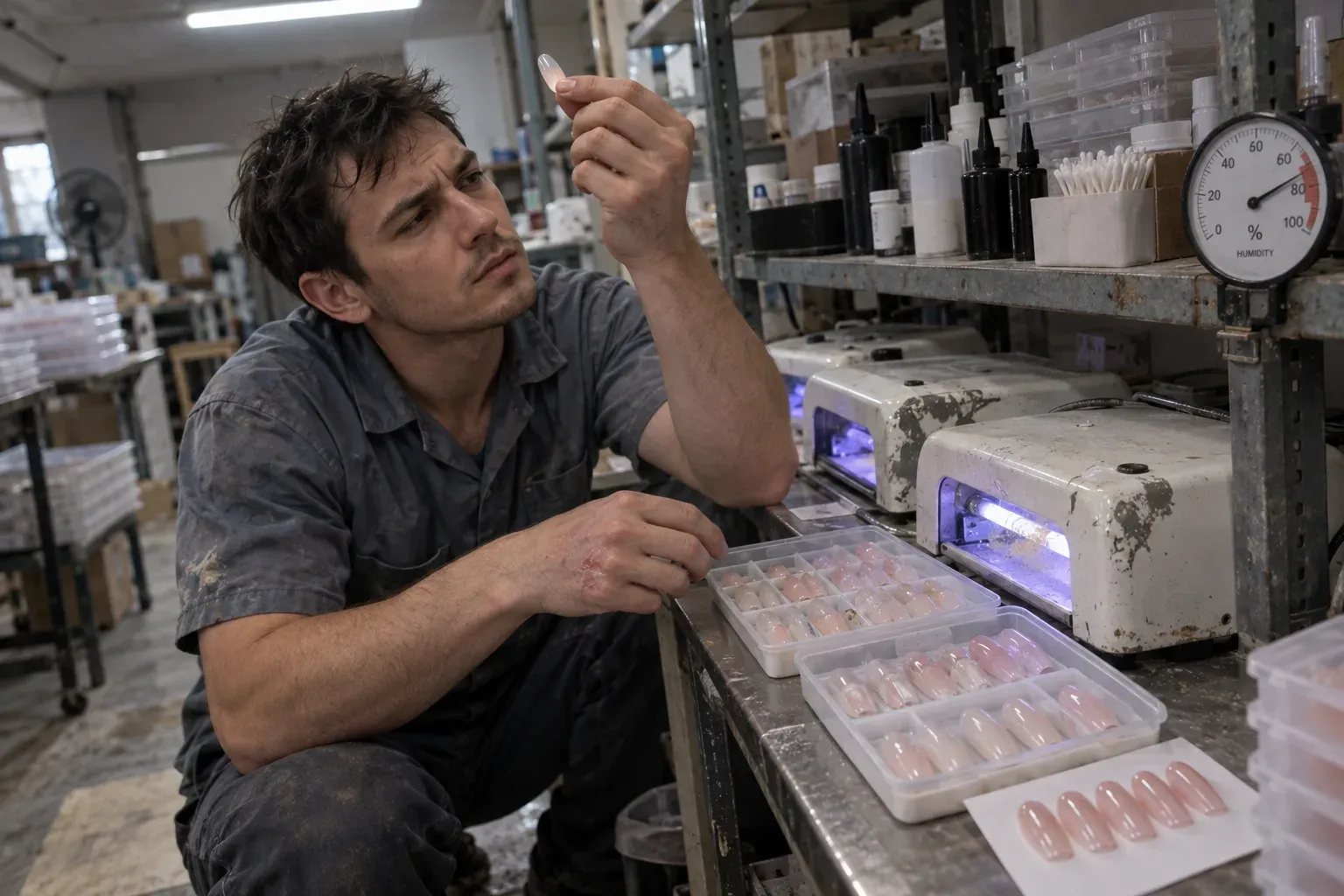
The curing environment variable deserves special attention. Factory humidity swings and aging UV lamps can make the same resin and topcoat finish differently than the sample did, even with identical materials. That is exactly why we ask vetted production network for a root cause analysis rather than accepting "handmade items just vary" as an answer.
✔ Once a buyer approves a sample and written specifications, major bulk deviations are a production failure, not acceptable handmade variation TrueThe approved sample and spec sheet define the contract standard; deviations in size, color, or structure beyond agreed tolerances are nonconformities the supplier must remedy.✘ Any visible difference between bulk handmade press-on nails and the sample counts as a defect FalseHandcrafted products are never as uniform as machine-made nails, so minor artistic variation within a pre-agreed tolerance is normal and not grounds for a claim.
How Can I Prevent Color or Texture Mismatches Before Mass Production Starts?
Every sampling budget we scope involves the same trade-off: spend more time and money locking specifications now, or gamble the full production payment on hope.
Prevent color and texture mismatches by approving a physical golden sample, signing written specifications for size, shape, thickness, finish, and packaging, requesting a small pilot run, and requiring batch-start approval photos of the first ten units before the factory completes the remaining inventory.
Prevention is cheaper than any dispute. When we set up a new press-on nail project for an overseas brand, the <a href="https://intracen.org/" target="_blank" rel="noopener noreferrer">pre-production sample comparison</a> <sup id="ref-1"><a href="#footnote-1" class="footnote-ref">1</a></sup> stage is where most future problems get killed. Never approve from catalog photos or digital mockups alone. Thickness, flexibility, C-curve, finish, and decoration quality can differ materially between what a photo suggests and what arrives in bulk. Also confirm whether your sample is a true production sample or only a best-effort prototype. Sample fees vary widely with customization complexity, and many suppliers deduct the sample cost from the first bulk invoice, so the real cost of doing this properly is lower than it looks.
Lock the Standard Before Money Moves
Prevention step | What it locks down | Best for |
|---|---|---|
Golden sample protocol | Both sides sign and keep identical physical samples | Every custom order |
Written material specifications | Base material, gel brand, topcoat, gem type | Repeat orders and reorders |
Colorimeter or spectrophotometer readings | Objective pigment data instead of "looks darker" | Color-critical designs |
Pilot run | Real production conditions at small scale | New suppliers, complex art |
Batch-start approval | Sign-off photos of the first 10 units before the run continues | Large or high-value orders |
Master artisan clause | The sample's lead designer supervises or trains the bulk team | Intricate hand-painted lines and 3D work |
Ask What Is Actually Handmade
One question we always push buyers to ask: which parts of this nail are truly handmade, and which are standardized? Base tips are usually molded and consistent. Hand-painted art and gemstone placement are not. Define acceptable variation ranges for the handmade elements in writing, in advance. Quality control standards only work when both sides agreed on the numbers before production started.
What Should I Check During Quality Inspection to Catch These Differences Early?
A nail brand founder in the US once asked me which single inspection check catches the most problems. My answer surprised her: sizing consistency, not nail art.
During quality inspection, compare bulk units against the golden sample for sizing and C-curve, topcoat finish and shine, hand-painted detail placement, gemstone adhesion, color accuracy under consistent lighting, and packaging contents. Pull random units from multiple cartons, not just the top layer.
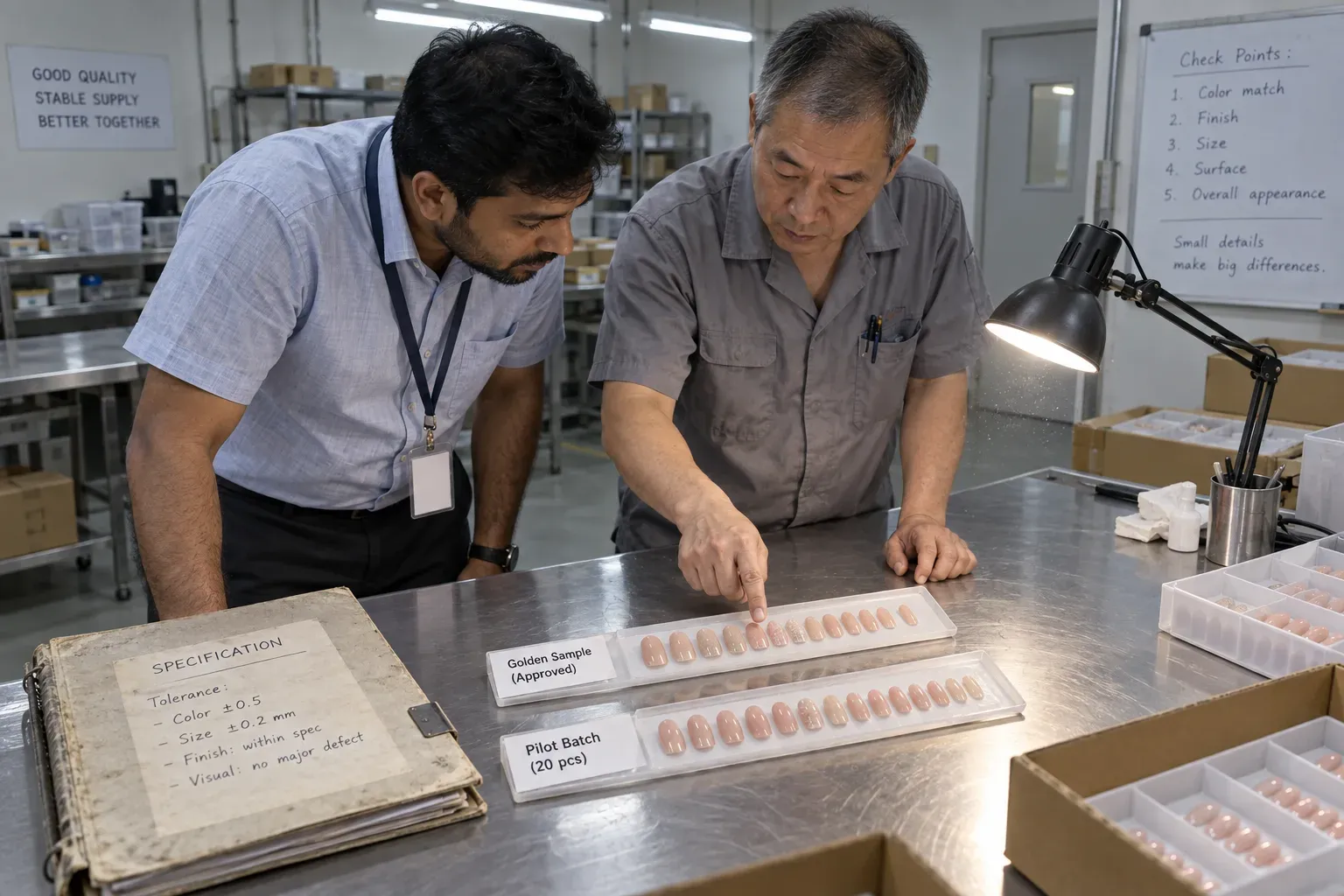
Sizing mismatches are a major driver of returns and end-customer complaints, so they sit at the top of every <a href="https://en.wikipedia.org/wiki/Quality_assurance" target="_blank" rel="noopener noreferrer">quality assurance checklist</a> <sup id="ref-2"><a href="#footnote-2" class="footnote-ref">2</a></sup> we run before shipment. A beautiful nail that does not fit the sidewall still comes home in a returns envelope. Structure your inspection around five zones and work through them in order.
The Five-Zone Inspection Table
Zone | What to compare against the sample | Common failure sign |
|---|---|---|
Shape and sizing | Length, width, C-curve, sidewall fit per size | One size runs wide or flat |
Finish | Shine level, topcoat smoothness, edge sanding, cuticle line | Dull patches, rough edges |
Art details | Line placement, 3D embellishments, gem position, shade match | Drifting patterns, loose stones |
Durability | Thickness, flexibility, reinforcement at stress points | Tips flex too easily, gems pop off |
Packaging | Box, file, glue tabs, instructions, branding pack-out | Missing inserts, wrong box finish |
Inspect Like a Claim Might Follow
Photograph bulk units next to the approved sample in the same lighting, ideally a small light box. Consistent lighting protects you later, because a supplier can dismiss photos taken under warm hotel lamps. Where color is critical, a digital colorimeter app <sup id="ref-3"><a href="#footnote-3" class="footnote-ref">3</a></sup> gives objective numbers instead of subjective descriptions. Then sort the lot into three piles: usable, borderline, and unacceptable. That sorting does two things. It quantifies your claim, and it tells you how much stock you can still sell while the wholesale supplier dispute gets resolved. When we run pre-shipment inspections for clients, this sorted count becomes the backbone of the negotiation.
✔ Random sampling across multiple cartons catches batch production discrepancies that top-layer checks miss TrueFactories often pack the best units on top and early in the run, so pulling units from different cartons and production stages reveals drift across artisans and material batches.✘ Checking a few sets from the first opened box is enough to confirm the whole order matches the sample FalseHandmade runs drift over time as artisans rotate and materials change, so a top-of-carton check can pass while half the order sits outside tolerance.
How Do I Handle a Supplier When My Bulk Order Doesn't Match the Sample?
Ten years of coordinating China supply chains taught me one hard lesson: the first message you send after finding a defect shapes the whole negotiation.
Notify the supplier within 48 hours with a written notice of non-conformity, attach side-by-side photos, reference the approved sample and agreed specifications, pause any final payment, request a root cause analysis, and negotiate a tiered remedy such as rework, replacement, partial refund, or credit.
Speed and documentation decide most disputes. Suppliers take a claim seriously when it arrives fast, in writing, with evidence, and while money is still on the table. If final payment has already cleared, your leverage drops sharply. Here is the order discrepancy resolution workflow we follow when coordinating claims for clients.
The Five-Step Claim Workflow
- Document. Photograph and video the bulk lot beside the golden sample in identical lighting. Log every difference item by item.
- Compare. Check the purchase order, spec sheet, and message thread for defined tolerances. Note exactly which clauses the goods violate.
- Escalate. Send a formal notice of non-conformity within 48 hours of delivery and pause pending payments.
- Negotiate. Request a root cause analysis and propose a tiered remedy matched to the defect severity.
- Resolve. Get the agreed remedy and deadline in writing before releasing any held payment.
Match the Remedy to the Damage
Defect severity | Reasonable remedy |
|---|---|
Minor aesthetic drift within borderline pile | Partial refund or discount on the lot |
Structural defects: sizing, adhesion, breakage | Full replacement of affected units |
Mixed lot with usable majority | Credit against the next order plus corrective plan |
A Short Claim Template
Keep the message factual, not emotional. State the approved sample date and reference number. List the exact differences found in bulk. Attach the side-by-side photos and your sorted counts. Reference the agreed specification clause. Request one concrete remedy with a deadline. That structure is the core of a working vendor communication strategy. And watch for red flags going forward: vague replies, refusal to provide production samples <sup id="ref-4"><a href="#footnote-4" class="footnote-ref">4</a></sup>, or blaming everything on "handmade character." A supplier who accepts a fair claim and fixes the process is worth keeping. One who goes quiet is telling you how the next order will end.
✔ Pausing final payment while a written claim is open is a legitimate and effective source of leverage TrueSuppliers prioritize resolving nonconformities when payment is still outstanding, which is why formal notice should go out before the balance is released.✘ Because the nails are handmade, buyers have no real recourse when the bulk order differs from the sample FalseAn approved sample plus written specifications creates an enforceable quality standard, and remedies like rework, replacement, and partial refunds are standard practice in wholesale trade.
Conclusion
A bulk-sample mismatch is a sourcing-control problem, not bad luck. Document fast, claim in writing, fix the process, and work with partners who inspect before goods ship.
Sourcing handmade press-on nails and need to check MOQ against your order plan? Browse the ZONO press-on nail range for finished sets, shapes, and private-label options.
Footnotes
1. The ITC provides resources for small businesses to manage quality standards in international trade. ↩︎ 2. Wikipedia provides an overview of quality assurance processes used to maintain production standards. ↩︎ 3. ISO provides international standards for color measurement and quality consistency in manufacturing. ↩︎ 4. Trade.gov offers guidance on managing international supply chains and resolving commercial quality disputes. ↩︎