Sep 14, 2026Products, Packaging & Formula
Is the MOQ for Handmade Press-On Nails from China Suppliers Reasonable?
Handmade press-on nail MOQs from China range 20-3,000+ sets by order type. Learn which minimum fits your brand size and avoid overstock or blocked testing.
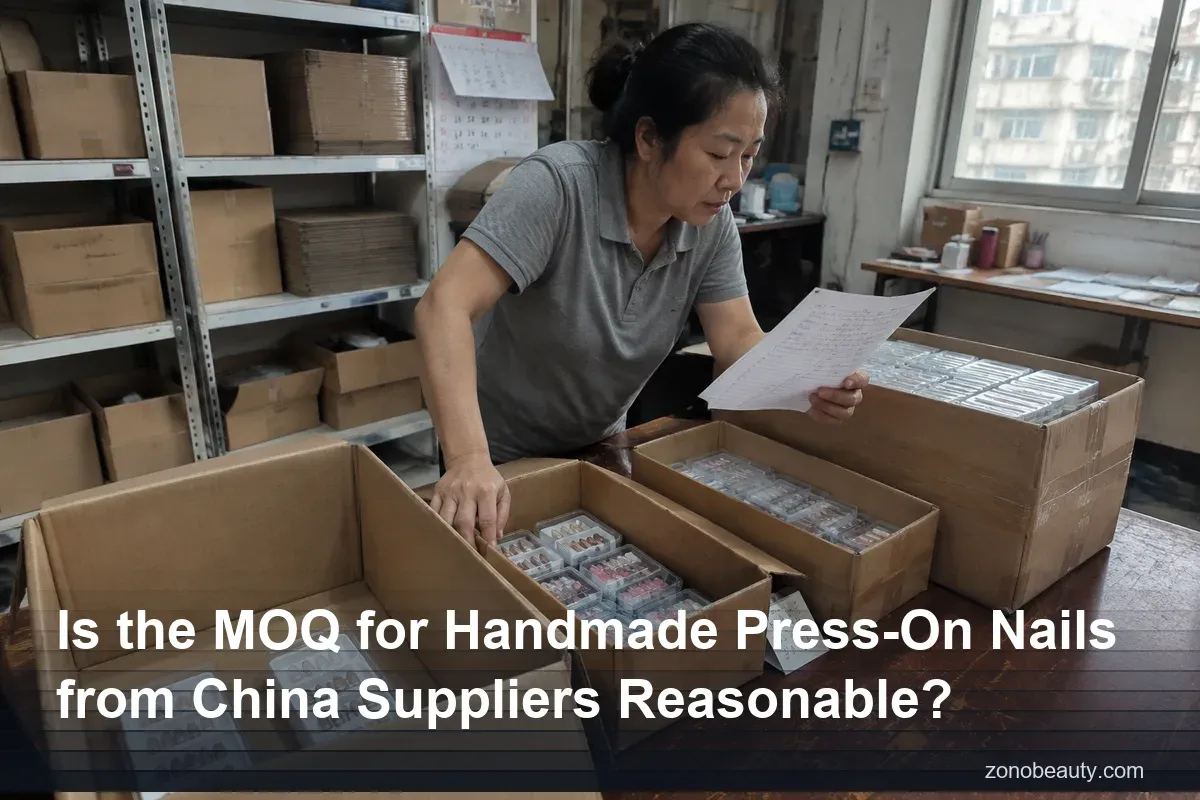
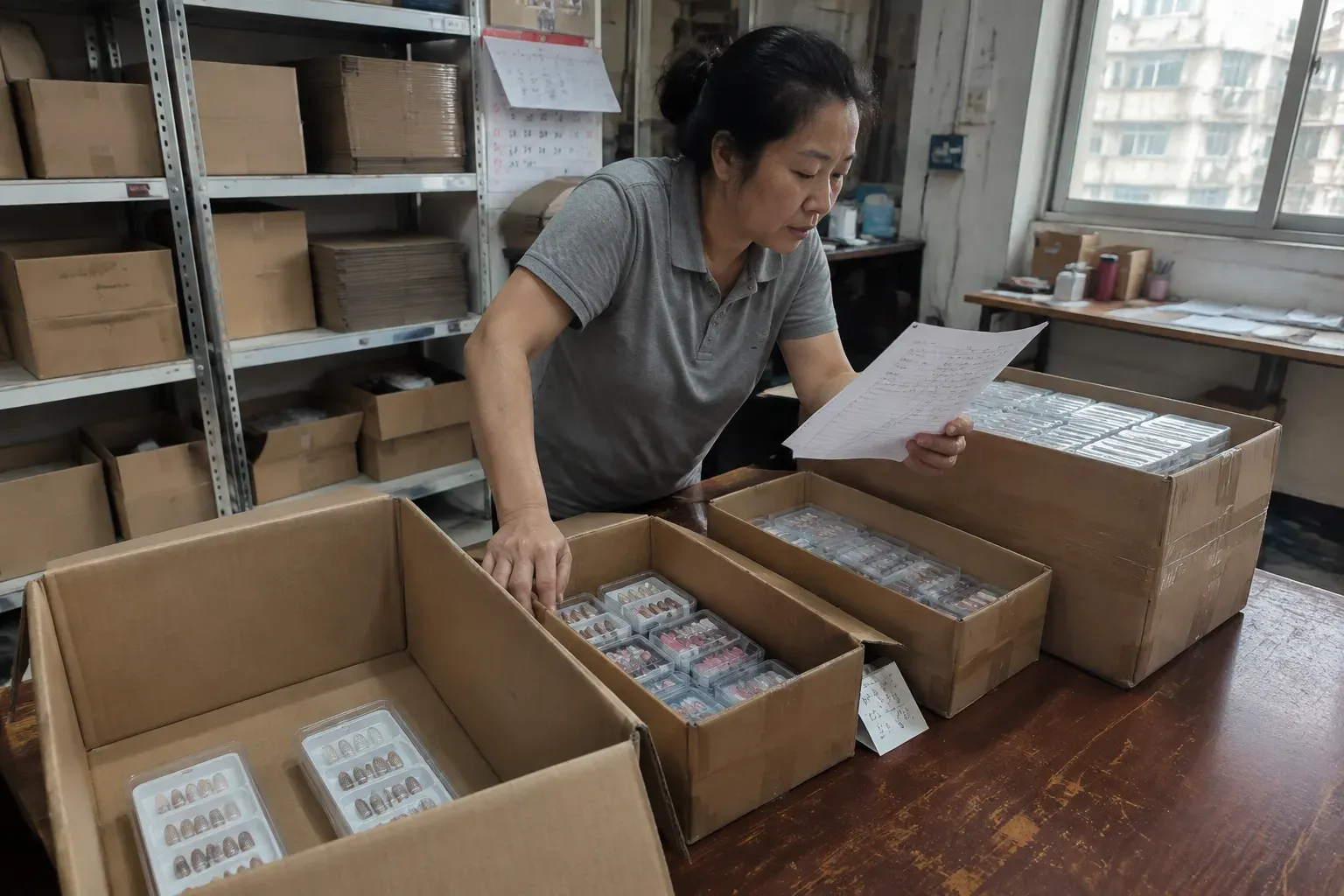
A founder recently asked our sourcing team why the MOQ for handmade press-on nails ranged so widely from one supplier to another. That gap hides real risk.
Yes, the MOQ for handmade press-on nails from China suppliers is generally reasonable when it matches the order type. Ready-stock wholesale starts at low per-design minimums, private-label launches sit in the middle, and fully custom runs with new tooling carry the highest minimums. At ZONO the standard minimum is 50 sets per design. Unreasonable MOQs force excess inventory or block testing.
So the honest answer is that "reasonable" is not one number. It shifts with customization level, packaging, and supplier type. Below, I break down why the spread exists, what to check before you commit, how to negotiate, and how your MOQ choice shapes both price and consistency.
ZONO confirmed terms (for reference)
- Sample sets: US$15 per set, credited against your first bulk order.
- Bulk production: around US$7 per set, quoted per design.
- Minimum order quantity: 50 sets per design.
- Compliance documentation: available upon request; final compliance responsibility rests with the brand owner.
- Markets served: Southeast Asia, North America, and South America.
Any other figures in this article are general industry context, not a ZONO quotation. Confirm current terms in writing before ordering.
Why does the MOQ for handmade press-on nails vary so much between suppliers I compare?
Ten years of matching nail projects to audited manufacturers taught me one thing early: two quotes for the same design brief can sit worlds apart, and both can be honest.
MOQs vary because supplier models differ. Ready-stock designs can ship from a single set. Handmade sets are quoted per design because hand-painting caps daily output, and dedicated lines set higher minimums to cover gel usage, artist scheduling, custom packaging, and setup costs. At ZONO the standard minimum is 50 sets per design.
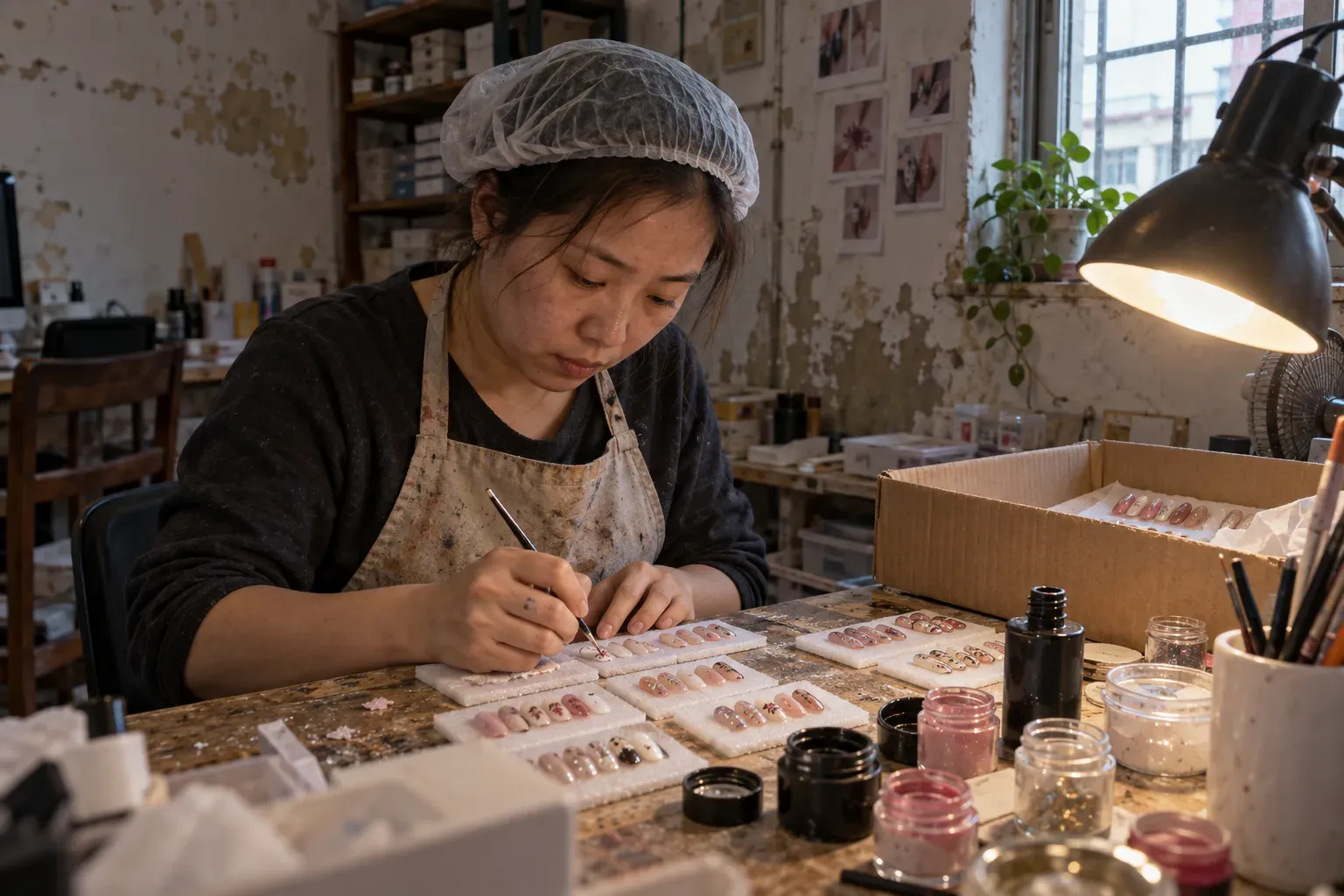
The spread you see when sourcing from Alibaba or contacting factories directly is not random. It maps almost perfectly to what you are actually buying. Here is the spectrum we see across the projects we coordinate:
Order Type | Typical MOQ Range | Best For |
|---|---|---|
Ready-stock, existing designs | 1–50 sets | First-time testing, market validation |
Mixed-style wholesale | 20–100 sets total | Small brands stocking variety |
Semi-custom (your colors, stock shapes) | 50–300 sets | Brands scaling with some identity |
Private label with branded packaging | 500–1,000 sets | Serious brand launches |
Fully custom factory runs | 3,000–5,000 sets | Proven brands with steady reorders |
Handmade Labor Sets the Floor
Hand-painting and 3D charm application limit daily output per artist. That is why handmade MOQs per design are often lower than machine-made minimums, which need mold volume to make sense. There is also a material reality most buyers never hear about: the gel-curing lifecycle. Opening a bottle of high-end imported gel for a single set wastes product to oxidation, so suppliers batch designs to use materials efficiently.
Business Models Set the Ceiling
Factories also use MOQs to keep <a href="https://en.wikipedia.org/wiki/Technician" target="_blank" rel="noopener noreferrer">skilled technicians</a> <sup id="ref-1"><a href="#footnote-1" class="footnote-ref">1</a></sup> in continuous work, which protects artist workflow stability and stops talent drifting to larger hubs. Some suppliers additionally treat minimums as a barrier against design scraping, so competitors cannot cheaply buy physical samples of proprietary custom nail designs. When private label packaging <sup id="ref-2"><a href="#footnote-2" class="footnote-ref">2</a></sup> enters the brief, minimums climb again, because packaging runs carry their own setup costs.
✔ Handmade press-on nail MOQs are typically lower than machine-made minimums, usually quoted per design TrueHand-painting limits daily output per technician, so suppliers price viability around small artist batches rather than large mold runs, which keeps per-design minimums comparatively low.✘ A supplier asking for a high MOQ is just trying to overcharge new buyers FalseHigher minimums usually reflect real costs: gel batch usage, artist scheduling, color matching, and packaging setup. A 500-set quote for private label work is often the honest price of doing it properly.
What should I check before I agree to a supplier's MOQ for my first order?
During a pre-shipment inspection last year, we found a client's approved sample used a packaging box the supplier could only produce at triple the nail MOQ. Nobody had checked.
Before agreeing to a MOQ, verify the sample order policy, unit cost per set at that volume, separate packaging minimums, lead time for production, payment terms, reorder pricing, and whether the supplier is a factory or trading company with documented quality control standards.
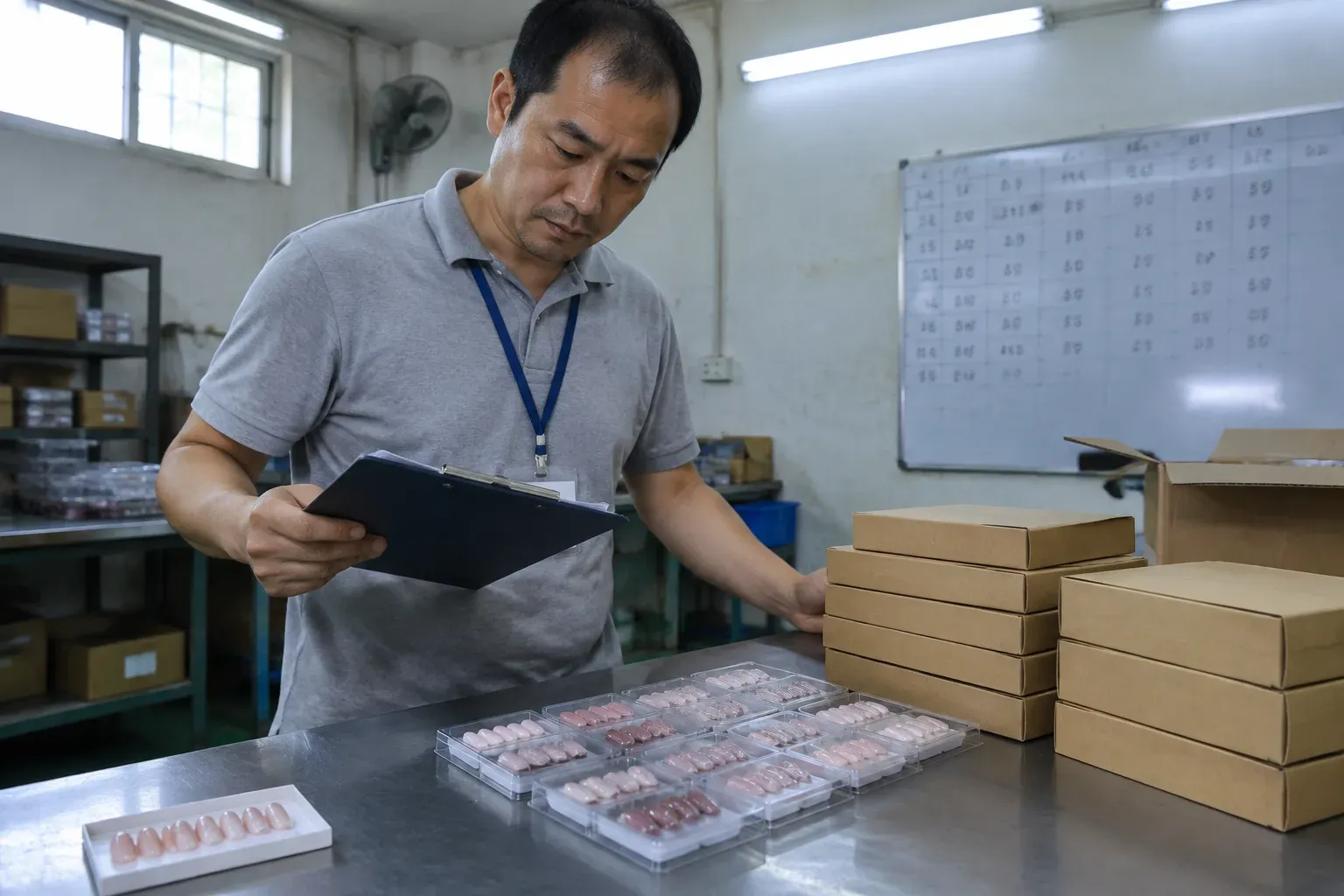
The headline MOQ is only one line in a much larger agreement. In our coordination work, most first-order disputes trace back to something the buyer never asked about. Use this checklist before you say yes:
What to Check | The Question to Ask |
|---|---|
Sample order policy | Are samples paid, and is the cost credited to the first bulk order? |
Packaging minimums | Is the packaging MOQ separate from, and higher than, the nail MOQ? |
Lead time for production | How long from deposit to shipment at this exact volume? |
Quality control standards | Who inspects, at what stage, and against what approved sample? |
Payment terms | What deposit is required, and when is the balance due? |
Reorder terms | Does the MOQ drop, or the price improve, on repeat orders? |
The Packaging MOQ Trap
This is the most common surprise. A supplier may accept 100 nail sets but require 1,000 branded boxes, because printing runs have their own economics. If you want private label packaging on a first order, ask for the packaging quote separately. Neutral stock packaging is often the smarter first move.
Verify Who You Are Actually Buying From
Marketplace listings run from 1-piece MOQs to 200-piece requirements for what looks like the same product. A very low minimum sometimes signals a trading company reselling stock rather than a workshop making it. Neither is automatically bad, but you should know which one you are dealing with, because it changes how much customization and consistency you can realistically expect.
Can I negotiate a lower MOQ if I'm a small or new nail brand?
A UK founder once told me she had walked away from a supplier over a 500-set minimum. She never asked about mixed styles. That single question would have changed the answer.
Yes, small and new nail brands can often negotiate lower MOQs. Effective levers include mixing styles within one order, accepting neutral stock packaging, staging orders across months, requesting sample credit, and committing to tiered reorders in exchange for small batch manufacturing terms.

In my experience coordinating between overseas founders and vetted production network, the published minimum is usually an opening position, not a wall. What matters is giving the supplier a reason to flex. Here are the levers that actually work, roughly in order of how often they succeed:
- Mix styles to hit the total. Many suppliers that accept mixed wholesale sets care about the order total, not the per-design count. Spreading a mixed order across several designs often works.
- Take stock packaging first. Dropping custom boxes removes the biggest hidden minimum and lets you launch faster.
- Stage the order. Propose a smaller first run with a committed second run at a set date. Suppliers value predictable volume more than one big order.
- Ask for sample credit. A fair sample order policy credits sample fees against your first bulk purchase.
- Negotiate the price curve, not just the floor. Ask for wholesale pricing tiers in writing, so scaling later has a clear path.
When Suppliers Say Yes Fastest
Some suppliers now run micro-batch fulfillment models, and a few are experimenting with AI-driven demand forecasting that offers near zero-MOQ terms to partners who commit to consistent monthly volume. Others offer dropshipping fulfillment for ready-stock designs, which removes inventory risk entirely while you validate demand. But be honest about the trade: lower volume almost always means a higher price per set. That is the supplier covering real setup costs, not punishing you.
✔ Suppliers frequently accept mixed-style orders that hit the total MOQ across several designs TrueMany wholesale programs, including those advertising 20 mixed sets, calculate minimums on order value or total quantity, so spreading volume across designs is a standard and accepted request.✘ MOQs published in supplier listings are fixed and non-negotiable FalsePublished minimums are usually opening positions. Packaging choices, staged commitments, and reorder promises routinely change the number a supplier will actually accept.
How does the MOQ I choose affect the price and consistency of my handmade press-on nails?
Every quote we coordinate involves the same tension: a lower MOQ protects cash flow, while a higher MOQ protects price and batch consistency. You rarely get all three at once.
Higher MOQs lower your unit cost per set through wholesale pricing tiers and improve consistency, since one artist team and one gel batch handle the run. Low MOQs raise per-set prices, and freight can exceed product value on orders under 10–20 sets.

The MOQ you accept is really a decision about three things at once: your cash exposure, your landed cost per unit, and how uniform your product will be. Here is how the trade-offs typically stack up:
MOQ Tier | Unit Cost Trend | Consistency | Main Risk |
|---|---|---|---|
1–20 sets | Highest per set | Variable across designs | Freight may cost more than the goods |
50–300 sets | Moderate | Good within each design batch | Some inventory risk if a style flops |
500–1,000 sets | Lower, better tiers unlock | Strong, single production run | Cash tied up in stock |
3,000+ sets | Lowest per set | Tightest, dedicated line time | Only sensible with proven demand |
Why Price Falls as Volume Rises
Setup work is fixed. Color matching, sizing kits from XS to L, gel preparation <sup id="ref-3"><a href="#footnote-3" class="footnote-ref">3</a></sup>, and artist briefing cost the same whether you order 30 sets or 500. Larger orders spread those costs thinner, which is exactly why marketplace listings show unit prices dropping sharply at higher quantity breaks.
Consistency Is the Hidden Variable
Small repeat orders may be produced weeks apart, by different technicians, from different gel bottles. That is where sample-to-bulk drift creeps in. When we run <a href="https://www.cbp.gov/trade" target="_blank" rel="noopener noreferrer">quality inspection</a> <sup id="ref-4"><a href="#footnote-4" class="footnote-ref">4</a></sup> against an approved sample, single larger batches almost always show tighter color and finish tolerance than several tiny ones. Also factor in logistics: international shipping overhead means orders below roughly 10–20 sets often make no financial sense once freight is added, regardless of how attractive the listing price looks.
✔ Freight can cost more than the product itself on very small international orders TrueShipping and logistics overhead is largely fixed per shipment, so on very small orders the freight charge frequently exceeds the value of the nails inside the box.✘ Choosing the lowest possible MOQ always saves you money FalseLow-MOQ orders carry higher unit costs and disproportionate freight, so the true landed cost per set sold can end up higher than a moderately larger, better-priced order.
Conclusion
The MOQ for handmade press-on nails is reasonable when it fits your stage. Test small, scale deliberately, verify packaging minimums, and treat every quote as the start of a conversation.
Sourcing handmade press-on nails and need to check MOQ against your order plan? Browse the ZONO press-on nail range for finished sets, shapes, and private-label options.
Footnotes
1. Wikipedia provides a general definition of skilled technicians and their role in specialized labor and manufacturing workflows. ↩︎ 2. The ITC offers resources for small businesses on export packaging and branding for international market entry. ↩︎ 3. The WTO provides insights into how small enterprises manage manufacturing costs and participate in global trade. ↩︎ 4. CBP provides official guidelines on trade standards and quality expectations for goods entering international commerce. ↩︎