What a Wholesale Cosmetics Order Really Costs: Freight, Duty and Landed Cost Explained
Unit price is not your cost. FOB, CIF and DDP change who pays freight, insurance, VAT and duty, and the difference between two quotes is usually the terms, not the goods.

A buyer posts a sourcing request for 100 units of press-on nails and gets back a quote. The unit price is lower than the competitor's. The order ships. Three weeks later, the actual cost per unit is higher than the expensive quote, nobody lied; the two numbers answered different questions. The first supplier quoted goods at the factory gate; the second quoted goods delivered to a warehouse door. Comparing them is not a price comparison. It is a vocabulary problem.
Two quotes with different terms are not a price comparison. Normalise them to the same delivery point and the same responsibility split first; only then does the cheaper one mean anything.
This happens constantly in beauty sourcing. On public sourcing boards, the same question appears from buyers in Chile, Canada, Mexico, Brazil and Indonesia: *what are the FOB and CIF shipping costs*, and *what is the total price including VAT and import duties*. The wording varies; the worry does not. Buyers surprised once learn to ask for the all-in number before the second order, and suppliers who answer clearly win the comparison before price is discussed.
Landed cost is the number that decides whether your first order makes money. It is also the easiest number to get wrong, because four separate parties touch it: the factory, the freight forwarder, customs, and your local delivery. This guide breaks the cost into its actual pieces, explains what each quotation term does and does not include, and gives you the questions that turn any quote, for stock press-on nails, a full private-label line, or a packaging component, into a comparable number.
A landed cost is never one number; it is four layers owned by four parties. Write the layers at the top of your spreadsheet, ask every supplier which layers their quote covers, and the comparison stops being a vocabulary problem.
The Four Layers of a Wholesale Cosmetics Order
Every cosmetics import breaks into four cost layers. Missing any one of them produces a budget gap.
Layer 1 — Goods. The unit price times quantity. This is what most quotes lead with, and it is the only layer where the cheapest supplier actually saves you money. Everything below this line varies by term, route and destination.
Layer 2 — Export-side costs. Inland transport in the origin country, export documentation, and the supplier's handling fee. On FOB terms these sit inside the unit price; on EXW terms they do not, and the gap between EXW and FOB quotes is often larger than the difference between two suppliers.
Layer 3 — International freight and insurance. Ocean freight, insurance, terminal handling, and, if you use a forwarder, their margin. This layer is charged by weight *or* by volume, whichever is larger, which is where lightweight packaging (and press-on nail boxes) quietly changes the math.
Layer 4 — Import-side costs. Customs duty, VAT or import tax, customs clearance, and final delivery to your address. This layer belongs to the importer of record, which is you unless the quote explicitly says otherwise.
How to choose: before comparing quotes, write the four layers at the top of your spreadsheet. Any quote that cannot be split into these four layers is not comparable, ask the supplier which layers their price covers.
What FOB, CIF and DDP Actually Include
The three terms account for almost every quote you will receive. The differences are specific.
FOB (Free on Board) covers goods plus export-side costs, delivered onto the vessel at the origin port. You pay ocean freight, insurance, duty, VAT and delivery from that port onward. FOB quotes look cheap for exactly this reason, the expensive layers sit on your side of the line.
CIF (Cost, Insurance and Freight) adds ocean freight and marine insurance to FOB, up to the destination port. It does *not* include import duty, VAT, customs clearance, or delivery beyond the port. A CIF quote is an FOB quote plus two layers; the layers that surprise buyers are still yours.
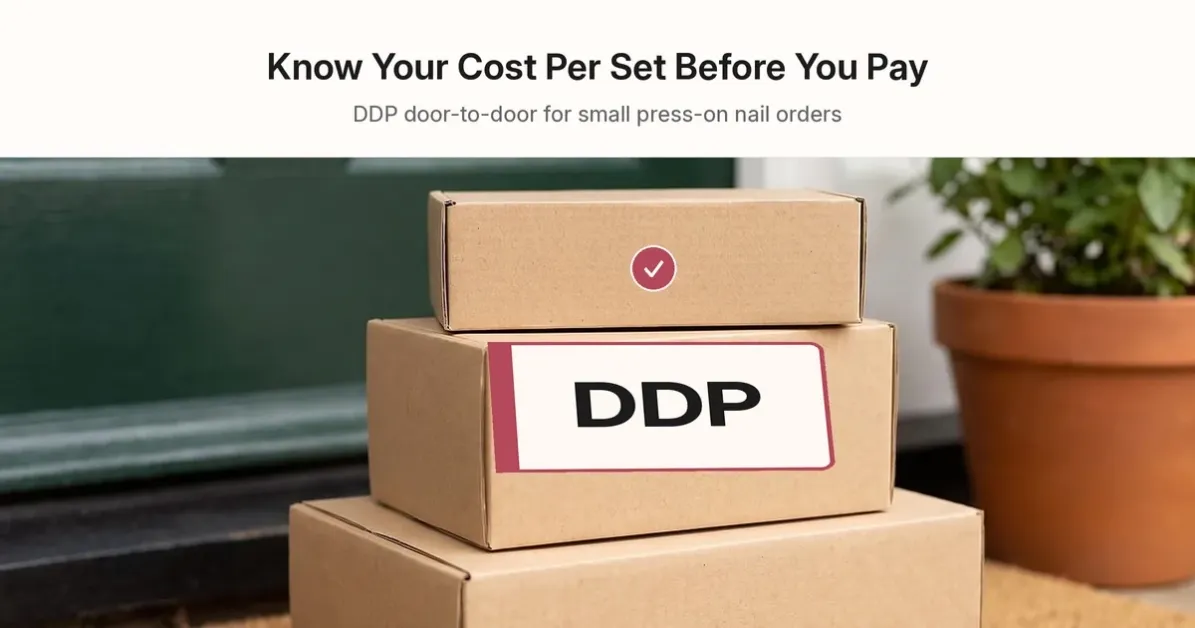
DDP (Delivered Duty Paid) means the supplier delivers to your address with duty and taxes paid, the only term where the quoted number approaches your true landed cost. But DDP has one question that decides everything: who is the importer of record, and whose door is the delivery point? "To door" can mean a port warehouse, a freight forwarder's facility, or your actual address, and the difference is the entire fourth layer.
When to use: use FOB when you have a forwarder you trust and want control of the freight leg; use CIF when you want one invoice but still handle the import yourself; use DDP when your total-cost certainty matters more than controlling the shipping. For first orders under a pallet, the courier-versus-ocean question below usually matters more than the term itself.

Where the Surprises Live: Weight, Duty and Thresholds
Three variables move the fourth layer more than any negotiation on unit price.
Volumetric weight. Couriers bill on the greater of actual and volumetric weight. A carton of nail boxes is light but bulky, so volumetric weight usually governs, suppliers who pack tightly versus loosely can change your courier bill by double digits on the same SKU. Ask for carton dimensions and gross weight per carton; a supplier who answers in one message is ahead of the rest.
Duty classification. Cosmetics and nail products carry different duty rates depending on classification in your country's tariff schedule. Press-on nails, lip products and packaging components can classify differently even in the same carton. The rate is set by customs on classification, not by the invoice description — "cosmetic" on an invoice does not determine it.
De minimis thresholds. Most countries exempt small shipments below a value threshold that varies by country and product category. A $150 sample order may arrive duty-free while a $150 × 100 order does not. Thresholds also change, verify the current figure for your market before planning around it.
Cost impact: on a small first order, freight and clearance can exceed the goods cost entirely. That is normal, and it is the reason the sample-to-bulk transition is where budget surprises happen, the same percentage cost on the sample round is trivial, on the bulk round it is not. Our ready-stock programme, which covers small trial quantities, is often the cheapest way to answer the landed-cost question for your first container: a real shipment, real invoice, real duty entry, small money. And when the samples arrive, test them the way a customer will, the landed-cost math only holds if the goods survive the trip.
The Quote Comparison Worksheet
When you have two or more quotes, make them comparable before you rank them. Ask every supplier the same seven questions, in writing:
1. What is the quotation term — FOB, CIF, DDP, or something else?
2. What exactly is included in the price, layer by layer (goods / export costs / freight / insurance / duty / VAT / delivery)?
3. What is the delivery point for that term, which port, which city, which address?
4. Who is the importer of record, and who handles customs clearance?
5. What are the carton dimensions and gross weight per carton, and how many units per carton?
6. What is the estimated transit time door to door, including customs?
7. What costs are excluded, this is the question that separates clear suppliers from the rest, and the answers are where the next quote gap usually hides.
When to use: run this worksheet before you negotiate anything. Once all quotes answer the same seven questions on the same terms, price becomes a real comparison, and often the ranking flips from what the unit price suggested.
None of this makes landed cost simple. Duty rates change, thresholds shift, and freight markets move weekly. But it makes the number *known*, and a known number can be planned around, which is the only version of a budget that survives a first order.
---
Send the destination country, quantity and packaging format, and ZONO Beauty will return a layer-by-layer estimate with the quotation term stated explicitly. We coordinate freight and documentation questions with the long-term manufacturing suppliers behind your programme, and we respond within one business day.
Request a landed-cost breakdownFrequently Asked Questions
What is the difference between FOB and CIF in plain terms?
FOB covers the goods up to the origin port; CIF adds ocean freight and insurance to the destination port. Neither includes import duty, VAT or delivery beyond the port. Only DDP moves those layers to the supplier's side, and only if the importer-of-record question is answered.
Who pays VAT and import duty?
The importer of record, usually you, the buyer, unless the quote is DDP and the supplier explicitly accepts importer-of-record responsibility in writing. On any other term, budget for duty and VAT on your side and verify the current rates for your market before ordering.
Is DDP always the safer choice?
DDP reduces your paperwork but concentrates risk: if the supplier's clearance fails, your shipment sits at customs with no broker relationship of your own. DDP is right when total-cost certainty is the priority and you have no local forwarder; wrong when you need control of freight and clearance.
Why is my courier bill higher than the ocean quote suggested?
Couriers bill on the greater of actual and volumetric weight, so bulky-but-light cartons (typical for nail boxes and cosmetics packaging) bill on volume. Carton dimensions and gross weight per carton, requested in writing before ordering, usually explain the gap.
Can duty rates change after I place the order?
Yes. Duty rates and de minimis thresholds are set by your destination country's customs authority and change without notice to either party. Treat any duty estimate as indicative, verify the current figure before the shipment arrives, and build a buffer into the first order's budget.
How do I compare two quotes with different terms?
Normalize them to the same term with the seven-question worksheet: term, inclusions, delivery point, importer of record, carton specs, transit time, exclusions. A quote that cannot answer all seven is not comparable, treat it as a price on goods only.
Conclusion
Landed cost does not become simple; it becomes known. Four layers, one normalised term, seven questions on every quote, and the number you planned against is the number that arrives on the invoice.