
How to Use Tiered Pricing to Find the Best Order Quantity for Lip Makeup?
Use a buyer decision sheet to compare lip makeup price tiers with written supplier terms, cash exposure, forecast confidence, and product evidence.

A lip makeup tiered-pricing sheet creates an order-choice problem: a lower unit price may require more cash and more inventory exposure. Evaluate the tiers against the launch plan, not the headline unit price alone.
Use tiered pricing as a comparison exercise. Ask what changes at each tier, then compare the supplier-specific cost inputs with your sales plan, cash limit, inventory assumptions, and product-specific storage or shelf-life information.
That sounds simple. A buyer can focus on the per-unit price drop and miss the inventory or cash impact. This article walks through a decision framework for reviewing a private-label cosmetics quote.
How do I figure out where the actual price breaks sit in a lip makeup tiered pricing structure?
A sharp price change between quantity tiers should prompt a question about the supplier's cost assumptions. Ask the supplier to explain the specific driver rather than treating every tier as equivalent.
Ask the supplier what changes at each price tier. The answer may involve batch setup, packaging purchases, testing, or another cost input. Request a written explanation for the exact configuration instead of assuming the reason for a price break.
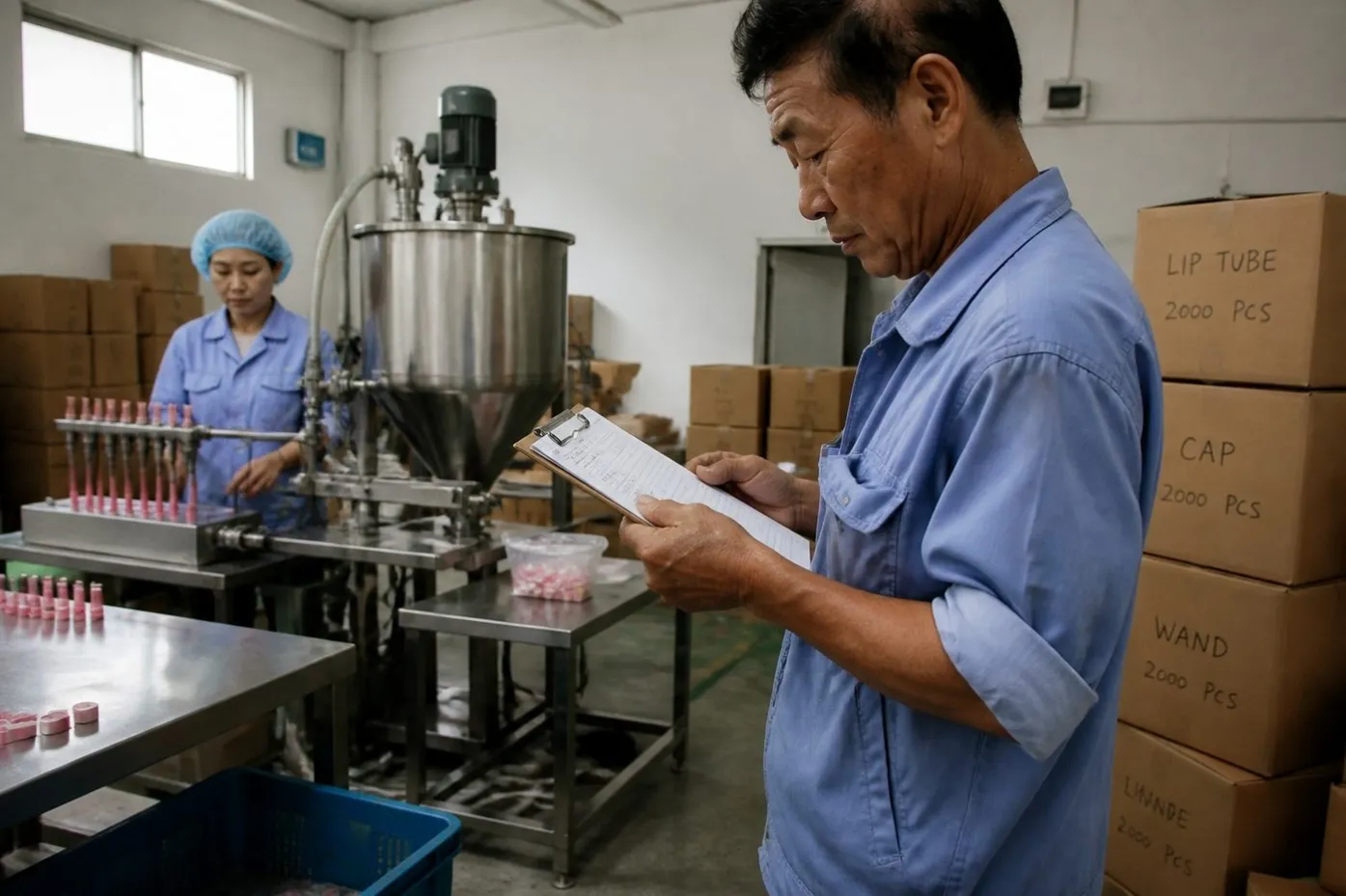
Ask each supplier to explain the cost logic behind its tiers. A price break may be linked to production setup, materials, packaging, order configuration, or another threshold. The explanation helps a buyer identify which tiers are relevant and which assumptions need confirmation.
What actually creates a price break
Use these questions to identify the cost inputs behind a price tier:
| Cost driver | How it shows in the quote | Question to ask the supplier |
|---|---|---|
| Bulk formula batch size | Ask how the formula batch configuration affects the quote | What is your minimum and standard batch size for this formula? |
| Packaging component MOQ requirements | Ask how the selected component and quantity affect the quote | At what quantity does the tube price change? |
| Line setup and changeover | Ask what setup, changeover, or service inputs are included | How many setups does my shade count require? |
| Regulatory and safety testing fees | Ask what target-market technical or quality evidence is applicable and how it is quoted | Which testing costs are fixed per SKU versus per unit? |
Ask which applicable technical, quality, or regulatory items are fixed, variable, included, or additional. Then calculate the effect of each tier with the supplier-specific and destination-specific inputs.
How to test whether a break is real
Use two follow-up questions to understand a tier. Ask whether multiple shades, a shared base, or another configuration changes the quoted tier. Ask whether any alternative commercial structure is available. Treat the supplier's written response as a project-specific input, not proof of a universal pricing rule.
How do I match my order quantity to my real sales forecast instead of guessing?
Do not let a discount tier set the order size before the sales forecast, cash limit, and inventory risk are considered.
Start with the buyer's own sales forecast, cash limit, and inventory assumptions. Use a simple order-quantity model, including EOQ if it fits the available inputs, as a decision aid rather than a universal rule. Then compare the result with the supplier's written tier terms.
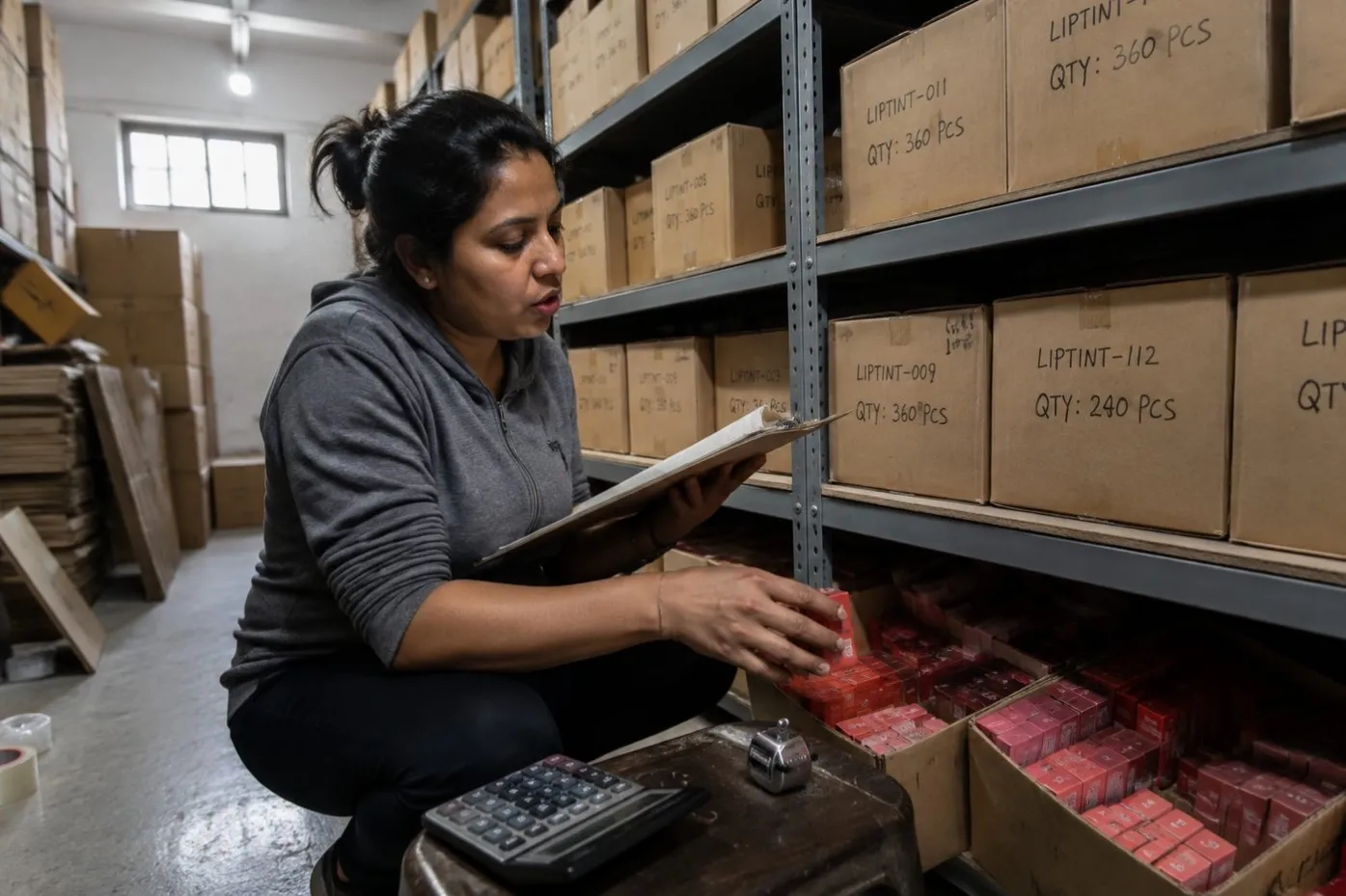
Forecast-driven ordering can follow a repeatable process. Use the following sequence because each step informs the next.
- Measure sell-through assumptions per SKU. Use the buyer's own channel data where available, then document any proxy used for a new product.
- Map time and buffer assumptions. Ask the supplier and logistics provider for the relevant project timings, then document any safety-stock decision rather than applying a fixed lead-time rule.
- Use a quantity model only when its inputs are real. An EOQ-style calculation can help organize demand, ordering cost, and holding-cost assumptions. Treat it as a reference point, and document which inputs are estimated for a new launch.
- Separate proven demand from unproven demand. Assign tier exposure from the buyer's documented channel evidence and launch plan rather than assuming one shade category will always repeat faster than another.
- Set an inventory-control rule for the project. Use the selected product's confirmed shelf-life and storage information to decide how stock will be reviewed and rotated. Do not apply a generic formula rule.
| Demand evidence | Buyer example | Decision question | What to document |
|---|---|---|---|
| Repeat sales evidence exists | An established core shade | Does the documented forecast support a higher tier? | Channel data, cash exposure, storage, and replenishment assumptions |
| Some historical evidence exists | A planned range extension | What quantity tests demand without overcommitting cash? | Forecast confidence, unit economics, and reorder decision point |
| Demand is new or uncertain | A limited launch shade | What trial configuration can the supplier quote? | Test objective, commercial terms, and inventory exit plan |
This matrix is a decision tool, not a category rule. Use it to make forecast confidence, cash exposure, and supplier terms visible before approving a larger tier.
How do I avoid overordering just to unlock a lower price tier?
At each tier, compare the possible unit-cost saving against the inventory, cash, and dead-stock risk the larger order adds. Put those trade-offs into the same decision sheet before choosing a quantity.
Avoid overordering by comparing the full trade-off: possible unit-cost changes, inventory carrying cost, cash commitment, markdown risk, and the buyer's documented sales plan. Do not assume a lower unit price makes a larger order commercially better.

Compare the possible savings from moving up a tier with the added inventory pressure, cash commitment, and sell-through risk. Do not assume a lower unit price outweighs the cost of unsold stock.
The hidden costs of the extra units
Use your own confirmed inputs to compare the additional units, unit-price change, carrying cost, storage requirements, shelf-life information, and markdown risk at each tier. Ask the supplier what storage or stability evidence is relevant to the selected formula rather than assuming a universal requirement.
| Factor | Stay at forecast tier | Jump to the next tier |
|---|---|---|
| Cash committed | Matches near-term sales | Assess inventory exposure against the buyer's documented sales plan |
| Storage | Minimal, fast turnover | Confirm storage conditions and cost with the selected provider |
| Shelf-life risk | Low, stock turns before aging | Confirm product-specific shelf-life and inventory-control requirements |
| Margin outcome | Slightly higher unit cost | Calculate total project economics from confirmed inputs |
Smarter routes to the discount
Ask whether alternative configurations, shipment structures, or future-order discussions are available. Compare any alternative using its written scope, commercial terms, product evidence, and the buyer's approved sales plan.
How does my choice of formula and packaging change which pricing tier makes sense for me?
A formula-and-component combination can affect the viable order tier. Ask for compatibility evidence for the selected formula, applicator, wiper, and tube before using a component price break in the decision.
Formula and packaging can affect the evidence, storage, component, and commercial inputs behind a tier. Ask the supplier what applies to the selected formula and component version, then compare that evidence with the buyer's approved launch plan.

Tier decisions do not happen in a vacuum. The product plan affects the inventory you can hold, and the packaging choice affects component constraints. Review both with the supplier evidence before choosing a tier.
Formula stability sets your holding window
Ask the supplier what formula-specific stability, storage, transport, and shelf-life evidence applies to the selected product. Do not use a generic product-type rule as a substitute for the evidence relevant to the formula, route, and target market.
Packaging thresholds unlock at volume
Ask the supplier which packaging options, component requirements, and commercial terms apply to the selected quantity. Use the written response when deciding whether a packaging option fits the launch plan.
| Product | Formula sensitivity | Packaging consideration | Tier tendency |
|---|---|---|---|
| Lip oil | Request formula-specific storage and shelf-life evidence | Request formula-to-wand compatibility evidence | Compare supplier terms with the buyer's launch plan |
| Lip gloss | Request formula-specific evidence | Request component and pricing scope | Compare supplier terms with the buyer's launch plan |
| Lip balm or lipstick | Request formula-specific evidence | Ask which component options are available at each quantity | Compare supplier terms with the buyer's launch plan |
| Lip tint | Request formula-specific evidence | Request component compatibility evidence | Compare supplier terms with the buyer's launch plan |
Before a bulk commitment, request formula-to-packaging compatibility evidence for the selected component version. A price-tier decision should not rely on an assumed fit between the formula and packaging.
Conclusion
Use a documented decision sheet before accepting a higher tier. Compare the written tier scope with the buyer's real forecast, cash exposure, inventory plan, and product-specific evidence instead of treating any pricing model as a universal answer.
Next step: Bring your forecast, cash limit, and supplier tiers into one decision sheet, review relevant private-label development options, then discuss your lip makeup project when you are ready to compare configurations.