How to Evaluate a Private Label Lipstick Supplier: A Scored, Printable Framework
Score a private label lipstick supplier with a printable weighted framework: factory vs trading company, batch consistency, compliance, itemized quotes.
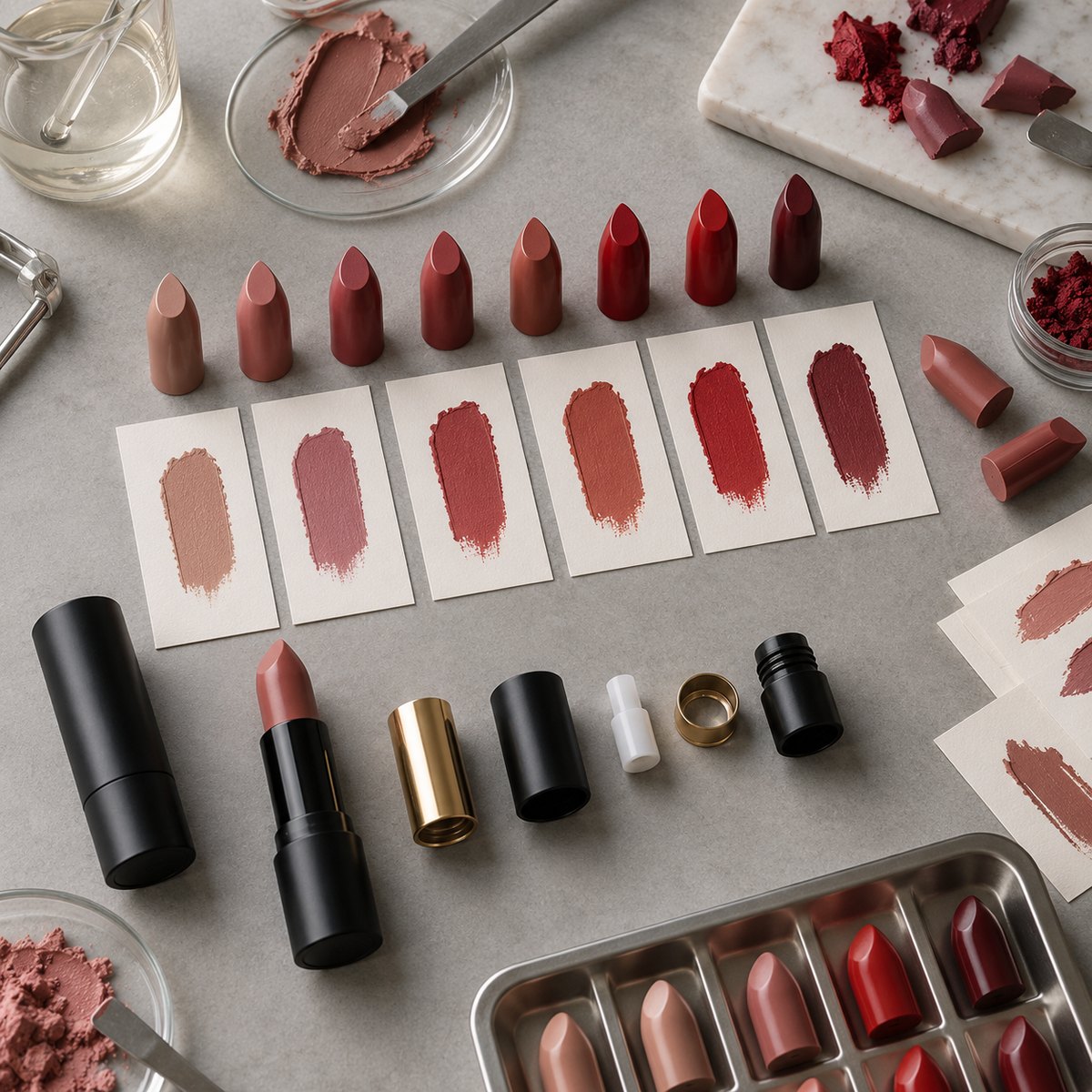
Choosing a private label lipstick supplier is a scored decision, not a catalogue browse. Work through eight weighted criteria and let the total decide; this guide gives you the printable scorecard and the question behind each number.
ZONO is not positioned as a single factory; we coordinate long-term manufacturers from Shantou, Guangdong, China. "The factories we work with" means partner factories we coordinate, never one we own or name.
What Route Does My Lipstick Actually Need?
Before scoring any supplier, confirm which production route the lipstick needs. Private label rebrands an existing finished formula; OEM builds a specification on the supplier's base; ODM develops the product from an idea. Most first-time buyers think OEM and actually start from private label.
The private label / OEM line
For lipstick, the boundary is the bullet formula and the shade. Private label picks a stock formula and existing shade, then adds a logo; OEM changes the shade, finish, fragrance or wax/oil balance, so the supplier re-engines the formula. Change the pigment load or swap satin for matte and it has entered OEM.
The full decision has its own treatment in our private label vs OEM vs ODM guide. A private label buyer has no shade-matching problem; an OEM buyer must score the shade system hard.
Am I Negotiating With a Factory or a Trading Company?
A trading company buys from a factory and resells; a factory runs its own filling and R&D. For lipstick the difference shows up as slower shade iterations, weaker batch-control answers and component markups. Ask for the production site, the filling line and the quality-document signatory.
Test the claim
Three questions separate a factory from a trading company faster than any brochure:
- Ask for the physical production site address and confirm it matches the address on the quality documents.
- Ask for a short video or walkthrough of the lipstick filling line; a trading company will hesitate or show marketing stills.
- Ask who signs the certificate of analysis and the batch record. A factory names a QC department and a site; a trading company deflects.
None of these is hostile; a real factory answers in one email. The longer test is in our factory vs trading company guide.
Why lipstick is different from a pouch
A trading company can coordinate a simple product well; lipstick is not simple. A shade or component fix means reweighing pigment, re-matching the master, or correcting a tolerance inside the line. A trading company relays that through an intermediary, lengthening the loop; with a factory the correction goes straight to the colorist.
| Signal | What a factory can show | What a trading company usually can't |
|---|---|---|
| Production site | Address on documents, visitable or third-party inspectable | Withholds or gives a different site than documents |
| Filling line | Video, line type, changeover process | Marketing stills, no process detail |
| Batch record signatory | Named QC department and site | Vague "our team" |
| Shade correction speed | Direct to the colorist | Routed through an intermediary |
| Component markup | None or transparent | Added on top of the factory price |
What Five Capabilities Must the Supplier Demonstrate?
Score capability across five columns: formula library, shade system, sampling speed, filling line and component supply. A supplier who can only describe these in marketing words, not process terms, is not ready to make the lipstick. Ask each as a question with a verifiable answer.
- formula library, by finish and base system;
- shade system, by ready-shade count and ΔE tolerance;
- sampling, made on the production line;
- filling line, with stated fill weight and changeover;
- component supply, with incoming inspection records.
Formula library and shade system
"We have a formula" means nothing until defined. Ask for the library by finish (matte, satin, sheer, velvet) and the base system, since the wax/oil/pigment balance sets payoff, wear and temperature survival. A supplier who names the base system and shows the INCI list under an NDA has one; "any finish" does not.
The shade system separates suppliers fastest. Ask how many ready shades exist, whether matching uses a trained colorist against a master standard or simple substitution, and the tolerance. A competent lab states a ΔE tolerance and its light booth; no tolerance means drift gets caught later, by the customer.
Sampling, filling and components
Sampling matters only if it reproduces on the production line. Ask whether the sample is made on the same line with the same materials as bulk, or on a bench; a bench sample that will not scale produces "the sample was perfect, the bulk was different." Pin down turnaround and revision rounds in writing.
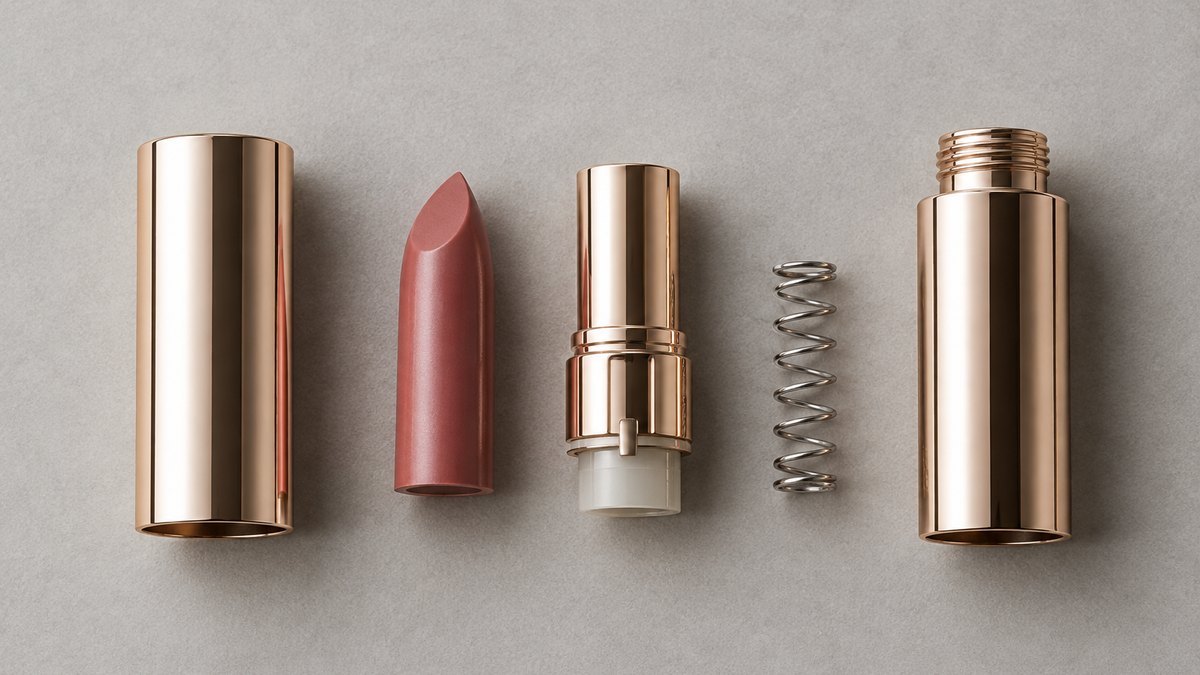
Filling line and component supply are one decision. Ask the fill weight tolerance, whether it runs hot-pour lipstick with a cooling tunnel, and the changeover between shades. Then ask whether the supplier sources the component (tube, mechanism, cartridge) or only fills what is sent; inspection should cover the click mechanism, bullet-to-tube fit and airtight seal.
How Does the Supplier Control Batch-to-Batch Consistency?
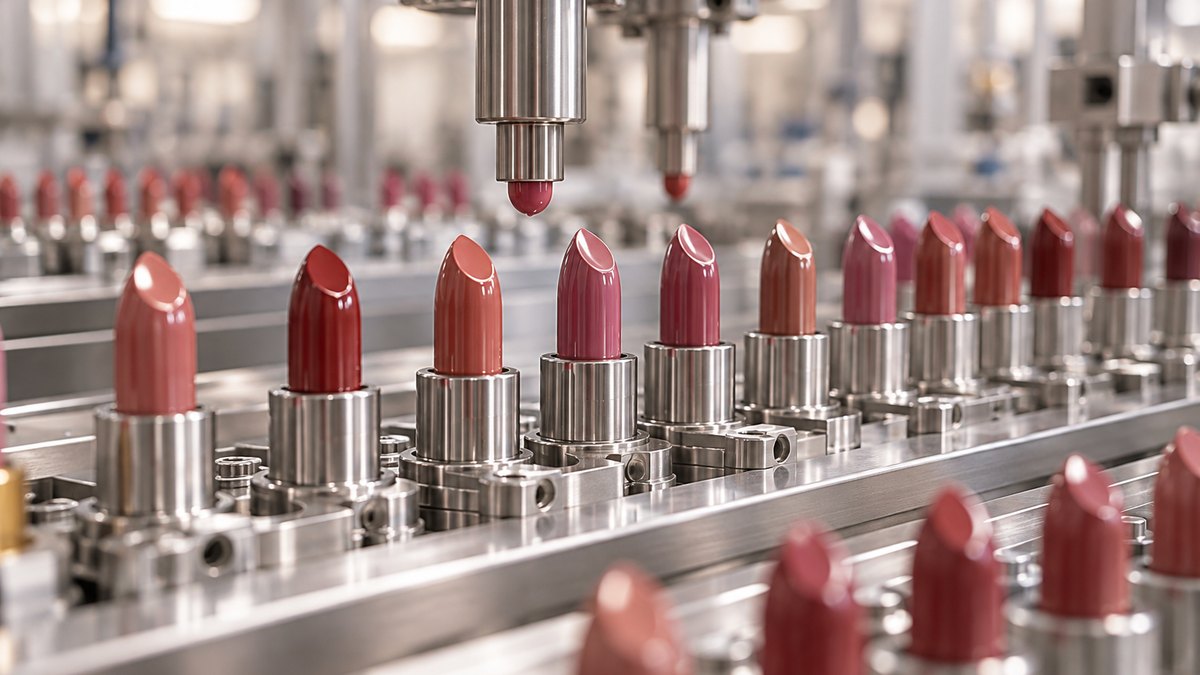
Consistency is the single biggest lipstick risk, because shade or texture drift between batches cannot be fixed after filling. Ask how the supplier controls shade, texture, fill weight and component fit, and demand the tolerance numbers and the measurement method in writing.
The three failures to ask about
Shade drift comes from a changed pigment lot, an off weighment, or a substituted colorant. The control is a stated ΔE tolerance against the approved master under fixed light. Ask for the number and instrument; a real lab gives a figure, not a promise.
Wax bloom is a whitish surface film from wax incompatibility or storage, and it ruins the look. The control is stability testing under temperature cycling. Ask the cycled range, the duration, and whether bloom appeared; a supplier who has never heard "bloom" has not stress-tested a bullet.
Fill weight variance is the quiet failure: over- or under-filling changes net content, unit cost and the compliance statement. Ask the tolerance in grams and how it is checked mid-run; no gram figure means nothing to hold them to later.
Texture and component fit
Texture drift applies the same discipline to the wax/oil/pigment ratio. Ask what ratio the formula is locked to and how it is checked: penetrometer, viscosity or sensory panel. "The chemist checks it" is not a control.
Component fit makes a lipstick unshippable even when the formula is perfect. The bullet must seat, click through its travel and seal when retracted. Ask the bullet-to-component tolerance and inspection record; a supplier who ignores the component still ships the defect.
What Compliance Documents Do I Request for Each Market?
There is no universal cosmetic compliance certificate. Ask by market: the EU runs on Regulation EC 1223/2009 with a Product Information File; the US requires MoCRA facility registration and product listing, with colour additives the only pre-approved exception; Indonesia requires BPOM notification. Ask for the documents that support each.
Request by market
Under Regulation (EC) No 1223/2009, a cosmetic needs an EU Responsible Person, a Product Information File with a Cosmetic Product Safety Report by a qualified assessor, notification through the Cosmetic Products Notification Portal, and Good Manufacturing Practice. The supplier provides the inputs: formula, INCI list, per-batch certificates of analysis, and the test data the assessor needs.1
The US differs: FDA does not pre-approve cosmetics; only colour additives must be approved for their intended use.2 Under the Modernization of Cosmetics Regulation Act of 2022 (MoCRA), facilities register with FDA and renew every two years, and a responsible person lists each cosmetic with its ingredients, updated annually.3 Confirm registration and supply the listing data. Never accept "FDA approved"; it does not exist.
Indonesia is regulated by BPOM, the national food and drug agency.4 A cosmetic must pass BPOM notification, filed in practice by the local distributor. Ask early for the formula, ingredient list and supporting documentation; this gates the launch.
Verify the certificate number
Request any certificate (GMP under ISO 22716, or otherwise) as a number, scope, issuing body and expiry, then verify it against the issuer's registry; a logo is marketing, a verifiable number is evidence. China's market is regulated by the National Medical Products Administration (NMPA).5 Because ZONO coordinates suppliers in Shantou, Guangdong, we expect any producing site to hold a current Chinese production licence for the named site.
| Market | Framework | What you request from the supplier | What you reject |
|---|---|---|---|
| EU | EC 1223/2009 | Formula + INCI, CoA, test data for the PIF/CPSR | "EU approved" claims |
| US | FDA + MoCRA | Facility registration confirmation, ingredient data for listing | "FDA approved" claims |
| Indonesia | BPOM | Formula, ingredient list, notification dossier support | A promise it "clears customs anyway" |
| China (site) | NMPA | Current cosmetics production license for the named site | A certificate with no number or scope |
1. Demand an Itemized Quote
A single all-in price hides where the cost actually sits. Demand an itemized quote that splits the formula, shade matching, components, filling, and per-unit versus one-time costs. Only then can two suppliers be compared against the same scope, exposing the one that looks cheaper because something is missing.
The comparable line items
An all-in price hides a missing line item behind a low number; an itemized quote exposes it. Require every quote to split, at minimum:
- per-unit costs: the component, the filling, the bulk formula, the assembly, and the inner and outer carton;
- one-time costs: shade matching, formula customisation, and any mould or tooling for a custom component.
Request the tier and MOQ separately; a good-looking price is often tied to a volume a first order will not reach. Ask which quantity the price is contingent on, and what changes below it. Ready-stock lines can start from very small quantities with fast dispatch, while custom development is confirmed per project: the minimum depends on the formula, the shade count, the component and the decoration, so treat any tier you are shown as specific to that scope until the supplier confirms it in writing against your brief.
Two suppliers almost never itemize the same way, so put both on a common template first: the complete cosmetic supplier quote RFQ. A quote you cannot itemize is a quote you cannot compare.
2. Print the Weighted Scorecard
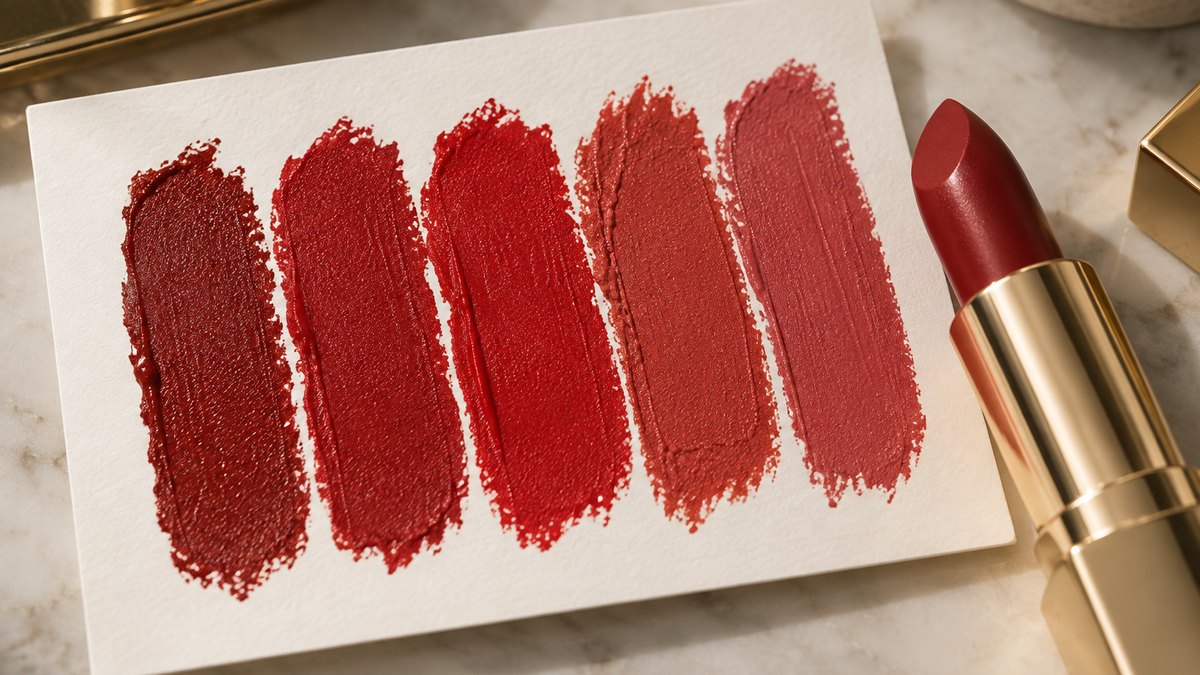
Print this scorecard and fill one row per supplier while talking to them. Each criterion carries a weight that reflects how badly that failure hurts a lipstick launch. Score 1 to 5, multiply, and compare totals; an expensive supplier can still win on consistency and documentation.
Using the scorecard
Score each criterion from 1 (missing) to 5 (demonstrated with evidence), then:
- multiply each score by its weight and divide by 5;
- total the column, where the maximum is 100;
- treat the total as a filter: 80+ means verify and sample, 60-79 means close the gaps first, below 60 means walk.
Weights matter more than labels. Consistency and documentation carry the most because they cannot be recovered after filling; a drifting shade or a dossier that will not clear BPOM is not fixed by price. A supplier scoring 5 on consistency and 2 on price beats one scoring 2 and 5.
| # | Criterion | Weight | What a 5/5 looks like | Score (1–5) | Weighted points |
|---|---|---|---|---|---|
| 1 | Route fit (private label / OEM / ODM) | 10 | States the route clearly and what changes would move it to the next one | ||
| 2 | Factory transparency | 10 | Production site address matches documents; filling line shown; QC signatory named | ||
| 3 | Formula library + shade system | 15 | Numbered formulas by finish; shade matching to a stated ΔE tolerance | ||
| 4 | Sampling capability | 15 | Sample made on the production line; fast turnaround; revision rounds defined in writing | ||
| 5 | Filling line + component supply | 10 | Line type, fill-weight tolerance, and incoming component inspection all stated | ||
| 6 | Batch consistency control | 15 | Written shade, texture, fill, and fit tolerances with the measurement method | ||
| 7 | Documentation & compliance | 15 | Market-specific dossier support; certificate numbers that verify | ||
| 8 | Quote itemization | 10 | Per-unit and one-time costs split; MOQ, lead time, and sample policy stated | ||
| Total (max 100) | 100 |
3. Know When to Walk Away
Walk away when a supplier refuses to itemize a quote, will not name the production site, claims "FDA approved," or cannot explain how it controls shade and fill tolerance. Any one of these is enough to disqualify; combined, they predict a launch where the samples never match the bulk.
Deal-breakers versus fixable gaps
Some signals are deal-breakers because the decision cannot be reversed later:
- A "FDA approved" claim means the supplier does not understand the target market or is willing to mislead.
- Refusing to itemize a quote means the price hides something.
- Refusing to name the production site means nothing can be verified.
- No stated shade or fill tolerance means there is no control to hold them to.
- A certificate shown as a logo with no number and no scope is decoration.
Other signals are fixable and should not by themselves eliminate a supplier:
- A high MOQ can be negotiated or timed against a phased order.
- A long lead time can be planned.
- A sample fee is normal when it is refundable against the first order.
- A language barrier is solved with a written specification sheet, not a penalty.
Red flag or honest gap
The test is how the supplier answers the hard question.
Reward candour, walk from evasion.
Conclusion
Evaluating a private label lipstick supplier is not a directory or price problem; it is a sequence of eight checks, from route and identity through capability, consistency, compliance and quote structure, that collapse into one score. Ask tolerance before price, request the certificate number instead of the logo, and write a score instead of a feeling.
That is how ZONO works on the other side of the table: 10 years of development, a 1,000+ SKU ready-stock library, ready stock from 12 pieces with 48-hour dispatch, and a reply within one business day. One lip-oil project we coordinate sold 700,000 units in 2024. Send the route, a shade reference, the target markets and the first-order volume, and we will return an itemized quote and the answers behind every score.
Footnotes
1. Cosmetics legislation: Regulation (EC) No 1223/2009, European Commission. EU cosmetics framework. ↩︎
2. FDA Authority Over Cosmetics, U.S. Food and Drug Administration. FDA regulates but does not pre-approve cosmetics; colour additives are the exception. ↩︎
3. Modernization of Cosmetics Regulation Act of 2022 (MoCRA), U.S. Food and Drug Administration. Facility registration renewed every two years and annual product listing. ↩︎
4. BPOM: Indonesia's Food and Drug Supervisory Agency. Regulates cosmetics in Indonesia. ↩︎
5. National Medical Products Administration (NMPA), China. National authority overseeing cosmetics regulation in China. ↩︎
Share the production route, a shade reference, the target markets, the required certifications and the first-order volume. ZONO can return an itemized quote and the capability answers for every criterion on the scorecard.
Discuss your private label lipstick briefTo see how the scorecard is applied across a full project, explore private label makeup development.