How to Source Private Label Highlighter: Pearl Grade, Format and Quote Scope
A sourcing guide to private label highlighter: the pearl grade and format to lock, the channel fit to weigh, and the questions that make two quotes comparable.
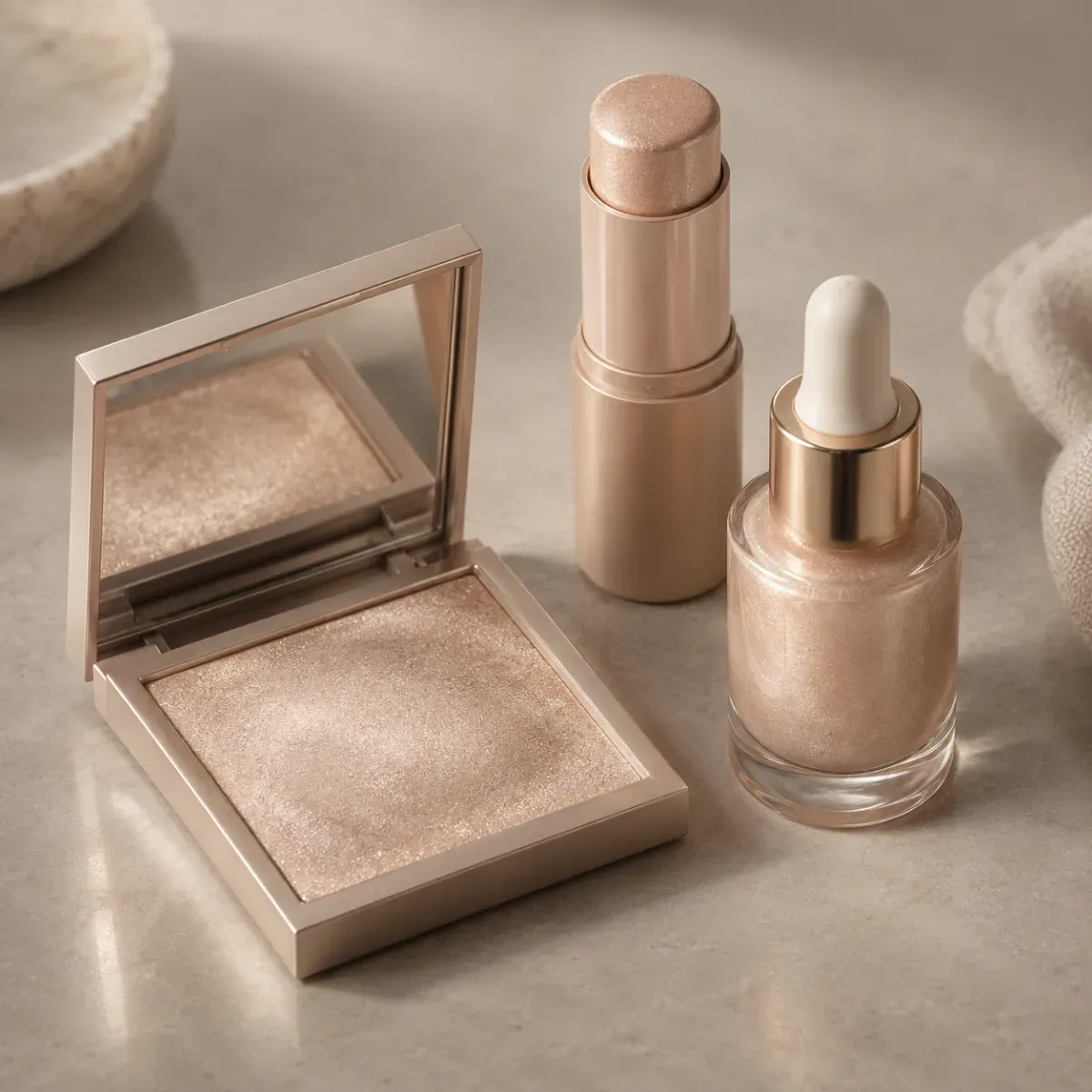
A private label highlighter is won in the pearl, long before the shade card. Highlighter looks like a colour project and is a light project: the glow comes from a particle — its size, substrate and coating — and the same nominal "champagne" built on two pearls behaves as two different products, so a supplier photo and an arm swatch are poor evidence at the quoting stage.
Most first highlighters are briefed with a reference image, a finish word and a price target. The decisions that decide whether the product reads luminous or glittery, and whether the bulk matches the sample, are the pearl grade, the format route and the components behind them — none visible in a swatch.
ZONO Beauty coordinates long-term manufacturing suppliers from Shantou, Guangdong, across ready-stock, semi-custom and full OEM/ODM routes, and is not positioned as a single factory. This guide covers what to lock in the brief, what to send before you quote, and what to verify before the first order; if you have settled on the jelly stick, the private label highlighter stick guide covers that format in more depth.
Lock the pearl first, then the format, then the shade. A highlighter approved on colour alone is the one that comes back as "not like the video".
What should my highlighter specification pin down before I ask for a price?
Two highlighters can share a name, a price point and a supplier photo and behave nothing alike on the face, because the difference sits in four variables inside the pearl, each a specification field and none visible in a catalogue image.
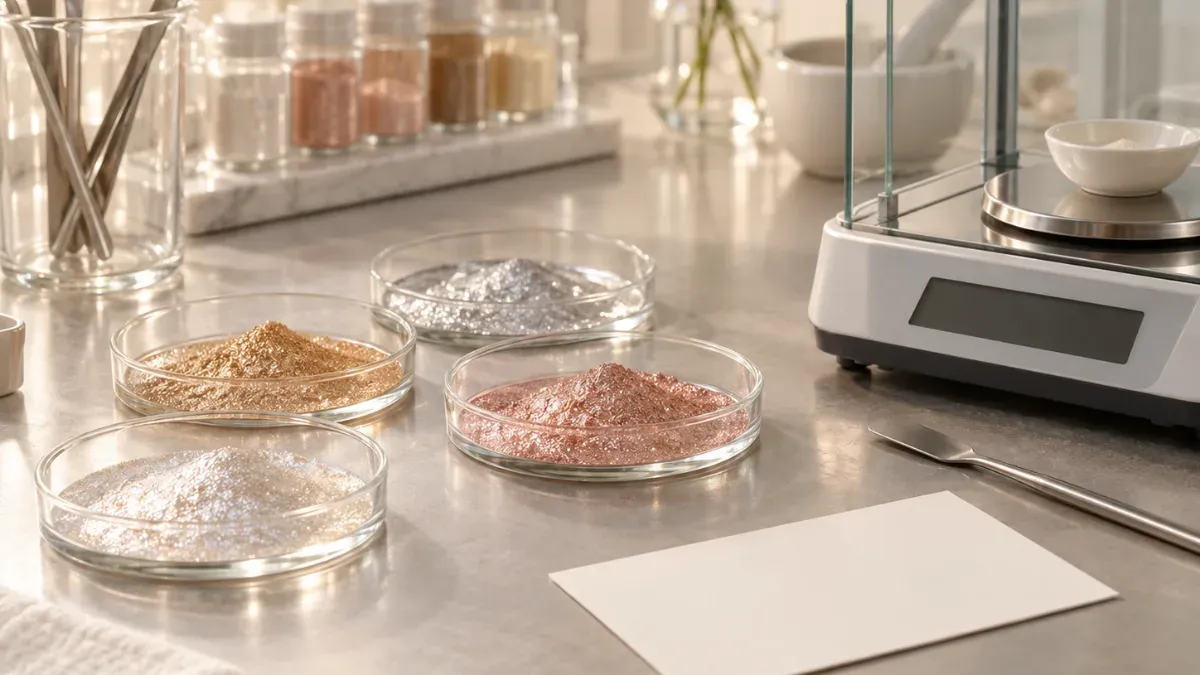
- Particle size: the single biggest driver. Fine particles scatter light broadly and read as a soft sheen; coarse particles return discrete points of light and read as sparkle. Ask for the particle size distribution figure, not the adjectives "fine" or "micro-fine".
- Substrate: natural mica is the cost baseline and carries sourcing due diligence; synthetic mica (synthetic fluorphlogopite) is brighter, more uniform and lower in trace impurities; borosilicate flake gives the sharpest flash at a higher raw-material cost.
- Coating: a metal-oxide layer of controlled thickness produces interference colour rather than pigment colour, which is why a champagne, a rose gold and a pink-shift duochrome can all start from one base particle.
- Surface treatment and load: treated pearls disperse into oils and waxes and resist clumping, where untreated ones agglomerate in a liquid and drag in a stick. Load is how much pearl the base carries before a powder turns chalky or a liquid separates.
Put all four into the spec in writing, and ask for a retained reference from the approved batch, because pearl lots vary between shipments in brightness as well as shade and a colour tolerance alone will not catch a substitution. The particle band also sets the proposition: fine sheen is the forgiving, everyday glow, medium pearl is the volume seller, and large flake or glitter carries high impact in video with high fallout and the most removal complaints.
Which format should I brief — pressed powder, liquid or stick?
The three formats are not one product in three textures: each commits you to different equipment, components, failure modes and cost structure, and switching after sampling is expensive because the pearl has to be re-tuned for the new base.
| Dimension | Pressed powder | Liquid (emulsion or gel) | Stick (wax-based) |
|---|---|---|---|
| Formulation difficulty | Moderate — the hard part is press behaviour, not chemistry | Highest — rheology must suspend the pearl, and preservation and stability add rounds | Moderate to high — payoff must survive structure, and climate shifts the balance |
| What usually goes wrong | Pan cracking in transit, surface glazing, dustiness, colour reading deeper once pressed | Pearl settling or agglomerating, separation, viscosity drift, weeping at the closure | Oil sweating in heat, sink marks, the bullet sticking or lifting out of the cup |
| Equipment and filling | Mill, blender, press with a die matched to the pan; a new pan shape means tooling | Emulsifying vessel, then piston or volumetric filling; shear must not break platelets | Hot pour with controlled cooling, then mechanism assembly and torque check |
| Typical packaging | Pan in a compact, mirror, brush or puff, carton | Bottle with dropper, pump or orifice reducer, wiper, carton | Barrel, spiral mechanism, cup, plug, cap, carton |
| Transport risk | Fragile — drop and vibration matter more than temperature | Leakage and weight; glass multiplies freight cost and breakage | Heat — softening, sweating and deformation in transit |
| Shelf life | Longest; anhydrous, minimal preservative burden | Shortest; needs preservation efficacy and stability cycling | Long if anhydrous, but oil oxidation and sweating still need checks |
| Unit cost driver | Lowest material cost at volume; tooling and components can erase it | Mid to high; filling, heavier components, more QC per batch | Mid; the mechanism is a real cost and often the highest minimum |
| Result on skin | Buildable, most forgiving on texture, easiest to layer over foundation | Strongest wet glow and best on video; hardest to keep consistent | Most portable and direct; heavier deposit can emphasise texture |
Pressed powder is the cheapest format to iterate and the most forgiving to launch: it tolerates the widest pearl range, ships better than glass, and its shelf life gives you room to sell through. Liquid earns its place when the proposition is a wet finish that has to perform in video, and the stick earns its place on portability. Component minimums routinely exceed the formula minimum — the gap is set out in why packaging MOQ often exceeds formula MOQ.
How does my channel change the format and packaging brief?
| Dimension | E-commerce and marketplaces | Open-shelf retail | Gift and seasonal sets |
|---|---|---|---|
| What the channel rewards | How the glow reads in a short video, review language, and a low return rate | Arm's-length read in three seconds, tester experience, a clean price ladder | Perceived value at a fixed price point, unboxing, and hitting a hard delivery date |
| Format that tends to fit | Liquid and stick film best; powder ships best. Many lines pair one hero liquid with a powder | Pressed powder in a compact with a mirror; stick for on-the-go segments | A pan inside a palette, or a mini liquid that fills volume cheaply |
| Packaging that works | Courier-survivable primary, protective secondary, tamper evidence, a carton that photographs | Shelf footprint and facing, barcode and legal labelling space2, sealed unit, supplied testers | Tray, sleeve and outer box — with every component landed before the assembly window |
| Risk to manage | Leakage and breakage in transit, shade-mismatch returns, "not like the video" reviews | Cracked pans on shelf, dried or contaminated testers, artwork that fails the retailer's checklist | One SKU carrying many minimums; the slowest component sets the date |
E-commerce buyers overweight how the product looks in fifteen seconds of footage and underweight what happens to it for three days in a parcel network; offline buyers do the reverse, so write both into the same brief. Where a highlighter enters as part of a palette, the pan questions decide tooling and lead time — the custom eyeshadow palette brief covers that side.
Which shades should a first range carry — and can I brief it near the eye?
Three anchors cover most of the market: champagne for light to light-medium skin, rose gold for light-medium to medium with a pink undertone, and bronze for medium to deep. The mistake is not the choice of anchors — it is where the range stops.
- Champagne: the safest first seller and the most crowded, and the shade most likely to turn ashy on deeper skin, because a light pearl with a high white-base content sits on the surface rather than reading as glow.
- Rose gold: carries the middle of the range and photographs warm; undertone matters more than depth, because a rose gold that leans too pink reads as blush on medium skin.
- Bronze and deep bronze: the shade that decides whether deep-skin customers come back; it needs real depth and a controlled white base, or it reads as a grey-white cast.
Deep shades are skipped because they are harder to develop and slower to sell through per SKU, and that is exactly why they drive repurchase when they exist. Treat the deep shade as a development item with its own sampling rounds, specify shade on two axes — depth and undertone — ask for the white-base level in writing, and approve in the final format, because a liquid shifts as it dries down and a stick always reads deeper in the bullet than on skin.
Large flake near the eye turns a marketing decision into a compliance decision. Colourants are regulated by area of application: the EU framework restricts which colourants may be used around the eye,3 and in the US a colour additive has to be permitted for its intended use.2 Do not brief a chunky glitter as an eye-area product without written confirmation that the colourant is permitted for that use in your market, and treat the physical migration risk as a review waiting to happen. Where pearl sits near the eye, the eye makeup supplier safety verification checklist is the documentation to request before the order.
How should I approve a highlighter sample so the bulk matches?
An arm swatch is the most common approval artefact in this category and the least reliable: the inner arm is flatter and often a different tone from the face, and it is usually held under one light source.
- Where: the cheekbone and the high points of the face, over the foundation or bare skin the product is sold for.
- Under what light: daylight, retail or office LED, warm indoor lighting, and a direct flash or phone camera, because flash is where a coarse pearl or a high white base shows up as a cast.
- On whom: at least three skin depths, deep skin included, plus one person with visible texture or mature skin.
- Over what time: at application, at thirty minutes, and at four to six hours, checking fallout, migration and how hard it is to remove.
- How it is recorded: a fixed photographic setup, a sealed retained reference, a written colour tolerance, and the batch records that let you trace the result later.1
What must the RFQ fix so two highlighter quotes compare?
Two highlighter quotes rarely cover the same scope, so the unit price alone misleads. Normalise the scope field by field, then read the number — the point is the scope you can hold the supplier to.
- Format and base: pressed, liquid or stick, with the pearl grade written into the quote rather than named after sampling.
- Component scope: which parts are stock and which are tooled, whether the decoration is included, and who assembles the compact or fills the stick.
- Testing and approval: whether colour tolerance, per-batch records and any stability work are inside the price or billed later.
- Shade count and references: how many shades the quote covers and whether each carries its own retained standard.
- Minimums: the formula minimum against the decoration and component minimums, broken out separately rather than as one floor.
- Trade term and reorder: ex-works or landed, and what changes on a second order.
Line the offers up field by field and the cheaper one often stops being cheaper, because the two are usually answering two different briefs.
Questions to send the supplier before you quote
Send these in writing, to every supplier, before any price is discussed, so the returned quotes compare on the same basis instead of on two different highlighters.
- Which pearl grade do you propose — substrate, particle size band and coating type — and will you write it on the spec?
- What pearl load will you quote for our format, and how does it behave as the load moves?
- Which format route can you run, and what filling line and equipment does it need?
- Which components are stock and which are tooled, and what is the decoration minimum billed separately?
- Will you supply a filled sample in the final packaging, checked on how many skin depths and light sources?
- What colour tolerance and retained reference will you hold per shade, and measured how?
- What documents come with the order — GMP evidence, colourant-permission confirmation per market, and any stability or heavy-metal reports?
Where do first highlighter orders actually go wrong?
Highlighter problems show up as a review, not a lab result, and most trace to an optical behaviour that was never written down. Each is caught by a record or a line item you could have asked for, and lost when it was never put in the brief.
- Dull bulk: bulk looks flatter than the sample because of a pearl lot change, a lower load than the lab sample, or particle breakage from higher shear at scale.
- Substituted pearl: an "equivalent" grade used at bulk, brighter or duller than approved, invisible in a colour tolerance.
- Cracked or glazed pans: breakage in transit or a glazed surface on a powder, discovered by the customer as a used-looking unit.
- Leakage, separation and ash: a liquid that weeps or separates because the pearl was not suspended for the shelf life claimed, or a champagne brief with a high white base found only after photographs on the skin depths you sell to.
Each is caught by an approval you can write into the order — a retained reference, a written pearl grade, a per-batch record, photographs on three skin depths. The failure is committing to bulk on a swatch and a colour match, without the record that proves the run matches the pearl you approved.
Frequently Asked Questions
- Can I use the same pearl across a powder and a liquid? Sometimes, but expect rework: a pearl that presses cleanly may agglomerate or settle in a liquid base, and the load a powder carries is usually higher than an emulsion can hold without separation. Test the pearl in the target base.
- Which format is lowest risk for a first private label highlighter? Pressed powder, for most launches. It tolerates the widest pearl range, has the longest shelf life, avoids the leakage and heat risks that liquid and stick carry, and its main risk — pan breakage — is manageable with a written drop test.
- Are large glitter particles safe to use near the eyes? Treat it as a question for your target market, not the supplier's catalogue. Colourants are restricted by area of application in the EU3 and must be permitted for intended use in the US,2 with a physical migration risk on top.
- How many shades should a first highlighter range carry? Three to four: champagne, rose gold, bronze, and one genuinely deep option. Four shades with real depth coverage outsell six that cluster in the light-to-medium band, because the fourth is the one that generates repeat buyers.
Conclusion
A private label highlighter is an optical product bought through a supply chain, so the order of decisions matters more than the number of them. Fix the pearl first — substrate, particle band, coating, load — and put it on the spec in writing rather than in a swatch, because every later choice is constrained by it. Then fix the format, on the understanding that powder, liquid and stick are three different projects with three different failure modes rather than one formula in three containers. Match the format to the channel you sell through, give the deep shade the development attention its repurchase value justifies, send one written brief and the same questions to every supplier so the quotes compare, and ask for the documentation while it is still cheap to walk away.
Need a highlighter sourcing brief? Share the format you are weighing, target market, channel, shade count, a pearl finish reference and your quantity and timing, and ZONO can help turn it into an RFQ that two suppliers quote on the same basis.