Private Label Eyebrow Pencil Manufacturer: What to Spec and Verify
A sourcing guide to private label brow pencils: the lead hardness and spoolie to specify, the shade architecture to brief, and the verification to request before you sign.
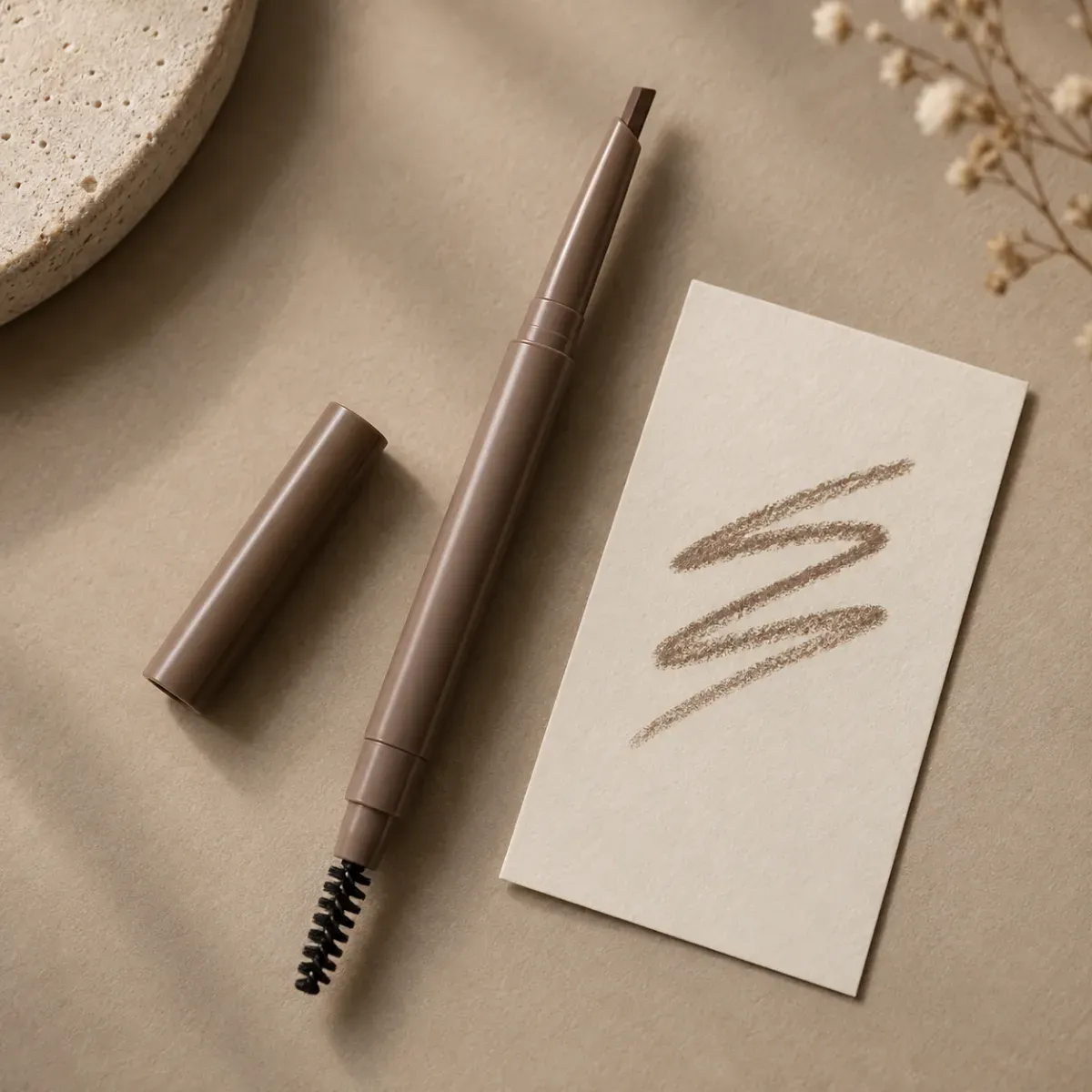
A private label eyebrow pencil is won at the lead, which means it is won in the brief long before it is won on the shade card. A supplier can match a shade reference and a barrel finish in a week; what decides how the product performs is how hard the core is, and that is a line most buyers never write down.
A brow lead has to deposit pigment on skin and through hair on a light stroke and stay in one piece doing it. More deposit means a softer core; more strength means less colour. That band is narrow and it moves with the wax blend, pigment load, pressing cycle and shipping temperature, so hardness is a specification to pin down rather than a sample to trust on the day.
ZONO Beauty coordinates long-term manufacturing suppliers from Shantou, Guangdong, across ready-stock, semi-custom and full OEM/ODM routes, and is not positioned as a single factory. This guide follows the order to settle it in: hardness and geometry, format, spoolie, shades, then the verification and claims to fix before you sign. For the pencil checks shared by eyeliner, brow and lip, see the makeup pencil sourcing checklist.
A pencil that draws too hard is returned as "no colour"; one that draws too soft is returned as "broken" — and both trace to one missing line on the specification.
What should my brow pencil specification pin down before I ask for a price?
Hardness is not one ingredient. It is four things a formulator moves together, and any one can undo the other three — which is why a quote built on a shade reference alone tells you nothing about performance.
- Wax phase: the skeleton. High-melting wax holds a point but resists transfer, so a wax-heavy lead drags and skips.
- Oil and ester phase: governs glide and payoff — more oil means colour on a lighter stroke, a softer core, more breakage.
- Pigment and filler load: colour strength; pigment also acts as filler, so raise the load without the binder and the point crumbles.
- Compression and cooling: extrusion and cooling set density, so one formula can test differently after a different pressing cycle.
Hardness is temperature dependent too: a lead right on the bench can smear in a summer container, so condition your references the way the product will travel and never accept "medium" — ask for the method by name, the target with a tolerance, and confirmation the test runs on bulk. Most sample-to-bulk drift has three causes — a softened lead, a changed pressing cycle, or a wax lot change — and a sealed reference plus a breakage test on production units prevents all three, the discipline behind keeping bulk consistent with approved samples.
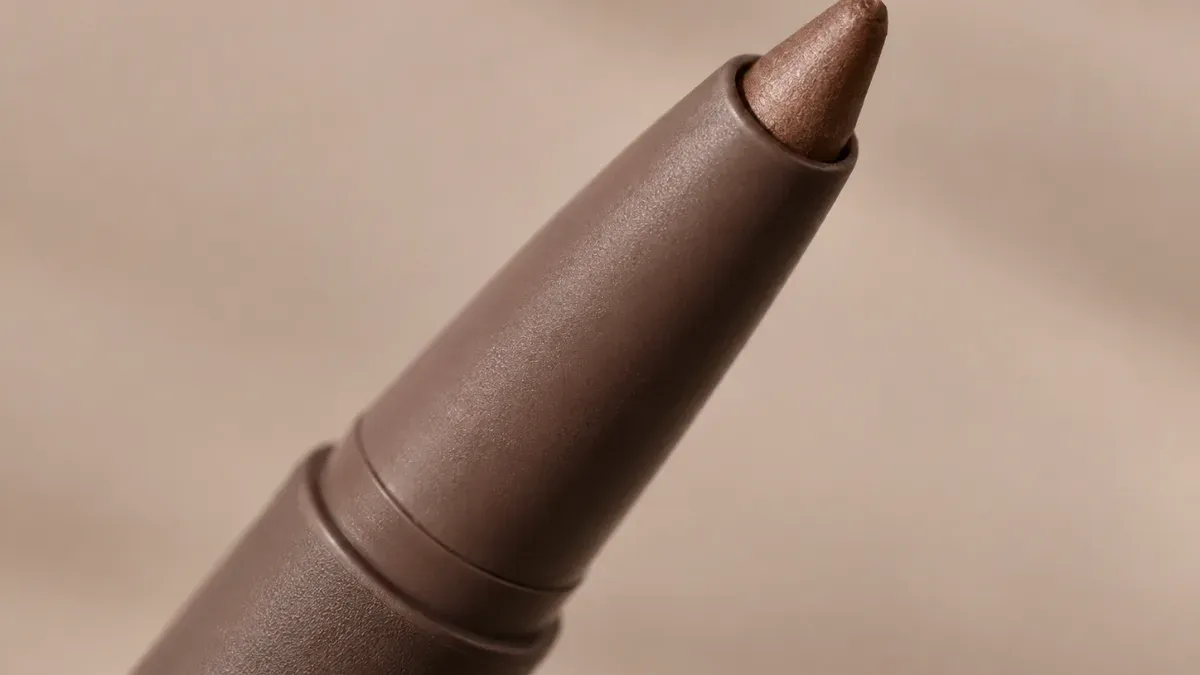
Which format should I brief first — wood, mechanical, push-up, liquid, powder or gel?
Format is a decision about the job and the skill, not only the cost, and it is the first field that changes the quote. Name the hero job — hair strokes, filling a sparse area, or setting existing hair — and the shortlist drops to two or three.
| Format | Build, cost and risk | Skill and result |
|---|---|---|
| Wooden pencil (sharpened) | Wood halves, glue line, centred core, lacquer. Risk in wood grade, centring, sharpening | Medium. Needs a sharpener; does strokes and fill |
| Mechanical / auto-rotate (thin lead) | Barrel, screw, lead carrier, cap. Risk in carrier alignment and cap force; highest tooling | Low. Best stroke precision; mechanism is the failure point |
| Push-up / propelling (thicker core) | Barrel with a sliding cup. Simple tooling, low unit cost, core consumed faster | Medium. Fills fast; user reshapes the tip by hand |
| Liquid brow pen (felt or fork tip) | Reservoir, fibre or trident nib, sealed cap. Risk in nib consistency and leakage | Medium to high. Fine strokes, but can read drawn |
| Brow powder / powder pencil | Pressed powder in a pan or soft loaded core. Cheap; looks cheap if badly pressed | Medium. Softest fill, shortest wear |
| Tinted brow gel / brow mascara | Tube, wiper, spoolie wand, gel formula. Risk in wiper bore and system stability | Low. Tints and sets hair; cannot shape bare skin |
Minimums follow tooling, not formula: stock barrels quote low because the factory is buying wood and printing, while a mechanism or a filling line adds tooling.
Which lead diameter, shape and hardness grade go into the RFQ?
Diameter decides what the pencil can draw; shape decides how long it keeps drawing it. State both in millimetres with a tolerance — "thin" and "thick" are not specifications, and a supplier quoting from adjectives is quoting a different product from the next one.
| Spec | What it gives, what it costs you |
|---|---|
| 1.0–1.4 mm core | Fine hair strokes and the natural look buyers ask for. Breaks under pressure unless harder; short usable life |
| 1.8–2.0 mm core | Strokes plus moderate fill; the usual first-launch compromise. Blunts fast, looks blocky if never reshaped |
| 2.8–3.5 mm core | Fast fill on a sparse brow. Cannot do hair strokes; depends on the user keeping a point |
| Round profile | Cheapest, fits any sharpener, familiar. Blunts quickly |
| Flat or oval profile | Two edges — wide for fill, thin for strokes. Needs a sharpener that does not round it off |
| Pre-shaped angled cut | Ready to use out of the box. The factory angle is the only angle, gone after two sharpenings |
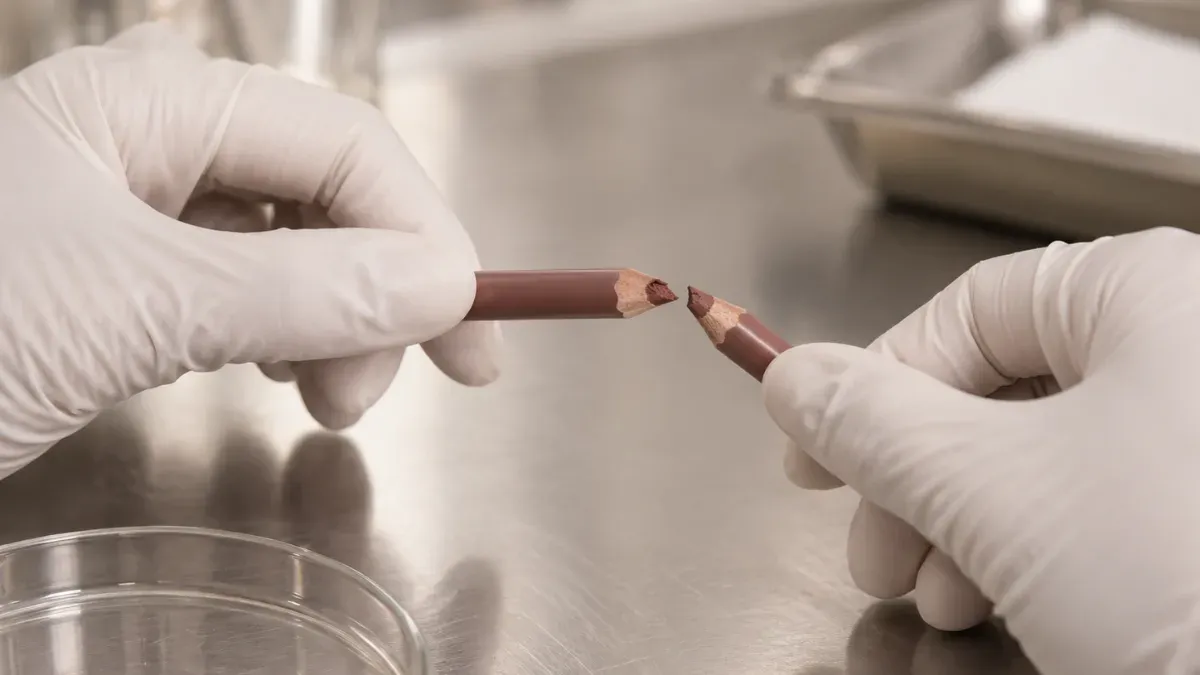
On hardness grading there is no universal public scale; factories run internal systems, and the same word means different things at different factories. Ask for the method, the target with a tolerance and a sealed reference held by both sides, then add the line most buyers skip: a conditioning temperature, so a lead that passes on the bench does not arrive soft.
What must the spoolie line item say before I approve it?
The spoolie is the second thing the customer touches and decides whether a mediocre pencil still looks acceptable. It is also the easiest part to downgrade silently, because it comes from a brush vendor and can be swapped without touching the drawing end — so it belongs on the specification as its own line.
- Bristle material: nylon is stiff and holds shape; softer synthetics feel gentler but lose form; animal hair varies by batch and complicates a vegan claim.
- Density and length: dense and short blends hard and can strip the colour just laid down; sparse and long barely blends. Over-stiff brushes prompt "the colour disappeared".
- Helix and attachment: how bristles are wound into the wire core and how the brush meets the barrel; failures are shedding, pull-out and adhesive creep in heat.
- Clean-off: a loaded spoolie clumps and stops grooming — test how it washes and dries, not only how it looks new.
How should I partition a brow shade range instead of one universal shade?
A brow product is judged against the wearer's own hair, in a mirror, in daylight, and no colour category is less forgiving of a wrong undertone — a warm, red-leaning brown on ash-brown hair reads as wrong at once. Partition on two axes instead of picking six browns: depth follows hair colour and undertone follows skin tone and whether the hair reads warm or ashy. Three depths by two undertones covers far more customers than six depths of one brown — the same grid logic as a concealer shade system, with hair rather than skin as the reference.
- Ash / taupe: dark hair on cool skin, or anyone avoiding red. Hardest to formulate — the red iron oxide has to be suppressed.
- Light / flaxen: blonde and grey hair. Low pigment load makes payoff and hardness harder to balance.
- Medium / warm brown: the volume shade in most Western markets, and the most crowded shelf position.
- Deep brown / black-brown: for black hair. Needs payoff without drifting blue or grey, which reads as eyeliner.
- Auburn: small volume, high loyalty. Worth a slot only once the range is four deep.
"One universal shade" quietly kills the second order: the customer does not return a five-dollar pencil, they stop buying it, and the review says "too warm" with no shade named. Give every shade a code as well as a name and quote the code on the order, then set a colour tolerance against a sealed standard and require the measurement per batch rather than a match approved by eye.
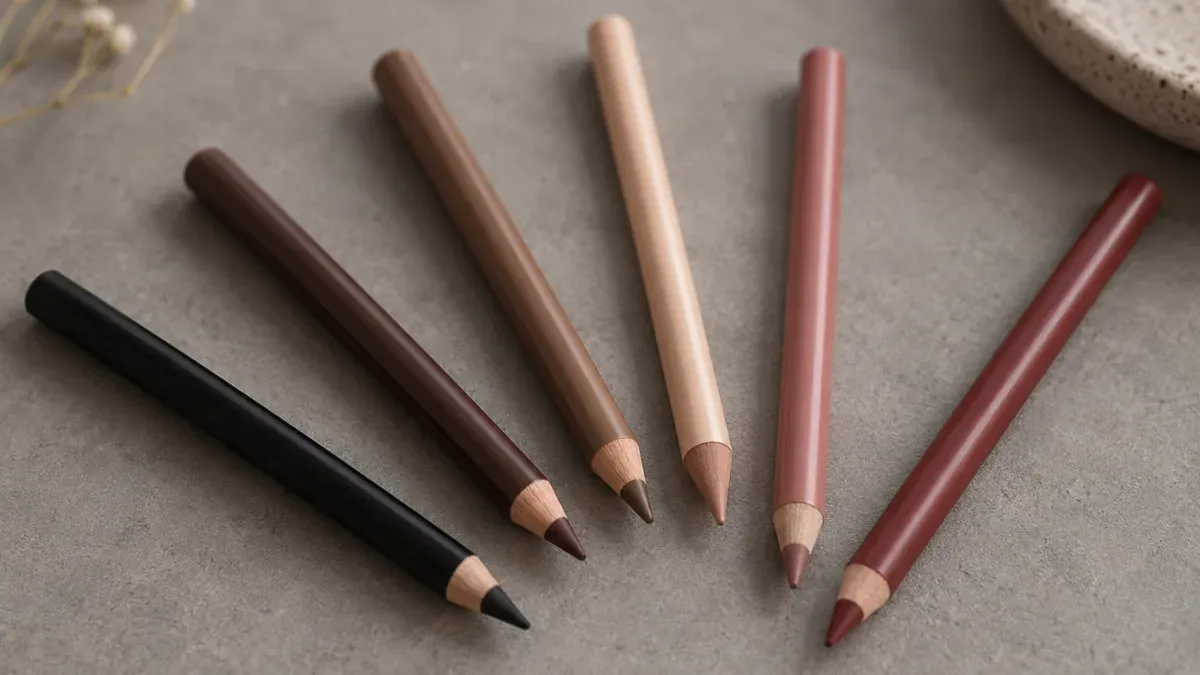
Which verification should I request before I sign?
Ask in one written list, and ask which items run in-house and which go to a third-party lab — the split tells you as much as the answers do. Claims belong on the same list: "waterproof" and "24-hour" are formulation properties with a ceiling lower than the words suggest, so a claim you cannot evidence is a claim you should not print.23
| What to request | Measured how, and the answer to reject |
|---|---|
| Lead hardness | Named method, target with tolerance at a stated temperature, repeated on bulk. Reject "same as the sample" |
| Breakage rate | Sharpening or extension test on a stated unit count, numeric threshold. Reject "we never had complaints" |
| Twist or retraction life | Cycle test with written pass conditions: no slip, no wobble, no lead drop. Reject "it works fine" |
| Heavy metals | Third-party report on the finished pencil against your market's limits, covering core, pigment and lacquer. Reject "raw materials are safe" |
| Microbiology | Preservation assessment fitted to the format: anhydrous pencils are low risk, a brow gel is not. Reject "no water, no problem" |
| Eye-area colourants | Each pigment permitted for eye-area use in every market, market named.5 Reject a list with no market reference |
| GMP and documentation | ISO 22716-based evidence with scope, site and validity, plus information file support.1 Reject a certificate with no date |
| Shade consistency | Colour-difference tolerance against a sealed standard, per batch, stated lighting. Reject "we will match it" |
| Spoolie specification | Bristle material, fibre diameter, brush dimensions, attachment on the spec sheet. Reject "with brush, standard" |
None of these requests is hostile: a supplier with real development and quality capability answers with process detail — which instrument, which cycle count, which lab, which tolerance. For the wider eye-category list covering preservation, eye-area pigments and filling controls, see the eye makeup supplier safety verification guide.
Questions to send the supplier before you quote
Send these in writing, to every supplier, before any price is discussed, so the returned quotes compare on the same basis instead of on two different pencils.
- Which format do you propose for our hero job, and is the barrel or mechanism stock or tooled?
- What lead diameter and profile will you quote, with what tolerance, and how is it centred?
- Which hardness method do you use, what is the target with a tolerance, and at what conditioning temperature is it tested?
- Does the core carry a breakage test on production units, on what unit count, and against what threshold?
- What spoolie will you supply — bristle material, fibre diameter, brush dimensions and attachment method?
- How is barrel sharpening controlled — wood species and grade, glue line, coat count, and a tape-test result?
- What colour tolerance per shade will you hold against a sealed standard, under what light, measured per batch?
- What documents come with the order — GMP evidence, heavy-metal and microbial reports, and eye-area colourant status per market?
Where do first eyebrow pencil orders actually go wrong?
Brow failures are felt by the customer on the first stroke, and most trace back to a component or a parameter that was never written down. Each is caught by a test you could have asked for.
- Soft lead in bulk: the core was softened to improve deposit, or the pressing cycle changed, so a pencil that passed on the bench smears in a warm container.
- Broken lead: a retractable lead that snaps on twist because its strength was never tested, or an off-centre wooden core that breaks on the thin side every time.
- Barrel defects at volume: splintering at the cone, a weak glue line that splits in dry transit, or lacquer that arrives scuffed — rarely visible in a sample of five, obvious at unit eight hundred.
- Spoolie downgrade or colour drift: a brush substituted at bulk, shedding or over-stiff, or a shade that reads different because no colour tolerance was set against a sealed master.
Each is caught by a record you can write into the order — a hardness method, a breakage threshold, a component lot reference, a colour tolerance per batch. The failure is committing to bulk without the per-batch record that proves the run matches the sample.
Frequently Asked Questions
- How many shades does a first brow pencil launch need? Four is the working minimum: ash or taupe, light brown, medium brown, deep brown or black-brown. Fewer sends customers to a competitor; more than six parks cash in slow codes before you have sell-through data.
- Can one "universal" shade work if I only want a single SKU? Not if you want repeat purchase. A mid-warm brown is visibly wrong on ash-brown and on black hair. Launch the shade matching your largest hair-colour group and plan shade two before the reorder.
- Why did my bulk pencils break more than the sample? Three causes cover most cases: the lead was softened to improve deposit, the pressing cycle changed, or the wood lot had different moisture content. All are prevented by a sealed reference, a written tolerance and a breakage test on production units.
- Is "waterproof" safe to print on the carton? It depends on the market and on what you can evidence; "water-resistant" or "sweat-resistant" backed by a protocol is far easier to defend.23 Settle it before artwork sign-off, because a claim is part of the label.
Conclusion
A private label brow pencil is a mechanical product before it is a colour product. The lead has to be hard enough to survive the user and soft enough to give colour in one pass, the spoolie has to be specified as tightly as the shade, and the range has to sit on two axes or it will not survive a second order. Write hardness, diameter, brush construction and colour tolerance into the brief as numbers rather than adjectives, put the same list of questions to every supplier so the quotes compare, and fix the claim language last, once testing shows what the formula can carry.
Need an eyebrow pencil sourcing brief? Share the format you intend to lead with, target market, shade count, lead diameter and hardness direction, spoolie build and quantity per shade, and ZONO can help turn it into an RFQ that two suppliers quote on the same basis.