Private Label Concealer Manufacturer: What to Spec, Ask and Verify Before You Order
A sourcing guide to private label concealer: the format to lock, the pigment load to quantify, the oxidation check to run, and the evidence to demand before your first order.
A private label concealer is usually lost in the RFQ, not on the shade card. The format you can actually fill, the pigment load the film carries while staying flexible, and the shade that still holds twenty minutes after it goes on skin are the three things that decide whether the order survives; the shade name is the part every supplier can match on a board. Treat the brief as a set of things to specify and verify, not a colour to send.
Most buyers brief a concealer the way they brief a lipstick: pick the shade, approve the sample in the jar. Concealer does not behave that way. It carries more solid pigment than almost anything else in a colour line, and gets judged twice — at minute one, and again at minute twenty once the film dries down. A sample that matches at approval can still darken or settle in bulk, and that is where first launches lose money.
ZONO Beauty coordinates long-term manufacturing suppliers from Shantou, Guangdong, across ready-stock, semi-custom and full OEM/ODM routes, and is not positioned as a single factory. This guide covers what to lock in the brief, the questions to send a supplier before quoting, and the batch and pack evidence to demand before a deposit; shade architecture has its own treatment in the concealer shade range sourcing guide, so this piece touches it only where a format decision changes the answer.
Concealer is a pigment-delivery problem wearing a colour problem's clothes: the formula that hides a shadow at minute one has to be the same formula at minute twenty, and again at month nine in the tube.
What must my concealer specification pin down before I ask for a price?
A shade mismatch is visible immediately and gets caught in sampling. A stability failure is invisible at approval and surfaces in returns. High pigment load is the root cause: to cover a dark circle in one pass, much of the formula has to be solid particles suspended in a liquid or wax phase, and solids do not dissolve — they settle, clump and migrate. So the specification has to name the stability behaviour, not the shade.
- Pigment settling: dense particles drift down over months, so the first and last third of a tube do not cover alike; state the suspension requirement.
- Syneresis: the liquid phase weeps out of the pigment mass, showing as a clear ring in a pan.
- Viscosity drift: a high-solids emulsion thickens or thins over time, changing fill weight and spreadability.
- Oxidation shift: the applied film darkens or dulls minutes after meeting air, skin and light.
- Dry-out: volatiles leave through the closure, the film loses flexibility, and creasing appears.
None of that shows up in a jar photograph, and all of it shows up for a customer by week two. Ask for the stability behaviour as a quote line, not a reassurance.
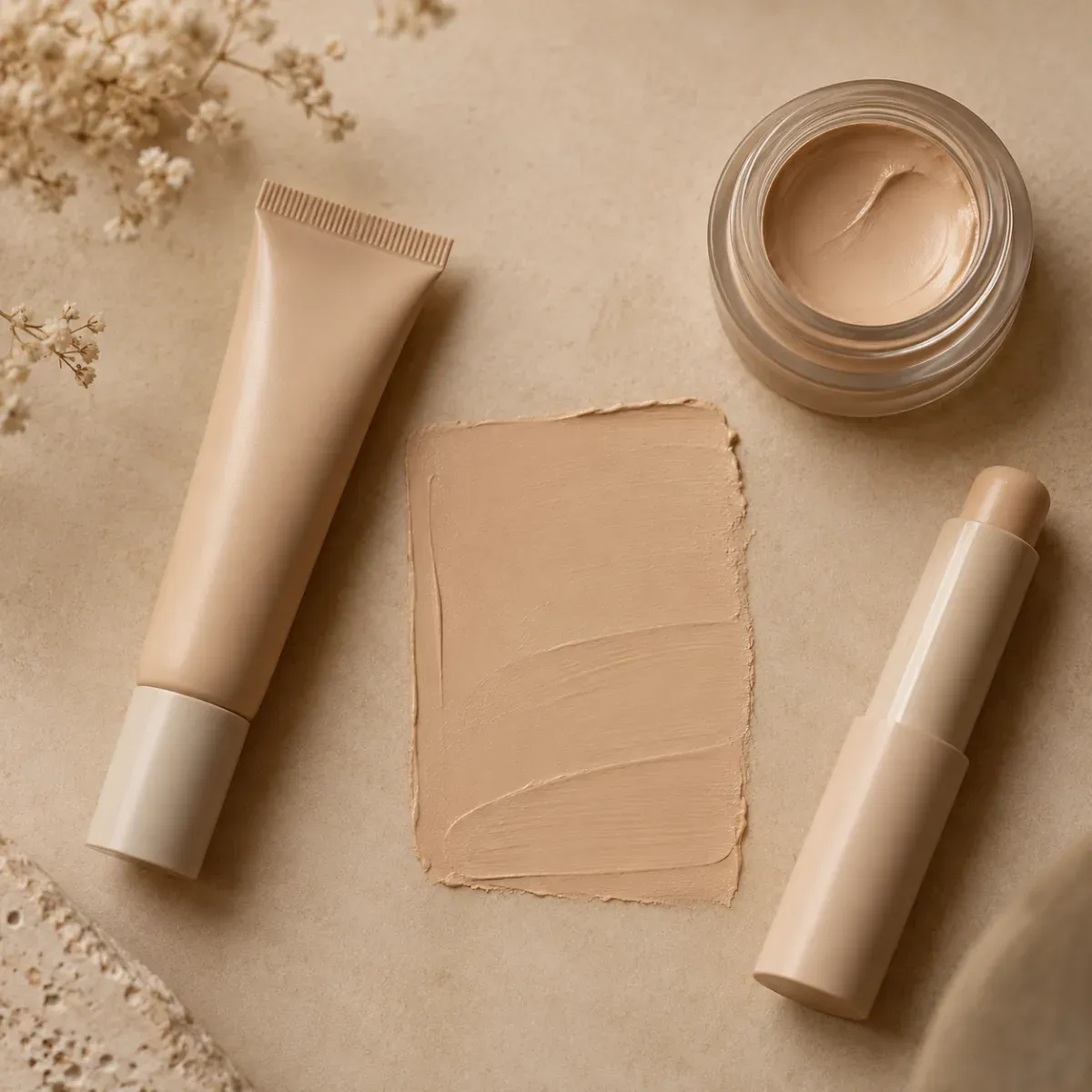
Which concealer format can the supplier actually fill and pack?
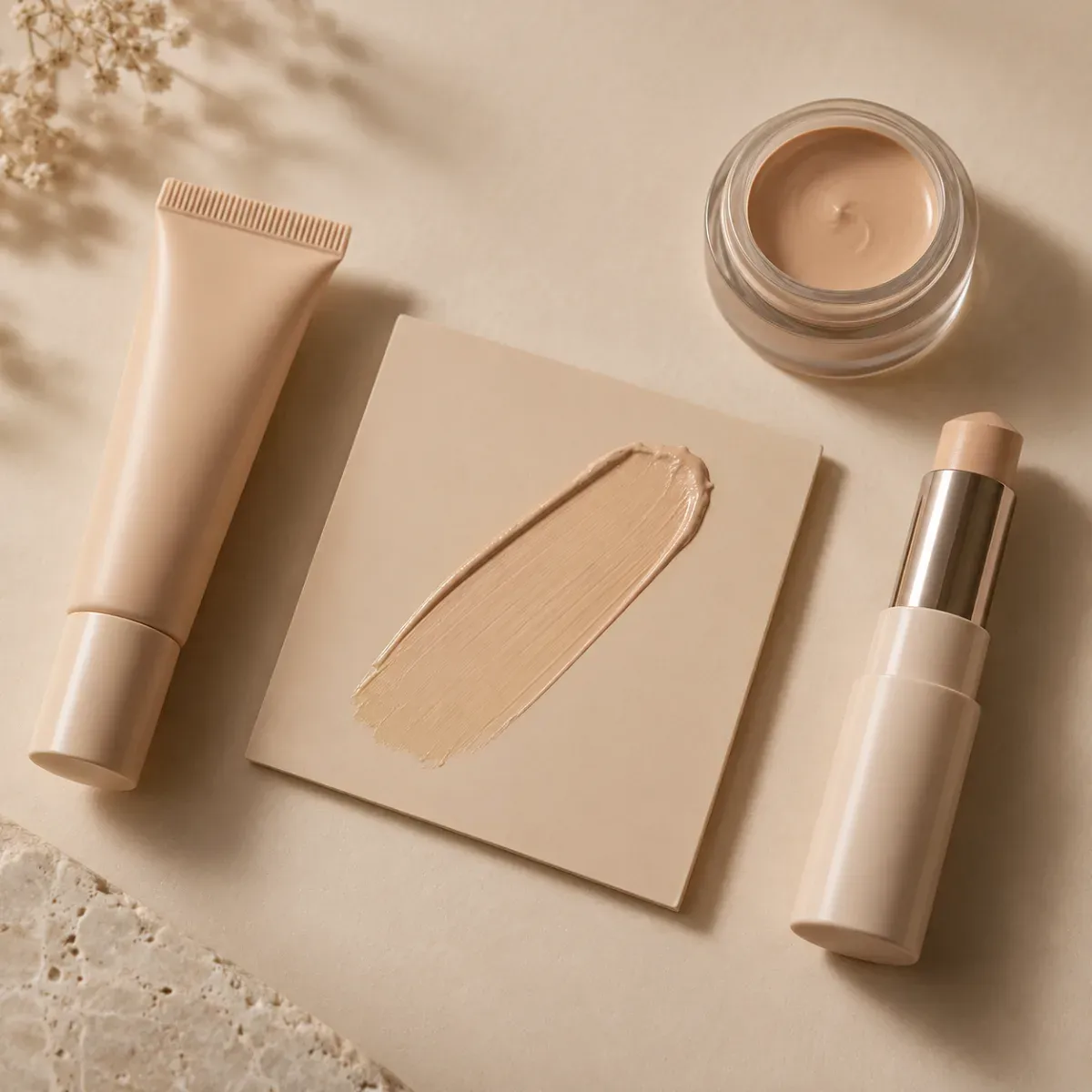
Format is not a marketing decision you translate into manufacturing afterwards. Each format is a different dispersion process, a different filling line and a different packaging chain with its own minimums, so the format you name in the brief decides which supplier can quote it at all.
| Signal | Liquid | Cream / pot | Stick | Pencil | Multi-pan palette |
|---|---|---|---|---|---|
| Base | Emulsion or anhydrous silicone gel | Anhydrous wax and ester blend | Wax-structured oil phase, hot-filled | Heavily waxed anhydrous core | Cream or cream-to-powder pans |
| Pigment load | High, bounded by viscosity and settling | Highest of the non-powder formats | High, bounded by drag | High, in a thin line | Varies; correctors load one oxide heavily |
| Dispersion | Pre-dispersed pigment, high shear, bead mill | Three-roll mill; agglomerates read as specks | Milled into hot wax; re-agglomeration reads grainy | Fine-milled, or the core scratches and wears the die | Each pan milled separately; green and peach differ |
| Filling | Cold fill; the viscosity window matters most | Warm fill; tolerance shows as a sunken surface | Hot fill with a cooling ramp; fast cooling cracks it | Extrusion or wood casing; hardness comes from the wax | Pan count multiplies tolerance and cycle time |
| Pack limit | Viscosity must suit pump or doe-foot; narrow orifices clog | Lid seal decides dry-out | Bore and swivel torque; stiff formula shears the mechanism | Sharpening tolerance or a propelling mechanism | Pan adhesion and seal; one dead shade carries the unit |
| First failure | Settling, syneresis | Oil bleed, graininess | Sweating, bloom, shrinkage | Core breakage, drag | Uneven drying, transfer between pans |
| Best fit | Hero SKU, broad market | Full coverage, drier skin | Travel, body and blemish | Precision spot work | Professional kits, correcting sets |
Where the risk sits differs by format: a liquid can be reformulated fairly late, while a stick cannot change viscosity without also changing filling temperature and the barrel mechanism. The palette is a packaging project before it is a formula project, the same logic as specifying a custom eyeshadow palette, where pan count and adhesion move the quote more than the cream does. Ask the supplier which format it fills today, not which it can draw.
How is coverage built, and what must the supplier put in writing?
Coverage is a measurable output, not an adjective, and a supplier who cannot name the three levers behind it is quoting you a feeling. Ask for each lever as a figure in the quote, so a coverage claim becomes something you can hold someone to.
- Pigment load: total weight of opaque and colouring solids. Expect full coverage to sit well above a sheer foundation by weight; treat the exact figure as something each supplier states in its quotation, not a universal rule.
- Titanium dioxide: a high-refractive-index white that scatters light and builds opacity; pigmentary grades are milled for visible-light scattering rather than transparency. Alone, it reads white and ashy.
- Iron oxides: red, yellow and black absorb light instead of scattering it, supplying the chroma that makes an opaque film look like skin.
- Film formers: silicone resins and acrylate or vinylpyrrolidone copolymers hold pigment in place once volatiles leave, turning coverage into wear and making the film feel tight.
Creasing is mechanical, not chromatic: as the film dries it shrinks, and a rigid film collects in the lines under the eye instead of flexing with them. The levers are known — treated pigments disperse better, spherical fillers add slip without opacity, and a plasticising emollient keeps the film flexible. Each costs something, and under the eye the maximum is rarely right, so coverage is a balance you specify, not a number you maximise.
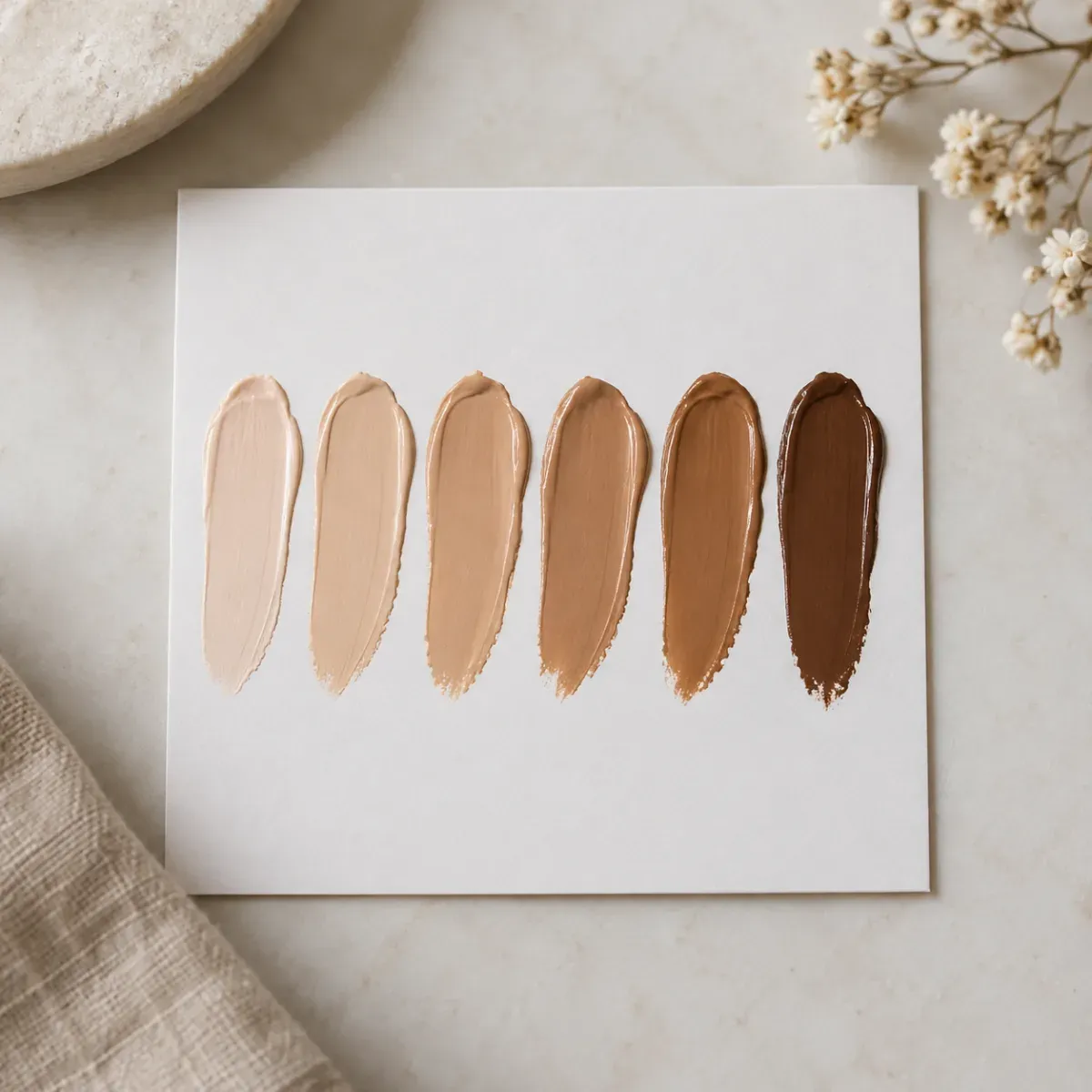
How do I test oxidation before I approve a sample?
"Oxidation" is the trade name for any shade shift after the product leaves the pack. Only part of it is oxidation in the strict sense, and the fixes differ, so the test has to separate the causes.
- Volatile loss: solvents and water leave the film, pigment concentration rises, the swatch darkens. The most common cause, and a formulation issue.
- Sebum and skin pH: the film sits on skin that produces oil, and oil changes how light moves through it. One shade, two readings.
- Pigment surface: untreated oxides are more reactive; surface treatment reduces darkening and the greying titanium dioxide shows in daylight.
- Real oxidation: unsaturated oils and poorly stabilised systems darken with heat, light and air over shelf life. Accelerated storage catches this; a twenty-minute read does not.
The read is cheap and needs no laboratory, but it does need a repeatable setup, because the thing it catches — correct at minute one, wrong at minute twenty — is invisible in a single photograph. Send the supplier this sequence and ask for the numbers back.
- Apply a fixed-thickness drawdown on an opacity chart, plus patches under the eye on three skin tones.
- Photograph within the first minute: one light source, fixed distance, colour reference in frame.
- Re-photograph at twenty minutes without re-applying. This is the read that matters.
- Repeat at two hours and at end of day, including one powder-set patch.
- Ask for ΔE* at each point, and ask the supplier to state the acceptance window it will sign against, so “close enough” becomes a number rather than an opinion.
- Repeat on a batch from a different pigment lot, to see whether the drift belongs to the formula or the pigment supply.
Questions to send the supplier before you quote
Send these in writing, to every supplier, before any price is discussed. Drift between sample and bulk usually traces to pigment lots and tolerances nobody wrote down, the failure covered in keeping bulk production consistent with approved samples, so the answers are what let you compare two quotes on one basis.
- Which format will you quote — liquid, cream, stick, pencil or multi-pan palette — and which filling line and packaging chain does it use?
- What pigment load will you quote, as a percentage, and how does it split between titanium dioxide and iron oxides?
- Which film formers hold the pigment, and what keeps the film flexible under the eye?
- What stability evidence will you provide — the conditions, the duration and the measured values, not a pass/fail verdict?
- How do you verify shade stability through dry-down on my target skin tones, and will you report ΔE* against the approved sample with the pigment lot number?
- How many colour-correcting shades will you quote, each with its own minimum, and which permitted colorants are cleared for my market?1
- Which package do you supply, and what filled-unit pack-compatibility test does the quote include?
- What documents come with the order — stability, pack compatibility, microbial, heavy-metal per pigment lot, GMP and the batch certificate?
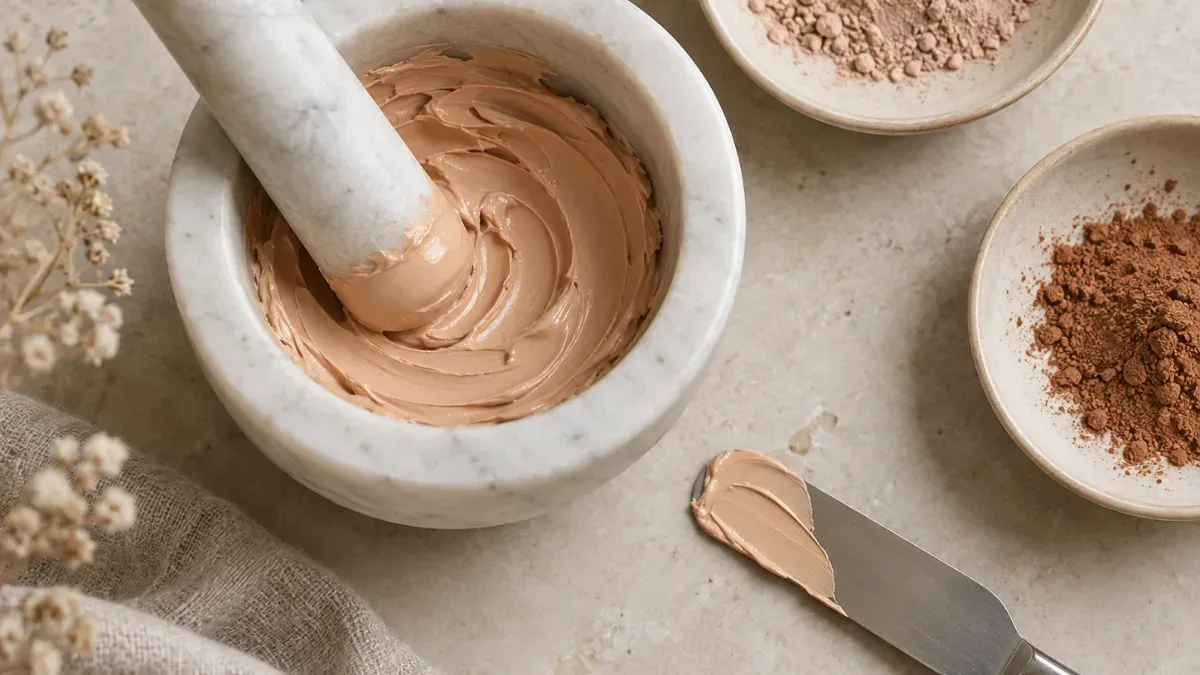
Where do first concealer orders actually go wrong?
Most concealer problems are not in the formula lab but in the hand-off: the package, the pigment lot or the master reference. Packaging failure is the commonest reason a good concealer reaches a customer in bad condition, and high pigment load makes it worse, because solids clog narrow channels and abrade moving parts. Test the filled unit, never the formula in a stock jar — a cream stable in a jar can fail in a cushion, because the sponge adds surface area and a microbial habitat the jar never had.
| Package | What goes wrong | What to test |
|---|---|---|
| Squeeze tube | Crimp weeping, laminate delamination, pigment at the orifice | Elevated-temperature hold, squeeze cycles, cut-open crimp check |
| Doe-foot tube | Wiper does not match viscosity, tip dries, used product returns to the pack | Wipe-and-return cycles, tip drying, preservation challenge |
| Airless pump | Piston stiction, failed priming, incomplete evacuation | Dose weight over ten strokes, total evacuation, inverted storage |
| Cushion compact | Uneven saturation, solvent loss past the seal, microbes in the sponge | Weight loss over storage, saturation uniformity, microbial challenge |
| Click or brush pen | Settling in a narrow barrel, valve dry-out, flow drift | Flow per click over the unit's life, cap-off drying, angled storage |
| Stick barrel | Shrinkage from the wall, dried tip, sheared swivel | Cooling-profile records, cap-off weight loss, advance torque |
| Pan and palette | Surface drying, oil bleed between pans, pan lifting | Weight loss per pan, cross-contamination, drop and vibration |
Two failures repeat on first orders. A correcting pan is not a small version of your hero shade: a different pigment system dries at a different rate, so a palette of four correctors carries four stability profiles under one lid. And a certificate folder is not proof of current capability — certificates age and scopes narrow, so what matters is whether the document covers your site and product. For eye-area colorant and preservation evidence, the eye makeup safety verification framework covers what to request.
Frequently Asked Questions
- Why did the approved sample look right in the jar and wrong on my face? You approved a wet reading of a film that then dries: volatiles leave within minutes, pigment concentration rises, the shade moves. Approve the twenty-minute reading instead.
- Can a supplier promise the bulk will match the sample? Nobody honestly can. Write the tolerances down, seal a retained reference, require the pigment lot number on every batch certificate, and re-run the oxidation read before release.
- Is a stick or a liquid the safer first launch? Liquid, usually. It fills cold on widely available equipment and tolerates late viscosity changes. A stick removes some preservation risk but adds hot-fill, shrinkage and bloom risks that are harder to fix after tooling.
- What does a first concealer order cost beyond the unit price? The format minimum, the pack-compatibility work, the oxidation read and the per-lot heavy-metal screening. Name all four in the brief and the quote stops being a guess at a shade.
Conclusion
A concealer brief is decided in the places that have nothing to do with the shade card: which format you can actually fill and pack, how much pigment the film carries while staying flexible, and whether the shade still holds twenty minutes after it goes on skin. Name the format and its filling route, ask for pigment load and the oxide split in writing, run the timed oxidation read, and hold colour and pack compatibility to a master standard per batch. Send one written brief and the questions above to every supplier so the quotes compare.
Need a concealer sourcing brief? Share the format, the market, your shade count with correcting shades listed separately, the coverage and finish target, your first-run quantity and launch window, and ZONO can help turn it into an RFQ that two suppliers quote on the same basis.