How to Source Private Label Eyeshadow Palettes: Pan Spec, Press Route and Cost
A sourcing guide to private label eyeshadow palettes: the pan and press specification to lock, the shade count that drives cost, and what to ask a supplier before you quote.
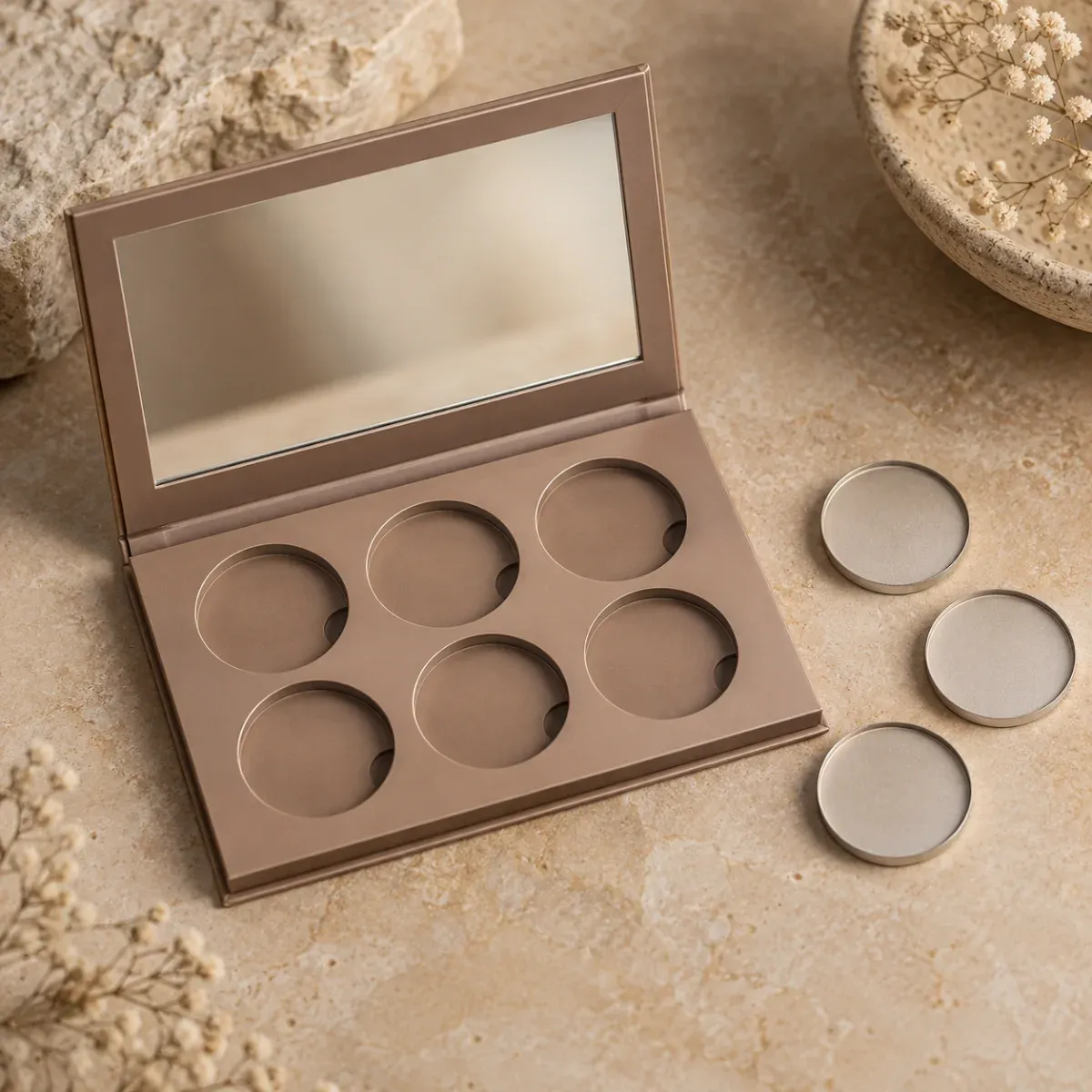
An eyeshadow palette is decided in the pan spec and the shade count, long before the pigment. Buyers negotiate the per-pan price down and hand the saving straight back by approving a 24-shade layout, a non-standard shell, or a pan fit nobody put a number on — the three choices that set your unit cost, your minimum and your failure rate on a first order.
Most first palettes are briefed as a colour story and a target retail price. Those are the surface signals; what decides whether the palette can be quoted and reproduced is the pan format, the press route and the component minimums behind the shell, none of which a shade chip reveals.
ZONO Beauty coordinates long-term manufacturing suppliers from Shantou, Guangdong, across ready-stock, semi-custom and full OEM/ODM routes, and is not positioned as a single factory. This guide covers what to lock in the brief, what to send a supplier before you quote, and what to verify before the first order; for your own inputs, the custom eyeshadow palette briefing guide covers shade architecture and reference chips.
A 24-shade palette is not a 4-shade palette six times over. It is six times the formulations, press setups, placements and inspections sharing one shell — and one scrap decision.
What should my palette specification pin down before I ask for a price?
A palette is not one product. It is several pressed powders sharing one shell, one line and one accept-or-reject call, and shade count pushes on five gates at once. Each gate is a line item the supplier has to price, so the count belongs in the written brief rather than in a sample you approve by eye.
- Colour development: every shade is a separate lab batch and approval round; twelve shades means twelve chances for one to come back wrong and hold the palette.
- Press setup: fill depth, pressure and dwell are set per shade, and the changeover between them is labour, not material.
- Assembly: pans are placed one at a time or row by row, so placement count and misplacement risk rise together.
- Inspection: a quad can be checked at a glance; a 24-pan needs a shade-by-shade check against a layout diagram.
- Scrap: one chipped or off-shade pan condemns the unit, because nobody buys a palette with a gap in it.
The fixed costs — shell tooling, artwork plates, stability and safety documentation — do not care whether the run holds 4 shades or 24; they spread across units and reward volume, while the shade-driven costs reward restraint. Because shade minimums are quoted per shade, a high-shade palette can commit several times the unit count of a quad, so ask for the minimum per shade and the total order in the same email.
Which pan size, pan material and fixing method should I specify?
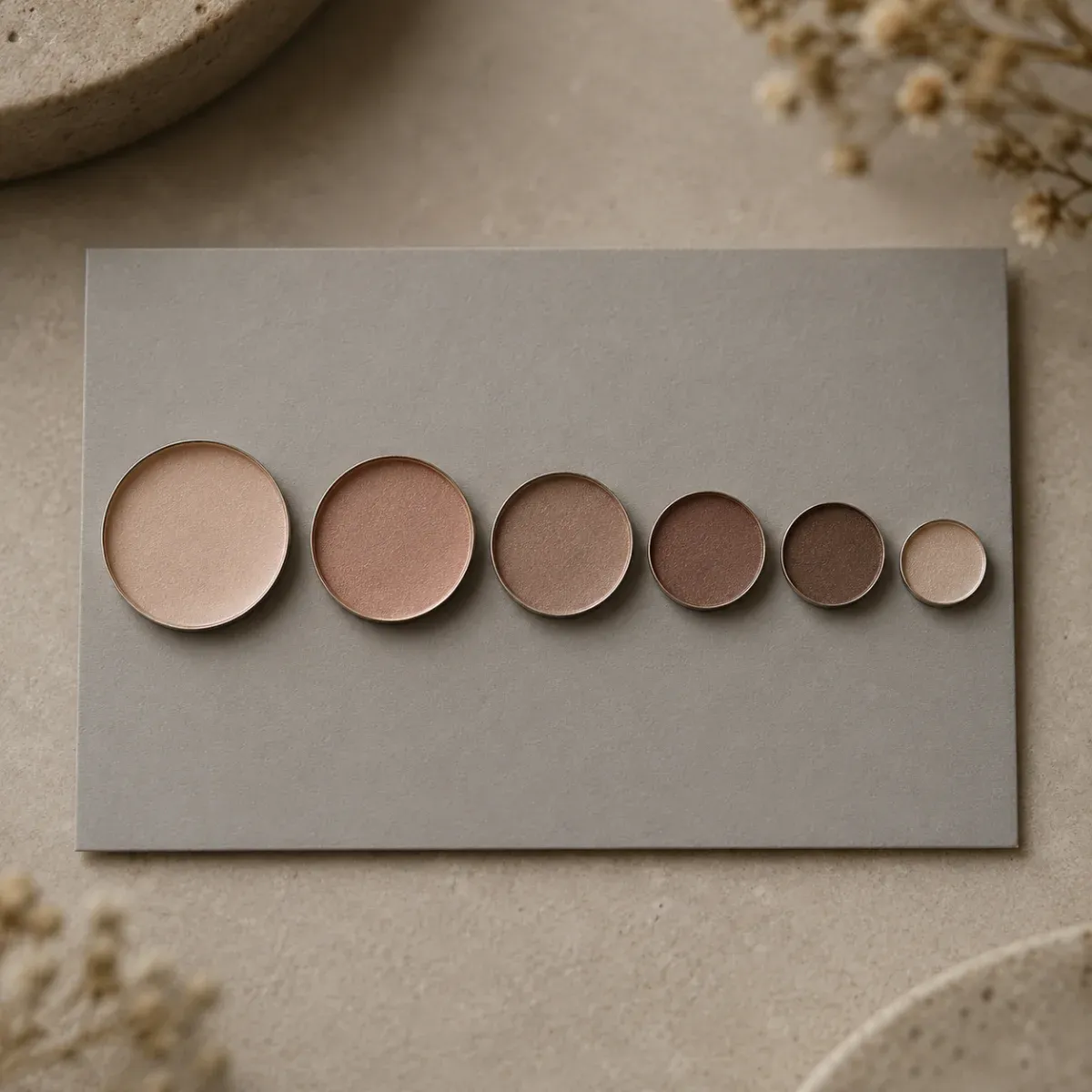
Pan choice is structural: it fixes how much powder you sell, how the pan stays in the shell, and how forgiving assembly is when tolerances drift. Common formats include 26 mm and 36 mm round pans, rectangular pans and half-pans for minis, and a 36 mm round holds roughly twice the fill of a 26 mm round — so the same shade count can mean very different powder cost. Confirm the fill weight per shade in writing rather than inferring it from the diameter.
| Field | Aluminium pan | Injected plastic pan |
|---|---|---|
| Dimensional stability | Holds rim geometry consistently across lots | Shrink and warpage vary by cavity and lot, which shows up as seating problems |
| Magnet compatibility | Ferrous grades take a magnet directly | Needs an added steel plate or sticker, or an adhesive route |
| Sourcing and minimum | Stocked in standard diameters, which usually avoids a tooling conversation | Cheap at volume, but a non-standard shape means cavity tooling and a moulding minimum |
| Main failure mode | Denting in transit on a thin wall gauge | Creep and gradual loosening in the well, especially in heat |
What decides whether pans stay put is the clearance between the pan outside diameter and the well inside diameter: a well a few tenths of a millimetre generous turns a snap fit into a rattle, and one cut tight will not accept the pan or cracks the powder as it is forced home. That is a dimension to write down, not a feel to describe.
- Magnetic retention: fast and refill-friendly, but depends on a ferrous pan and on the magnet holding pull through the tray.
- Interference or snap fit: clean and adhesive-free, but the most sensitive to tolerance drift, and it fails silently when a shell lot changes.
- Adhesive fixing: tolerant of dimensional variation and cheap, at the cost of a process step, a cure time and a heat-failure mode.
Ask for the pan diameter, the well diameter, the permitted clearance on both and the intended fixing method, then ask what the drop test is and whether it runs per batch.
Which pressing route and binder level go into the RFQ?
Binder is what turns a pressed powder into a pan rather than a pile of dust, and it trades payoff against survival. That is why no palette should run on one set of press parameters, and why the route is a question to settle before sampling.
- Dry pressing: compacted directly — faster and cheaper, softer on the brush, more prone to dusting and breakage.
- Wet pressing: wetted, compacted and dried — slower and more binder-hungry, but denser, smoother and better in a drop test.
- Binder level: more binder gives a travel-proof pan that can feel stiff; less gives a blendable pan that chips and dusts.
- Pearl loads: platelets align under pressure, so over-pressing glazes the surface and stops it releasing colour.
- Matte loads: denser and more oil-thirsty, so they need more binder and go hard first if a wet press dries unevenly.
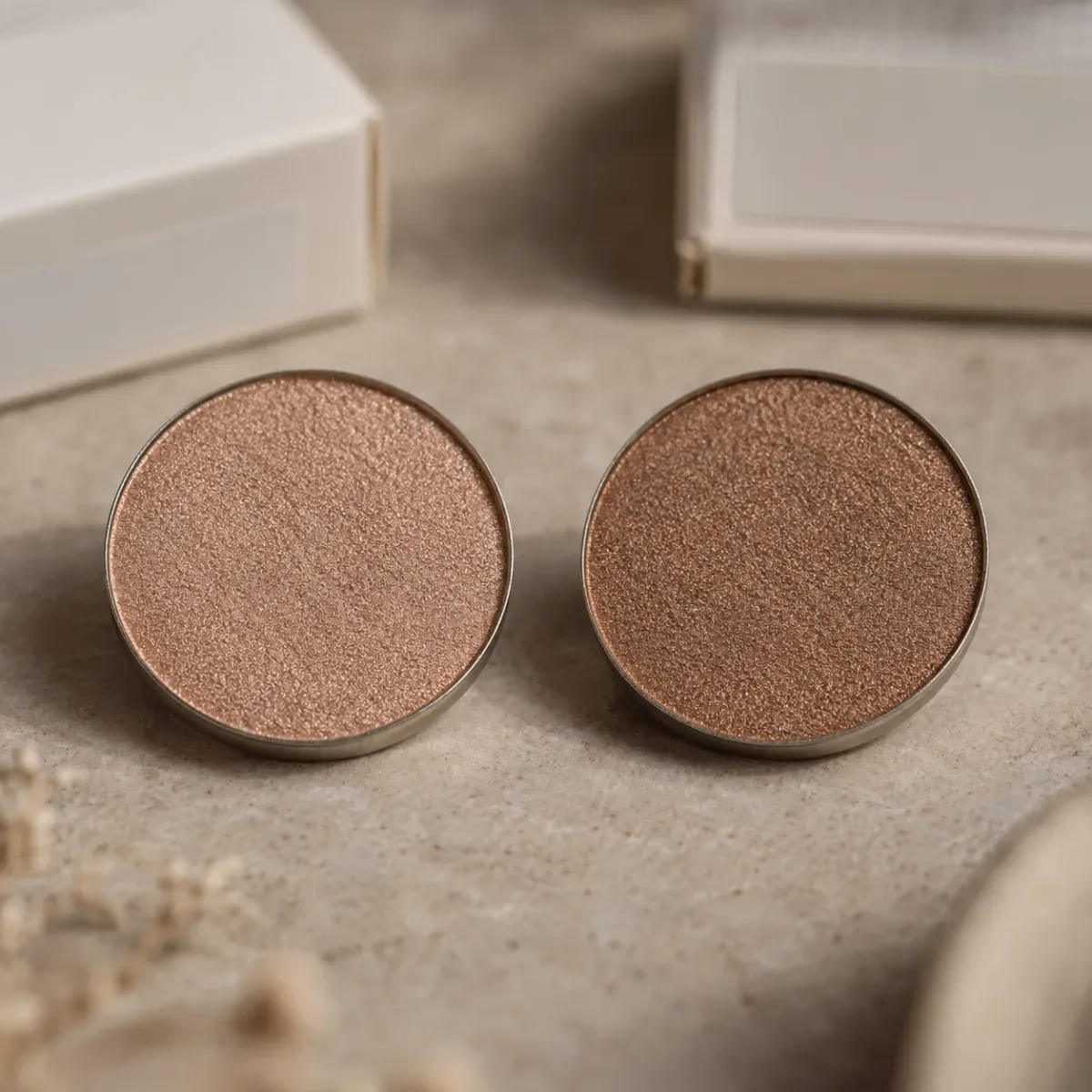
Pigment load, particle shape, oil absorption and bulk density differ by shade, so fill depth, pressure, dwell and strikes have to differ too. A supplier who presses every shade the same way is telling you which shades will fail, and the press sheet is the baseline you keep for every reorder.
What do I put in the RFQ so two palette quotes are comparable?
Powder and packaging are not made by the same people, and that single fact is why palette quotes rarely compare line for line. Powder can be weighed small; a print run or an injection run cannot. Shells, trays, mirrors, brushes, cartons and film come from separate vendors whose minimums are set by machine setup — a press has to be plated and registered, a mould fitted and purged, before the first acceptable piece comes off it.
- Outer carton or rigid box: print setup plus plates or dies; foil, emboss and soft-touch each add a setup.
- Injected compact or tray: tooling if the well layout is non-standard, and a moulding minimum even on stock tooling.
- Mirror: cutting, edgework and backing, usually from a specialist working to its own lot size.
- Brush or applicator: ferrule, handle and hair assembled separately and sold in set-scale lots.
For palettes the cheapest lever is the shell: stock shells come in standard well counts, and any other count is a tooling conversation. Packaging, not powder, usually sets your first order size — the mechanism is set out in why packaging MOQ often exceeds formula MOQ. Name every component in the RFQ and ask whether it sits inside the quote scope or is billed separately.
| Cost factor | 4 shades | 9 shades | 12 shades | 24 shades |
|---|---|---|---|---|
| Shell availability | Stock quads everywhere | Stock 9-well common | Stock 12-well common | Larger shell or new tooling likely |
| Setups per unit | 4 press, 4 placements | 9 and 9 | 12 and 12 | 24 and 24, often in two passes |
| Colour approval rounds | 4 | 9 | 12 | 24, with more re-matches before production |
| Inspection scope | Visual check | Layout check | Shade-level sampling | Full shade-by-shade check against a diagram |
| Scrap exposure | Low | Moderate | Moderate to high | High; one pan in 24 fails the unit |
| Cost behaviour | Material-led | Material plus labour | Labour-led | Labour, tooling and scrap-led |
The 4-to-9 step is where assembly and inspection start appearing as their own quote lines, and the 12-to-24 step is where the shell grows past stock formats, freight climbs and scrap exposure compounds. Fill the numbers in from your own quotes — the shape of each row is what they show you — then read the two offers on the cost of the pans you expect to sell, not the nominal unit price.
How do I verify a production palette against the approved sample?
A bench pan is pressed on a small lab press from a hand-weighed batch, while production runs at speed on a multi-station press from a bulk blend, possibly from a different binder lot. Approval has to leave behind something you can measure against later, or the second order becomes an argument.
- Sealed reference set: one approved pan, a drawn-down swatch card and a retained powder sample, stored away from light and heat.
- Written press parameters per shade: fill depth, pressure, dwell, strikes and the dry or wet route.
- Component lot references: pan, shell and tray lots, plus the pigment lot behind each shade.
- First articles from the production press: not a second bench sample, compared against the sealed reference under the same light.
- Tests on production units: drop, adhesion pull and swatch comparison, run per shade rather than per palette.
The same discipline is set out more fully in keeping bulk production consistent with approved samples.
Questions to send the supplier before you quote
Send these in writing, to every supplier, before any price is discussed, so the returned quotes compare on the same basis instead of on two different palettes.
- Which shell are you quoting — a stock well count or a tooled one — and what is the minimum for each?
- What is the minimum per shade for the powder, and does it differ from the minimum per order?
- Which pan diameter and well diameter do you propose, with what permitted clearance on each, and with which fixing method?
- Which press route do you run, dry or wet, and what fill weight and tolerance per pan?
- What press parameters will you record per shade, and will you hold that sheet for reorders?
- Who produces the shell, mirror and any applicator, and are they inside your quote scope or billed separately?
- What press yield per shade does the quote assume, how much overmake does it carry, and who pays if the finished quantity falls short?
- What documents come with the order — GMP, eye-area colourant status per shade, heavy-metal and microbial reports, and a fill-weight tolerance?
Where do first eyeshadow palette orders actually go wrong?
Palette problems show up at the pan, not on the shade card, and most order problems show up in the hand-off rather than in the lab. Each is caught by a record or a line item you could have asked for, and lost when it was never written down.
- Cracked or chipped pans: most common in large pans and in dry-pressed, low-binder shades, felt the first time a brush touches the cake.
- Dusting and glazing: a press parameter problem, usually confined to one or two shades, invisible until the palettes are unpacked.
- Off-shade pans: pigment lot drift, or a re-match approved by eye rather than against a sealed standard.
- Misplacement: the right pan in the wrong well — invisible until the customer opens the palette.
The arithmetic of scrap is unforgiving. If a single pan comes out right 99 times in 100, a 4-pan palette is right about 96 times in 100 and a 24-pan one about 79 — illustrative figures, not a measured yield, but the shape of the curve does not change. Rework is limited, because depanning a bad pan risks the shell and the neighbouring pans, so many lines scrap the unit instead. Ask what press yield the supplier expects per shade, how much overmake the quote carries, and who pays when the finished quantity falls short — agree it before the deposit.
What documents and compliance evidence should I request before the first order?
- Eye-area colourants: not every pigment permitted elsewhere in cosmetics is permitted around the eye. Confirm the status of each shade for your target market before you approve it — the US and EU routes differ.23
- Good manufacturing practice: ask for the GMP documentation covering pressing and assembly, with scope, site and validity shown.1
- Labelling: one ingredient declaration covers every shade and net weight is stated for the assembled unit; check printed shade names against the approved artwork.4
- Eye-area safety: microbial quality, preservation and any sensitive-eye claim assessed for the whole palette, including a packed-in applicator.5
The eye category has its own sequence — preservation, eye-area pigment status, filling controls and the documents to request — set out in the eye makeup supplier safety verification guide.
Frequently Asked Questions
- Does a higher shade count always raise what I pay? It raises the unit price and lowers the cost per shade, which is not the same as lowering your cost per sale. Compare quotes on the cost of the pans you expect to sell, not the nominal unit price.
- Why is my packaging minimum higher than my formula minimum? Powder is batched by weight in one plant, while boxes, compacts, mirrors, brushes and labels each come from a vendor pricing by machine setup. A stock shell with custom decoration is usually the fastest way down.
- How many shades should a first palette carry? Nine or twelve, in a stock shell, unless your own sell-through data says otherwise. A quad is hard to price at margin; a 24-shade layout puts cash into pans most customers never touch.
- What causes pans to fall out, and who pays for it? Nearly always a clearance problem between pan diameter and well, or an adhesive never tested against your freight temperatures. Specify both dimensions with tolerances, require a drop test on production units, and agree in writing who carries units that fail after assembly.
Conclusion
An eyeshadow palette is a pressing and assembly project sold as a colour story. Pan size sets your powder cost and your freight, binder and press route decide whether the pan survives the journey, and shade count decides how often you pay for setup, placement, inspection and scrap before one unit is sellable. Choose the shell and the shade count together, because a count that misses a stock layout is a tooling decision made by accident. Then put pan dimensions, per-shade press parameters and scrap terms in writing, and require first articles off the production press. Send that list before the deposit and the plan either holds or breaks where it is still cheap to fix.
Need an eyeshadow palette sourcing brief? Share the shade count, pan format, target market, packaging direction and quantity band, and ZONO can help turn it into an RFQ that two suppliers quote on the same basis.