How to Brief a Private Label Foundation Supplier: Shade Ladder and Tolerance
A sourcing guide to private label foundation: the format to lock, the shade ladder to brief, the oxidation tolerance to set, and the supplier questions to send before you quote.
A private label foundation is lost on the shade ladder long before it is lost on the formula. Buyers who spend months on texture and one afternoon on the shade grid order a product that photographs well and returns badly, because the decisions that move the outcome — the format, the ladder, the tolerance, the package — are specification lines rather than lab discoveries.
Foundation is four problems stacked into one SKU: an emulsion that has to stay stable, a pigment dispersion that has to stay suspended, a colour match that has to survive the customer's skin chemistry, and a package that has to dose all of it without separating, clogging or leaking. A foundation multiplies all four by every shade you fund, so a thin brief gets expensive later.
ZONO Beauty coordinates long-term manufacturing suppliers from Shantou, Guangdong, across ready-stock, semi-custom and full OEM/ODM routes, and is not positioned as a single factory. This guide covers what to lock in the brief, what to send before you quote, and what to verify before the first order; the same two-axis shade logic applies to a smaller colour system, which the concealer shade system guide covers in detail.
A foundation is not one product with several shades. It is one emulsion, one dispersion and one package, multiplied by every shade you fund.
What should my foundation specification pin down before I ask for a price?
Lip colour is largely an anhydrous system — waxes, oils and pigments melted, filled and cooled. Foundation is a water-and-oil system with pigment inside it, and every element of that sentence is somewhere the batch can drift from the sample, so the brief has to name the system rather than the finish.
- Emulsion stability: an oil-in-water or water-in-oil base must survive heat, cold and shelf time without splitting, creaming or drifting in viscosity. Ask which conditions it was held at.
- Pigment suspension: iron oxides and titanium dioxide are denser than the base, so a weak dispersion settles and the top of the bottle reads light.
- Shade as its own batch record: every shade needs its own dispersion, colour standard and approval — ten shades is ten colour decisions.
- Oxidation on skin: the film a customer sees after twenty minutes is not the film that left the bottle, and that drift shows only on skin.
- Package interface: pumps, droppers and sponges are not neutral containers; each applies shear, air exposure or material contact.
- Claim exposure: SPF, long-wear or "oil-free" language pulls in extra testing and label review that differs by market.24
Ask the supplier to name the emulsion type and the pigment system by ingredient, not just the shade. A supplier who cannot name the base is describing a look, not a formula.
Which format should I brief — liquid, cream, cushion, stick or BB/CC?
Format is not a marketing decision made after the formula is approved. It decides the filling line, the component count and the minimum you have to fund, so choose it as a specification before you sample it.
| Format | How it is filled | What the package demands | Where it fits |
|---|---|---|---|
| Liquid | Low- to mid-viscosity emulsion, filled volumetrically. | A viscosity window the pump can dose, dip-tube clogging, sedimentation. | Core SKU; easiest ladder to extend. |
| Cream | High-viscosity base into a jar, tube or pan. | Jar exposure and preservative load; pressing control and pan adhesion. | Dry or mature-skin positioning. |
| Cushion | Emulsion dosed into a foam reservoir, then assembled. | Sponge absorption and release, microbial control, drying between uses, puff material. | Portable use; heaviest minimums. |
| Stick | Low-water or anhydrous base, melt-filled and cooled. | Shrinkage, sink marks, heat integrity, how the shade reads in solid form. | Contour and on-the-go. Run the checks in testing a foundation stick on deep skin first. |
| BB / CC | Light-coverage emulsion with skincare positioning. | Any SPF claim adds testing and label review before artwork locks. | Entry price point; shorter ladders. |
Two questions settle the format before you commit: the fill viscosity window, meaning the range in which the filler holds dose accuracy plus the component count behind it, since each cap, pump, sponge and puff has its own vendor and minimum; and the sample itself, which should be a filled, closed, transported unit rather than a scoop, with a note of which line made the sample and which will run the bulk.
How does coverage relate to pigment load, and what does it cost in skin feel?
Coverage is mostly a pigment-load decision, and pigment load is a cost you pay in texture. On a typical lab sheet, total pigment — titanium dioxide plus iron oxides — climbs with coverage, Expect a sheer base to run lower and a full-coverage base to run higher, and take the exact figure from the supplier’s own quotation. Treat the load as orientation, not specification: particle size, surface treatment and dispersion quality move the outcome as much as the percentage does. What matters is that the target load is written on the spec sheet, because it is the number someone quietly changes when a later request comes in to "make it more covering."
Every point of it is paid for somewhere: load raises viscosity, which can push the product out of the pump's dosing window; it raises the chance of a chalky cast on deeper skin and makes settling likelier; and a heavy pigment film reads as cakey. The levers other than adding pigment are surface-treated grades, which cut the chalky cast at the same load; the dispersion method, since three-roll or bead milling changes how finely pigment breaks up; and particle size, because finer iron oxides give a smoother film at equal load.
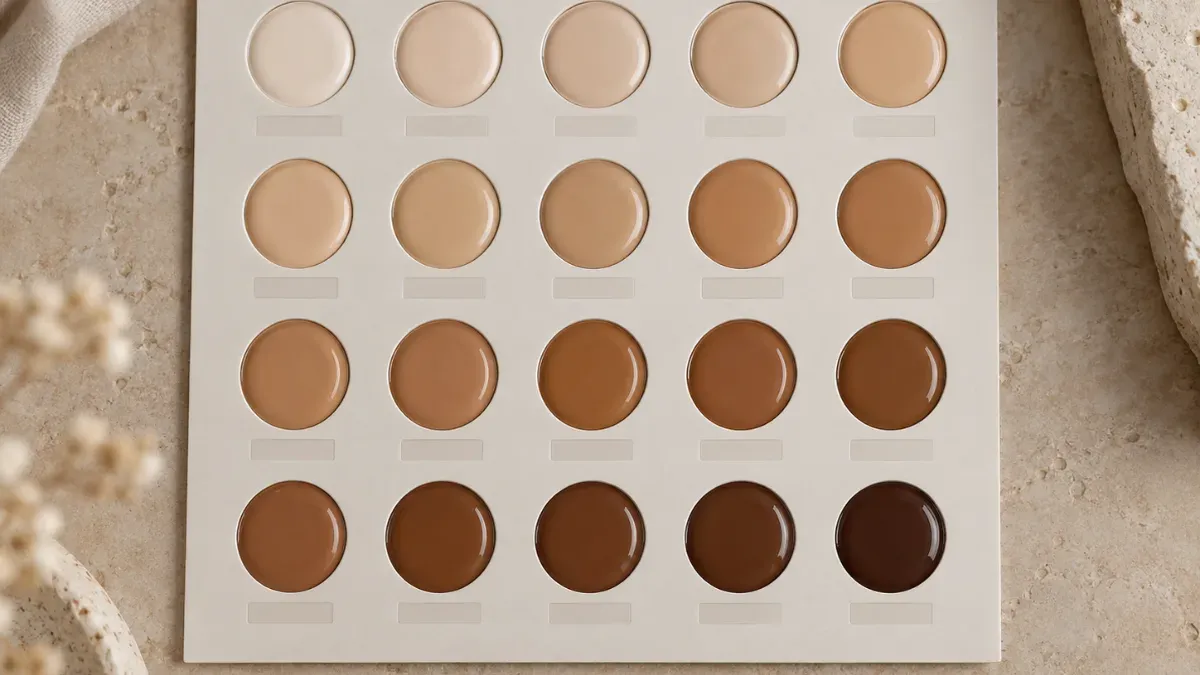
How do I specify the shade ladder, and how many shades should the first run carry?
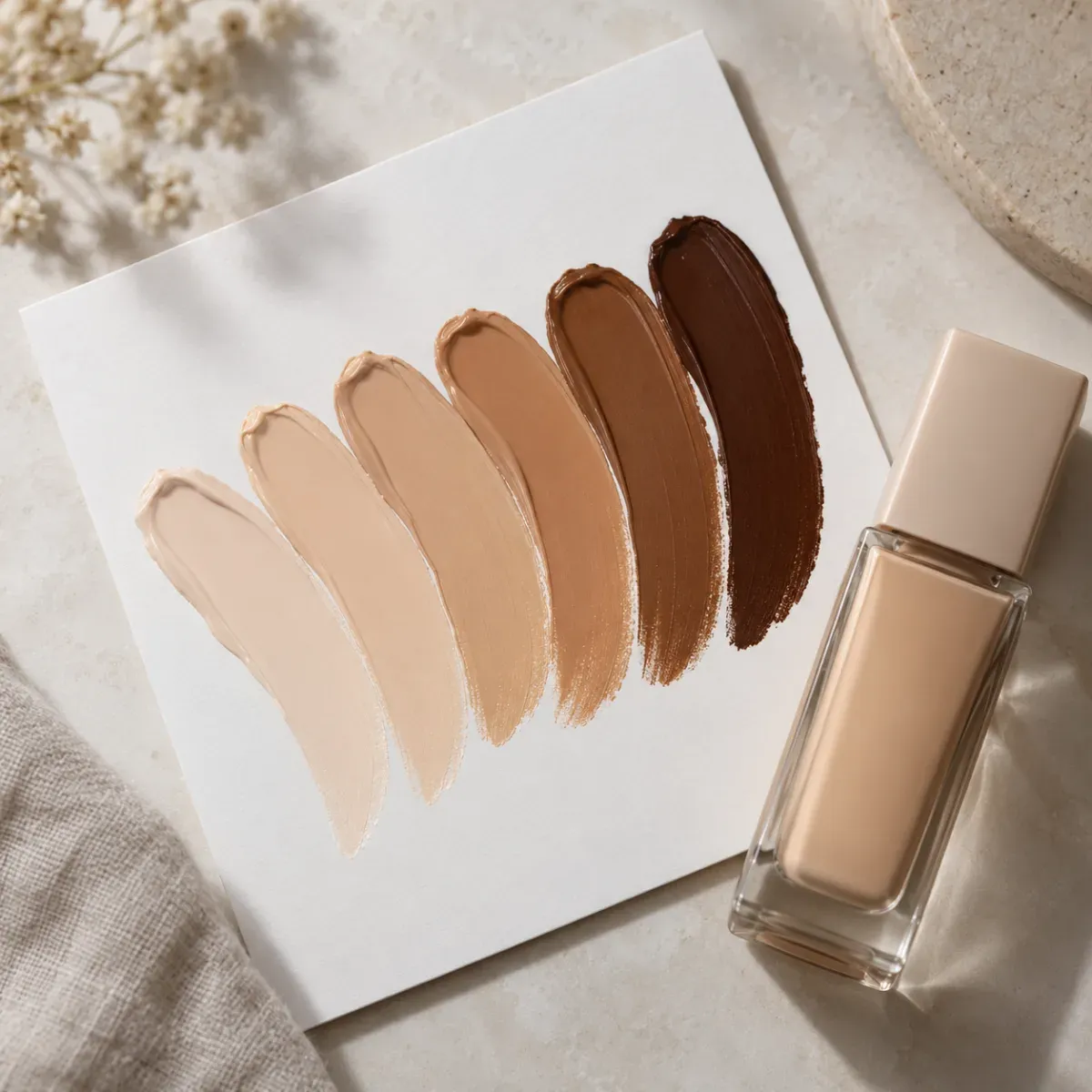
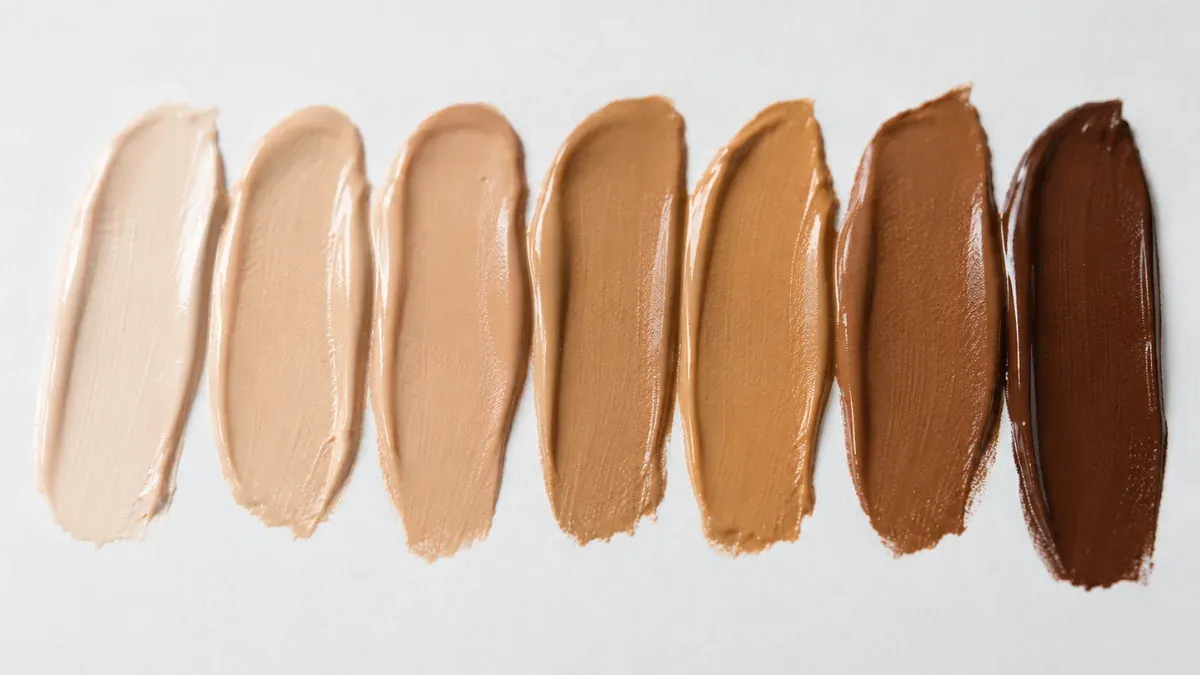
A shade ladder has two axes, and most first-time buyers specify only one. Depth is how light or dark the shade is; undertone is the hue direction underneath — cool, warm, neutral, and in some markets olive. A ladder with twelve depths and one undertone fails in front of anyone whose skin runs the other way.
| Axis | What to write down | What goes wrong if you don't |
|---|---|---|
| Depth | Number of steps, lightest and darkest target, spacing between steps. | Gaps in the deep end nobody can bridge. |
| Undertone | Which families you carry and how many depths each covers. | A warm-only ladder reads orange on cool skin. |
| Tolerance | A ΔE number against a sealed master, plus the formula used. CIEDE2000 is the common reference. | "Close enough" becomes an argument after the goods land. |
| Light source | At least two illuminants: a daylight-simulating one and a retail or warm one. | A match that is perfect in the lab and wrong in the shop. |
| Substrate | A drawdown on a contrast card plus a jaw application on skin per depth band. | A card match never checked on the skin tones you sell to. |
| Colorants | Which iron oxide and titanium dioxide grades are used, and that they are permitted for facial use in your market.5 | A shade you cannot sell in one of your markets. |
On tolerance, get the number in writing, measured against a sealed reference rather than the last batch. Ask each supplier to state, in writing, the ΔE window it will hold across runs and what happens when a batch drifts past it — the point is not which number you choose, it is that you choose it before the order. State who approves, and keep retained reference samples as the tie-breaker if a reorder is questioned.1
Shade count is a cash decision before it is a positioning decision. Every shade is its own SKU, and a formula minimum is quoted per batch against a shade minimum per shade. Do not split the order evenly, because the deep end is the most consistently under-ordered part of a first run, and adding a shade later is harder than designing the grid now — so build the full ladder as depth steps times undertone families and decide which cells you fund. Six to ten shades is a defensible opening for a direct launch with a known audience, while a broader ladder becomes necessary once you sell where shoppers filter by shade. The cash-first arithmetic behind deciding how many shades a first launch should carry applies here too, with one difference — a lip shade that misses becomes a gift, and a foundation shade that misses becomes a return.
When must oxidation be tested, and how do I run the protocol?
Oxidation is the colour shift after application: volatiles evaporate, the film keeps wetting the pigment, and sebum and skin pH interact with what is left. Customers describe it as "it went orange by lunchtime," and it belongs at the sampling stage because of what a late fix costs — if the drift is unacceptable after bulk approval, the remedy is a pigment or antioxidant change, a new dispersion, a new colour standard and a fresh round of stability work. Units already made do not get repaired.
- Same surface, same timeline: apply to clean forearm or jaw, and record at 0, 5, 20 and 60 minutes.
- Same light and camera: fix white balance and light source — a phone left on auto hides the drift.
- Same underlayer: repeat over bare skin and over primer or moisturiser; the layer underneath changes the result.
- Measure, and set the limit first: compare the 20-minute reading against the 0-minute one, record the ΔE, and write the acceptance number before seeing a result. Include the deepest shades, where load is highest.
What must I test between formula and package before I order?
A foundation and its package are one system, and the failure usually appears after transport rather than at the filler. These checks are cheap on filled units and expensive to skip, so put them in the order rather than in a hope.
| Component | What to test | Failure mode |
|---|---|---|
| Pump | Dose per stroke over repeated actuation, primability after storage, corrosion of the metal spring. | Clogged actuator, uneven dose, rust spots or dark specks. |
| Dropper | Bulb swelling or hardening against the oil phase, pipette fit, torque after transit. | A tacky bulb, or a neck that weeps on arrival. |
| Bottle or tube | Weight loss over accelerated storage, paneling, seal integrity with an oil-rich base. | Leakage in the carton, or a panel that makes a full bottle look half used. |
| Airless pack | Fill method with minimal headspace, dose consistency to the end. | A pack that will not prime, or the last tenth left behind. |
| Cushion sponge | Absorption and release over repeated presses, drying between uses, microbial control. | A sponge that floods on first use and is dry by week six. |
| Puff | Material compatibility and behaviour after cleaning. | A puff that hardens, sheds or transfers unevenly. |
Ask for accelerated storage on filled, packaged units rather than bulk alone: an elevated-temperature hold, a cold cycle, and a transit test on the packed carton. Weight loss across the hold is the cheapest leakage signal available before a shipment.
Questions to send the supplier before you quote
Send these in writing, to every supplier, before any price is discussed, so the returned quotes compare on the same basis instead of on two different products.
- Which format do you propose, and what is the fill viscosity window your filler holds dose accuracy in?
- Which emulsion type and which pigment dispersion system do you intend to use, named by ingredient?
- What target pigment load and what fill tolerance will you quote, and what happens to the viscosity when the load moves?
- How many components does the pack carry, and are they stock or tooled, inside your quote scope or billed separately?
- What ΔE tolerance will you hold against a sealed master, under which illuminants, measured on which substrate?
- Will you run an oxidation comparison at 0 and 20 minutes per shade, and against what limit?
- What accelerated storage and transit test will you run on filled, packaged units, and what weight-loss result will you hold?
- What documents come with the order — GMP evidence, stability data, colorant permission per market, heavy-metal and microbial reports?
- What changes on a reorder — price, lead time, minimum quantity per shade — and what is fixed?
Where do first foundation orders actually go wrong?
Foundation failures show up on the customer's face or in the returns column, and most of them were a blank field in the brief. Each is caught by a number or a record you could have asked for, and lost when it was never written down.
- Oxidation drift: a shade that leaves the bottle right and turns on skin by midday, because no acceptance limit was set before sampling.
- Shade mismatch at bulk: a bulk colour that differs from the approved sample because no sealed reference was kept or the pigment lot changed.
- Dose failure and leakage: a pump that clogs, an airless pack that will not prime, or weight lost across an accelerated hold — discovered after the cartons ship.
- Ladder gap: a range that stops short in the deep end, so the customers who would repurchase find no shade and settle elsewhere.
Recovering from a shade failure costs more than recovering from a texture failure, because the units are already filled and the customer has already decided. The remedy for each item above is a line in the order — a ΔE tolerance, a sealed master, a package test result, a written shade count — not a renegotiation after the goods land.
Frequently Asked Questions
- How many shades should a first foundation order carry? Six to ten if you sell direct to a defined audience, more if you sell where shoppers filter by shade. Design the full ladder first and fund part of it, so later additions drop into a structure rather than being matched ad hoc.
- Can one base formula serve every shade? The base can be shared, but each shade is its own pigment dispersion with its own colour standard and approval. Ask whether stability testing covered the full shade set or only representative shades.
- Why does the bulk shade look different from the sample I approved? Usually because no sealed reference was kept, or the pigment lot changed. Ask for retained samples and a written ΔE tolerance before the order.
- Do I need extra testing if I add SPF? Yes. A sun protection or other functional claim adds testing and label review, and in some markets changes how the product is regulated at all.3 Decide the claim before artwork is locked.
- Can I change the pump after the formula is approved? Only after re-running compatibility. A different pump has a different dose, spring and orifice, any of which changes how a pigmented emulsion behaves. Treat it as a new approval.
Conclusion
A private label foundation is one emulsion and one pigment system repeated across every shade you fund, so the specification has to be written before sampling begins rather than rebuilt after the first complaint. Lock the format and its filling constraints first, because they decide the components and the minimums; then fix the ladder on two axes, the tolerance as a number, the oxidation drift as a number, and the package as a tested system. Send one written brief and the same questions to every supplier so the quotes compare, keep your own retained sample, and the project either comes together cleanly or shows you where it breaks while changing it is still cheap.
Need a foundation sourcing brief? Share the format, ladder structure, coverage target, market and per-shade quantity, and ZONO can help turn it into an RFQ that two suppliers quote on the same basis.