Sep 25, 2026Startup & Private Label Guides
How Many Lip Shades Should Your First Launch Carry? A Cash-Flow-First Answer
Decide your shade count by format, budget, and shade story: four to six shades for lipstick, three to six for gloss or tint, three to five plus a clear opt
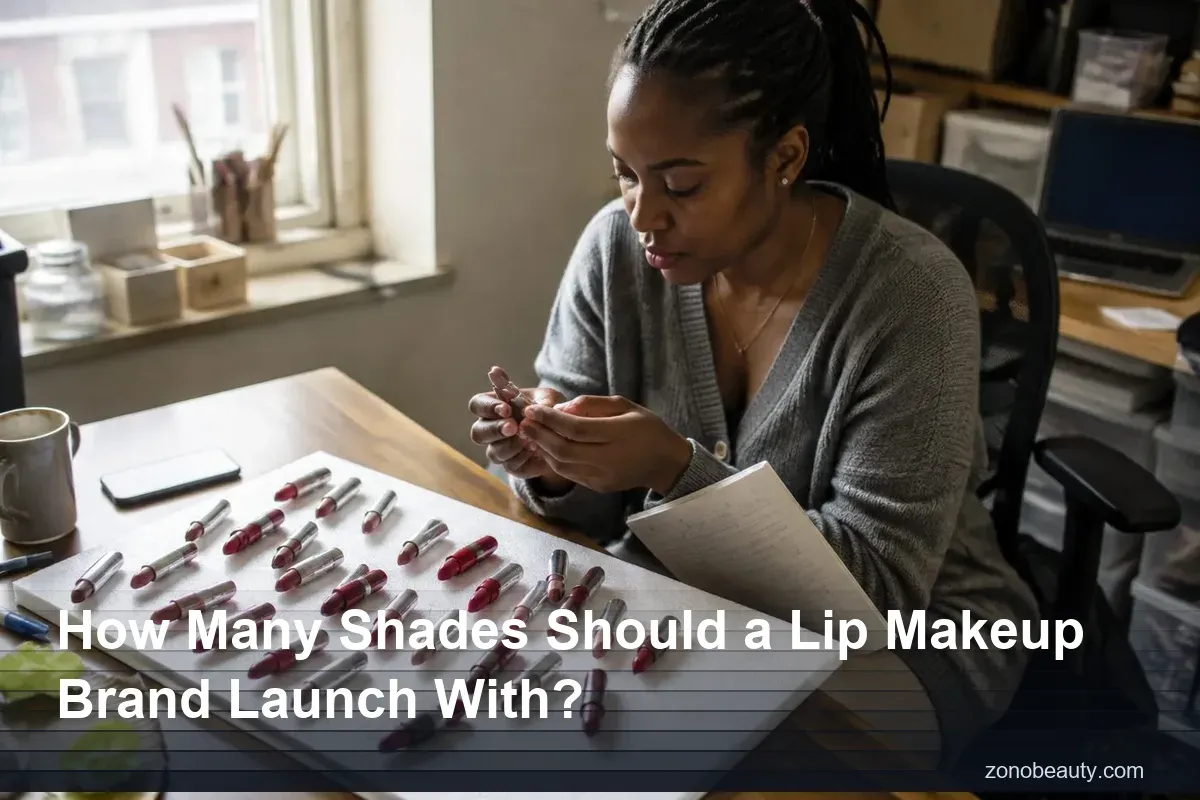
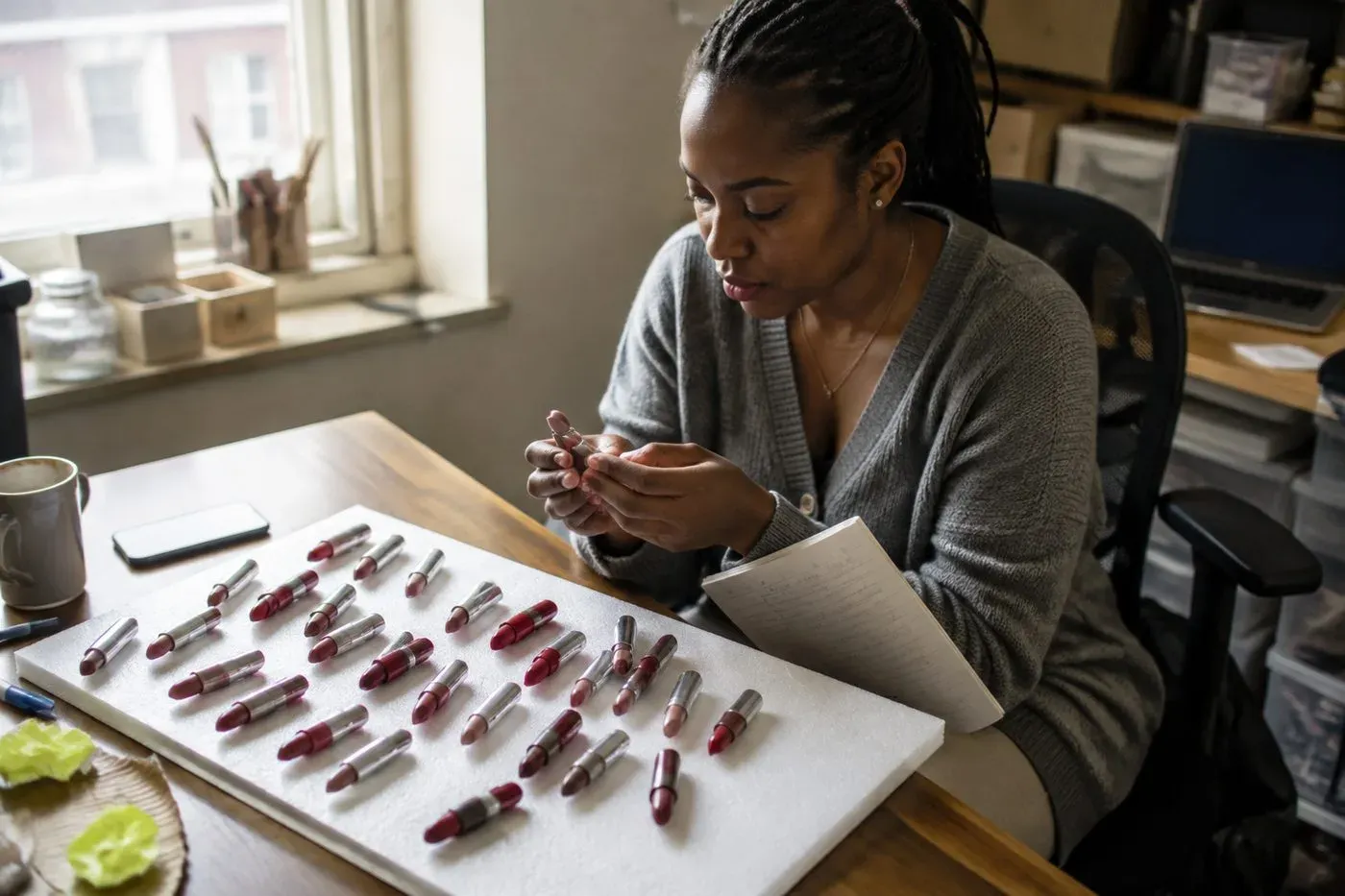
Every week, founders send our coordination team lip makeup brand briefs with twelve shades attached. Too many shades drains cash. Too few flattens the story. That tension decides launches.
Most lip makeup brands should launch with three to six shades—around five for lipstick, three to six for gloss or tint—covering a nude, a red, a pink or berry, and one deeper tone. Expand toward ten shades only when budget, testing, and marketing capacity clearly support it.
Shade count is not a creative decision alone. It is a production decision, a cash flow decision, and a marketing decision at the same time. Below, I break down how we help brands make that call before a single sample is poured.
How do I decide the right number of lip shades for my first product launch?
A London founder recently sent us a mood board with fourteen lipstick shades for her first order. We walked her back to six. Here is the reasoning behind that call.
Decide your shade count by format, budget, and shade story: four to six shades for lipstick, three to six for gloss or tint, three to five plus a clear option for tinted balm. Launch the smallest range that still feels complete and covers your core customer.
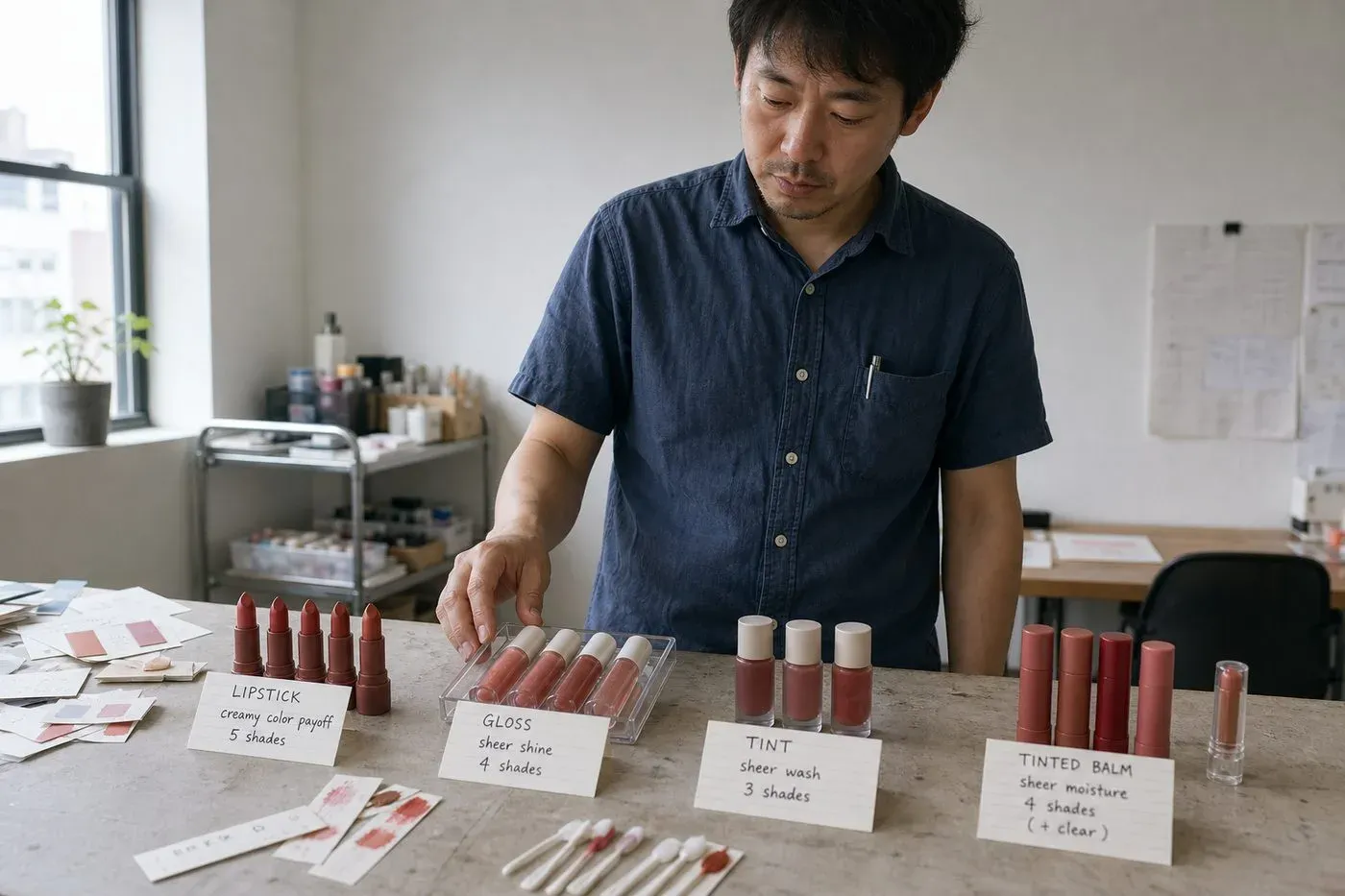
The real question is not "how many shades are ideal?" It is "how many shades can you launch and still do each one well?" Every shade you add multiplies sampling rounds 1, stability checks, approval cycles, and inventory risk. A tight edit forces clarity. A sprawling debut hides weak shades inside the lineup, and those weak shades quietly eat your capital.
Recommended shade counts by product format
Product format | Practical launch range | Common sweet spot |
|---|---|---|
Lipstick | 4 to 6 shades | 5-shade capsule |
Lip gloss | Hero shade, or 3 to 6 shades | 3 to 4 shades |
Lip tint | 3 to 5 shades | 3 to 4 shades |
Tinted balm | 3 to 5 shades plus one clear option | 4 plus clear |
Ambitious full launch | 6 to 10 shades | Only with proven demand |
Published OEM planning guides tend to converge here: lip lines often land at 8 to 15 total SKUs, and multiple private-label sources point to 5 starter shades as the practical capsule. One 70/30 rule is worth stealing: roughly 70% commercial "safe" colors like nudes and pinks, 30% bold statement shades that build brand authority.
Now the objection I hear most: "won't a bigger launch look more serious?" Sometimes. But the beauty industry trends we track have shifted toward capsule launches and shade edits, especially for DTC brands. One published estimate put a 12-shade liquid lipstick launch at $28,000–$65,000 all-in. That is a market entry strategy few first-time founders can fund well. Your product SKU count should match your operational capacity, not your ambition slide. Also consider finishes: launching one cosmetic formulation in two textures, such as matte and satin, usually teaches you more than launching many formulas at once.
✔ A 5-shade capsule launch is a recurring sweet spot in private-label and OEM planning guides TrueMultiple independent sourcing and private-label guides converge on five starter shades for lipstick because it covers a nude, red, pink, berry, and deep tone while keeping sampling and inventory manageable.✘ Launching more shades always makes a new brand look more established FalseA broad debut with underfunded marketing and thin inventory per shade usually reads as unfocused, and slow-moving shades tie up cash that a focused capsule would have kept liquid.
What factors affect the minimum order quantity when I want to launch multiple lip shades at once?
During a lip gloss project last year, our partner factory paused the filling line five times in one day for color changeovers. Every pause traced directly back to the client's shade count.
Shade count multiplies your minimum order quantity because each shade is a separate color batch, filling changeover, and often a separate packaging decoration run. Base formula, pigment dispersion, and component printing each carry their own MOQ, so exact figures are confirmed against your specific project scope.
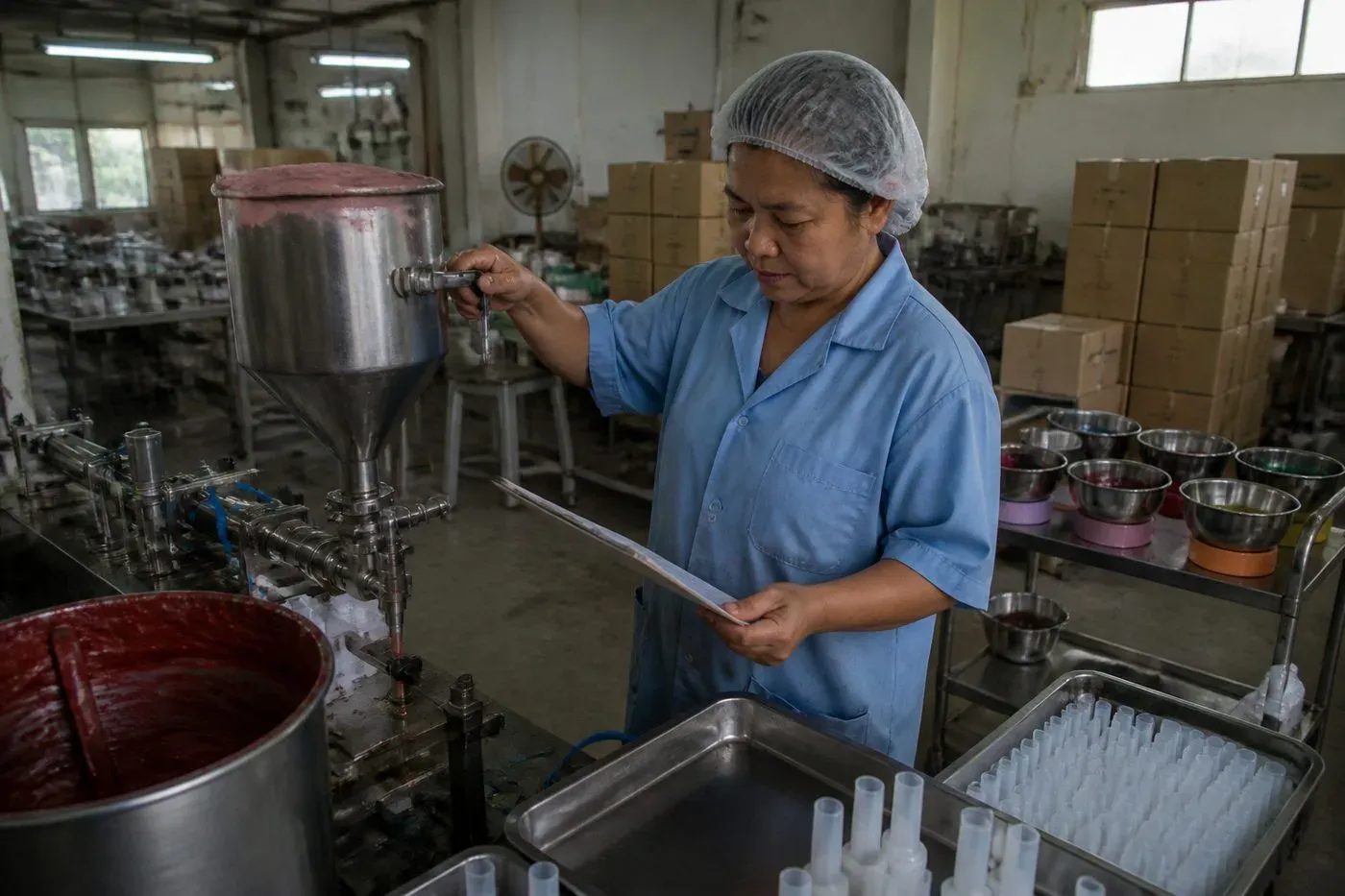
Founders often assume MOQ is one number for the whole order. In lip production, it rarely works that way. Think of it as stacked minimums, each triggered separately by every shade you add.
The five MOQ layers behind every shade
MOQ layer | What triggers it | Why shade count matters |
|---|---|---|
Base formula batch | Minimum kettle or mixer volume | A shared base helps, but each colored batch still needs minimum volume |
Pigment dispersion | Minimum pigment paste run per color | Every shade is its own dispersion, no exceptions |
Filling changeover | Line cleaning between colors | More shades mean more downtime, which factories price in |
Packaging decoration | Minimum print run per artwork | Shade-specific labels or boxes multiply print minimums |
Component supply | Tube, wand, or cap supplier minimums | Shared components across shades keep this layer flat |
In practice, when we match a project to a partner factory, we look at whether the shades share one base cosmetic formulation. Five gloss shades built on one base with different pigment loads 2 are far friendlier to MOQ than five distinct formulas. We also push clients toward shared packaging components with shade-differentiated labels, because a single tube spec across the whole line spreads component minimums across the whole line instead of per shade.
Here is the trade-off we weigh with every brief: cutting from six shades to four often frees enough budget to order deeper on your two best sellers. That protects you from the worst launch outcome—your hero shade selling out while slow shades sit in a warehouse. MOQ per shade, sample fees, and unit pricing all move with formula type, packaging, and target market, which is why we quote against a full project scope rather than a shade count alone.
✔ Sharing one base formula and one packaging component across all shades lowers the effective MOQ burden TrueA shared base and shared tube spec mean only the pigment dispersion and decoration layers scale with shade count, keeping the other minimums pooled across the whole order.✘ A factory's stated MOQ applies to the total order, so ten shades split the same quantity ten ways FalseMost lip production MOQs apply per shade because each color requires its own batch, dispersion, and changeover, so ten shades typically means ten separate minimums, not one divided minimum.
How do I match my shade range to what my target market actually wants to buy?
One lesson from coordinating orders across Europe, the Middle East, and South Asia: the same berry shade can be a hero SKU in one market and dead stock in another.
Match your range by mapping your target audience demographics against skin undertones and depth, running a competitive landscape analysis for shade gaps, anchoring on universal lip colors like a blue-toned red, and validating demand through waitlists or preorders before committing bulk quantities.
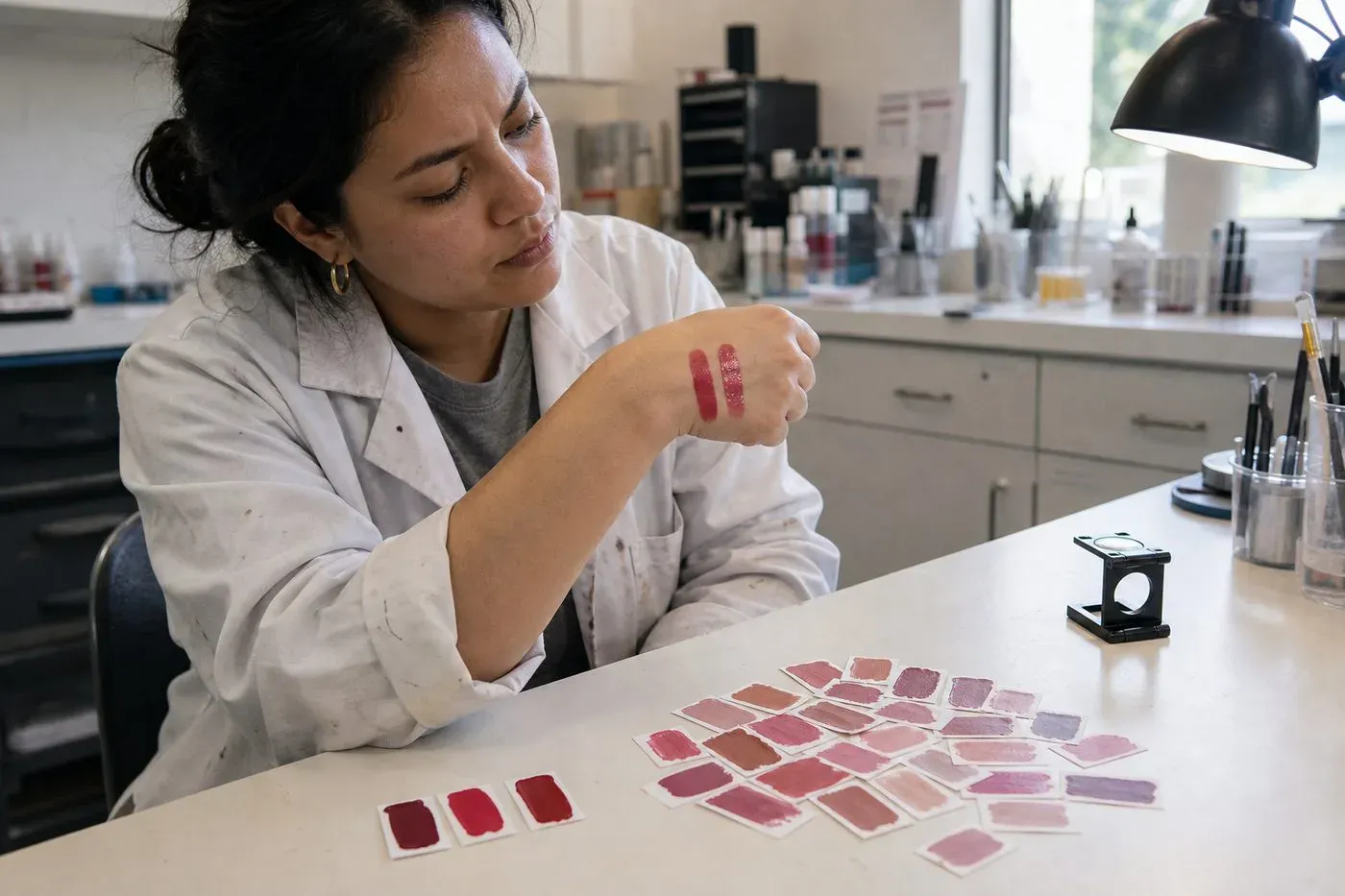
Shade selection is applied color theory 3 in makeup, not guesswork. Warm undertones pull orange-reds and caramel nudes. Cool undertones pull blue-reds and mauve pinks. Your job is to know which undertone mix dominates your actual buyer base, then build the smallest set that serves it convincingly.
Give every shade a job
Shade role | Purpose in the lineup | Notes from our project work |
|---|---|---|
Hero shade | The face of the launch and the ad creative | Should photograph true under phone ring lights |
Everyday nude | The repeat-purchase workhorse | Often needs a warm and a cool version |
Statement red | Brand authority and gifting appeal | Blue-toned reds flatter the widest undertone range |
Wearable pink or berry | The bridge shade for hesitant buyers | Usually the safest second purchase |
Deeper tone | Serves deeper skin depths credibly | Test on real deep skin, not just swatch cards |
Optional mixer or clear | White, blackberry, or clear topper | Lets customers customize depth and doubles perceived range |
A useful benchmark for horizontal inclusivity: aim for at least two workable options across each core depth category—light, medium, and deep. That is how a six-shade edit can function as a genuinely inclusive shade range, while a twelve-shade line clustered around light-medium beige cannot. The market now distinguishes symbolic variety from commercially useful shade architecture. One mainstream brand example launched just seven shades but tested them on fifty skin tones; the depth of validation mattered more than the count.
Two tactical ideas from what currently ranks in this space are worth considering. First, one intentionally polarizing anchor shade can drive "is this for me?" social discussion even if it never tops sales. Second, prioritize pigments that stay true-to-tone on camera, because your target market increasingly meets your shades through a phone screen before ever swatching them.
What should I check during sampling to make sure every shade stays consistent once bulk production starts?
A berry tint once drifted noticeably warmer between the approved lab sample and the pilot batch. Our inspection step caught it before bulk filling began, and the pigment lot was traced and corrected.
Approve a signed color standard for every shade, review each one under daylight, store, and phone-camera lighting, run formula-to-packaging compatibility checks per shade, confirm pigment lot documentation, and require pre-production samples pulled from the actual bulk batch before authorizing full filling.
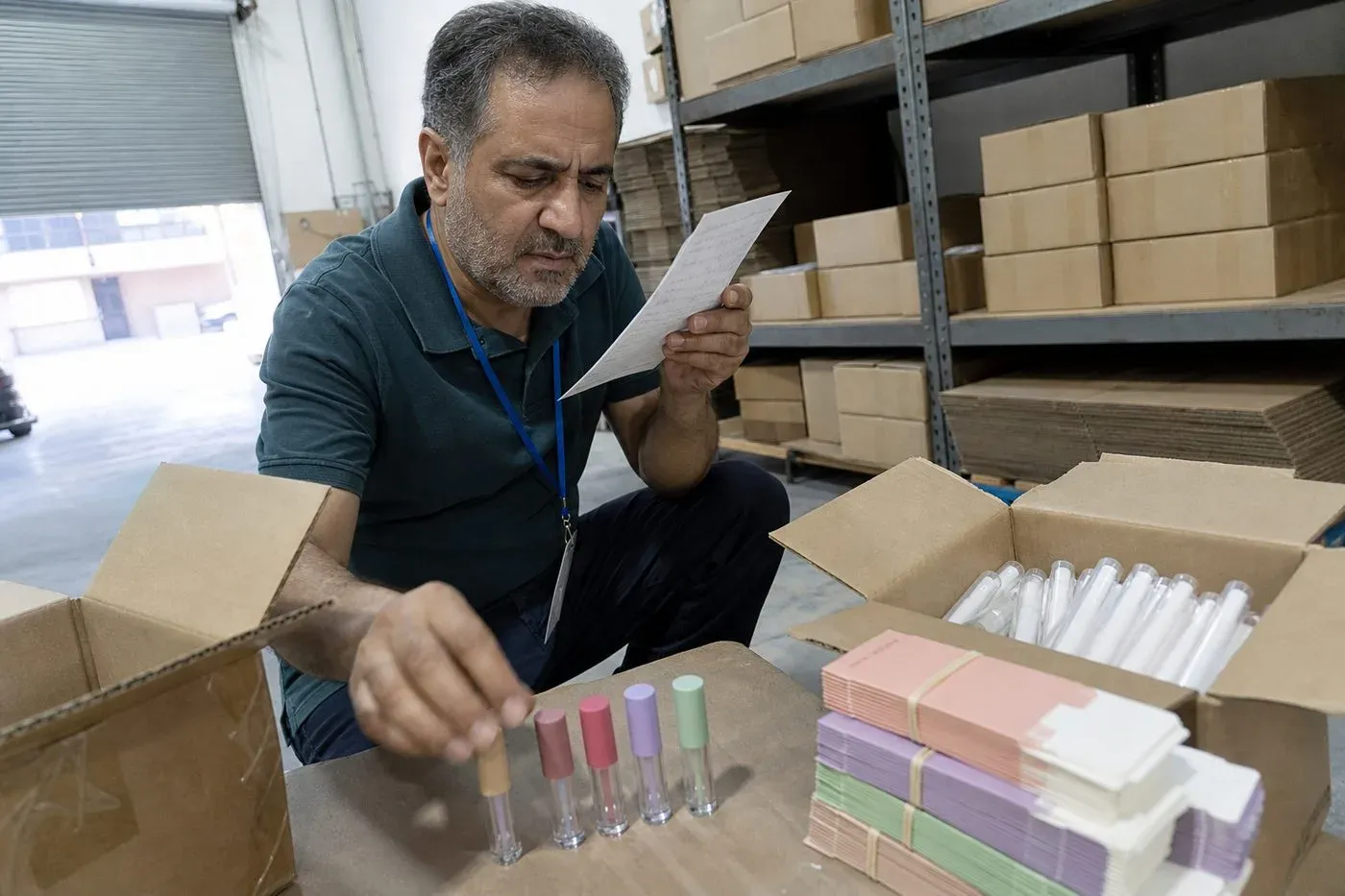
Color drift is the single most common way a multi-shade lip order goes wrong. It rarely comes from carelessness. It comes from small variables stacking up: a new pigment lot, a slightly different mixing temperature, a tube material that shifts perceived color. Here is the checkpoint sequence we run as the coordination window between the brand and the partner factory.
- Lock a physical color standard per shade. A signed, retained master sample for every shade—not a Pantone reference alone, because lip bases shift how pigment reads.
- Approve under three light sources. Daylight, warm retail lighting, and a phone camera with ring light. A shade that passes one and fails another will generate returns.
- Check formula-to-packaging compatibility per shade. Darker, higher-pigment shades can stain wands and tube interiors differently than paler ones. We test every shade in its final component, not just one representative shade.
- Verify pigment lot traceability. The bulk batch should reference the same pigment lots as the approved sample, or include a documented re-match against the standard.
- Demand a pre-production sample from the bulk batch. This is the sample that predicts your goods, filled in final packaging from the actual production base.
- Inspect against tolerance before shipment. Our quality inspection compares filled units to the retained standard for color, texture, and fill level before export documentation moves forward.
One compliance note we give every client: stability data, challenge testing, and partner-factory documentation are available upon request, but regulatory review, labeling, and safety assessment responsibility sit with the brand owner or the appointed responsible person in the target market. No supplier can lawfully claim a lip product is "FDA approved," because that approval pathway 4 does not exist for cosmetics. Build your market entry strategy with your own regulatory advisor from day one.
✔ A pre-production sample pulled from the actual bulk batch is the most reliable predictor of final shade accuracy TrueLab samples are made in small vessels under ideal conditions, while a bulk-batch sample reflects real production mixing, pigment lots, and filling, so it exposes drift before the full run is committed.✘ Approving a Pantone code is enough to guarantee shade consistency in bulk production FalsePantone references describe flat printed color, but lip bases, gloss levels, and packaging materials all shift how pigment reads, so only a retained physical master sample per shade holds a factory accountable.
Conclusion
Launch the smallest shade range that still feels complete—usually three to six shades with clear roles—then let real sales data, not ambition, fund every expansion afterward.
If you are planning a lip launch, send us a short project brief with your product type, target market, shade count, packaging direction, expected quantity, and any reference products. We will come back with matched supplier options, a realistic sampling path, and MOQ and pricing confirmed against your specific scope.
Footnotes
1. International standards organization providing guidelines for cosmetic manufacturing, including sampling and quality management practices. ↩︎
2. Authoritative scientific resource for chemical compositions and pigment behaviors in industrial and cosmetic applications. ↩︎
3. Fundamental principles of color theory and how colors interact, essential for makeup shade development. ↩︎
4. Official FDA guidance on the regulatory status and lack of pre-market approval for cosmetic products. ↩︎