Private Label Face Cream Supplier: What to Spec, Ask and Verify Before You Order
A sourcing guide to private label face cream: the emulsion type and stability evidence to specify, the packaging compatibility to test, and what to verify before you order.
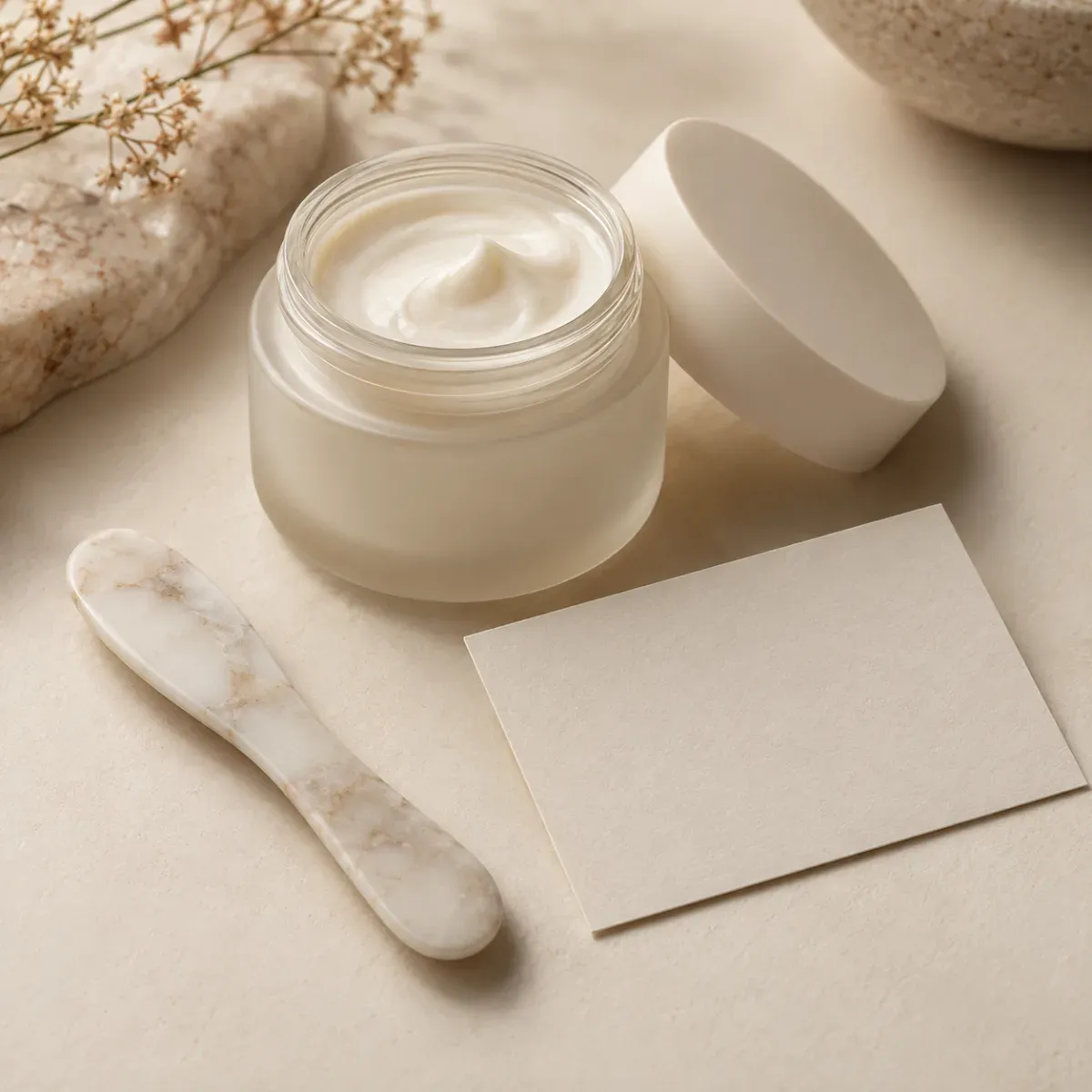
A private label face cream is decided in the specification, not in the jar. The emulsion type, the stability evidence and the preservation system are the three lines that decide your quote, your bulk run and your reorder; the texture is the part every supplier can fake at sampling. Treat the cream brief as a set of things to pin down and ask, not a fragrance and a feel to send.
Most first-time buyers brief a cream by texture and fragrance and stop there. Texture and fragrance are the easiest parts to fake at sampling and the first to fail in bulk. The decisions that decide whether a cream survives its shelf life are the emulsion type, the stability evidence and the preservation system, none of which a smooth swatch reveals. A cream can feel perfect in the lab jar and still separate, haze or lose preservation by month eleven in a warehouse you do not control.
ZONO Beauty coordinates long-term manufacturing suppliers from Shantou, Guangdong, across ready-stock, semi-custom and full OEM/ODM routes, and is not positioned as a single factory. This guide covers what to lock in the brief, the questions to send a supplier before quoting, and the stability and batch evidence to demand before the first order; for the container side of the same product, the private label face cream jar specification covers what the jar actually includes.
A cream is judged a year after filling, not at the sample. Stability and preservation are the product; the texture is just the part you can feel on day one.
What should my face cream specification pin down before I request a quote?
The emulsion type sets almost everything downstream: feel, stability window, preservative behaviour and even the jar you can use. Picking it is the first specification, not a detail, and it is what turns a quote from a guess into a scope you can hold the supplier to. State it in the brief, because it fixes the preservative class, the viscosity system and the component compatibility in one move.
- Emulsion type: O/W, W/O, multiple emulsion or anhydrous, named, because each carries a different shelf-life risk.
- Feel to deliver: a light day cream, a rich night or barrier cream, stated as a target rather than an adjective.
- Claim set: the exact wording you intend to print, because a therapeutic claim changes the evidence and labelling route.
- Actives intent: the ingredients you want and the ones you exclude, because actives decide both stability and compatibility.
Ask the supplier for the emulsion type by INCI and for the stability window, not just the feel. A supplier who cannot name the type is describing a texture, not a formula that will scale.
Which emulsion type and jar can the supplier actually run?
The emulsion type also decides which supplier can make the cream, and which jar it can go into. A W/O or a multiple emulsion is more forgiving on feel but harder to make reproducible, and it may not be compatible with the jar you had in mind, so the format is chosen with the base, not after the bulk is planned.
| Type | Feel & use | Stability note |
|---|---|---|
| O/W (oil-in-water) | Light, fast-absorbing, common for day/light creams | Water-rich; preservation and freezing risk matter |
| W/O (water-in-oil) | Richer, more occlusive, common for night/barrier creams | More forgiving on feel, heavier |
| Multiple emulsion | Light yet cushioned, premium feel | Harder to make reproducible |
| Anhydrous (no water) | Balms, ointment-like | No water phase; preservation differs |
For a cream, the jar is part of the formula's performance, so it belongs in the same brief. The wrong material or closure can change the product before the customer opens it: glass reads premium but is heavier and breakable, PET and PP are lighter but interact differently with certain actives, and the closure and liner must be compatibility-tested against the emulsion because some oils migrate into certain plastics. Airless limits air return and extends post-open life, whereas an open jar exposes the whole product with every use.
What stability and preservation evidence must be in writing before I order?
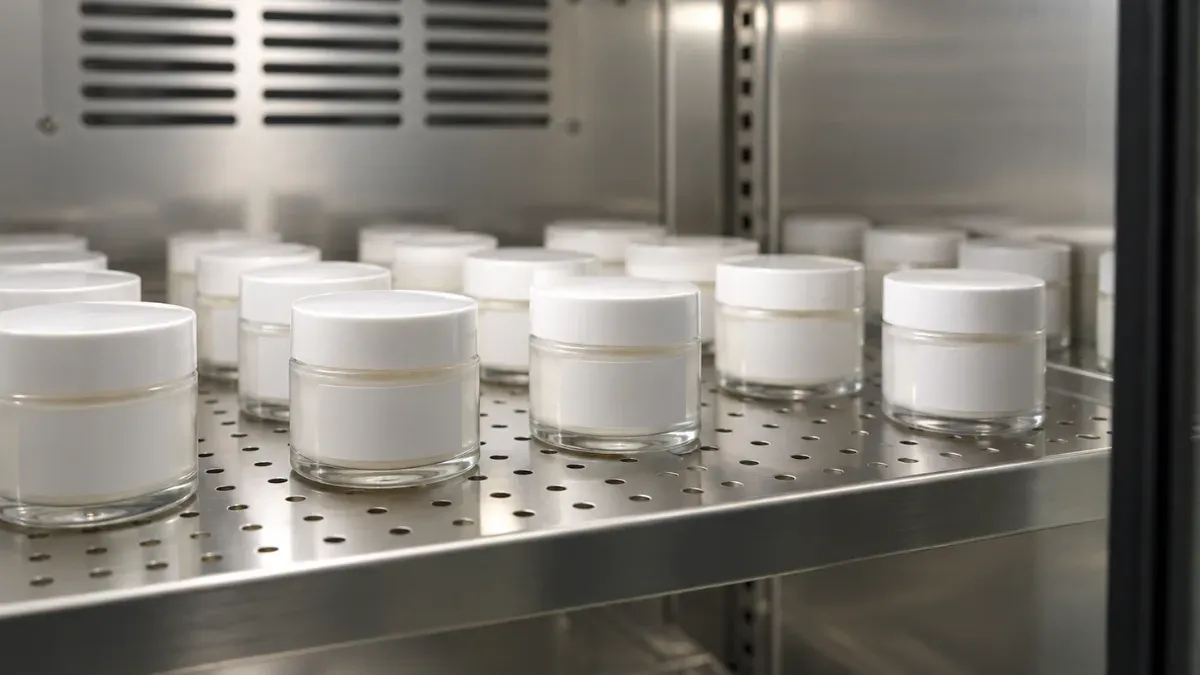
A "stability test" is not one test; it is a set, and each part answers a different failure mode. Ask for the protocol and the recorded results, because a cream that passes one and fails another is still a risk. A one-word "passed" is not evidence you can compare between suppliers or defend to a retail buyer.
| Test | What it catches | Buyer note |
|---|---|---|
| Accelerated (heat) | Separation, oiling out | Fast signal, not a substitute for real-time |
| Low temperature | Freezing, graininess, syneresis | Matters for cold-transit markets |
| Freeze-thaw cycling | Emulsion breakdown in transit | Key where the cold chain is unreliable |
| Real-time | Slow drift over shelf life | The only test that proves the claim period |
| Centrifuge / stress | Hidden instability | Surfaces what a shelf test takes months to show |
Track appearance, phase, viscosity, pH and odour in every one of them. A water-containing cream is a growth medium if the preservative system fails, so preservation is part of the formula's safety, not a finishing touch, and it must hold across the whole pack life rather than the first month. Ask for a preservative efficacy or microbial-limit result against the organisms that matter, and require the pH to be controlled rather than just stated, because many preservatives lose effectiveness outside a band.
The packaging MOQ guide is where the jar decision usually collides with the formula decision, because the container floor often sets the order size. State the jar, the closure and the stability protocol in one brief, and the quote reflects the system rather than a stock base in a stock jar.
What do I put in the RFQ so two cream quotes are comparable?
Two cream quotes rarely cover the same scope, so the headline unit price is the least useful number. Normalise the scope, then read the price. Name the following fields in the RFQ so both suppliers answer the same question.
- Emulsion route: stock base or developed, because development carries R&D and extra sampling rounds.
- Stability and preservation testing: whether the accelerated study and challenge test are included or billed later.
- Jar and closure: whether the component is included, since the jar often sets the order minimum.
- Fragrance: stock oil or custom blend, which changes cost and lead time.
- Fill weight and tolerance: the actual grams and the band, not the nominal jar size.
- Trade term and MOQ: ex-works or landed, and the binding minimum across formula, component and fragrance.
The claim set belongs in this same brief, because the claim can force a different ingredient palette and a different label. "Moisturizes" is cosmetic; "treats eczema" or "repairs the barrier" can cross into therapeutic territory in the US, EU and several Asian markets. Lock the claim set before formula work, and the ingredient list your customer needs for registration is the same document that keeps the claim honest across markets.
Questions to send the supplier before you quote
Send these in writing, to every supplier, before any price is discussed. The answers are what let you compare two cream quotes on the same basis instead of on two different products.
- Which emulsion type do you propose, named by INCI, and what stability window will you quote for it?
- Which preservative system does that emulsion need, and is it effective at the formula's real pH across the pack life?
- Which stability protocol do you run, and will you send the recorded results rather than a pass/fail verdict?
- Which jar and closure do you supply, and is the component inside your quote scope or a separate supplier?
- Has the closure and liner been compatibility-tested against this emulsion, and what was the result?
- Is the fragrance a stock oil or a custom blend, and how does that change cost and lead time?
- What fill weight and tolerance will you quote, and how are they measured per batch?
- What documents come with the order — INCI, stability data, preservation evidence, component compatibility, heavy-metal and microbial reports?
State the brief up front and the quote reflects the product you intend to sell. In a cream the emulsion, the claim and the package are one system, so they belong in one brief.
Where do first face cream orders actually go wrong?
Most cream failures are slow and physical, and they show up in the hand-off rather than the lab: a claim the formula cannot support, a jar that was never tested with the emulsion, or bulk approved against a written description instead of a sealed sample. Each is caught by a document you already requested, and lost when it was never put in writing.
- Phase separation: a cream that holds in a sample but splits under heat or over shelf time, because no stability protocol was written into the order.
- Preservation shortfall: a water-rich cream whose efficacy drops as the jar is opened daily, because pH and microbial limits were not held across the pack life.
- Component incompatibility: a liner that swells or an oil that migrates into the plastic, discovered weeks after filling.
- Claim overreach: "barrier repair" or a therapeutic claim printed where the market does not allow it, caught only at registration.
Each of these is caught by a test or a clause you can write into the order; the failure is committing to bulk from a smooth swatch instead of a filled, aged jar that has been through the stability protocol.
Frequently Asked Questions
- Which emulsion type should a first cream use? O/W for a light day cream, W/O for a richer night or barrier cream. Name the type in the brief, because it decides preservation, viscosity and the jar you can use.
- What stability proof is enough? Accelerated plus real-time data tracking appearance, phase separation, viscosity and pH, with the protocol and the recorded results — not a one-word "passed".
- Is a jar or a tube better? A jar reads premium and is easy to use but exposes the whole product each open; airless or pump formats limit contamination. Match the format to the claim and the market, not just the look.
- Can I claim "barrier repair" on a cream? In many markets that crosses into drug or therapeutic claims and changes the path. Keep cosmetic claims like "moisturizes" unless you have cleared the stricter route.
- Why will two suppliers quote different minimums for the same cream? Because the floor is counted against the formula, the jar and closure, and the fragrance separately. Ask each to break the minimum into those numbers, then compare like with like.
Conclusion
A private label face cream is won in the brief, not the jar. Name the emulsion type by INCI, demand a stability protocol and the recorded results covering the full shelf life, require preservation evidence across the pack life, keep the claim inside the cosmetic boundary, and run a component-compatibility test before bulk. Send one written brief and the questions above to every supplier so the quotes compare, hold the supplier to the data, and the last jar still matches the first.
Need a face cream sourcing brief? Share the emulsion direction (light day, rich night, barrier), target market and claim set, jar format and approximate quantity, and ZONO can help turn it into an RFQ that two suppliers quote on the same basis.