Makeup Gift Sets Factory: How to Plan Components, Assembly and QC
Plan a multi-item makeup gift set by reconciling component minimums, lead times, assembly and labelling before quoting. A short supplier checklist for kits.
A makeup gift set looks like a simple packaging exercise: choose a few products, put them in a box, ship them. It is the opposite. Every item carries its own formula, component, minimum and lead time, and the assembled unit is a new product with its own failure modes. The box is what the customer opens, so the box is what gets judged first.
A makeup gift set is not several products in a box; it is one assembled SKU. Its minimum, quality and labelling are decided at the unit level, so each component must be reconciled before the set is quoted. Plan the tray first, then the item mix, then assembly and transit.
A custom beauty gift set that mixes a lip, an eye and a face product inherits the label and claims sensitivity of every item inside it, so compliance is treated per item and per carton, not as a single approval. ZONO Beauty coordinates long-term manufacturing suppliers from Shantou, Guangdong, across ready-stock, semi-custom and full OEM/ODM routes, and is not positioned as a single factory. The points below are the checks applied to gift set projects before any commercial term is fixed.
Why a gift set is not several products in a box
The assembled unit is the product, not the items inside it. A set has its own minimum, its own QC gate and its own labelling question, because the carton is what ships and what the customer opens. Treating it as a repack of existing SKUs hides every cost and risk that makes sets hard.
A single product has one formula, one component and one label. A set has one of each per item, plus a tray, an outer carton and an assembly step. Every layer adds a place for the plan to break, and the customer sees all of them at once in the unboxing.
- Its own minimum: every item, the tray and the carton each carry a floor that the set quantity must clear.
- Its own QC problem: a set passes only when every item and the assembled unit pass together.
- Its own labelling question: the outer box often needs information the inner items do not.
How do I choose the insert and tray structure first?
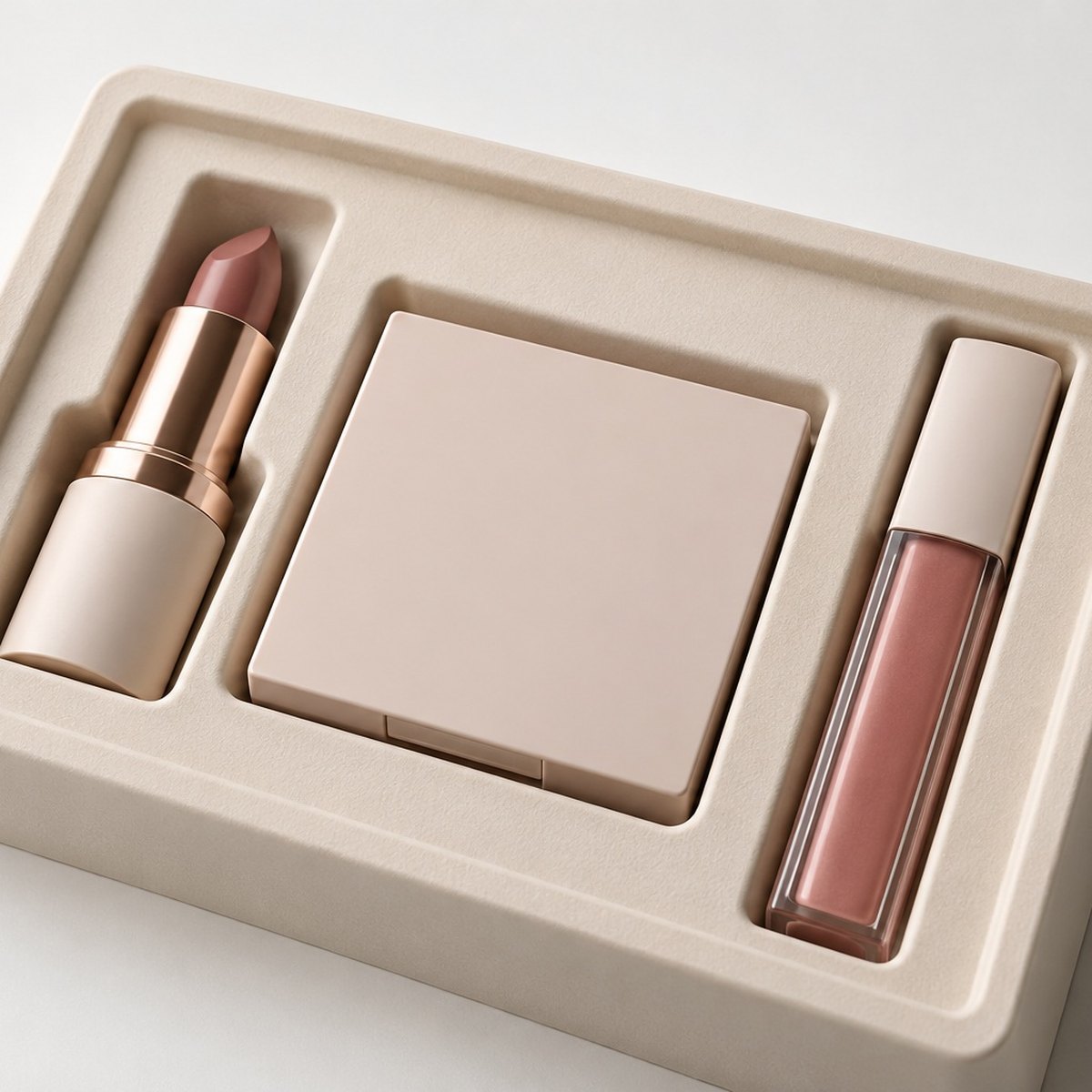
Component matching is the first design decision because the tray sets the unboxing and every later failure mode. Decide whether items are held by friction, a foam cavity or a moulded tray before fixing the mix. A height or weight that differs from the plan changes how the set sits, rattles and photographs.
The tray is not packaging; it is the structural design of the product. A friction fit is cheap but loosens with vibration. Foam holds well but can mark glossy components or shed. A moulded tray is precise but adds a tooling step and a lead time, and it is unforgiving if an item's dimensions change.
| Hold method | Unboxing feel | Main risk | Buyer question |
|---|---|---|---|
| Friction | Items nest in cut cavities | Loosens with vibration, items shift | How is the cavity fit toleranced? |
| Foam insert | Soft, premium, hides gaps | Can mark or shed on glossy finishes | Is the foam tested against each component finish? |
| Moulded tray | Precise and repeatable | Tooling step and lead time, unforgiving to change | Who owns the tray tool, and what changes force a new one? |
Confirm the tray against the actual component dimensions, not the catalogue. A taller lip product or a wider palette changes the cavity fit and the total carton depth, and the unboxing is the first place the mismatch shows.

What do I need to reconcile before I quote a set?
Every item in a set carries its own minimum, and the set quantity must clear all of them at once. Adding an item adds another floor to reconcile. Surface the highest minimum early, because a mismatch here is the most common planning failure and it is discovered only after the quote is fixed.
The minimum of a set is not the average of its items; it is the highest item minimum, plus the tray and the carton. A stock lip item may clear its floor while a custom palette needs far more units, and the set cannot ship until both are made. The same applies to the packaging: a moulded tray or a printed carton often carries a higher floor than the fill.
The same logic appears when the insert or carton minimum exceeds the fill quantity; the component, not the formula, sets the real floor.
- The minimum of every item, stated per SKU.
- The minimum of the tray and the outer carton.
- Whether any item can swap to a stock equivalent to clear a floor.
- Who carries the excess when one item's minimum is far higher than the rest.
How to plan when components have different lead times
A set is ready only when its slowest item is ready. One stock item and one custom item means the custom item gates the whole box. Map every lead time before ordering, and plan the fast items around the slow one instead of discovering the gap at packing.
Lead time is the second reconciliation, after minimum. A stock component is available quickly; a custom one is not. The set's readiness is gated by the slowest item, so the planning question is not how long each item takes but which item is the critical path from the last custom component to assembly.
Order the slow items first and treat the fast items as fill that can be scheduled late. Ask the cosmetic gift set supplier to name the longest lead time in the set and whether any item can be brought forward or swapped. A supplier who quotes one blanket lead time for the whole set has not done the reconciliation.
Who assembles the set, and why is assembly its own quality risk?
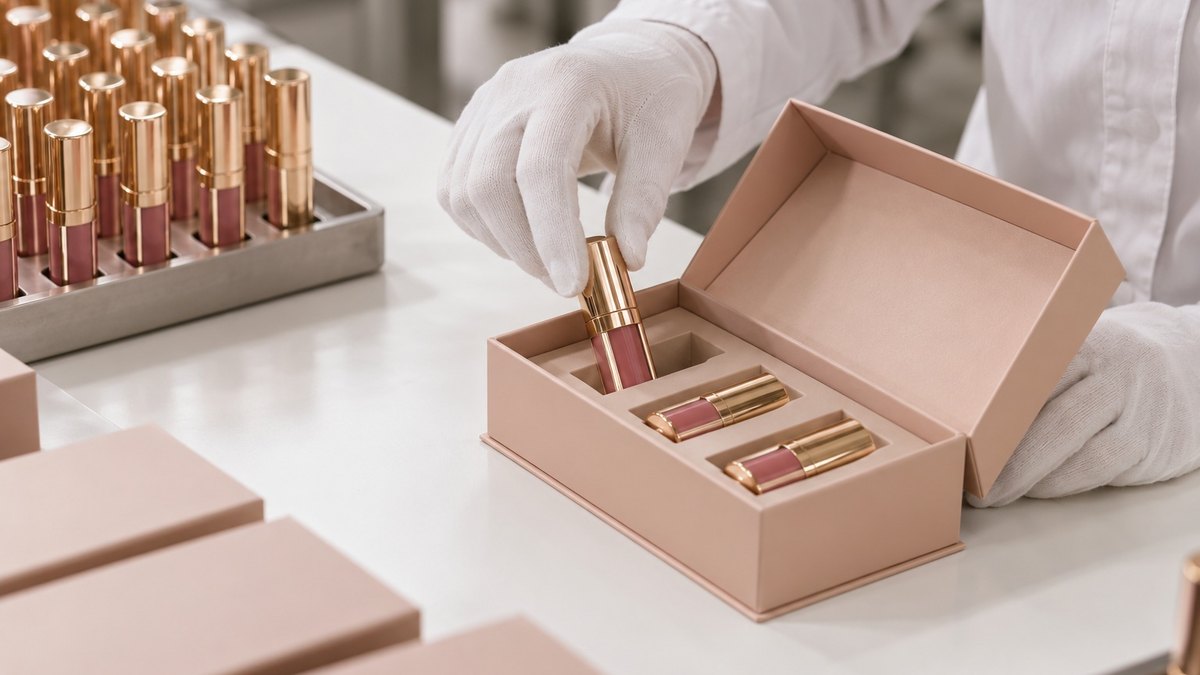
Assembly is a separate quality risk from the items themselves. Every item can pass inspection and the set can still fail because the tray, the carton and the pack-out were never controlled. Confirm who packs the set, where, and which QC gate covers the assembled unit.
Assembly happens either at the component factory or at a third party, and each choice changes who owns the final QC. At a makeup kit manufacturer, the line that filled the items often packs them, but that line may not treat the assembled carton as a new product. At a third party, the pack-out is cleanly separated, but the brand must hand over a precise assembly spec and the responsibility for the final check.
Good manufacturing practice for cosmetics is built on controlled production and documentation, and that control extends to packing and the assembled unit.1
Decide the QC split the same way as factory QC versus a third-party or buyer inspection, and write down who signs off the assembled carton, not only each loose item.
- A written pack-out spec showing item order, orientation and tray seating.
- A first-off assembled sample approved before the full run.
- An in-process check that the tray and carton are not damaged during packing.
- A final check on the sealed carton, not only on the loose items.

How does a gift set fail in transit that a single product does not?
An insert that holds in a sample can loosen through a shipment. Corners crush, items shift, and the difference between retail-shelf handling and parcel handling decides the failure mode. Test the sealed carton as it will actually travel, not as it sits on a table.
A shelf set is handled gently and displayed. A parcel set is dropped, stacked and vibrated, and the tray that survives the showroom does not necessarily survive the courier. Item shift is the classic failure: a component works loose in its cavity, scratches the one beside it, or lands on the wrong side of the lid.
| Handling | Typical stress | Set-specific failure | Check |
|---|---|---|---|
| Retail shelf | Gentle, upright display | Scuffing, dust, label edge wear | Cosmetic inspection of the assembled face |
| Parcel or courier | Drop, vibration, stacking | Item shift, crushed corners, torn tray | Drop and vibration test on the sealed carton |
| Pallet or freight | Compression, long dwell | Carton collapse, foam compression set | Compression test and tray recovery check |
Ask for a transit test on the sealed unit, not only a component test. The question is whether the tray recovers, whether any item migrates, and whether the outer carton still protects after being dropped from a reasonable height.
How to reverse-plan a seasonal set to a fixed date
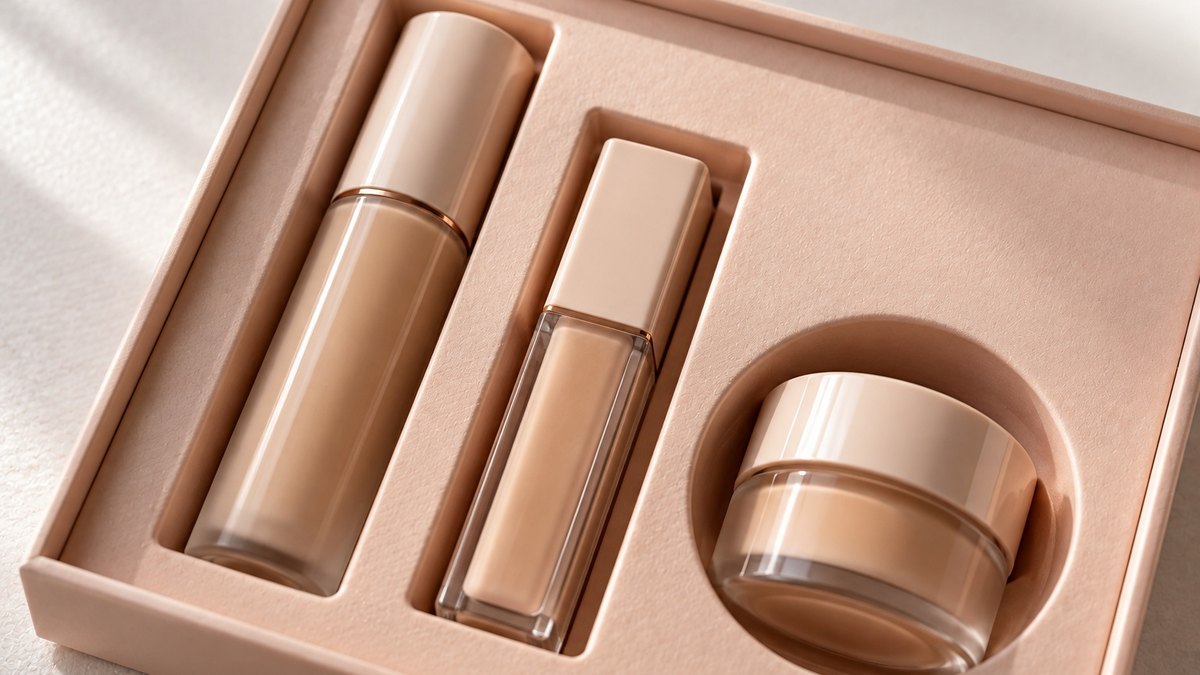
Gift sets are deadline-driven, so plan backwards from the retail date. Work from the sale date through freight, assembly and item production to find the order date. Reverse planning exposes the slowest item early and turns a seasonal set into a sequence with a named critical path.
Seasonal demand is fixed and unforgiving. The retail date does not move, so the plan must move instead. Start from the date the set must be on shelf and walk backwards through freight, assembly and the slowest item's production. No durations are invented here; the point is to name each step and let the supplier fill in the times.
- Fix the retail date and the latest acceptable arrival date.
- Work back through freight and customs to the ship date.
- Work back through assembly to the date every item must be packed.
- Work back through each item's lead time to the order date.
- Confirm the slowest item is the critical path.
What does the assembled carton need to say?
The outer carton generally carries its own information, separate from the items inside. Confirm what the pack must show in each market, and treat a set that mixes formats, such as a lip and a face product, as per-item labelling plus per-carton labelling, not a single label.
Labelling is the assembled unit's own question, not an afterthought. In the US, cosmetics are regulated rather than pre-approved, and the firm is responsible for the label information that must appear on the pack.2 Under MoCRA, facilities register and products are listed, which means the set and its items each carry a listing question to confirm.3 The intended use decides whether a product is a cosmetic or a drug, and a mixed set can change that answer item by item.4
In the EU, each product's labelling and claims follow the framework set by the cosmetics regulation, which the assembled set must also satisfy.5 In Indonesia, the relevant authority is BPOM, and notification is a separate question to raise for that market.6
The checklist to send a supplier
Send a short checklist, not a long wish list. State the item mix, tray type, target market and seasonal date, then ask for each item's minimum and lead time, the slowest path, the assembly spec, the transit test and the per-carton labelling. Keep every line tied to one verifiable output.
Send the scope first, then hold the supplier to evidence for each row.
| Item to send | Question to ask | Verifiable output |
|---|---|---|
| Item mix and formats | Which items, and any lip, eye or face mix? | Written scope with per-item formats |
| Tray structure | Friction, foam or moulded, and why? | Tray sample against actual components |
| Minimums | What is each item's floor, plus the tray and carton? | Per-SKU minimum confirmation |
| Lead times | Which item is the critical path? | Named slowest item and order date |
| Assembly | Who packs, and which QC covers the assembled unit? | Pack-out spec and first-off approval |
| Transit | How is the sealed carton tested? | Drop and vibration test result |
| Labelling | What must the outer carton show per market? | Label artwork with per-carton and per-item notes |
Review in this order:
- Fix the item mix and formats.
- Choose the tray structure against the components.
- Reconcile every item's minimum and lead time.
- Lock the assembly spec and the QC gate.
- Confirm transit testing and per-carton labelling.
Red flags that should pause a set
Pause any supplier who quotes a set with one blanket minimum and lead time, ships a sample with a different tray than the production run, or answers with a photo and a price. Treat any "FDA approved" or universal "EU approved" claim as a warning, and ask for the certificate number and scope.
Sets are where a careless supplier hides the hardest problems, because the complexity is multiplied and the customer finds it late. Cosmetics are not approved by the FDA in that sense; they are FDA regulated, so the phrase should always be pushed back on.7
- One blanket minimum and lead time for the whole set.
- A sample tray that differs from the production tray.
- No answer for which item is the critical path.
- No transit test on the sealed carton.
- Uses "FDA approved" or "EU approved" as a blanket credential.
- Quotes a firm set price before seeing the item mix.
Frequently Asked Questions
- Which comes first, the tray or the item mix? The tray, because it sets the unboxing and every later failure mode; fix the item dimensions before committing to a tray.
- Is a set's minimum the sum of its items? No. It is the highest item minimum plus the tray and carton, cleared by every item at once.
- Can a set mix a lip and an eye product? Usually yes, but treat compliance as per item plus per carton, and confirm classification and labelling in each market.
Conclusion
A private label gift set is one assembled SKU, not several products in a box. Fix the tray first, reconcile every minimum and lead time, then control assembly and transit as their own risks. Send a short checklist and hold the supplier to evidence, and the set either comes together cleanly or shows where the plan breaks before the order does.
Share the item mix and formats, tray direction, target market, seasonal date and approximate quantity. ZONO can help surface each item's minimum and lead time, the slowest path, and the assembly and labelling questions.
Discuss the gift set brief To see how stock, semi-custom and full OEM/ODM routes are staged across a private label project, explore private label makeup development.Footnotes
1. ISO 22716:2007 Cosmetics — Good Manufacturing Practices (GMP), ISO. ↩︎
2. Cosmetic Labeling, U.S. Food and Drug Administration. ↩︎
3. Cosmetics & U.S. Law, U.S. Food and Drug Administration. ↩︎
4. Is It a Cosmetic, a Drug, or Both?, U.S. Food and Drug Administration. ↩︎
5. Regulation (EC) No 1223/2009 of the European Parliament and of the Council on cosmetic products, EUR-Lex. ↩︎
6. Badan Pengawas Obat dan Makanan (BPOM), Indonesia. ↩︎
7. FDA Authority Over Cosmetics: How Cosmetics Are Not FDA-Approved, but Are FDA-Regulated, U.S. Food and Drug Administration. ↩︎