Halloween Press-On Nail Packaging and Display: What Changes the Sourcing Decision
How seasonal packaging and counter displays change a press-on nail sourcing decision: themed sleeves, display units, dark-base print and supplier checks.
A press-on nail set is not just the nails. The box or window card a shopper picks up, the backing card that holds the nails in place, the seal that keeps the set closed, and the counter unit that presents several sets together are all part of the product being sold. For a Halloween range, that packaging is where most of the seasonal signal lives, and it changes the sourcing decision in ways the nail design alone does not.
ZONO Beauty is not positioned as a single factory. It coordinates long-term press-on nail and packaging suppliers from Shantou, Guangdong, across three routes: ready-stock, semi-custom and full OEM/ODM, backed by ten years of product development and a ready-stock library of more than 1,000 SKU. Ready-stock sets can ship from 12 pieces within 48 hours, and project replies normally come back within one business day. The checks below are the packaging and display questions applied to a Halloween range before any commercial term is fixed.
Seasonal packaging changes the sourcing decision because the print, the retail unit and the counter display are separate components to confirm. A Halloween range needs a removable themed signal, a display unit that survives the counter, and a dark-base print that actually holds up.
What does Halloween packaging actually consist of?
A press-on nail retail unit is rarely a single pouch. It is a box or window card, a backing card that holds the nails, a seal or closure that keeps the set intact, and a counter display that holds several units. Each layer is a separate component to confirm, not one line item.
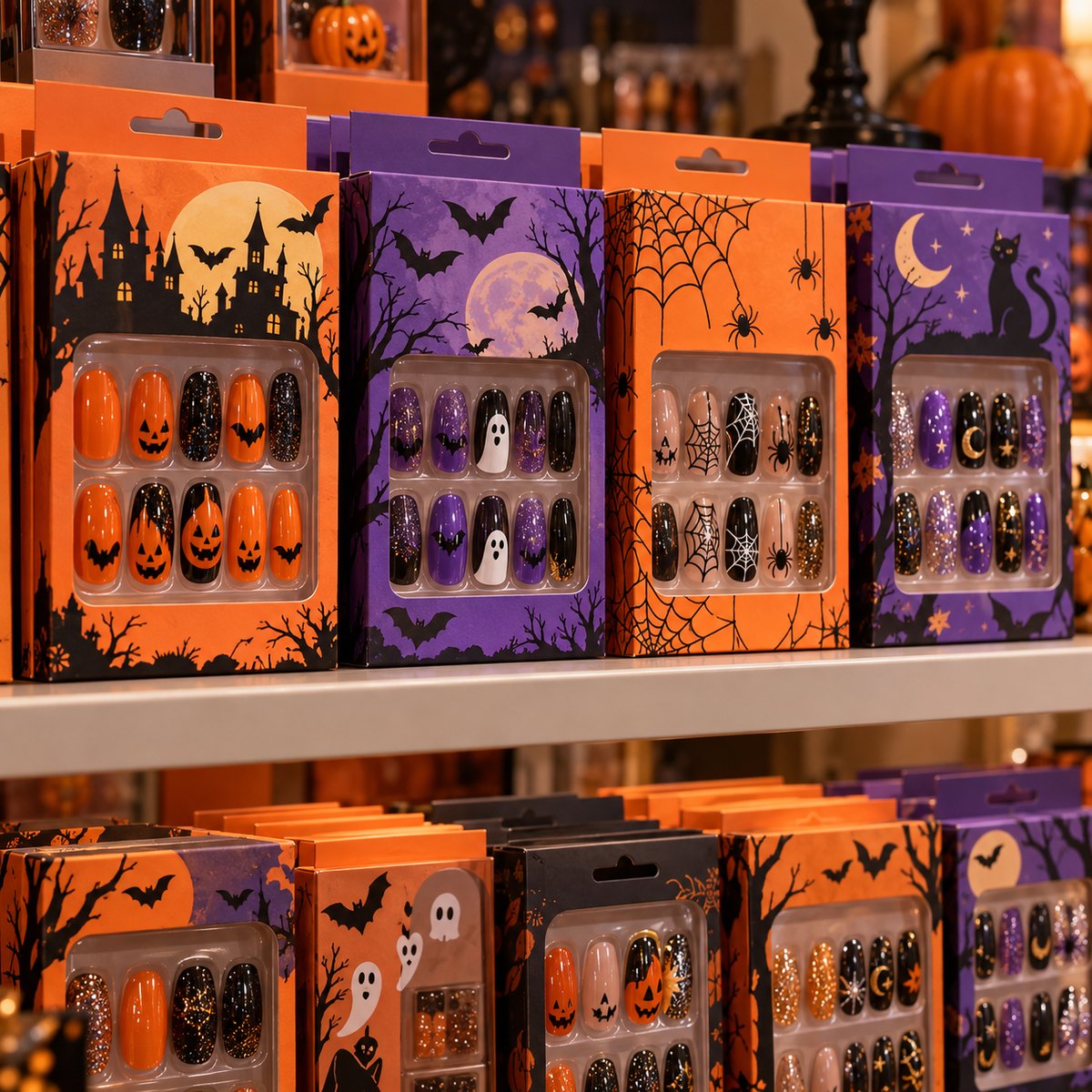
Most buyers picture the nails and stop there. The retail-ready unit is the thing a customer actually picks up: a box with a window, or a window card, that shows the nail design and carries the brand face. Inside, a backing card holds each nail in position and usually prints the size legend. A seal or closure keeps the set closed until first use, and a counter display presents several units at once. All of this is manufactured and shipped as part of the same SKU, so each part gets its own confirmation.
- Retail unit: the box or window card the shopper picks up.
- Backing card: holds the nails in place and carries brand and size information.
- Seal or closure: keeps the set closed until first use.
- Counter display: a multi-unit tray, sleeve or stand at retail.
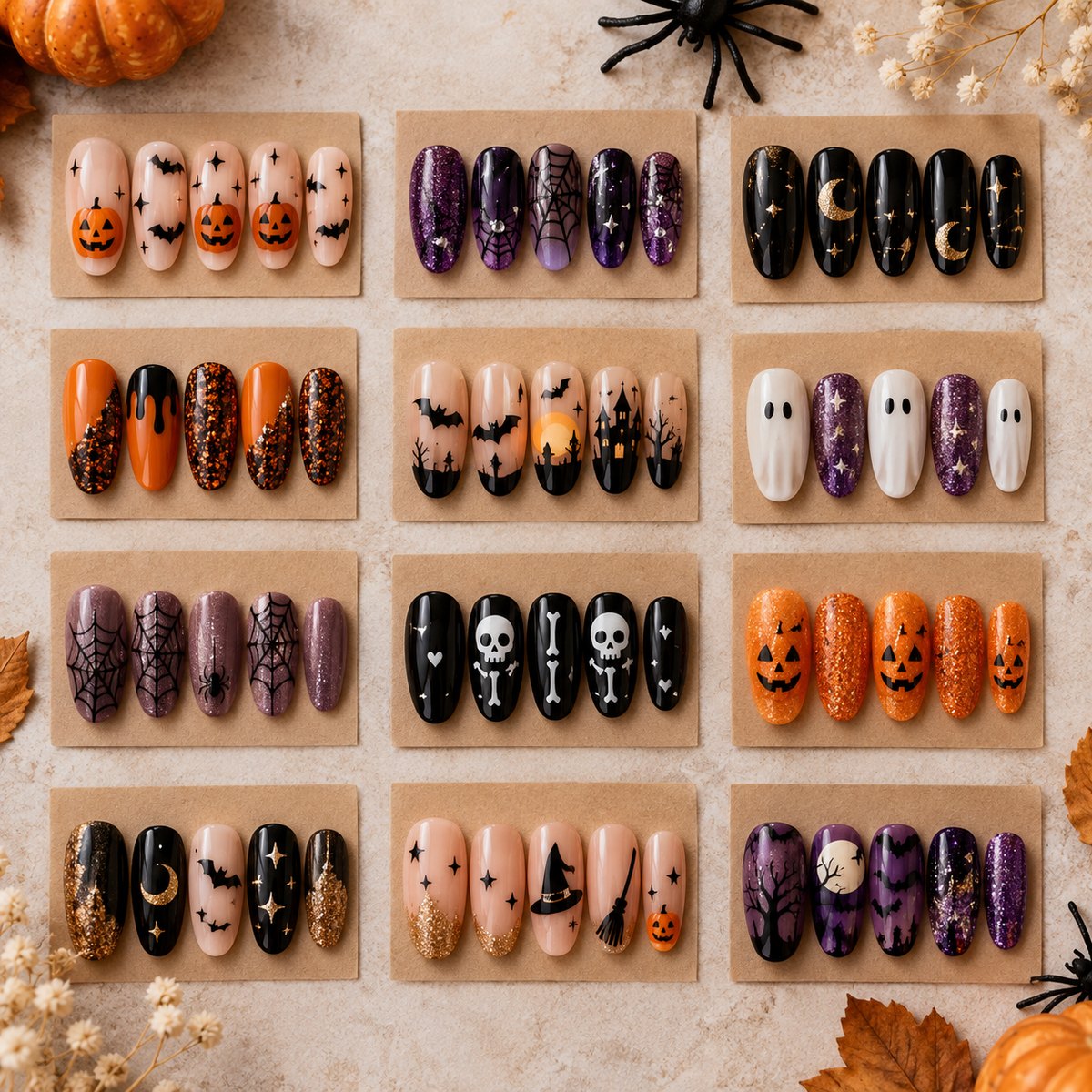
The artwork printed on the nails themselves is a separate decision, covered in the guide to Halloween press-on nail design themes. This article stays on the packaging and display around them.
| Component | What it does | What to confirm for Halloween |
|---|---|---|
| Box or window card | Front-facing surface; the window shows the nails, the card shows the art | Window shape and size, card stock, and whether the seasonal print sits on a removable layer |
| Backing card | Holds nails in position; carries brand and size information | Material, size legend, and whether it stays neutral or carries the theme |
| Seal or closure | Keeps the set closed until first use | Closure type and whether it holds in a hanging display |
| Counter display | Presents several units at retail | Unit capacity, standing or hanging, and rigidity when loaded |
What does seasonal packaging actually change?
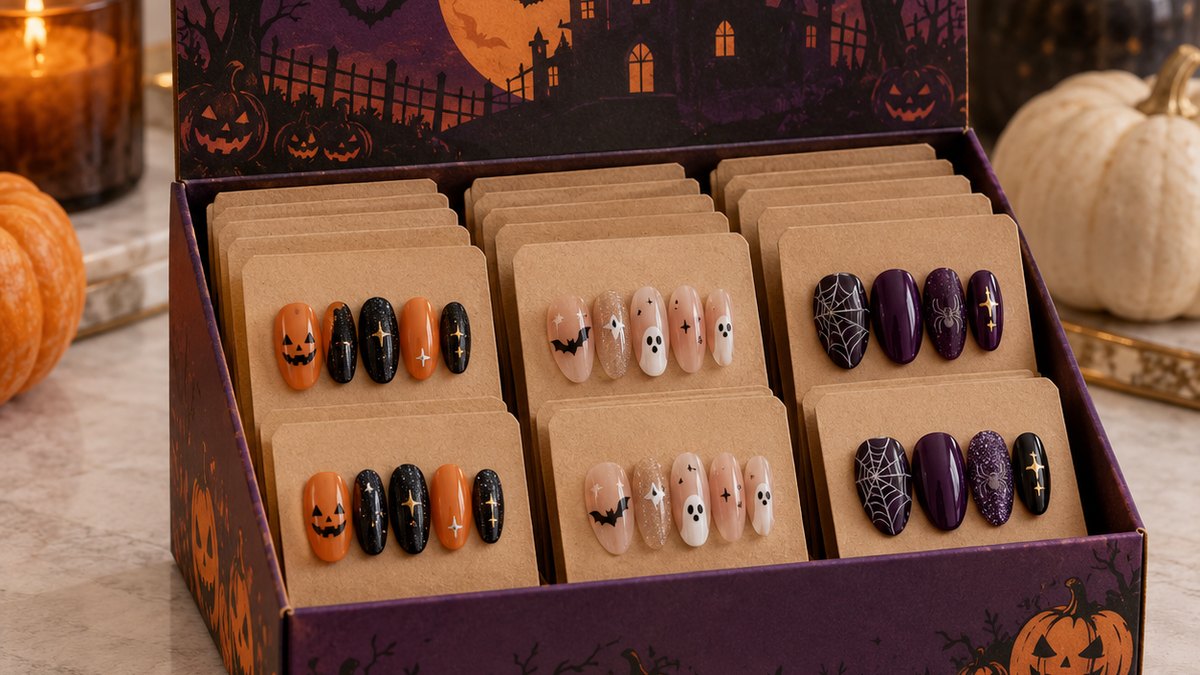
Seasonal packaging turns a standard nail SKU into a timed retail asset. The same nails on a neutral card sell all year; wrapped in a Halloween layer, the set sells into one window and then risks sitting unsold. The fix is a removable seasonal layer, so the real decision is where to put the theme.
The seasonal angle does not change the nails; it changes which surfaces carry the theme and for how long. A themed print forces a choice between committing the whole box to Halloween and keeping the theme on a removable sleeve or band. The second route keeps the base box neutral, so the same units remain sellable once the season ends. That is a packaging-design decision, not an inventory plan: the sleeve carries the seasonal signal while the unit stays generic.
- The outer surface becomes a themed sleeve or band over a stock box, not a fixed print.
- The backing card can stay neutral so the set remains sellable after the season.
- The display unit can carry the seasonal signal while the units themselves stay generic.
Should I use a stock box with a themed sleeve, or a fully custom box?
A stock box with a themed sleeve or band keeps the seasonal signal removable; a fully custom printed box commits the whole unit to one season. The sleeve route leaves unsold stock sellable after Halloween because the base stays neutral. Choose by how seasonal the range really is.
Two routes sit on the table. A stock box with a themed sleeve or paper band puts the seasonal print on a removable layer, so the base box and backing card stay neutral. A fully custom printed box burns the theme into the box itself, which looks finished but commits every printed unit to one season. For a range that will not sell through completely, the sleeve is the safer design; it also avoids new tooling because the base box already exists, which matters when a stock component avoids a new mould.
| Factor | Stock box + themed sleeve | Fully custom printed box |
|---|---|---|
| Seasonal signal | Removable sleeve or band over a neutral base | Printed into the box; the unit is committed to Halloween |
| New tooling | Usually avoids new tooling when the base box exists | May need new printing plates or a new box structure |
| Cost profile | Two elements to buy, but the base is reusable | One printed unit, heavier per-box decoration |
| Unsold stock | Base stays sellable once the sleeve is removed | Stays Halloween-branded after the window closes |
| Buyer question | How does the sleeve align and stay on the box? | How many units does a full print run require? |
What should a counter display unit actually do?
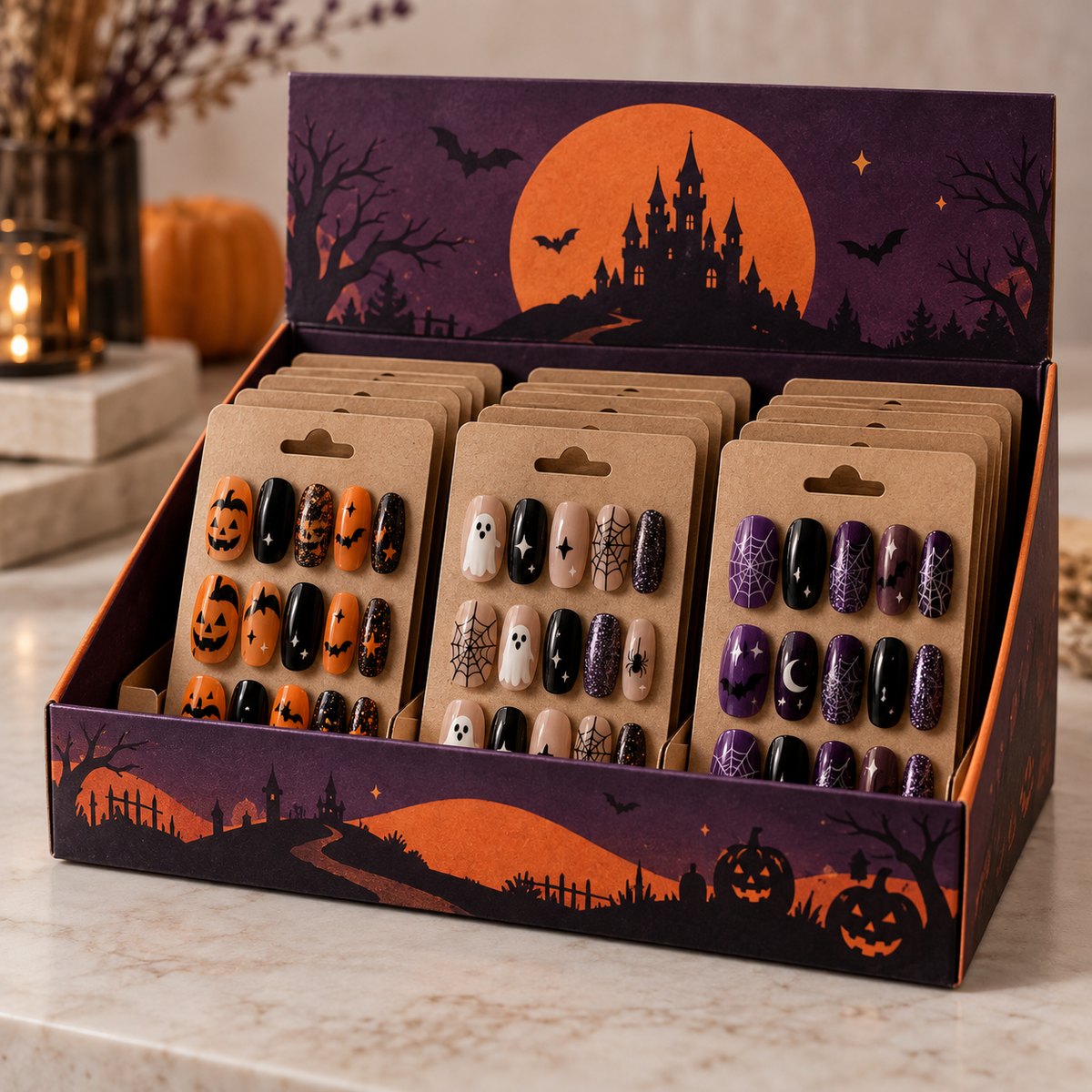
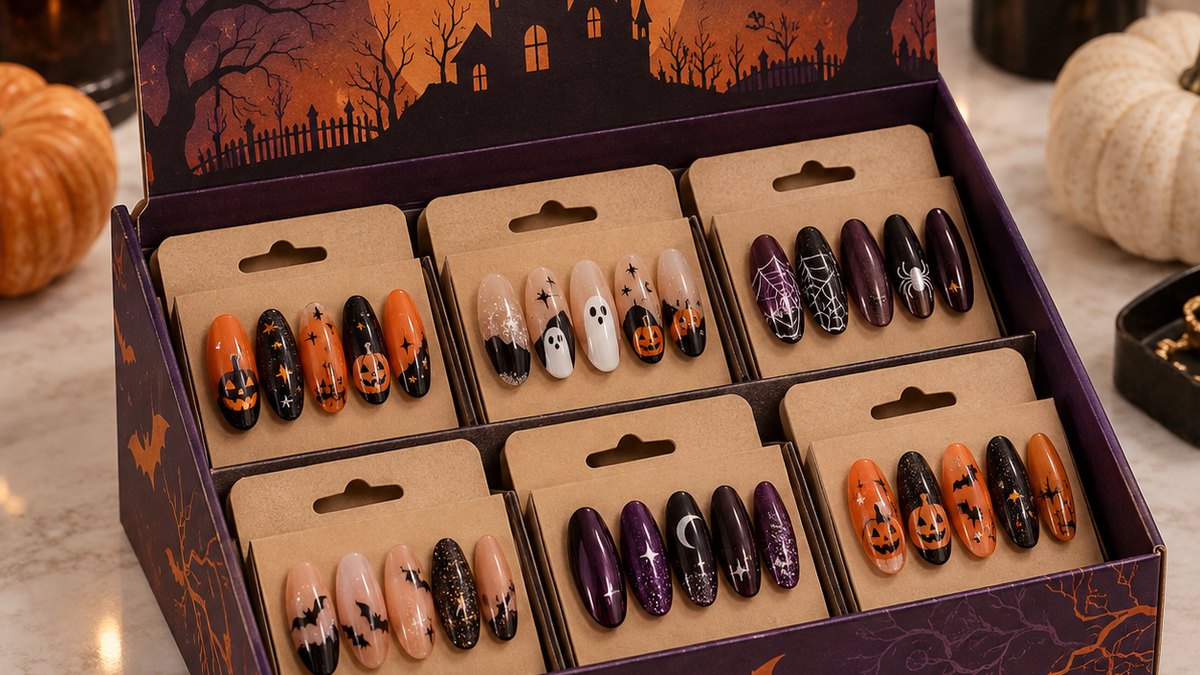
A display unit is load bearing, not decorative. It must hold its stated number of units without sagging, stand on a counter or hang from a rail, and keep each unit visible and reachable. Ask how many units it holds, how it mounts, and whether it arrives flat or assembled.
The counter unit is where the range meets the shelf, and it changes what the packaging must do. A box that sits flat is fine on its own; a box that hangs from a peg needs a stronger closure and a die-cut hole. Ask for the unit capacity as a question, not a number, because the right count depends on the retail pack and the channel.
- How many units does the display hold, and does that match the retail pack?
- Does it stand on a counter or hang from a rail or peg?
- How rigid is the base and back when fully loaded?
- Does it arrive flat-packed or pre-assembled, and who assembles it?
Which display form a given channel actually needs is covered in the guide to Halloween press-on nail channel assortment; a party store and an online seller rarely want the same unit.
Which print and decoration choices survive a dark Halloween base?
Dark bases hide weak ink, so the print method matters more on a black or deep-purple box. Light and metallic inks need enough opacity to read against the dark ground, and glow accents need a coating that actually charges and releases light. Confirm the method, not the mock-up.
Halloween leans on dark bases and glow accents, and both stress the decoration more than a pale box does. A light logo or type on black needs an opaque ink or foil, not a thin screen pass. A glow accent needs a phosphor or light-reactive coating that charges under light and releases it in low light; a flat mock-up cannot show whether the effect actually works. Keep every decoration choice qualitative until a physical proof exists.
| Method | Why it matters on dark stock | What to confirm |
|---|---|---|
| Screen print | Strong opacity for light-on-dark art | Ink coverage and opacity on the dark base |
| Hot stamp or foil | Metallic reflect that reads on black | Foil color and whether it holds on the card stock |
| Digital print | Good for photo-real art and variable data | Color accuracy against the dark proof |
| Glow or phosphor accent | Charges and releases light in low light | How it charges and how long it visibly reads |
How do I confirm the packaging before I commit?
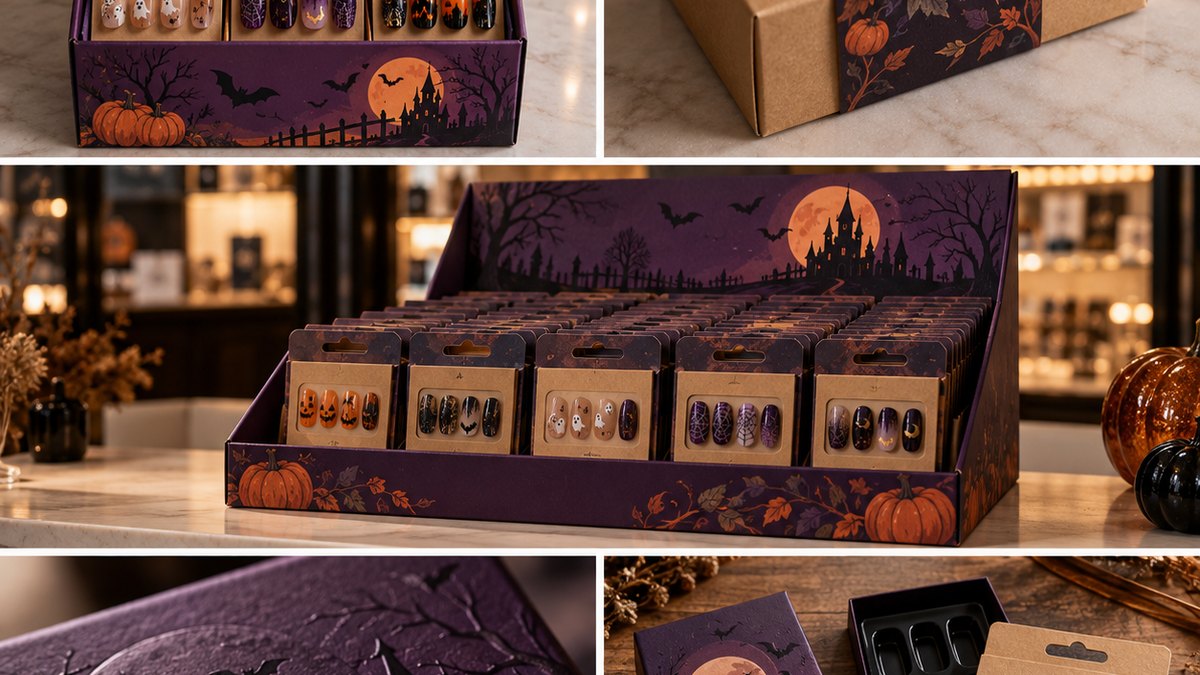
Confirm three things before ordering: the artwork files the printer needs, whether the print method holds up on dark stock, and a physical sample of the fully assembled unit with its sleeve and display. A render proves the design; only the assembled sample proves it works.
Before any commercial term is fixed, send a short checklist and hold the supplier to evidence for each row.
- Lock the artwork files and the exact print method for the dark base.
- Request a physical proof of the box, sleeve and backing card together.
- Request a sample of the assembled display unit, fully loaded.
- Check the seal and closure on the sample, not on a render.
- Confirm the minimum for the box, sleeve and display as one project.
The minimum for the box, sleeve and display is confirmed per project, because it depends on the box structure, the print method and the display unit rather than a fixed list.
The outer unit is where legally required information lives in many markets: the identity statement, net contents, responsible party and ingredient list. The exact set differs by market, so confirm what the target market requires against the official rules rather than assuming a supplier default.12 Cosmetics are regulated rather than approved, so treat any supplier using the phrase "FDA approved" as a warning and ask for the specific labeling and registration the market needs.4 Nail adhesives sit against skin, so request ingredient and allergen information and any testing the supplier holds instead of accepting a blanket safe claim.5
Good manufacturing practice guidance for cosmetics runs through production, control and storage, and the packing stage sits inside that same controlled process, so packaging is not an afterthought to the GMP scope.3 Markets differ as well: Indonesia, for example, runs its own notification and labeling path through the local regulator, so confirm the local route rather than assuming one global rule.6
- Approves a render as final without a physical sample.
- Cannot name the print method for dark stock.
- Quotes a firm minimum before seeing the box and display brief.
- Uses "FDA approved" as a blanket credential.
Frequently Asked Questions
- Do I need a separate supplier for the box and the nails? Usually not; the box, sleeve and display are coordinated as one project, but confirm who assembles and packs each unit.
- Can I reuse the stock box after Halloween? Yes, when the seasonal signal sits on a removable sleeve or band, the neutral base stays sellable once the sleeve is removed.
- Does a press-on set need the same labeling as liquid makeup? Confirm what the target market requires; in many markets the outer unit carries required information, and the exact set differs by market.
Conclusion
Halloween packaging changes the sourcing decision because the retail unit, the seasonal layer and the counter display are separate components. Keep the theme on a removable sleeve so the base stays sellable, choose a print method that reads on dark stock, and approve only a physical assembled sample. Confirm the labeling and adhesive checks against the market before any commercial term is fixed.
Share the nail styles, box direction, sleeve or custom print preference, target market and approximate quantity. ZONO can help organize the packaging and display questions and mark the remaining commercial facts for confirmation.
Discuss the Halloween packaging brief To see how press-on nail sourcing is handled across ready-stock, semi-custom and OEM routes, explore press-on nails.Footnotes
1. Cosmetic Labeling, U.S. Food and Drug Administration. ↩︎
2. Regulation (EC) No 1223/2009 of the European Parliament and of the Council on cosmetic products, EUR-Lex. ↩︎
3. ISO 22716:2007 Cosmetics — Good Manufacturing Practices (GMP), ISO. ↩︎
4. FDA Authority Over Cosmetics: How Cosmetics Are Not FDA-Approved, but Are FDA-Regulated, U.S. Food and Drug Administration. ↩︎
5. Allergens in Cosmetics, U.S. Food and Drug Administration. ↩︎
6. Badan Pengawas Obat dan Makanan (BPOM), Indonesia. ↩︎