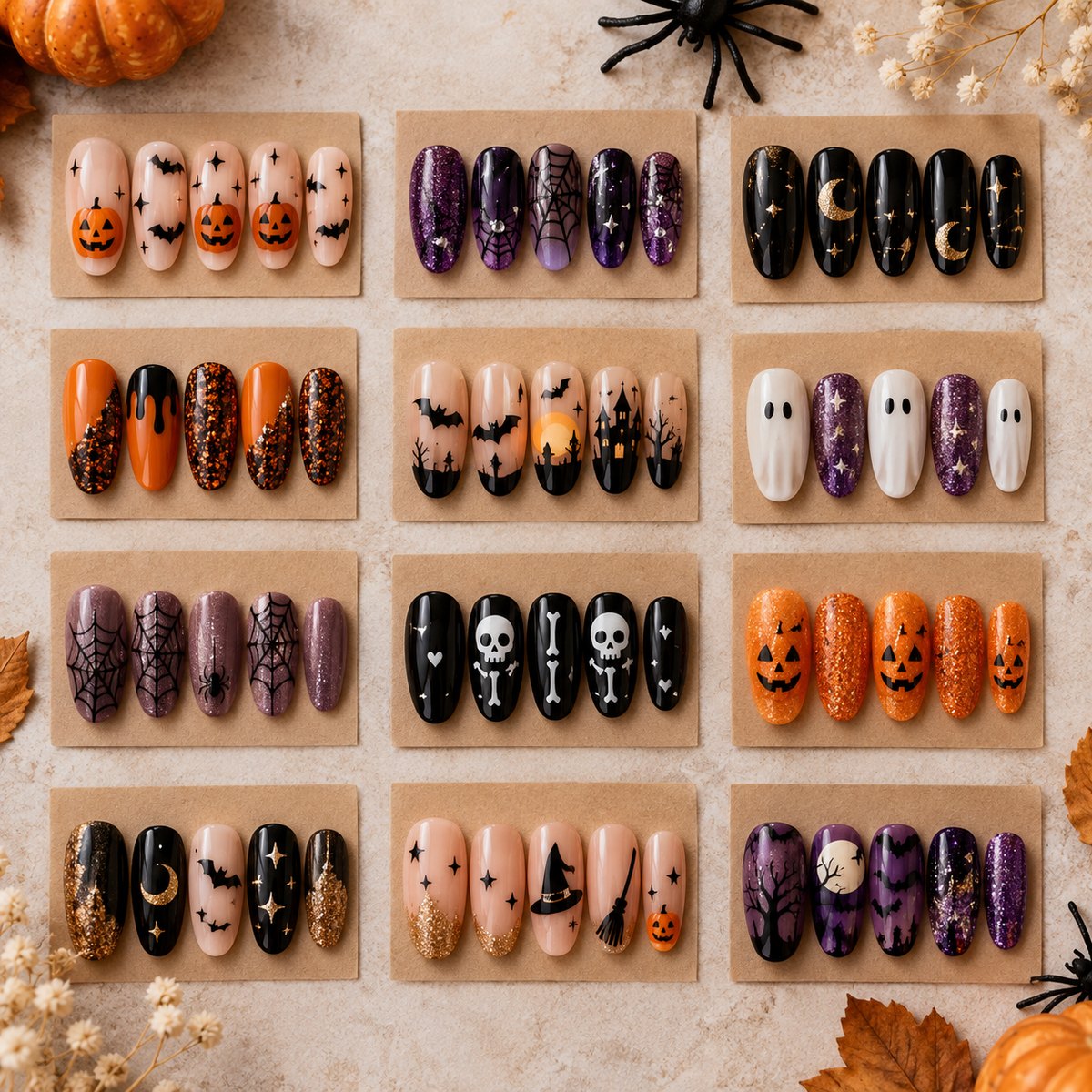
Halloween Press-On Nails by Channel: Assortment, Pack Format and Size Mix
Party shops, beauty boutiques and online sellers need different Halloween press-on nails. See how assortment, pack format and size mix should tilt per channel.
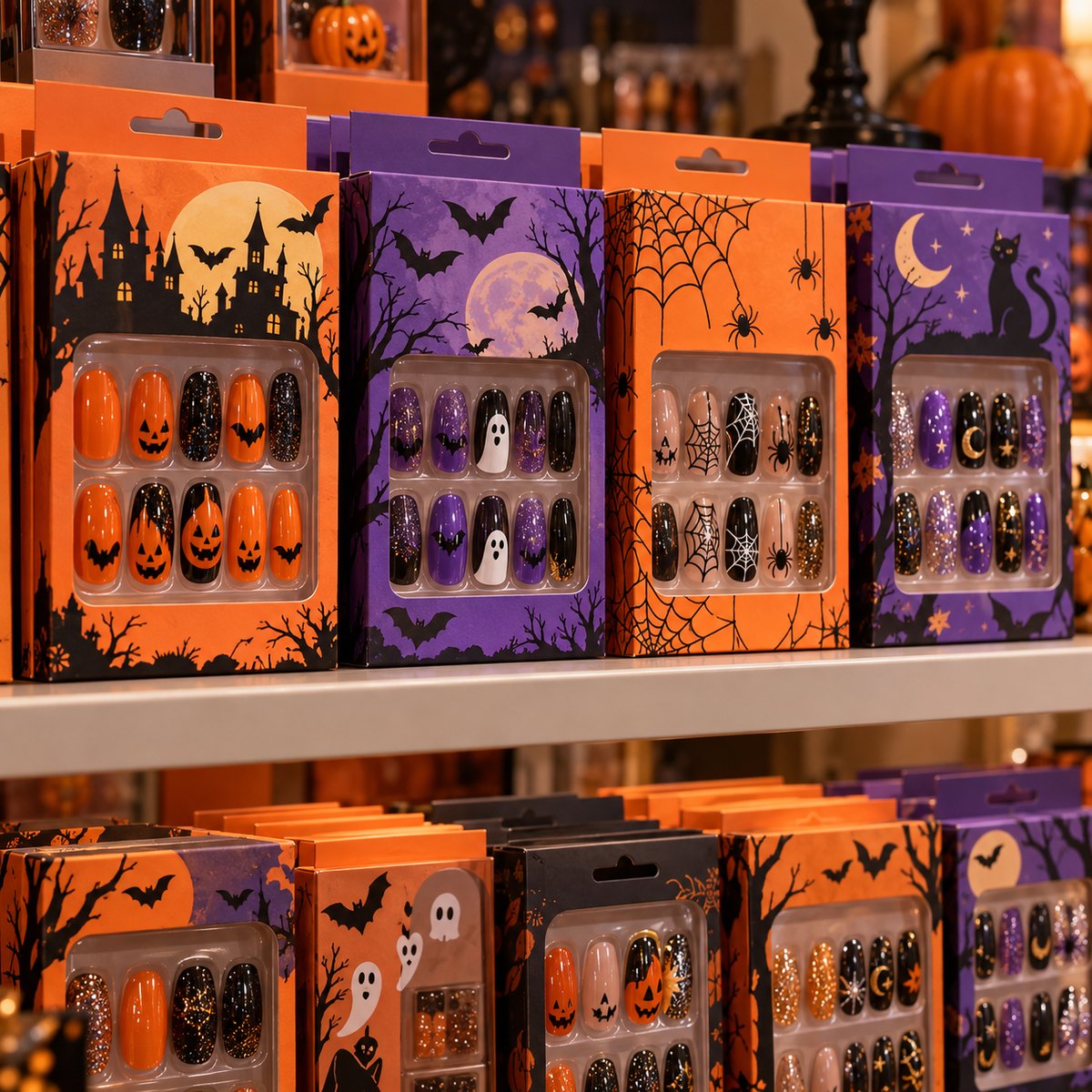
Halloween press-on nails look like one product on a sourcing sheet: one range, one supplier, one carton. At the point of sale they stop being one product. A party or costume shop sells them as throwaway novelty, judged in seconds from a few feet away. A beauty boutique sells them as finished fashion beside polish and skincare. An online seller sells a flat-lay photograph and a size chart. The same set is asked to do three different jobs, and one uniform assortment under-serves all three.
This guide covers halloween press on nails bulk and how the same range should tilt across the three channels that actually sell it. Design themes are handled separately in the guide to Halloween press-on nail design themes, so this article stays on assortment, pack format and size mix.
The same Halloween press-on nail range behaves differently by channel. Party and costume shops need bold, readable novelty at impulse price points; beauty boutiques need design-led packaging and clean finishes; online sellers need photographable designs and shipping-safe packs. Request a channel-tilted assortment, and vary pack format and size mix per channel.
ZONO Beauty is not positioned as a single factory; we coordinate long-term manufacturing suppliers from Shantou, Guangdong, across ready-stock, semi-custom and full OEM/ODM routes, backed by 10 years of product development and a ready-stock library of 1,000+ SKUs. For a seasonal top-up the ready-stock route ships from 12 pieces within 48 hours.
One compliance note before the channels. Press-on nails carry lighter regulatory weight than color cosmetics in most markets, but the adhesive is the sensitive part because it touches skin. The supplier questions below request ingredient and allergen testing rather than a blanket claim.
Why the same Halloween range behaves differently by channel
One range, one supplier and one carton become three different products at the point of sale. A party shop buys impulse and visual legibility; a beauty boutique buys finish and brand cohesion; an online seller buys a photograph and a size chart. The same SKU cannot optimize for all three, so the assortment must tilt.
The difference is not in the nails; it is in how the buyer sees them. A walk-in customer sees the whole card at once and decides in a glance. A boutique customer compares the set against the rest of the beauty wall. An online customer sees a cropped image and a list of measurements. Each context rewards a different part of the same product.
- Party and costume shops reward bold, readable designs and an open pack that sells itself.
- Beauty boutiques reward finish quality, packaging and a set that looks at home on the wall.
- Online sellers reward a clean flat-lay image, a clear size chart and a pack that arrives undamaged.
The channel-comparison table below is the whole argument in one view. Read it first, then use the sections that follow to turn each row into a supplier request.
| Channel | What it is actually selling | Assortment tilt | Pack format | Size mix |
|---|---|---|---|---|
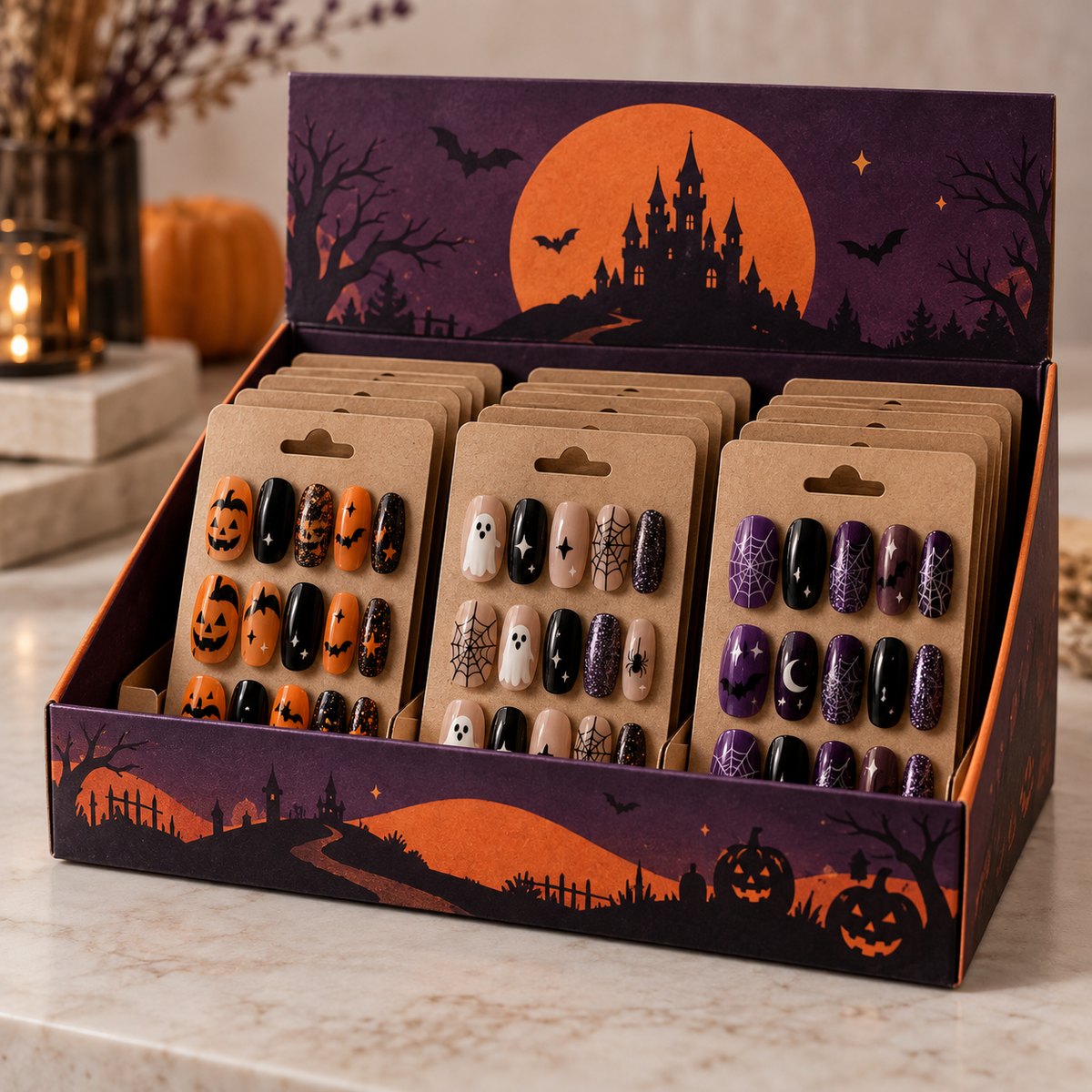
| Party and costume shops | Impulse novelty read at arm's length | Bold, high-contrast costume designs | Self-select display card, open or clear pack | Broad mix that fits most walk-in hands |
| Beauty boutiques | Finished fashion on the beauty wall | Refined finishes, design-led | Giftable box, cohesive with the wall | True-to-scale with clear fit information |
| Online sellers | A photograph and a size chart | Photographable, detail-clear designs | Flat, shipping-safe pack | Accurate chart printed on the pack |
What does a party and costume shop need from the range?
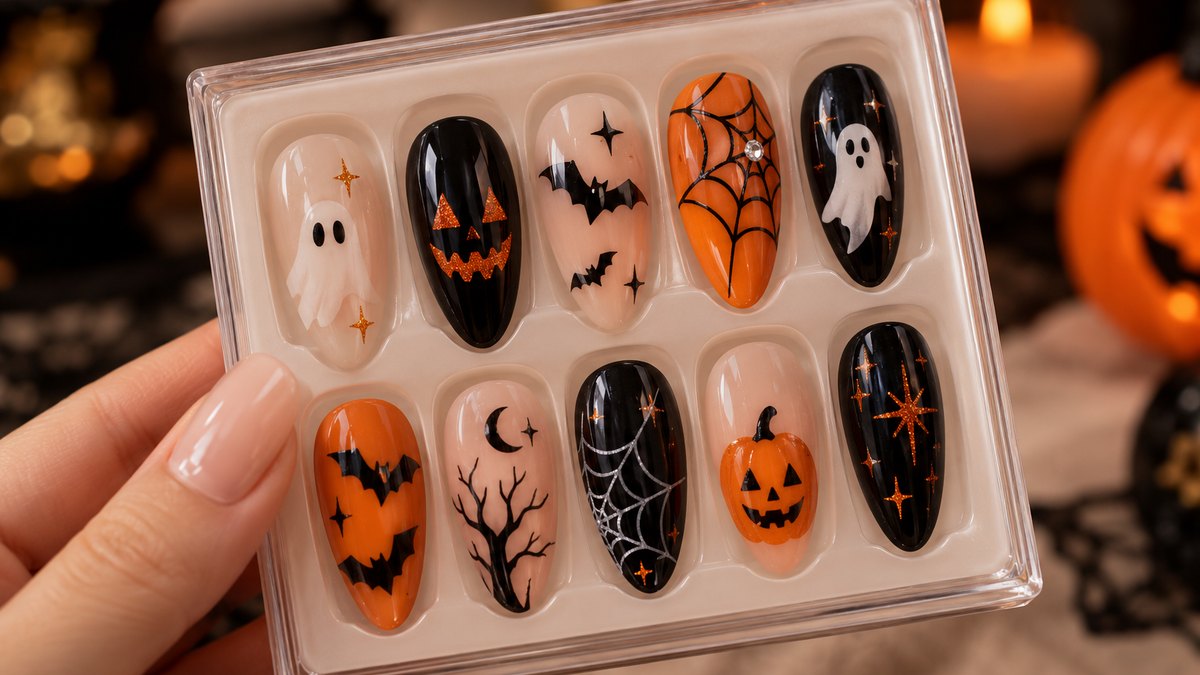
A party or costume shop sells press-on nails as an impulse buy, judged in seconds from a few feet away. Bold, high-contrast designs that read at arm's length matter more than fine finish. Choose self-select display cards, open packs and a size mix that fits walk-in hands without a fitting.
For press on nails for costume shops, the customer is usually on the way to an event and picks the set up the same way they pick up a mask or a wig. Nobody reads a size chart at the counter. The set has to look right instantly and fit most hands without a fitting, which pushes the assortment toward bold shapes, strong contrast and a forgiving size mix.
- Lead with designs that read from a few feet away, not fine detail that only shows up close.
- Use a self-select display card or an open pack so the design is visible without opening anything.
- Size the mix to cover the most common adult hands, since walk-in customers do not measure.
Party shops sell at impulse price points, so the range should favor novelty that turns quickly over finishes that raise the per-set cost. Keep the refined, design-led pieces to a minority and let the bold pieces carry the display. For a seasonal top-up, the ready-stock route suits a channel that reorders as the event approaches.
What does a beauty boutique need from the same range?
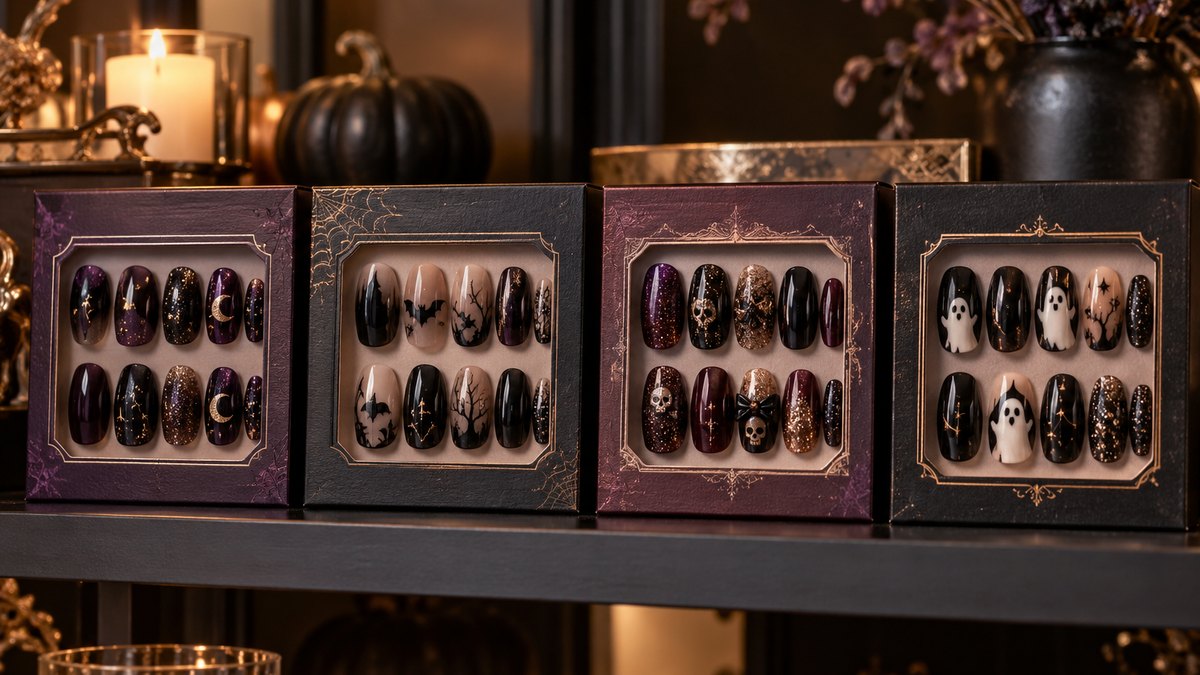
A beauty boutique sells the same range as finished fashion next to polish and skincare. Packaging must be design-led and giftable, and finishes must be clean and consistent, so the set reads as part of the beauty wall rather than a costume item. Request refined finishes, cohesive packaging and true-to-scale sizing.
Press on nails for retail stores in the beauty channel are judged the way a boutique judges polish: finish first. The customer holds the set, checks the edge quality and the gloss, and expects it to match the store's other brands. A costume-grade set with rough edges or glue residue does real damage to the wall.
- Specify clean cut edges, even application and a consistent finish across the set.
- Request design-led packaging that sits beside polish and tools without reading seasonal or cheap.
- Keep the finishes cohesive so a Halloween accent set still belongs on the wall.
Finish consistency is a production discipline, not luck. Good manufacturing practice for cosmetics is built on controlled production and documentation, which is where edge quality and batch-to-batch finish are actually won or lost.2 The pack format matters here as much as the nail: a boutique wants a giftable box or a cohesive sleeve that sits on the wall without reading as a Halloween throwaway.
What do online sellers need instead?
Online, the customer never touches the product; they read a photograph and a size chart. Flat-lay appeal, on-image scale cues and clear sizing matter more than in-store display. Choose sets that photograph well from above, ship in packs that survive transit, and print an accurate size chart on the pack.
Online marketplaces and seller storefronts remove the one thing a physical shop gives for free: the customer can hold the set. Everything a display card does in a shop has to be done by a flat-lay photograph and a listing. The design must read in a square crop, and the size must be legible before the order is placed.
- Shoot each set as a flat lay with a scale cue, such as a coin or a rule, so the buyer judges true size.
- Choose sets whose contrast and spacing survive compression and a small thumbnail.
- Ship in a rigid, flat pack so nails arrive unbent and the adhesive stays contained.
Online buyers read the size chart rather than seeing the product, which makes sizing the highest-return detail. A chart that does not match the physical nails is a direct source of returns, so the chart has to be tested against the actual set and printed on the pack where the customer keeps it. Any on-pack information still has to meet the labeling rules of the market being sold into.3
How the assortment tilts by channel
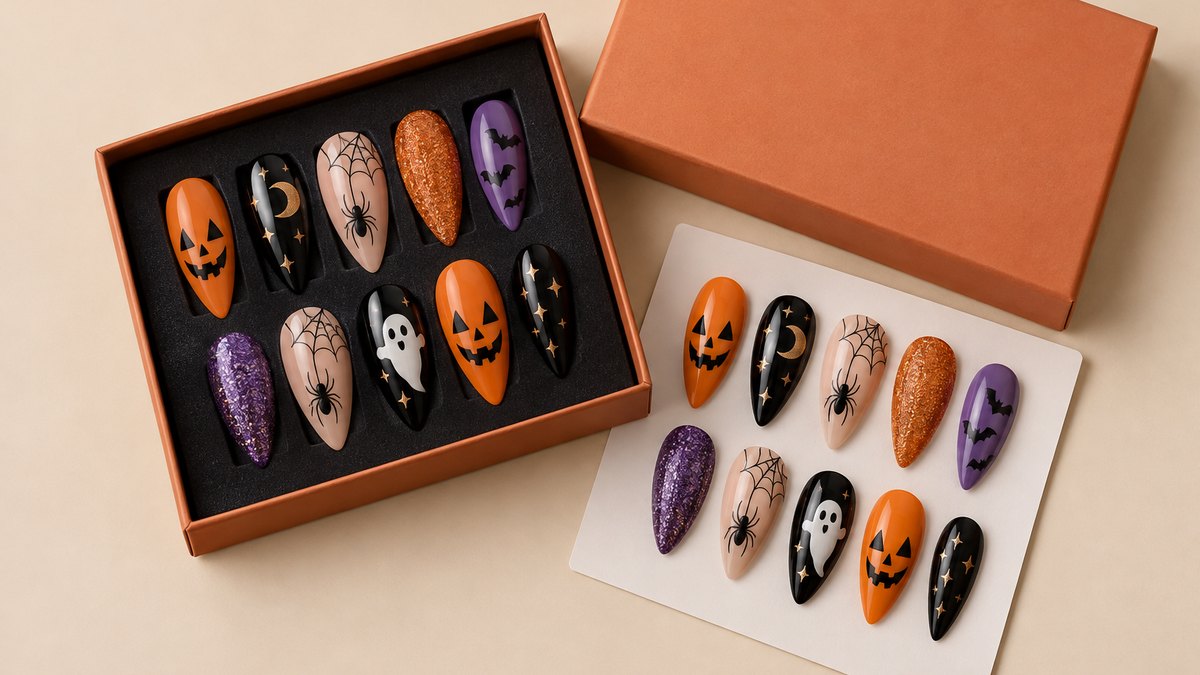
Tilt the range, do not rebuild it. Give party and costume shops a majority of bold novelty and a minority of refined finishes; give beauty boutiques the reverse; give online sellers the designs that photograph cleanly and hold up in transit. The tilt changes the proportion of SKUs and the pack format, not the core range.
A wholesale press on nails assortment does not have to be a different product for each channel; it has to be a different mix. The bold novelty pieces and the refined finish pieces can come from one range, but the proportion each channel receives should change, along with the pack format that carries them.
| Channel | Bold novelty share | Refined finish share | What changes with it |
|---|---|---|---|
| Party and costume shops | Lead with bold | Keep a small refined minority | Open self-select packs, broad size mix |
| Beauty boutiques | Keep a small bold accent | Lead with refined | Giftable boxes, true-to-scale sizing |
| Online sellers | Split by photographability | Split by photographability | Flat shipping-safe packs, printed size chart |
The reason one uniform range under-serves all three is that each channel is forced to sell against its own display or listing. A bold, chunky novelty set looks crude on a beauty wall and photographs badly in a refined flat-lay; a subtle, refined set vanishes on a party-shop card and reads flat in a thumbnail. The tilt is how one range serves each channel without rebuilding it.
Which channel should I stock for first?
Start with the channel that matches how you already sell. Costume and party sellers lead with bold novelty and self-select display; beauty walls lead with refined finishes; online sellers lead with photographable sets and an accurate size chart. The same range can follow, but the first assortment should match the strongest existing shelf.
Sequencing matters because the first assortment sets the pack format and the size mix that the rest of the range inherits. Pick the channel that is already closest to how the business sells, and let the other two follow as a tilt rather than a rebuild.
- Confirm the strongest existing channel: a shop floor, a beauty wall, or an online storefront.
- Lead the first assortment with that channel's tilt.
- Reuse the same core range for the other two, changing only pack format and size mix.
- Check the stock model before committing, so the assortment matches how the inventory is held.
Stock model is its own decision: whether you hold inventory in a warehouse or run dropship changes which pack format and size mix are affordable to carry. That comparison is covered in the guide to press-on nail inventory, dropshipping vs warehouse, so this article links rather than repeats it.
The pack format and size-mix questions to send a supplier
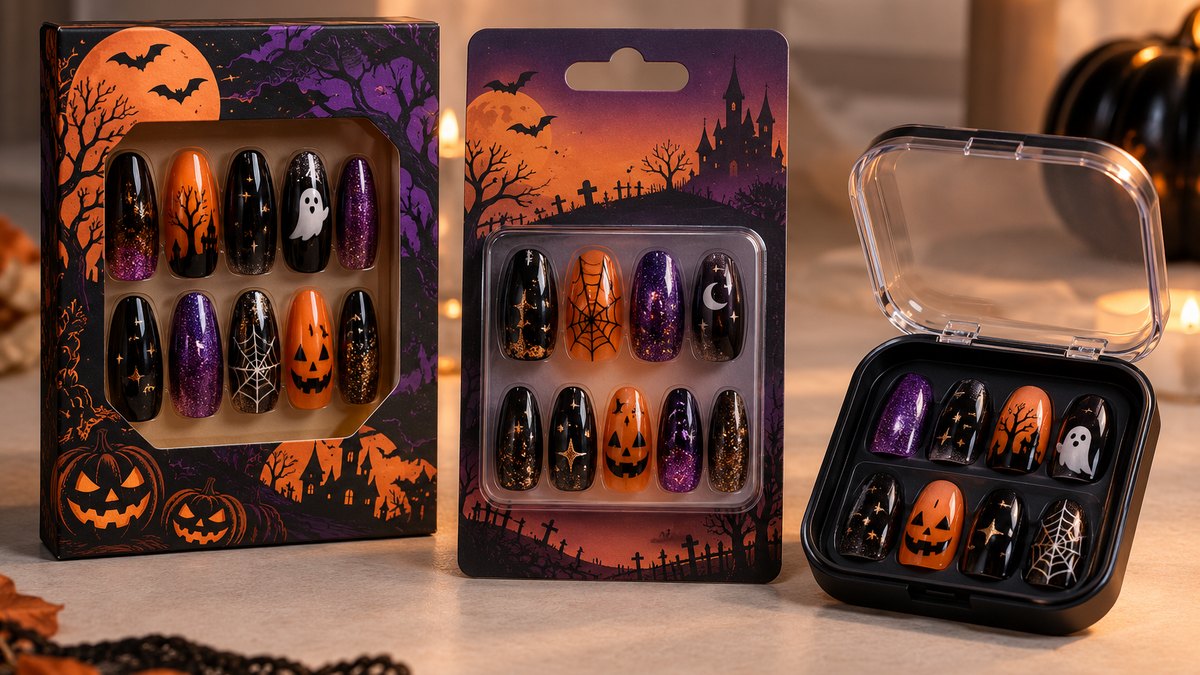
Send a supplier the channel, the display or listing format, and the target market, then ask four things: what pack format each channel needs, what size mix is offered, whether the size chart is printed on the pack, and whether the adhesive has ingredient and allergen test data. Tie each answer to a sample or document.
A supplier should answer in pack format and size mix, not in adjectives. The table below turns the channel decision into concrete requests, and each row points to a verifiable output.
| Input to send | Question to ask | Verifiable output |
|---|---|---|
| Channel | Which pack format fits this display or listing? | Physical pack sample per channel |
| Size mix | How is the set matched to common adult hands? | Printed size chart against the physical set |
| Adhesive | Can the ingredient list and allergen test data be shared? | Adhesive document set, evaluator confirmation |
| Target market | Which registrations are in place, and which remain? | Registration or notification scope per market |
Review the answers in this order.
- Confirm the channel and its display or listing format.
- Fix the pack format and size mix per channel.
- Request the adhesive ingredient list and allergen test data.1
- Confirm market registrations before the assortment is locked.
For the EU, the adhesive caution sits inside a product safety framework: a responsible person, a safety assessment and notification are required before a cosmetic product is placed on the market.4 For markets such as Indonesia, confirm the local registration or notification path first.5 The minimum order is confirmed per project, and depends on design count, size mix, pack format and decoration, so a firm quote before those are fixed is a warning sign.
Frequently Asked Questions
- Which channel should get the boldest designs? Party and costume shops, where the set is read at arm's length and bold contrast turns the impulse into a sale.
- Can one range really serve all three channels? Yes, if the proportion of bold and refined SKUs and the pack format tilt by channel instead of staying uniform.
- What is the most common online seller mistake? Reusing a store display card as the listing, which buries the design in a thumbnail and skips the size chart.
Conclusion
The same Halloween press-on nail range is a novelty, a fashion item and a photograph depending on where it is sold. Tilt the assortment and the pack format per channel rather than buying one uniform range, and send the supplier a size-mix and pack-format question list. One core range, three tilts, and the pack and sizing that each channel actually sells.
Share the channels you sell into, the display or listing format, the target market and the approximate breadth of the range. ZONO can help organize the pack-format and size-mix questions and mark the remaining facts for confirmation, with a reply within one business day.
Discuss your Halloween assortment To see the ready-stock, semi-custom and OEM/ODM routes behind a press-on nail project, explore press-on nails.Footnotes
1. Allergens in Cosmetics, U.S. Food and Drug Administration. ↩︎
2. ISO 22716:2007 Cosmetics — Good Manufacturing Practices (GMP), ISO. ↩︎
3. Cosmetic Labeling, U.S. Food and Drug Administration. ↩︎
4. Regulation (EC) No 1223/2009 of the European Parliament and of the Council on cosmetic products, EUR-Lex. ↩︎
5. Badan Pengawas Obat dan Makanan (BPOM), Republic of Indonesia. ↩︎
6. FDA Authority Over Cosmetics: How Cosmetics Are Not FDA-Approved, but Are FDA-Regulated, U.S. Food and Drug Administration. ↩︎