Sep 14, 2026Products, Packaging & Formula
How Should I Allocate Handmade Press-On Nails Inventory Between Dropshipping and Warehouse Fulfillment?
Learn the ideal warehouse-to-dropship inventory split for handmade press-on nails, plus a velocity threshold that protects cash flow and bestseller stock.
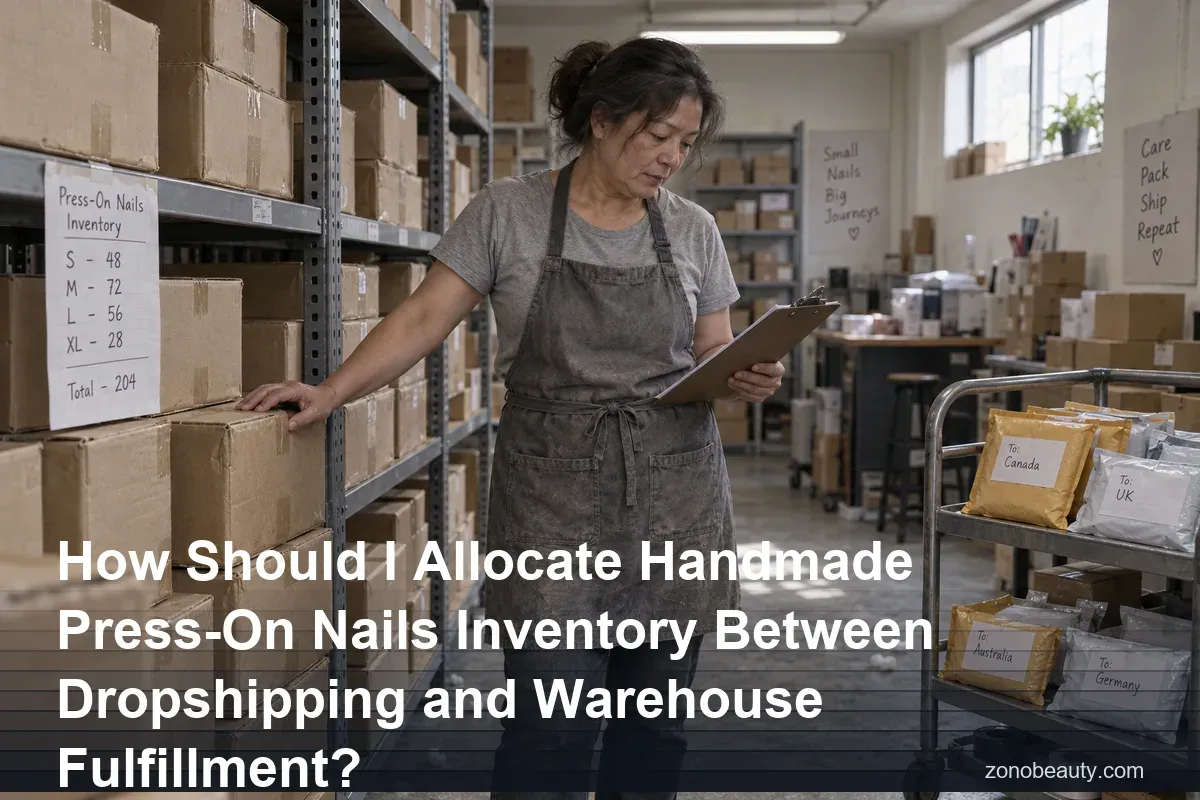

Handmade press-on nails inventory ties up cash. I've watched buyers we coordinate production for overstock a trend that died in six weeks — painful, avoidable, and fixable with a hybrid split.
Allocate handmade press-on nails inventory using a hybrid fulfillment model: warehouse roughly 70% for proven bestsellers, core shapes, and bundles that need fast shipping, and dropship the remaining 30% — new launches, trend tests, and long-tail designs — until a SKU proves stable sell-through.
That single sentence hides a lot of moving parts. The right split depends on your margins, your supplier's capabilities, and how fast your designs go stale. Let me break each part down the way I would in a sourcing call.
ZONO confirmed terms (for reference)
- Sample sets: US$15 per set, credited against your first bulk order.
- Bulk production: around US$7 per set, quoted per design.
- Minimum order quantity: 50 sets per design.
- Compliance documentation: available upon request; final compliance responsibility rests with the brand owner.
- Markets served: Southeast Asia, North America, and South America.
Any other figures in this article are general industry context, not a ZONO quotation. Confirm current terms in writing before ordering.
How do I decide what percentage of my press-on nail inventory should go to dropshipping versus warehouse stock?
A US nail brand founder asked me this exact question last quarter. Her catalog had ninety designs, and she was warehousing all of them. Half hadn't sold in months.
Start with a 70/30 split: warehouse 70% of inventory value in core essentials — neutral colors, standard almond and coffin shapes, proven bestsellers — and dropship 30% for seasonal, avant-garde, or experimental designs. Adjust monthly based on sell-through, stockout frequency, and return rates.

The 70/30 number is a starting point, not a law. The real logic behind it is the 80/20 pattern we see across almost every nail brand we support: roughly 20% of SKUs drive most of the revenue. Those SKUs deserve warehouse stock, because a <a href="https://www.investopedia.com/terms/s/stockout.asp" target="_blank" rel="noopener noreferrer">stockout on a bestseller</a> <sup id="ref-1"><a href="#footnote-1" class="footnote-ref">1</a></sup> is the most expensive mistake in this category. That is stockout risk management in its simplest form — protect the designs that actually pay your bills.
Allocate by product type, not by business
Do not pick one model for your whole brand. Assign a fulfillment lane to each SKU type instead.
SKU Type | Recommended Channel | Why |
|---|---|---|
Evergreen basics (nude, French, standard shapes) | Warehouse | Stable demand, fast shipping lifts conversion |
Proven bestsellers | Warehouse | Stockouts here cost the most revenue |
Bundles and gift sets | Warehouse | Dropship partners rarely handle multi-item packaging well |
New launches and trend tests | Dropship | No dead-stock risk if the style cools |
Custom and made-to-order sets | Dropship | Made per order by nature |
Long-tail niche designs | Dropship | Low volume never justifies carrying cost |
Set a velocity threshold before promoting a SKU
Treat dropshipping as a low-risk market testing phase. When a design holds a steady sales velocity for two or three consecutive review cycles, promote it to warehouse stock. Some brands we work with go further with dynamic rebalancing: warehouse inventory is reserved for subscription members and repeat customers, while one-time buyers are routed to dropship stock. That protects your highest-value relationships with the fastest fulfillment.
One objection I hear often: "Dropshipping preserves my cash, so why warehouse anything?" Because cash preservation is not profit. If your three bestsellers convert better with two-to-three-day delivery, warehousing them earns back the capital quickly.
✔ Dropshipping works well as a low-risk testing phase before committing a design to warehouse stock TrueNew press-on designs are trend-sensitive, so dropshipping lets you validate demand without buying bulk inventory that might never sell through.✘ Once you set your inventory split, you should keep it fixed for the year FalseNail trends shift within weeks, so the split must be reviewed monthly using sell-through, stockout frequency, and return data — a static split guarantees either dead stock or lost sales.
What MOQ and lead time factors affect my ability to dropship handmade press-on nails from a China-based supplier?
There is a trade-off we weigh on every press-on nail project: a lower MOQ usually means longer per-order production queues, while bulk runs shorten unit cost but lock capital.
MOQ and order lead time determine dropshipping feasibility: handmade sets require hand-application time per order, so supplier production queues, single-unit shipping capability, cross-border transit, and peak-season capacity all affect delivery promises. Confirm each factor in writing before allocating SKUs to a dropship channel.

Handmade changes the math completely. A machine-pressed nail set can sit in ready stock by the thousands. A handmade set with hand-placed charms, layered gel art, and individual curing has real labor hours in every unit. When we scope press-on projects with our vetted supply network, the first thing we map is whether a design can be dropshipped at all, or whether its complexity forces batch production and bulk wholesale distribution instead.
The factors that decide feasibility
Factor | How It Affects Dropshipping | What to Verify |
|---|---|---|
MOQ structure | Some suppliers accept single-unit orders; others only quote wholesale tiers | Written confirmation of single-set fulfillment |
Production queue | Handmade orders stack behind bulk runs | How dropship orders are prioritized |
Cross-border transit | International last-mile delivery speed varies widely by lane | Realistic door-to-door times per market |
Peak-season capacity | Holiday, prom, and wedding spikes strain hand-labor capacity | Surge capacity and cutoff dates |
Design complexity | Heavy 3D art extends per-set <a href="https://www.investopedia.com/terms/l/leadtime.asp" target="_blank" rel="noopener noreferrer">order lead time</a> <sup id="ref-2"><a href="#footnote-2" class="footnote-ref">2</a></sup> | Which designs qualify for dropship |
Two structural workarounds worth asking about
First, geography. Many brands warehouse stock for their primary domestic market — where buyers expect two-to-three-day delivery — and use China-based dropshipping for international orders, sidestepping complex cross-border logistics on low-volume destinations.
Second, semi-finished goods. We coordinate bulk and semi-finished bases for several clients: plain handmade nail bases are stocked near the customer, then custom-painted locally per order. That approach combines warehouse speed with dropship flexibility, and it shortens order lead time on custom work dramatically. Ask whether your supplier can quote semi-finished bases separately from finished sets — the answer tells you a lot about their flexibility.
How do I prevent quality or design mismatches between dropshipped batches and warehoused bulk inventory?
Last year our inspection team caught a glitter density drift between a client's dropship batch and her warehouse bulk run. Same design code, two visibly different products. Customers notice that.
Prevent mismatches by locking a golden sample per design, using one approved artwork and color-standard file for every batch, requiring pre-shipment inspection against that sample for both channels, and sourcing dropship and bulk orders from the same production source whenever possible.

Consistency is where hybrid setups quietly fail. Your warehouse stock might come from a bulk run produced in March, while dropship orders ship from a batch made last week — different gel lots, different painters, sometimes a different workshop entirely. In a handmade category, small drift compounds fast. Here is the process we run to hold both channels to one standard.
A golden sample system in six steps
- Approve a physical golden sample for every design, signed off before any production — dropship or bulk.
- Attach a written spec sheet: base color codes, glitter type and density, charm placement, shape and length tolerances, and topcoat finish.
- Require the supplier to keep a retained duplicate of the golden sample at the production site.
- Inspect every bulk run against the golden sample before shipment, and spot-check dropship batches on a set schedule.
- Use one shared design code across both channels, and keep multi-channel inventory sync tied to that code so a customer reordering gets the identical product regardless of which channel fulfills it.
- Photograph each approved batch under standard lighting and archive the images for dispute resolution.
Handle sizing and returns where control is highest
Press-ons carry a high return rate from sizing errors — part of the real Cost of Quality in this category. Returns are far cheaper to process through a central domestic hub than through a dropship partner overseas, which is another argument for warehousing your volume sellers. The same logic applies to bundles: premium glue, prep kits, and cuticle oil rarely survive the rigid packaging limitations of third-party dropshippers, so branded unboxing belongs in the warehouse channel. For limited artist collaborations, consider a micro-batch warehouse approach — small, exclusive, tightly inspected runs that protect the brand from mass-market dropship dilution.
✔ A signed golden sample with written tolerances is the anchor that keeps dropship and bulk batches consistent TrueWhen both channels are inspected against the same physical reference and spec sheet, drift in color, glitter density, or charm placement gets caught before shipment instead of in customer reviews.✘ If the same supplier produces both your dropship and bulk orders, the batches will automatically match FalseHandmade batches vary by gel lot, painter, and production date even within one supplier, so consistency comes from inspection against a retained sample, not from supplier loyalty alone.
What demand forecasting approach helps me balance dropshipping flexibility against warehouse holding costs?
One lesson a decade of supply chain work taught me: forecasting handmade nails by gut feeling fails, because trend cycles move faster than bulk production can respond.
Use a rolling monthly forecast built on sell-through rate, stockout frequency, return rate, and customer acquisition cost per SKU. Warehouse only designs with stable repeat demand, set safety stock levels from lead time variability, and keep the volatile long tail on dropshipping.

Forecasting is really margin math wearing a different hat. Every allocation decision moves money between two cost buckets: the margin penalty of dropshipping, and the <a href="https://www.investopedia.com/terms/c/carrying-costs.asp" target="_blank" rel="noopener noreferrer">inventory carrying costs</a> <sup id="ref-3"><a href="#footnote-3" class="footnote-ref">3</a></sup> of warehousing. You need both numbers on paper before any forecast means anything.
The margin math both channels must survive
Metric | Dropshipping | Warehouse Fulfillment |
|---|---|---|
Typical gross margin | Varies widely by channel and ad spend — model your own | Higher per unit through bulk purchasing |
Net margin after ads, shipping, returns | Often thin once CAC and per-order shipping are deducted | Better, but only above steady volume |
Main cost risk | Per-order shipping erodes low-ticket profit | Storage, labor, and dead stock |
Cash commitment | Minimal upfront | Significant upfront |
Do not assume low upfront cost means high profit. On a low-to-mid-ticket product like press-ons, customer acquisition cost plus per-order <a href="https://www.trade.gov/navigate-shipping-and-logistics" target="_blank" rel="noopener noreferrer">international shipping</a> <sup id="ref-4"><a href="#footnote-4" class="footnote-ref">4</a></sup> can erase an apparently healthy gross margin entirely. Warehousing shifts the problem: your 3PL logistics fees and carrying costs run continuously whether units sell or not. Shipping margin optimization — consolidating bulk freight inbound, then shipping domestic parcels outbound — is usually where warehoused SKUs win back their edge.
Monthly rebalancing signals
Signal | Threshold Behavior | Action |
|---|---|---|
Sell-through rate | Stable or rising for 2–3 cycles | Promote SKU to warehouse |
Stockout frequency | Repeated stockouts on a dropship SKU | Move it into stocked inventory |
Return rate | Elevated sizing returns | Route through domestic hub, review size kit |
CAC vs. margin | CAC eating net margin | Demote SKU to dropship or retire it |
Slow warehouse turns | Units aging past your target | Bundle, discount, stop reordering |
Forward-looking brands also feed AR try-on engagement data into this loop — if a specific shape or length spikes in virtual try-ons, they position warehouse stock before the sales arrive. Set safety stock levels from your supplier's actual lead time variability, not their quoted average; handmade production queues stretch during peak season, and your buffer has to absorb that.
✔ Net margins in dropshipping often fall to low single digits after shipping, advertising, and returns TrueGross margins that look workable on paper are compressed sharply by per-order fulfillment costs and customer acquisition spend on low-ticket items like press-on nails.✘ Because dropshipping needs little upfront cash, it is automatically the more profitable channel FalseLow capital requirement is not profit — per-unit shipping and ad costs frequently make dropshipped bestsellers less profitable than the same SKUs fulfilled from bulk warehouse stock.
Conclusion
Guessing your split burns cash either way. Warehouse proven bestsellers, dropship experiments, review monthly, and lock consistency with golden samples — that hybrid discipline protects margins and brand alike.
Sourcing handmade press-on nails and need to check MOQ against your order plan? Browse the ZONO press-on nail range for finished sets, shapes, and private-label options.
Footnotes
1. Defines the situation where inventory is exhausted, leading to lost sales and customer dissatisfaction. ↩︎ 2. Explains the latency between the initiation and completion of a production process. ↩︎ 3. Details the various expenses associated with holding unsold goods in a warehouse. ↩︎ 4. Official guide to international shipping and logistics from the International Trade Administration. ↩︎