Sep 14, 2026Products, Packaging & Formula
How to Manage Cash Flow Gaps When Sourcing Press-On Nails from China?
Manage press-on nails from China sourcing with confidence: use 30/70 deposit terms, buffer 15-20% for landed costs, and time reorders to close cash flow gaps.
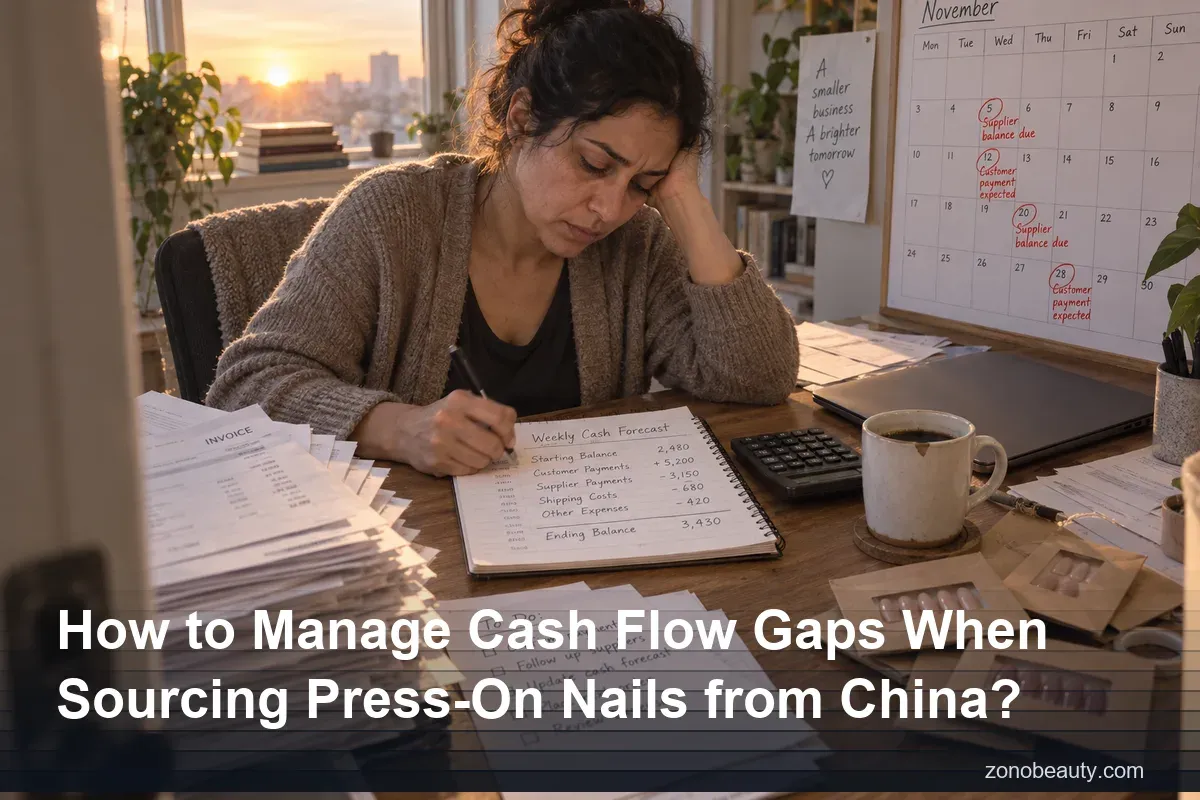

Cash flow gaps when sourcing <a href="https://www.trade.gov/" target="_blank" rel="noopener noreferrer">press-on nails from China</a> <sup id="ref-1"><a href="#footnote-1" class="footnote-ref">1</a></sup> have quietly killed more young brands than bad designs ever did. I've watched it happen from our coordination desk in Shantou.
To manage cash flow gaps when sourcing press-on nails from China, build a weekly cash forecast, negotiate 30/70 payment terms tied to inspection milestones, budget 15–20% above landed cost as a buffer, and time reorders with split shipments so revenue arrives before supplier balances come due.
The core problem is a timing mismatch. You pay your supplier weeks or months before your customers pay you. Your business can look profitable on paper and still run out of cash. In this guide, I'll walk through deposits, payment terms, hidden costs, and order timing — the four levers that decide whether working capital management makes or breaks your nail brand.
ZONO confirmed terms (for reference)
- Sample sets: US$15 per set, credited against your first bulk order.
- Bulk production: around US$7 per set, quoted per design.
- Minimum order quantity: 50 sets per design.
- Compliance documentation: available upon request; final compliance responsibility rests with the brand owner.
- Markets served: Southeast Asia, North America, and South America.
Any other figures in this article are general industry context, not a ZONO quotation. Confirm current terms in writing before ordering.
How much deposit should I really expect to pay before production starts on press-on nails?
A US nail brand founder once wired a 50% deposit before asking us a single question about milestones. Her cash sat locked in production for eleven weeks.
Expect to pay a 30% deposit before production starts on press-on nails, with the remaining 70% due after production or a passed pre-shipment inspection. New buyers placing small first orders may face higher upfront demands, while repeat customers can often negotiate deposits below 30%.

The 30/70 structure is the default in most <a href="https://www.cbp.gov/trade" target="_blank" rel="noopener noreferrer">China sourcing arrangements</a> <sup id="ref-2"><a href="#footnote-2" class="footnote-ref">2</a></sup>, and press-on nails are no exception. But the deposit is only part of the upfront money. Before any production deposit, you'll usually pay sample fees. For handmade press-on nails, a design brief often goes through two or three revision rounds before approval. Each round costs money and time, and none of it generates revenue.
What drives the deposit percentage up or down?
When we coordinate press-on nail projects through our vetted supply network, the deposit level tends to follow trust and order history, not a fixed rule. Here is how it typically breaks down:
Buyer situation | Typical deposit | Balance timing |
|---|---|---|
First order, small volume | 30–50%, sometimes T/T in advance | Before shipment |
Second or third order | 30% standard | After production or passed inspection |
Established repeat buyer | Below 30% is negotiable | Against Bill of Lading or delivery evidence |
First runs in this category are small enough to test demand but still large enough to lock up meaningful cash — at ZONO the minimum is 50 sets per design — especially once custom packaging enters the quote.
Protecting the deposit you do pay
A deposit is not just a cost; it's a risk position. Alibaba Trade Assurance or a third-party <a href="https://www.investor.gov/introduction-investing/investing-basics/glossary/escrow" target="_blank" rel="noopener noreferrer">escrow</a> <sup id="ref-3"><a href="#footnote-3" class="footnote-ref">3</a></sup> service holds your funds and releases them only when agreed milestones are met. For first-time private label manufacturing <sup id="ref-4"><a href="#footnote-4" class="footnote-ref">4</a></sup> orders, I push buyers toward these structures even when the supplier seems solid. There's a real trade-off here: paying faster and larger builds supplier goodwill and can speed up your production slot. But in my experience, a new brand's survival depends more on liquidity than on being a supplier's favorite customer. Preserve the cash first. Earn the goodwill through consistent reorders instead.
✔ A 30% deposit with 70% due after production or inspection is the common baseline for China sourcing orders TrueThe 30/70 split is the standard structure across most China manufacturing arrangements, including press-on nails, with the balance typically due at completion or before shipment.✘ Deposit percentages are fixed industry rules that suppliers cannot change FalseDeposits are negotiable and shift with order history and trust; repeat buyers regularly secure deposits below 30%, while unproven buyers may face full advance payment.
What payment terms can I negotiate with a Chinese supplier to protect my cash flow?
Every negotiation we run balances two forces: the supplier's fear of unpaid goods and the buyer's fear of prepaid nothing. Payment terms live inside that tension.
You can negotiate a 30/70 split with the balance released only against the Bill of Lading or a passed third-party inspection, escrow or Alibaba Trade Assurance protection, split shipments, and stock-and-release agreements that let you pay for goods in smaller batches.

Payment terms are the cheapest financing you will ever get, because they cost nothing but negotiation effort. The key is to tie every payment to a verifiable milestone rather than a calendar date the supplier controls.
The negotiation levers, ranked by realism
Lever | How it protects cash | Realistic for new buyers? |
|---|---|---|
Balance against passed pre-shipment inspection | You never pay full price for defective goods | Yes, widely accepted |
Balance against Bill of Lading | Goods are confirmed shipped before final payment | Yes, with escrow support |
Stock-and-release agreement | Supplier produces the full MOQ but stores it; you pay and ship in batches | Sometimes, after one or two orders |
Split shipments | Smaller invoices spread across weeks | Yes, if freight economics still work |
Letter of credit | Bank-controlled release for larger orders | Usually only at higher order values |
Supplier credit or net terms | Pay after delivery | Rarely, before a payment history exists |
The stock-and-release model deserves special attention for press-on nails. MOQ negotiation often stalls because the production team genuinely can't run a smaller batch economically. Stock-and-release sidesteps that. The factory hits its MOQ in one run, and you pull inventory in cash-sized bites.
Here's the honest objection I hear from buyers: "New suppliers will never give me these terms." Partly true. You won't get net-60 on order one. But milestone-tied releases and escrow are achievable from day one, because they protect the supplier too. Trade credit insurance and genuine supplier credit come later, after your payment history proves you're a safe counterparty. Build toward them deliberately — that history is an asset with real financial value.
✔ Tying the balance payment to a Bill of Lading or passed inspection is a realistic goal even for smaller buyers TrueMilestone-based releases protect both sides, so suppliers accept them far more readily than open credit terms, especially when escrow or Trade Assurance handles the funds.✘ First-time buyers can usually secure net-30 or net-60 payment terms from Chinese suppliers FalseOpen credit terms require an established payment history; new buyers should expect advance-payment or 30/70 structures and negotiate milestones instead of credit.
What hidden costs should I budget for so I'm not caught off guard mid-production?
Ten years of reconciling landed costs across lip gloss, packaging, and press-on nail shipments taught me one rule: the unit price on a quote sheet is the smallest number that will hurt you.
Budget for sample and revision fees, freight forwarding costs, customs clearance fees and import duties, quality control inspections, packaging tooling, currency spread, and local delivery. Keep a buffer fund of 15–20% of total landed cost to absorb volatile shipping rates and port delays.
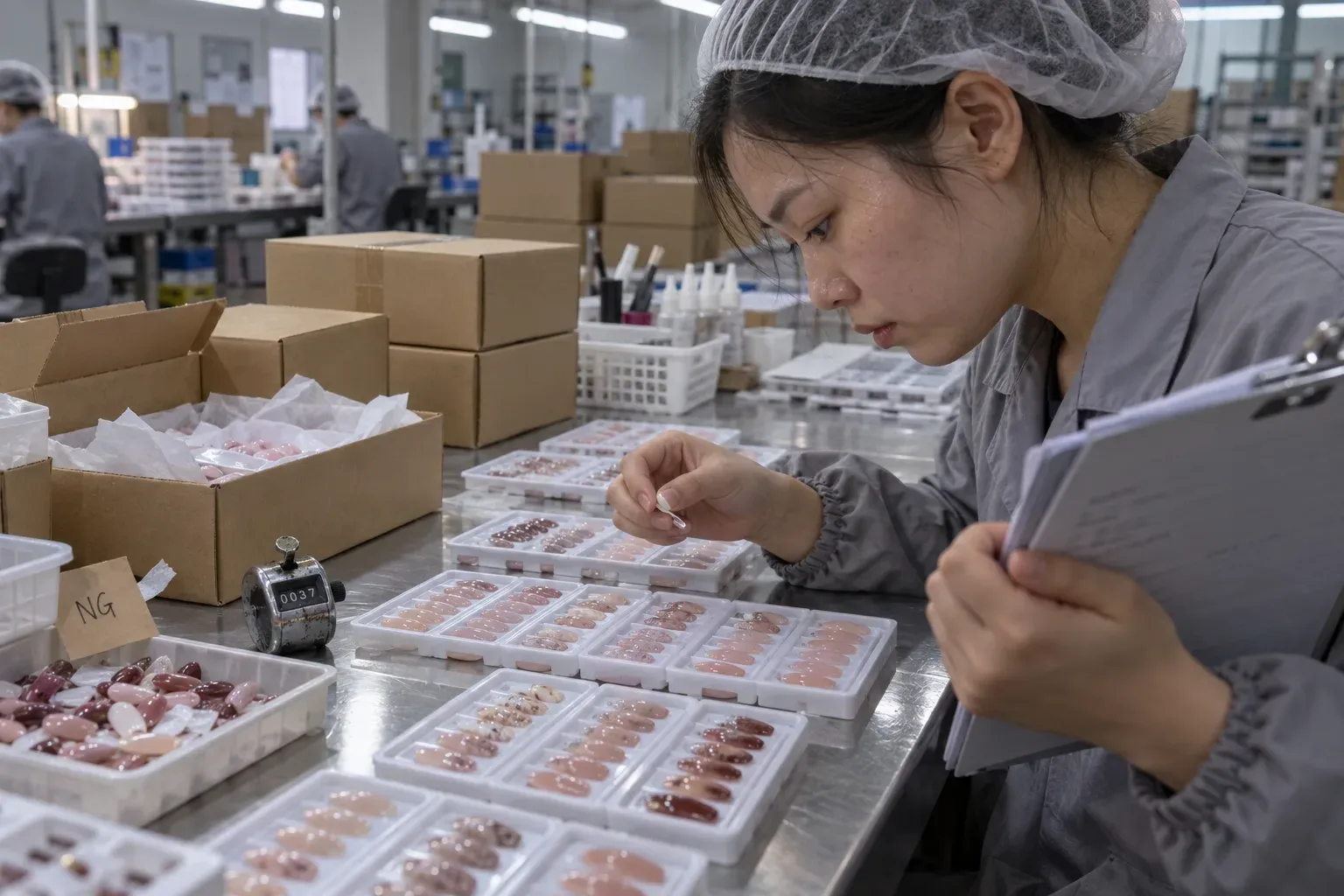
Most cash flow gaps I've helped untangle didn't come from the deposit. They came from a string of smaller bills that landed mid-cycle, when the buyer's cash was already committed to production. Each bill looked minor alone. Together, they broke the forecast.
Where the money actually leaks
Cost item | When it hits your cash | Why buyers underestimate it |
|---|---|---|
Sample and revision fees | Before any order exists | Two or three revision rounds are normal for custom nail designs |
Custom packaging and tooling | With or before the deposit | Boxes, inserts, and adhesive tab cards are quoted separately |
Freight forwarding costs | At booking, before goods arrive | Rates swing with season and route |
Customs clearance fees and duties | At the port, on the forwarder's schedule | Quoted unit prices never include them |
Quality control inspections | Before the balance payment | Skipping them risks paying 70% for defective stock |
Local delivery and warehousing | After clearance | Often forgotten entirely in landed cost math |
The buffer fund test
Before you approve any purchase order, calculate the full landed cost — product, freight, duty, inspection, delivery — and then check whether you'd still be solvent if the total came in 15–20% higher. That buffer is not pessimism. It's the realistic cost of shipping rate volatility and port delays in this category.
One structural option worth weighing: a component sourcing model, where nail tips, adhesive tabs, and packaging come from separate specialized vendors. It can lower total cost and break one large PO into smaller staged payments. The trade-off is coordination burden — formula-to-packaging and design-to-packaging compatibility checks become your job, which is exactly the failure point we spend the most time preventing on client projects.
How do I time my orders and shipments so I'm not sitting on cash-heavy inventory?
Last January, a Lunar New Year shutdown stretched one client's press-on nail reorder by nearly five weeks. Her bestseller sold out while her cash sat in a closed factory's queue.
Time orders using a weekly cash-flow forecast mapped to deposit, balance, freight, and payout dates. Start with a minimum-size test run — 50 sets per design at ZONO — then reorder proven designs at cash capacity, split shipments between air and sea, and use pre-order campaigns to collect revenue before balances fall due.

Inventory is cash wearing a costume. Every carton sitting unsold in your warehouse is money you can't spend on marketing, samples, or the next collection. Good timing turns that around, and it starts with forecasting by event, not by month.
A forecasting method that actually catches the gap
- Build a weekly cash-flow forecast, not just a monthly P&L. Monthly views hide the exact week your balance payment and freight invoice collide.
- Model every cash event by date: order date, deposit date, balance date, shipping date, customs date, and the expected customer payout date.
- Run a running-balance test to find your lowest cash point in the cycle. Compare it to your true operating reserve, and keep at least a 10–14 day buffer of supplier obligations and operating costs on hand.
- Size reorders by cash capacity, not just demand. Growth that outruns liquidity is just a slower way to fail.
Tactics that compress the cash cycle
Split shipments are the highest-impact move in this category. Fly a small portion of the order by air to start selling immediately, while the bulk travels by sea at lower cost. Sales revenue starts landing weeks before the main stock arrives, which directly improves your inventory turnover ratio.
Pre-order and VIP early access campaigns do the same thing from the demand side — customer cash arrives before your 70% balance is due. Some brands even test new designs via dropshipping for 30 to 60 days before committing to a bulk run. The proven scaling pattern I've seen work: start at your supplier's minimum per design, then scale reorders once a design proves itself.
For lead time optimization, plan around Lunar New Year and peak freight season, because both stretch the cycle without warning. And for larger operations, a 4PL partner offering bonded warehousing or duty deferment can delay import tax payments until goods actually sell. Supply chain financing, inventory loans, and revenue-based financing can bridge the remaining gap — but treat them as bridges over a forecasted gap, never as substitutes for the forecast itself.
✔ Splitting an order between air and sea freight lets you generate sales revenue before the bulk of your inventory arrives TrueThe air-freighted portion reaches customers weeks ahead of the sea shipment, so incoming revenue helps cover the balance payment and freight costs on the larger batch.✘ Ordering the largest possible quantity is always the smartest move because the per-unit price is lower FalseA lower unit price means nothing if the order locks up your operating cash for months; reorder size must fit cash capacity and sell-through speed, not just the discount table.
Conclusion
Cash flow gaps compound quietly, then strike all at once. Forecast weekly, tie payments to milestones, budget the hidden costs, and stage your shipments — and scale your nail brand deliberately.
Sourcing handmade press-on nails and need to check MOQ against your order plan? Browse the ZONO press-on nail range for finished sets, shapes, and private-label options.
Footnotes
1. Official U.S. government portal providing resources and data for businesses engaged in international trade and sourcing. ↩︎ 2. Authoritative U.S. Customs and Border Protection site covering regulations and procedures for importing goods into the United States. ↩︎ 3. SEC resource defining escrow accounts and their role in protecting funds during commercial and financial transactions. ↩︎ 4. FDA regulatory information regarding the safety, labeling, and manufacturing requirements for cosmetic products like press-on nails. ↩︎