Christmas Press-On Nail Range Sizing: How Wide a First Seasonal Range Should Be
How wide should a first Christmas press-on nail range be? A role-based method for seasonal SKU count, hero and supporter depth, and channel fit decisions.
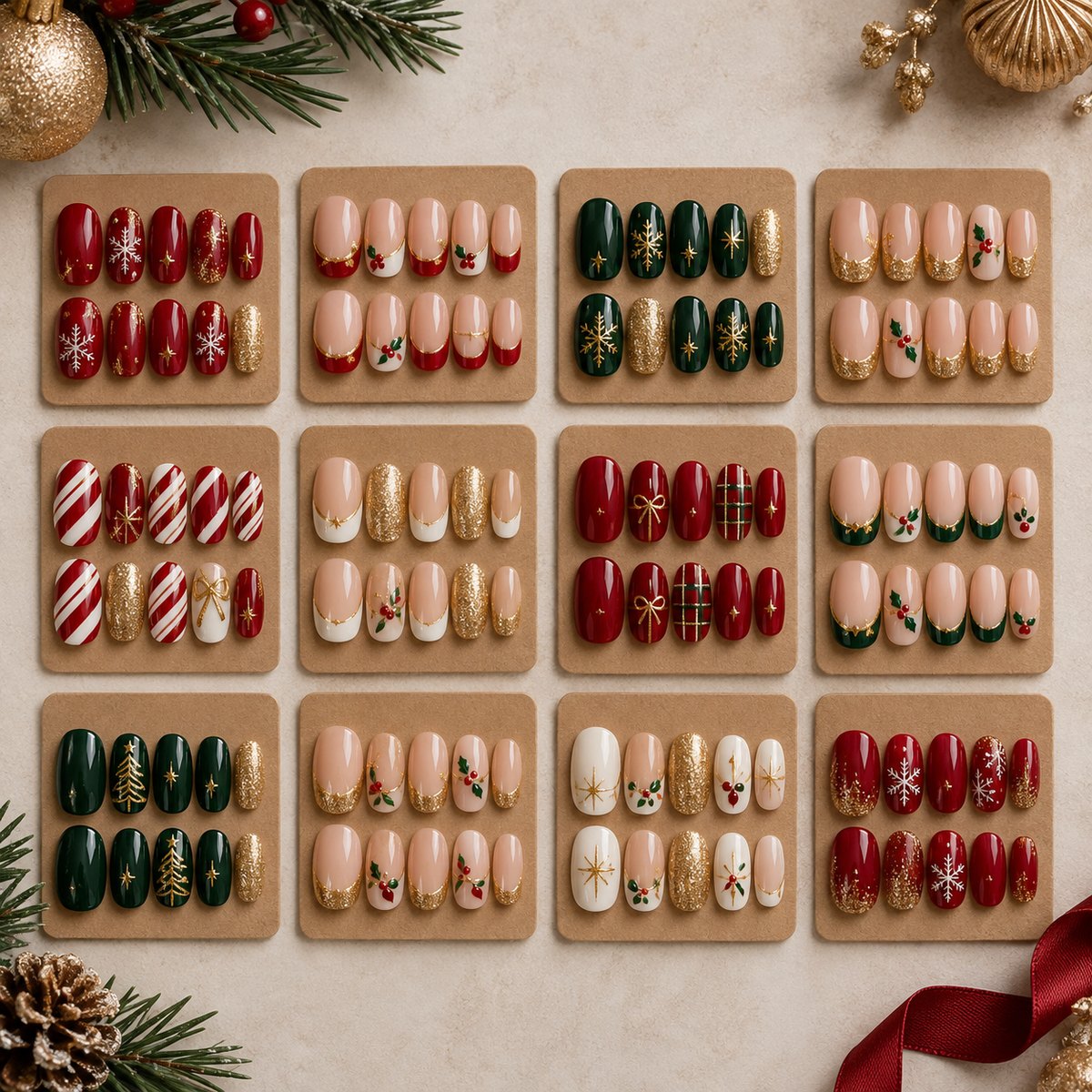
A Christmas press-on nails wholesale range is a bet placed inside a short window. Every seasonal range fails the same way when it is sized by feel: a buyer starts too narrow and watches the holiday browse pass by, or starts too wide and sits on designs that had only weeks to sell. Christmas sharpens this because the buying window is short, the gift intent is high, and the whole season collapses right after it ends. Width is the first decision to get right, and it is a call you make before any design is drawn.
A first Christmas press-on range is sized by role, not by count. Name a small set of hero designs to carry the season, add enough supporters to tell a shelf story, and treat the long tail as optional. Then let the channel and the budget set the actual width.
ZONO Beauty coordinates long-term manufacturing suppliers from Shantou, Guangdong, across ready-stock, semi-custom and full OEM/ODM routes, with a decade of product development behind the team. The sizing logic below is the method applied to seasonal press-on projects before any design is locked, because width is the decision every later cost, minimum and deadline sits on top of.
Why do seasonal ranges punish both extremes?
Too narrow misses the gift and browse traffic that peaks only in season, and a range with no clear heroes reads as thin. Too wide locks capital into designs that must sell inside a short, fixed window, then turn into leftover stock. Both fail for the same reason: width was set before each design's role.
A seasonal line behaves differently from a core line. A core design sells all year and can recover from a slow month. A Christmas design has to earn its place inside a compressed window, and anything left after the window closes becomes markdown inventory, not an asset. That is why width is a risk decision, not a variety decision.
| Extreme | What happens | Root cause |
|---|---|---|
| Too narrow | The range reads thin, and the gift and browse traffic that peaks in season passes to a wider competitor range. | Width chosen by caution instead of by role. |
| Too wide | Capital is locked into designs that must sell in a short window, then turn into markdown stock. | Width chosen by enthusiasm instead of by budget. |
- A narrow range misses browse traffic, which is how seasonal buyers discover a new line.
- A wide range spreads the budget across designs that never get a fair chance to sell.
- The same mistake repeats every season because width is decided before any design has a job.
How wide should my first Christmas range be?
The width is not a number to memorize; it is whatever the channel and budget support once each design has a job. Lead with a handful of heroes, fill the middle with supporters, and hold the tail until the core range proves itself. Start narrower than feels exciting.
The honest answer is that no fixed number works, because the right width changes with your channel, your budget and your target market. What holds steady is the method: name the heroes first, then the supporters, then decide whether the tail earns a place. A range that leads with roles reads as curated even when it is small.
The same role-first logic shows up in other categories. For a lip launch, the question is how many shades to open with, and the answer is the same discipline applied to color instead of seasonal themes; the guide to deciding how many shades a lip launch needs runs that argument in a different category, so it is not repeated here.
| Role | Job | Guidance |
|---|---|---|
| Heroes | Carry the season's revenue and marketing; the designs a customer is expected to remember. | A handful, treated as the lead and given the deepest stock. |
| Supporters | Fill the shelf story and make the heroes look deliberate. | Enough to complete the story, without duplicating the hero. |
| The tail | Everything else; more variety than the season can support. | Optional in a first range; hold until the core proves itself. |
The SKU count is the last thing to decide, not the first. Most buyers reverse this: they pick a number you feel safe committing to, then stretch designs into it. That produces a range where nothing is a hero, because the budget was split before the roles existed.
- Name the heroes before counting; the SKU count follows the roles, not the other way around.
- Give each supporter a clear, non-duplicating job, or cut it.
- Treat the tail as a test, not as the range.
Give each design a role before counting it
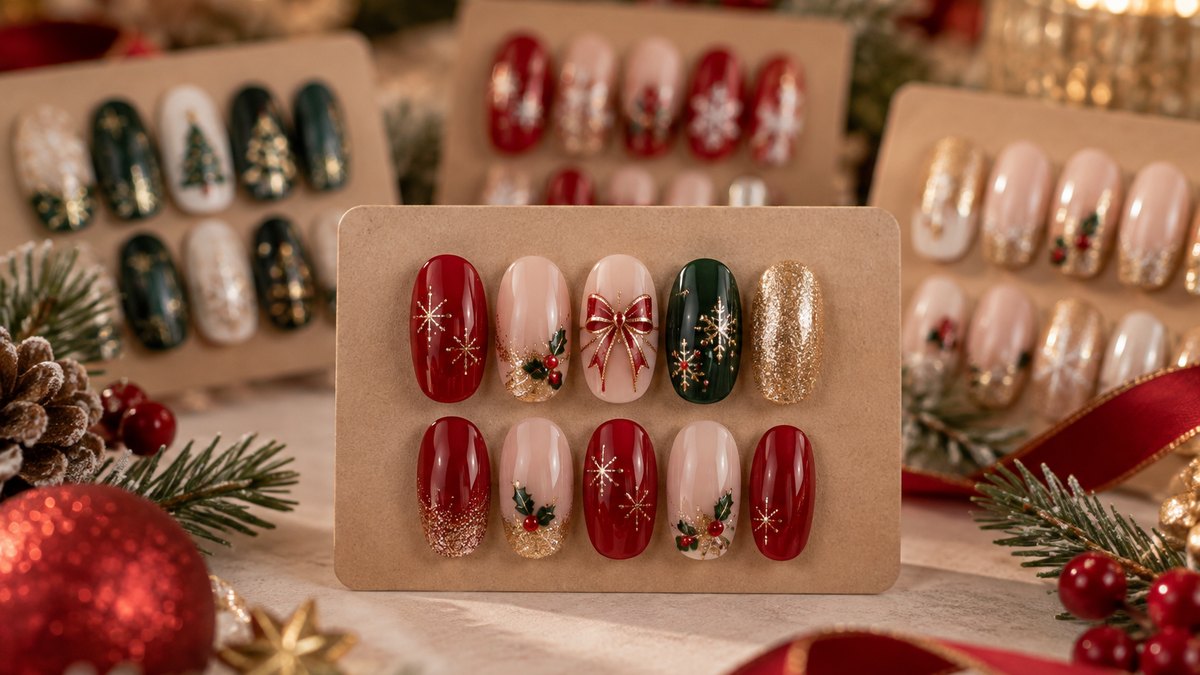
Heroes are the few designs expected to carry the season's revenue and most of the marketing. Supporters round out the shelf story and make the heroes look deliberate. The tail is everything else, and it is optional in a first range. Count only after these roles are fixed.
Assigning a role is a yes-or-no exercise for each design. Ask what this design does for the range: does it carry the season, support the hero, or pad the count? If the answer is pad the count, it is a tail item, and a first range can live without it.
This article sizes the range and deliberately leaves the finish choices aside. Which finishes read gift-ready in December, and which hold up in a photograph, is a separate job; the guide to Christmas press-on nail finishes that read gift-ready covers that side. For sizing, treat the finish as an attribute of the role, not a role of its own.
- Hero test: would a customer remember this design after leaving the page or the counter?
- Supporter test: does this design make the hero look stronger, or just repeat it?
- Tail test: is this here because it earns a place, or because the count needed filling?
How does the sales channel change the answer?
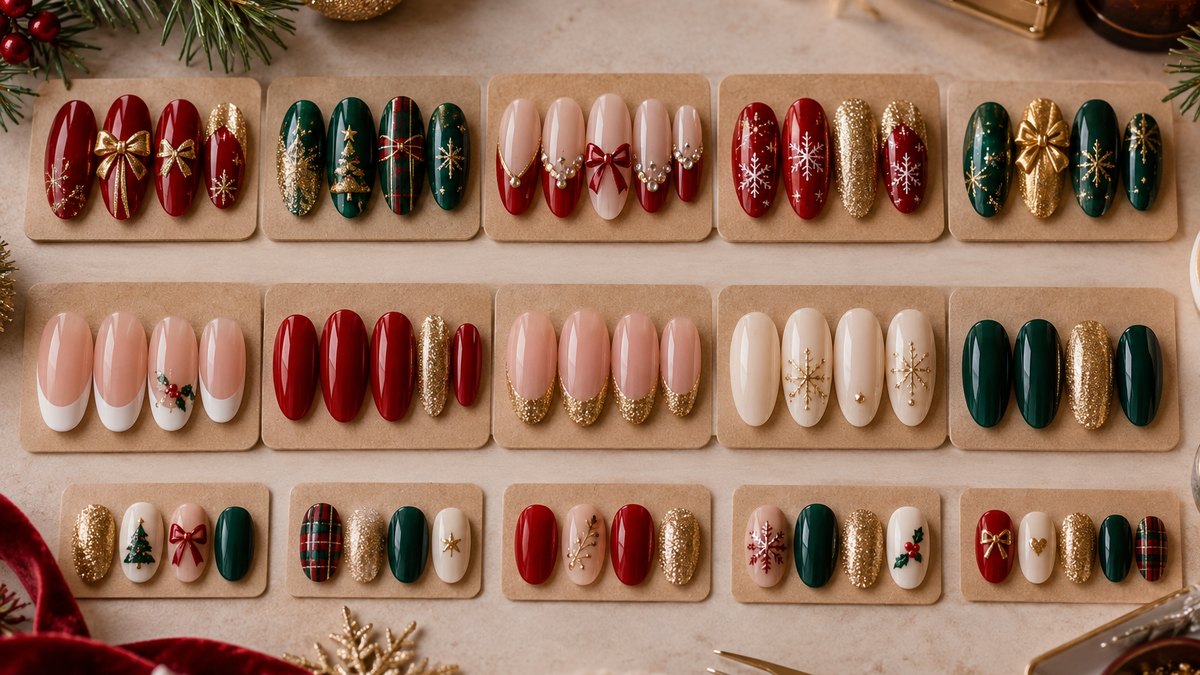
A boutique counter needs fewer, bolder designs, because every slot competes for limited space and a weak design wastes it. An online catalog can carry a wider set, because search and browse reward more options. Match the width to the channel before committing stock.
Channel is the strongest single driver of width, because it changes how a customer encounters the range. A physical counter shows every design at once and has no search function, so a weak design steals attention from a strong design. An online catalog is different: customers arrive by search and browse, so a wider set captures more entry points, as long as each design still has a clear job.
| Channel | How the range should read | Width and depth |
|---|---|---|
| Boutique counter | Fewer, bolder designs; every slot has to earn its place. | Narrow and deep on the hero. |
| Online catalog | A wider set that captures search and browse; themes can spread wider. | Wider, with depth still held on the hero. |
| Mixed or marketplace | Channel rules split; keep the physical set tight and let the online set run wider. | Separate widths, a shared budget. |
- Space: a counter has fixed slots; a catalog does not.
- Discovery: browse and search reward a wider online set.
- Commitment: a customer at a counter decides faster, so bolder reads better.
What happens when I trade depth for breadth?
The same budget buys either more designs at shallower depth or fewer designs at deeper depth, and stock-out risk rises as depth falls. Wide and shallow sells the range but invites fast sell-outs on the few designs that work. Deep and narrow protects the hero but leaves little room to test.
Depth is how many units a single design can back up; breadth is how many designs the range carries. On your fixed budget, depth and breadth trade directly. Every design added at the same spend reduces the depth available to the hero, and the hero is the design most likely to sell out.
- Wide and shallow sells the range but risks fast sell-outs on the few designs that move.
- Deep and narrow protects the hero but leaves no room to test a wider story.
- The stock-out risk is not uniform; it concentrates on the hero and the strongest supporter.
A sell-out sounds like a good problem, but in a seasonal window it is not: you have no time to reorder before the window closes. A buyer who over-spreads the budget buys variety and buys back risk at the same time.
| Choice | What it protects | What it risks |
|---|---|---|
| More designs, shallower depth | Shelf variety and discovery. | Fast sell-outs on the designs that move. |
| Fewer designs, deeper depth | The hero and the strongest supporters. | A thin story with little room to test. |

Treat width as a budget decision, not a design count
Every added design brings its own minimum, its own label and its own batch, so width is a spend decision, not a taste decision. The minimum for the range is confirmed per project, but the principle holds: more designs mean more committed units. Add a design only when its role earns the budget.
The minimum for press-on nails is not a fixed number; it is confirmed per project and depends on the design, the component, the decoration and the target market. What matters for sizing is the principle: every added design brings its own minimum, so a wider range is a wider commitment of units, not just a wider look.
Because press-on nails attach with adhesive, the adhesive is the component worth checking separately. Request the ingredient list and allergen testing for the adhesive2, then have the responsible safety assessor for the target market confirm it rather than accepting a summary.1
Each added design also carries its own label and ingredient declaration. Labeling must follow the target market, and the ingredient list has to be accurate for each design rather than copied across the range.3 That overhead is why a wider range costs more than the sum of its artwork.
Batch planning and documentation under cosmetics GMP add the same effect on the production side: each design means extra planning, records and changeovers, not just another color.4
A supplier that answers the adhesive question with "FDA approved" or a blanket "EU approved" should be asked for the certificate number and scope instead. Cosmetics are regulated, not approved.5
A market such as Indonesia ties the ingredient list to national registration, which is another reason to keep the range tight until the market requirements are confirmed.6
Run the sizing method step by step
Size the range in order, not by instinct. First, name the roles and what each must do. Next, split the budget across roles, giving heroes the most. Then, check the resulting width against the channel and trim or deepen. Repeat the same passes every season.
Seasonal nail range planning is a repeatable exercise, not a once-a-year guess. This is a method you can run in an afternoon, before any supplier is contacted, and it produces the inputs your supplier needs for a real quote.
- Name the roles. Write down which designs are heroes, which are supporters and which are tail, and what each must do for the range.
- Split the budget by role. Give the hero the deepest share of the budget, fund enough supporters to complete the shelf story, and leave the tail unfunded until the core proves itself.
- Sanity-check against the channel. Hold the resulting width up to the counter or catalog, then trim or deepen where the channel disagrees.
- Does every hero have a clear, memorable reason to exist?
- Does each supporter make the hero stronger instead of repeating it?
- Is the depth on the hero enough to survive the season's peak?
- Would the channel pass this width, or trim it on sight?
Frequently Asked Questions
- Is there a single right number of designs for a first Christmas range? No. The width follows the channel, budget and market; the method stays constant while the number changes.
- Should a first range include a long tail of extra designs? Not usually. The tail is optional until the hero and supporters prove themselves in the window.
- Does a wider range always mean a higher minimum? Yes in principle, because every added design brings its own minimum; the exact figure is confirmed per project.
- How should the adhesive be checked? Request the ingredient list and allergen testing, and have the responsible safety assessor for the target market confirm it.
Conclusion
A first Christmas press-on range is sized by role, then budget, then channel, never by a number picked from instinct. Name a handful of heroes, fund enough supporters to complete the story, and hold the tail until the core earns it. Width is a spend decision, so every added design has to earn its own minimum.
Share the target market, the channel, the rough budget and the themes a first range should carry. ZONO can help you name the roles, check the width against the channel and mark the remaining minimums and compliance facts for confirmation.
Discuss the press-on range brief To see how press-on nail sourcing is handled across a project, explore press-on nail sourcing.Footnotes
1. Regulation (EC) No 1223/2009 of the European Parliament and of the Council on cosmetic products, EUR-Lex. ↩︎
2. Allergens in Cosmetics, U.S. Food and Drug Administration. ↩︎
3. Cosmetic Labeling, U.S. Food and Drug Administration. ↩︎
4. ISO 22716:2007 Cosmetics — Good Manufacturing Practices (GMP), ISO. ↩︎
5. FDA Authority Over Cosmetics: How Cosmetics Are Not FDA-Approved, but Are FDA-Regulated, U.S. Food and Drug Administration. ↩︎
6. Badan Pengawas Obat dan Makanan (BPOM), Indonesia. ↩︎