Sep 14, 2026Press-On Nails
How to Negotiate MOQ Allocation for Mixed Container Orders of Press-On Nails?
Struggling to split MOQ across press-on nail designs in one container? Learn the 70/30 allocation strategy that gets supplier approval fast.
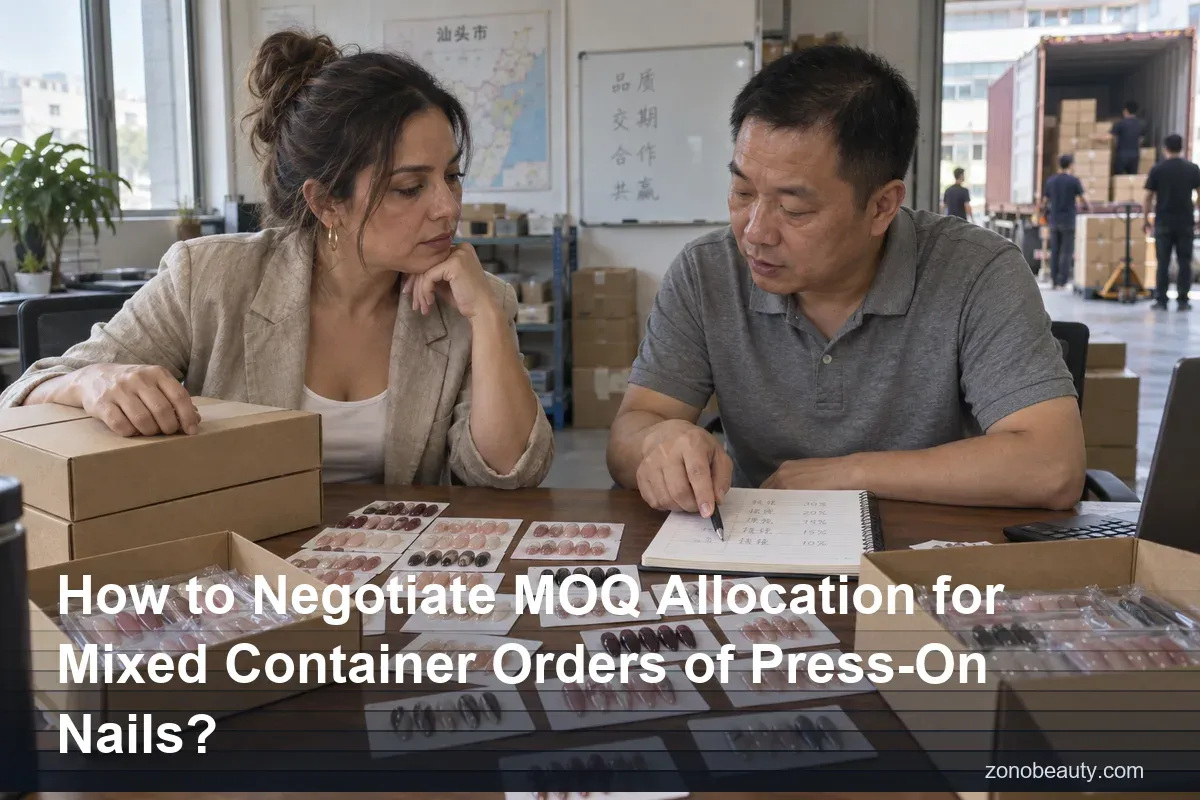
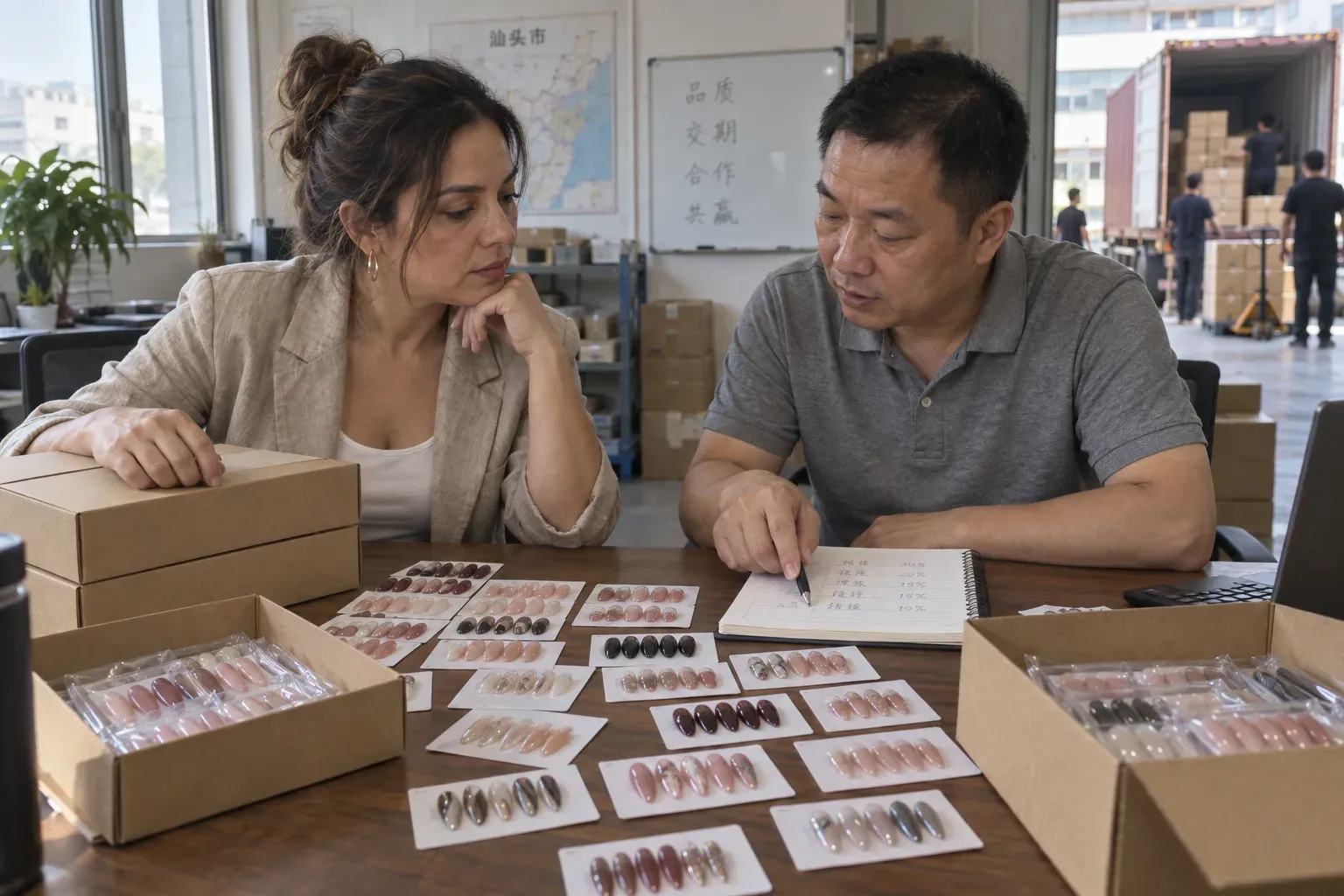
MOQ allocation for mixed container orders of press-on nails trips up almost every buyer we coordinate for. Designs multiply, minimums stack, and suddenly one container feels impossible to fill.
To negotiate MOQ allocation for mixed container orders, first confirm whether the minimum applies per design or per shipment, then trade simplicity for flexibility: standardize packaging, anchor 70% of volume in evergreen styles, and offer a modest price premium or deposit on low-volume experimental designs.
That short answer hides a lot of moving parts. The good news is that each part can be negotiated separately. Below, I walk through how to split your minimums, what drives factory flexibility, how to protect consistency, and which questions to ask before you commit to a Full Container Load (FCL).
ZONO confirmed terms (for reference)
- Sample sets: US$15 per set, credited against your first bulk order.
- Bulk production: around US$7 per set, quoted per design.
- Minimum order quantity: 50 sets per design.
- Compliance documentation: available upon request; final compliance responsibility rests with the brand owner.
- Markets served: Southeast Asia, North America, and South America.
Any other figures in this article are general industry context, not a ZONO quotation. Confirm current terms in writing before ordering.
How do I split my minimum order quantity across different press-on nail designs in one container?
A nail wholesaler recently sent me a container plan with fourteen designs at equal quantities. Her supplier rejected it in one email. We rebuilt the split together, and it cleared.
Split your minimum order quantity by percentage, not equal shares. Confirm the per-design floor first, then allocate roughly 70% of the container to proven evergreen styles and 30% to experimental designs, keeping every SKU at or above the supplier's per-style minimum.
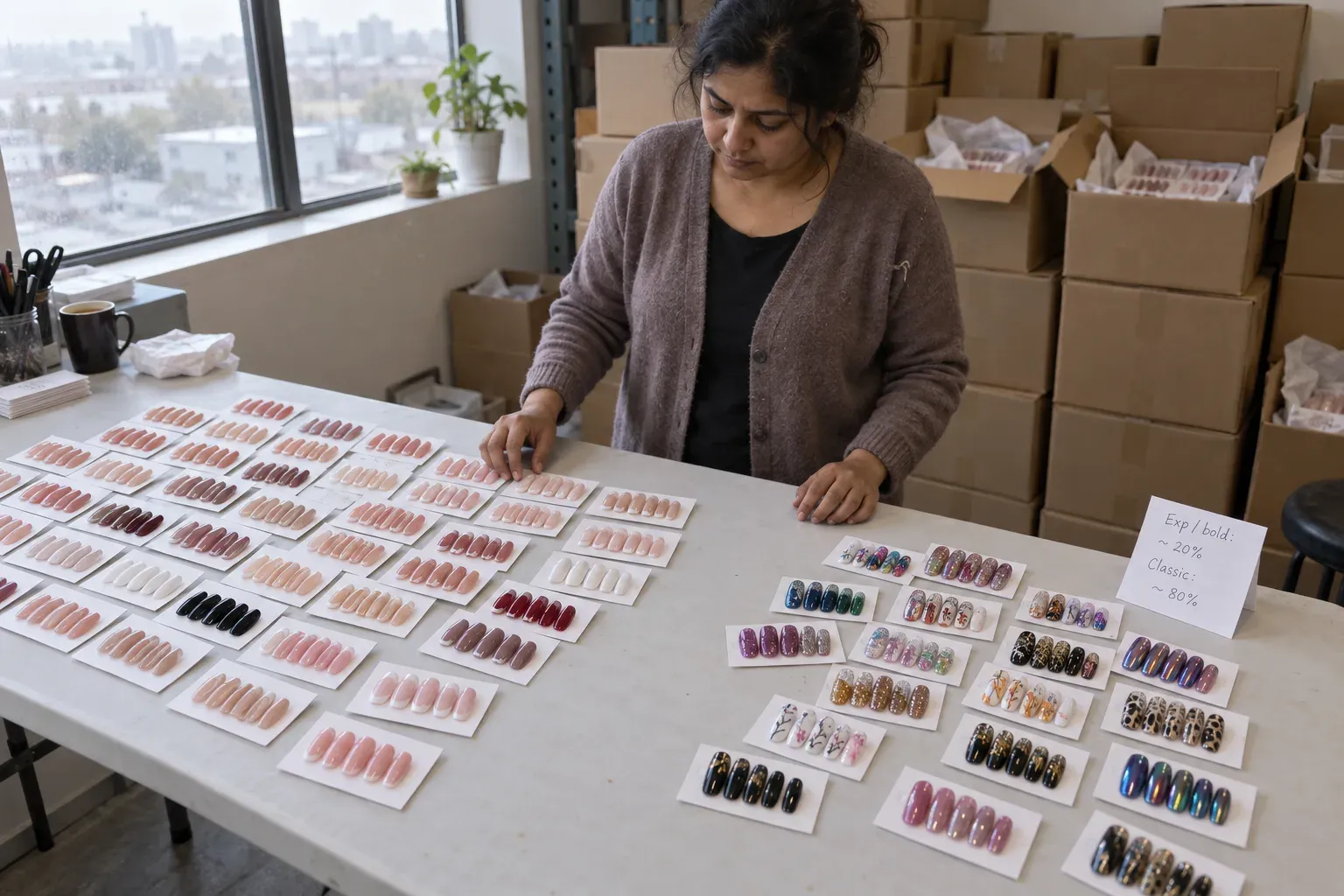
The first mistake buyers make is treating MOQ as one number. It rarely is. In press-on nails, the minimum can attach to the design, the color, the packaging variant, or the total order. Suppliers themselves warn buyers to clarify which rule applies, because a "total MOQ" can still hide a per-SKU floor. A classic example: 1,000 total sets sounds flexible, until you learn the factory also requires 300 sets per style. That quietly caps your mix at three designs.
Confirm Which MOQ Rule Applies
Before you split anything, map the rule structure. Here is how the common formats compare:
MOQ structure | What it really means | Hidden risk for mixed orders |
|---|---|---|
Per design | Each style has its own floor | Variety multiplies your total commitment |
Per color | Each colorway counts separately | Ten colors of one design equals ten SKUs |
Per packaging variant | Each box or card type adds a floor | Custom packaging requirements raise the effective minimum |
Per total order | One combined floor | May still hide a per-SKU minimum underneath |
Allocate by Percentage, Not Equal Shares
Once the rule is clear, build a product matrix listing every design, length, color, packaging type, and target quantity. This shows the supplier your order is planned, not random, and it makes SKU diversification look like a strategy instead of a headache. Then think in percentages. A 70/30 split between bestsellers and test designs gives the factory production stability while your product assortment strategy still gets fresh styles into the market. It also protects your inventory turnover rate, because most of the container is stock you already know will sell.
✔ A total MOQ can hide a per-SKU floor, such as 1,000 total sets that still require 300 sets per style TrueSuppliers often layer a per-style minimum under the headline total, which is why the allocation formula, not the total number, is the real negotiation target.✘ Splitting a container evenly across every design is the safest allocation approach FalseEqual splits ignore sell-through data and often fall below per-design floors; percentage-based allocation weighted toward proven styles is both safer and easier for the factory to approve.
What factors affect how much MOQ flexibility a factory will offer for mixed-style orders?
Every quote we review for clients balances the same tension: the factory wants long, stable runs, while the brand wants variety. Understanding that tension is your real leverage.
MOQ flexibility depends on five factors: whether designs are ready-stock or fully custom, packaging complexity, manufacturing difficulty of each finish, your commitment level through deposits or annual volume guarantees, and the price tier you accept, since lower minimums usually raise the wholesale unit cost.
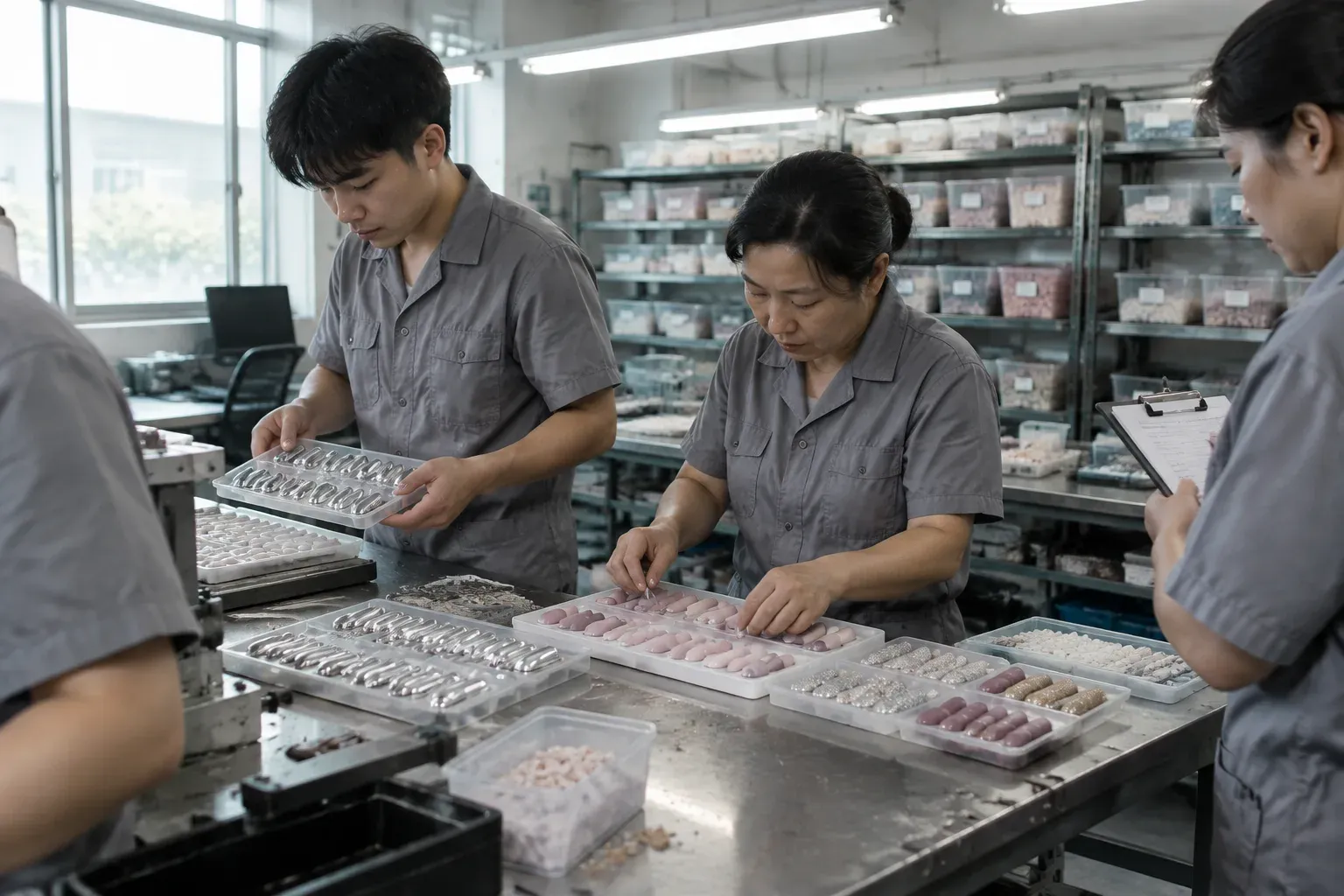
Buyers often assume mixed container ordering is a logistics question. Factories treat it as a production planning question. Every extra style means another setup, another material pull, another packaging changeover. That is why the market shows such a wide MOQ spread, and why the supplier type you choose matters more than your negotiation script.
Supplier type | Typical MOQ structure | Flexibility for mixed orders |
|---|---|---|
Large OEM lines | higher per-design minimums — confirm in writing | Low; built for long single-SKU runs |
Private label manufacturing suppliers | 500–1,000 sets | Moderate; some SKU mixing allowed |
Custom small-batch lines | from a lower per-design minimum — confirm in writing | Good within approved product families |
Handmade wholesale | 500 sets regular; 300 per custom design with 3,000 total | Moderate; custom art raises floors |
Ready-stock wholesalers | Mixed orders from as low as 20 sets total | High; mixing is the business model |
"No MOQ" sellers | Stock-based only | High for stock, none for custom work |
What You Can Trade for Flexibility
Here is the supplier objection you will hear: mixed orders disrupt line planning and packaging workflows, so too much flexibility earns you higher prices or longer lead times. That objection is rational, and the answer is to trade, not argue. A 5% to 15% price premium on low-volume styles compensates the factory for small-run setup. A larger deposit on the mixed-SKU portion offsets their inventory risk. A <a href="https://en.wikipedia.org/wiki/Letter_of_intent" target="_blank" rel="noopener noreferrer">Letter of Intent</a> <sup id="ref-1"><a href="#footnote-1" class="footnote-ref">1</a></sup> guaranteeing annual volume can unlock SKU-level flexibility inside a tiered pricing structure. Even timing helps: aligning your order with the factory's existing schedule for a nail shape lets you piggyback on a larger run, which supports lead time optimization for both sides.
✔ Suppliers accepting lower minimums usually charge a higher per-set price to offset small-run setup costs TrueAs MOQ drops, setup, labor scheduling, and material sourcing costs spread across fewer units, so the wholesale unit cost rises unless the supplier is clearing stock.✘ A "no MOQ" offer means the factory will custom-produce any design in any quantity FalseNo-MOQ marketing almost always refers to ready-stock designs; fully custom production still requires minimums to justify molds, finishes, and packaging runs.
How do I keep quality and color consistency when negotiating MOQ across multiple nail designs?
During a <a href="https://www.wto.org/english/tratop_e/preship_e/preship_e.htm" target="_blank" rel="noopener noreferrer">pre-shipment inspection</a> <sup id="ref-2"><a href="#footnote-2" class="footnote-ref">2</a></sup> last spring, our QC team caught a pink base that shifted between two designs from the same order. The cause traced back to the MOQ split.
Keep all designs within one base material, one shape family, and one finish system, then lock a signed golden sample for every SKU. Shared resin and molds let the factory treat your mixed order as one production run, which protects both color consistency and your MOQ terms.
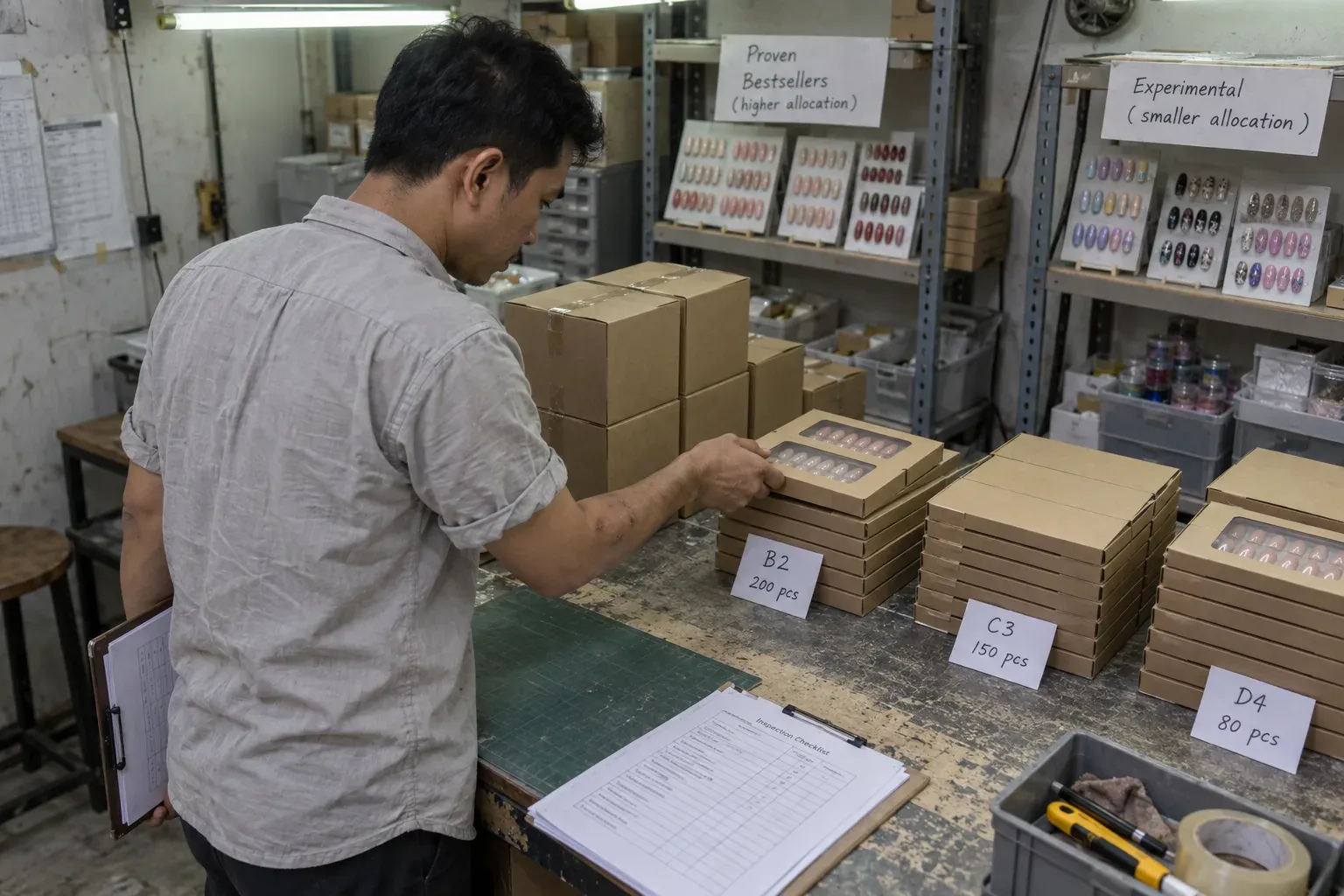
Consistency and MOQ are connected more tightly than most buyers realize. When your designs share materials, the factory can batch them together, which lowers their risk and your effective minimums at the same time. When each design needs a different resin, mold, or finish, every SKU becomes its own mini production run, and both quality control <sup id="ref-3"><a href="#footnote-3" class="footnote-ref">3</a></sup> and negotiation get harder. Aesthetic variety and manufacturing complexity are not the same thing, and the smartest mixed orders maximize the first while minimizing the second.
Negotiate Around Shared Materials
Two structural tactics do most of the work here:
- Push for a raw-material MOQ. If every design uses the same base resin and nail mold, ask the supplier to apply the minimum to the shared base, with only the printed art or film varying per SKU.
- Propose a blank-stock arrangement. The factory produces a large volume of unpainted blanks, then applies finishes or prints in smaller on-demand batches. Custom molds, crystals, embossed elements, and semi-cured gel finishes all push MOQ up, so save those for proven reorders.
Lock Golden Samples and Inspect Against Them
In our coordination work between clients and vetted production network, we hold a signed reference sample for every SKU and check bulk goods against it before shipment. With mixed orders, we pay extra attention to shared colors that appear across multiple designs, because base-batch drift is where consistency quietly breaks. Ask your supplier to confirm that shared colors come from one pigment batch, and get that in writing alongside your custom packaging requirements.
What questions should I ask my supplier before locking in a mixed container MOQ allocation?
One lesson from ten years of coordinating China <a href="https://en.wikipedia.org/wiki/Supply_chain" target="_blank" rel="noopener noreferrer">supply chains</a> <sup id="ref-4"><a href="#footnote-4" class="footnote-ref">4</a></sup>: buyers rarely lose money on the MOQ itself. They lose it on the terms nobody asked about before signing.
Ask whether the MOQ applies per design, per color, per packaging variant, or per total order; whether a hidden per-SKU floor exists; how reorders are priced; what custom packaging adds to minimums; and how lead time changes as your mix grows.

A mixed container MOQ allocation is only as good as the assumptions behind it. The questions below force those assumptions into the open before your deposit moves. I have watched buyers skip three of these and pay for it across two seasons.
Question to ask | Why it matters |
|---|---|
Is the MOQ per design, per color, per packaging type, or per total? | Defines your entire allocation math |
Is there a per-SKU floor under the total MOQ? | Prevents the 1,000-total, 300-per-style surprise |
How does pricing change on reorders of winning styles? | Reveals the tiered pricing structure you will scale into |
What do my custom packaging requirements add to the minimum? | Custom print runs carry their own MOQ and can dominate the deal |
Can standard packaging lower my per-design floor? | Standardizing packaging is one of the fastest MOQ unlocks |
Will a higher deposit on niche SKUs buy more flexibility? | Directly offsets the supplier's inventory risk |
How does lead time shift as SKU count rises? | Keeps your launch calendar and cash flow realistic |
Can you work with a consolidation hub near your cluster? | Lets you mix SKUs from specialized factories into one container and manage freight forwarding costs |
Also propose a staged structure: samples first, then a small mixed pilot, then repeat bulk for the winners. Framing the deal as test-and-scale, backed by a written reorder intent, reads as partnership rather than a one-off discount request. That framing is usually what moves a hesitant factory from "no" to "here is what we can do."
✔ Custom packaging often carries its own minimum print run, raising your effective MOQ even when nail quantities qualify TrueBoxes, branded cards, and barcode labels are separate production runs with separate minimums, so packaging choices frequently set the real floor of a mixed order.✘ Mixed container allocation is purely a shipping issue that your freight forwarder can solve FalseForwarders can consolidate cartons, but they cannot change per-design production minimums; allocation is a production planning agreement that must be negotiated with the supplier.
Conclusion
Winning MOQ allocation for mixed container orders is not about demanding zero minimums. Structure a clean, percentage-based order the factory can approve easily, and both sides protect their margins.
Sourcing handmade press-on nails and need to check MOQ against your order plan? Browse the ZONO press-on nail range for finished sets, shapes, and private-label options.
Footnotes
1. Background on this legal commitment tool used to secure annual volume guarantees with suppliers. ↩︎ 2. WTO's Preshipment Inspection Agreement explains formal standards for quality checks before shipment. ↩︎ 3. ISO defines quality control standards relevant to maintaining consistency across mixed production runs. ↩︎ 4. Provides background on supply chain coordination relevant to negotiating multi-factory container orders. ↩︎