Christmas Press-On Nail Finishes: Which Designs Sell and What Makes Them Gift-Ready
Which Christmas press-on nail finishes sell: glitter, chrome, red-and-green, festive French and matte contrast, plus the checks that make a design gift-ready.
Christmas press-on nails are bought on a screen, and the finish is the first thing that reads. A shopper scrolls a gift list, sees a thumbnail, and decides in that instant whether the design says festive, wearable and worth giving. For a brand building a December line, the job is to choose finishes that read clearly at that moment, suit a recipient the shopper does not know personally, and hold up through normal wear. This guide covers the finish families that sell, the checks that make a design gift-ready, and the durability questions to send to a supplier.
At Christmas, the finishes that sell are the ones that read clearly on a screen and suit someone other than the shopper. Lead with glitter, chrome and the red, deep green and gold pairing, then add a festive French and a matte-versus-glossy contrast. Match every finish to a durability check and a gift-reason before ordering.
ZONO Beauty coordinates long-term manufacturing suppliers from Shantou, Guangdong, across ready-stock, semi-custom and full OEM/ODM routes. ZONO is not positioned as a single factory; we coordinate long-term manufacturing suppliers. With 10 years of development and a 1,000+ SKU ready-stock library, the finish points below are the ones applied to Christmas press-on projects before any commercial term is fixed.
Which finish families carry a December collection?
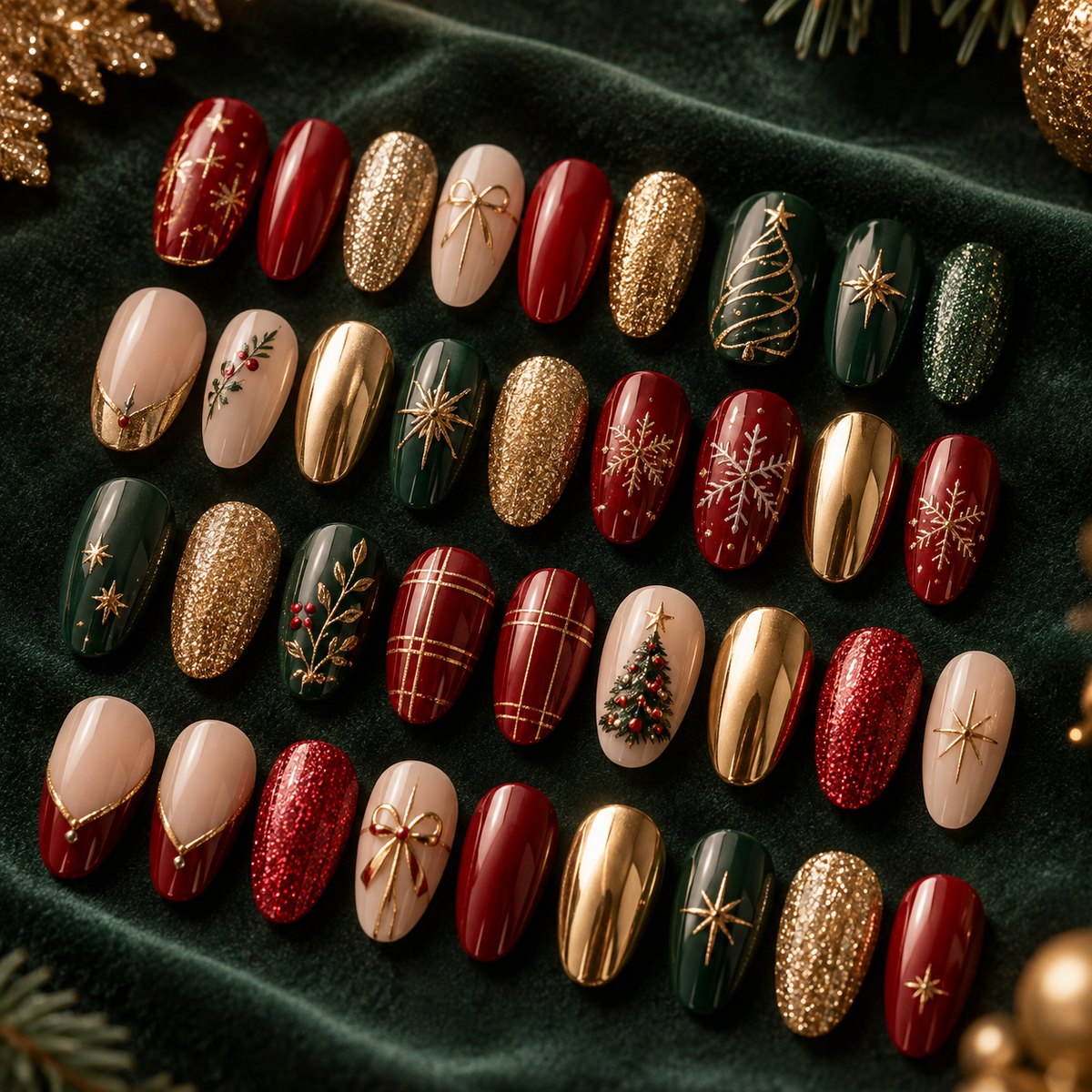
Five finish families do most of the December work: glitter, chrome or metallic, the classic red and deep green with gold accents, a festive French tip, and a matte-versus-glossy contrast. Each family reads differently on a screen and fails differently on a nail, so finish is a design decision and a durability decision at once.
A December collection does not need every finish, but it needs contrast. Glitter is the workhorse of the season: it photographs bright and says celebration instantly. Chrome and metallic finishes read as mirror shine and give a design a modern, high-contrast edge. The classic red and deep green with gold accents is the safe gift default, because it matches the season without asking the shopper to guess taste. A festive French tip keeps a familiar, wearable shape and adds a holiday line, color or accent at the tip. Matte-versus-glossy contrast adds depth and makes a design look more considered than a single flat finish.
| Finish family | What it reads as on screen | Durability check | Cost position |
|---|---|---|---|
| Glitter | Bright, festive, catches light | Glitter lift, even density | Higher as density rises |
| Chrome / metallic | Mirror shine, high contrast | Rubbing, dulling at the free edge | Higher |
| Red and deep green with gold | Traditional, gift-coded | Color bleed, gold adhesion | Mid |
| Festive French tip | Familiar, wearable, holiday line | Tip seal, line crispness | Mid to lower |
| Matte vs glossy contrast | Modern, textural depth | Matte wear, gloss boundary | Mid |
Each family's durability and cost behavior is different, which is why finish should be fixed before any range decision. Finish is the design-side lever; range width and pricing are separate decisions handled in their own guides.
- Lead with one hero finish that reads in a thumbnail, then build contrast around it.
- Fix the finish before the shade count, because finish drives both durability and cost.
- Keep a matte or neutral option in the mix so the line is not all shine.
Why does glitter change the look and the cost at the same time?
Glitter density and particle size move the look and the cost together. Sparse, fine glitter reads subtle and costs less to lay; dense, coarse glitter reads as full sparkle but needs more material and more careful application, so it sits higher in a supplier's range. Ask for a density reference, not only a color swatch.
Glitter is the season's default finish, but it is not one finish. Density decides how much sparkle the design carries, and particle size decides whether that sparkle is a fine shimmer or a chunky, textured sparkle. Both change the look and both change the cost, so a buyer should approve glitter from a density reference rather than a color swatch alone.
A sparse scatter of fine glitter reads as a subtle shimmer and costs less to lay, because it needs less material and tolerates a simpler top seal. A dense, coarse glitter reads as full sparkle but needs more material, more even application and a thicker top seal to keep the particles flat. The same logic explains why two red-glitter designs can sit at different points in a supplier's range even when the base color is identical.
| Particle size | Look | Application and cost |
|---|---|---|
| Fine | Soft shimmer, smooth surface | Easier to lay, lower cost |
| Medium | Visible sparkle, some texture | Balanced |
| Coarse | Full glitter, raised texture | More material, careful top seal, higher cost |
Glitter and other colorants used in a nail design sit under color-additive rules, so the pigment and glitter choices should be checked against the target market rather than assumed universal.1 Some colorants are restricted or prohibited in a given market, which is why a shade cleared in one region may need substitution in another.2 Controlled production with documentation is what keeps that application consistent across a batch, so good manufacturing practice is part of the finish decision rather than a separate certificate.5
Which Christmas finishes photograph well enough to sell online?
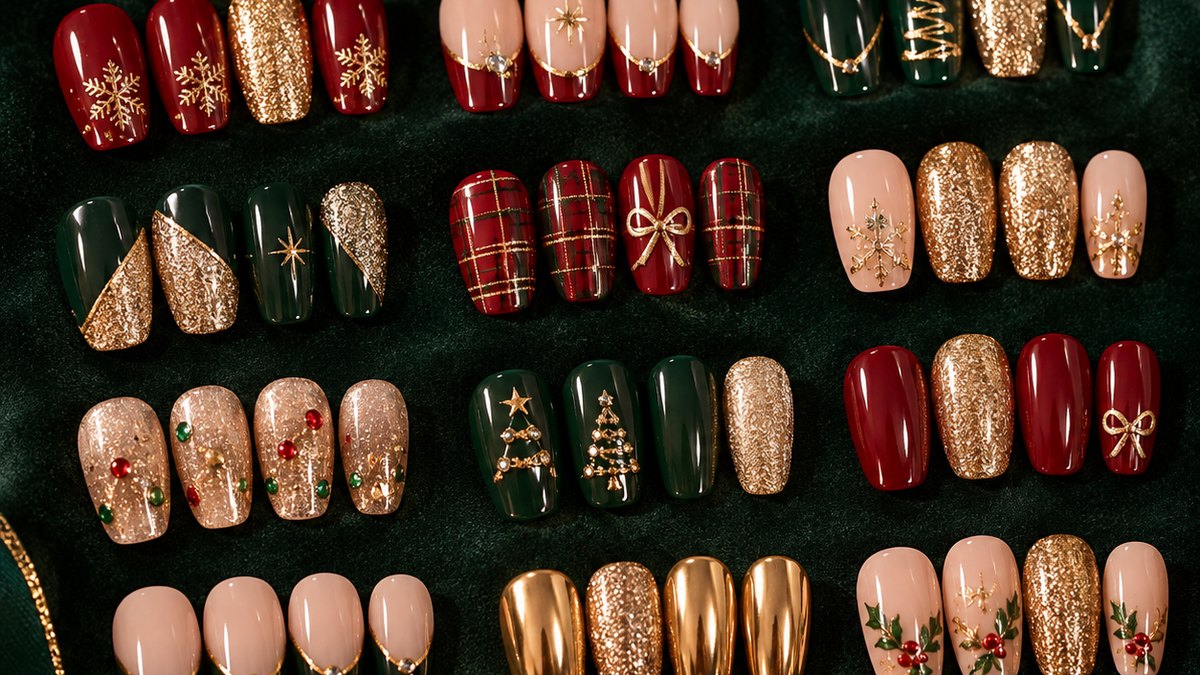
Gift browsing is visual, and the design has to read in a thumbnail before a shopper clicks. High-contrast finishes photograph best: glitter, chrome and the red-and-gold pairing survive compression, while matte and subtle neutrals need better lighting and larger crops. Test every design as a small screen image before committing.
Gift browsing is visual, and the design has to read in a thumbnail before a shopper clicks. The finish, not the shape, carries that first glance. High-contrast finishes survive compression and small screens best: glitter catches light, chrome reads as a clean reflection, and the red-and-gold pairing holds its contrast. Matte and subtle neutral finishes lose their subtlety at thumbnail size, so they need better lighting, larger crops or a contrasting accent to stay visible.
Photography is part of the finish decision, not an afterthought. A finish that looks rich in person can look flat or blown-out on a screen, so each design should be tested the way a customer will first see it: small, compressed and in a grid. The same principle applies to the buyer's own catalog, where the finish has to sell the design without the benefit of touch.
- Shoot each finish on a neutral background at the size a product grid will use.
- Check glitter for blown-out highlights and chrome for a clean reflection rather than a smeared one.
- Pair a matte surface with one glossy or metallic accent so the contrast survives compression.
- Compare the photo to the physical nail to catch color drift in reds and greens.
What makes a press-on design gift-ready beyond the box?
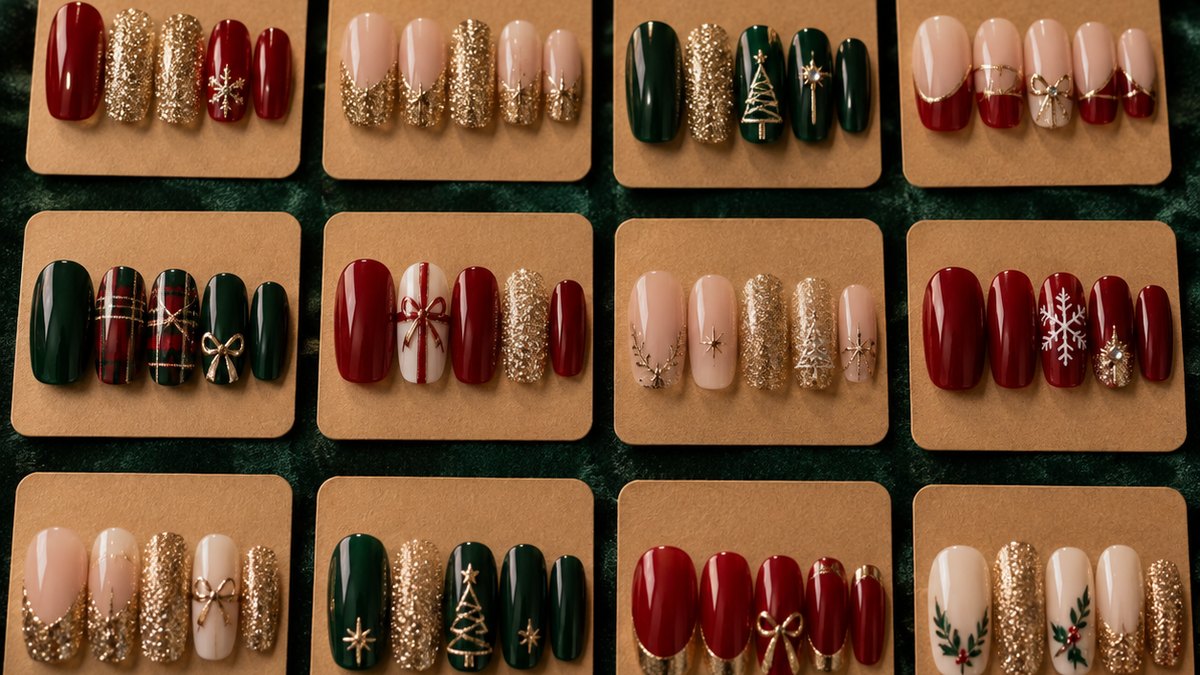
Gift-ready means the design suits a recipient other than the buyer. A shopper buying for someone else needs options that are safe to give: neutral-friendly classics and medium-length, everyday finishes alongside statement glitter and chrome. The box matters, but the finish is what the recipient wears, so gift-readiness starts with the design itself.
A gift is bought for someone else, and that changes the design brief. The shopper does not know the recipient's exact taste, length preference or finishing style, so a gift-ready line pairs safe options with statement options. Neutral-friendly classics such as a soft nude, a single-shimmer or a clean festive French are safe to give to almost anyone. Statement finishes such as dense glitter and chrome suit a recipient whose taste is already known, and they drive impulse purchases even when the fit is less certain.
Gift-readiness is decided at the design level, before any box or packaging is considered. The finish is what the recipient wears, so it must carry the gift on its own. A balanced festive design such as a red or green base with one gold accent sits between the two, festive enough to feel like a gift and safe enough to suit a broad recipient.
- Offer a neutral-safe classic so an unknown recipient is a low-risk give.
- Keep one statement finish for impulse buyers and known-taste gifting.
- Put the festive signal in an accent, not the whole nail, to widen who can wear it.
- Check that each finish still reads after the box, since the wearer keeps the nail, not the packaging.
| Design approach | Who it suits | Gift-readiness |
|---|---|---|
| Neutral-safe classic | Broad recipients, low risk | High |
| Balanced festive accent | Gift default, festive without extremes | High |
| Statement glitter or chrome | Known taste, impulse buyers | Niche but high intent |
What durability questions should I ask about glitter and chrome?
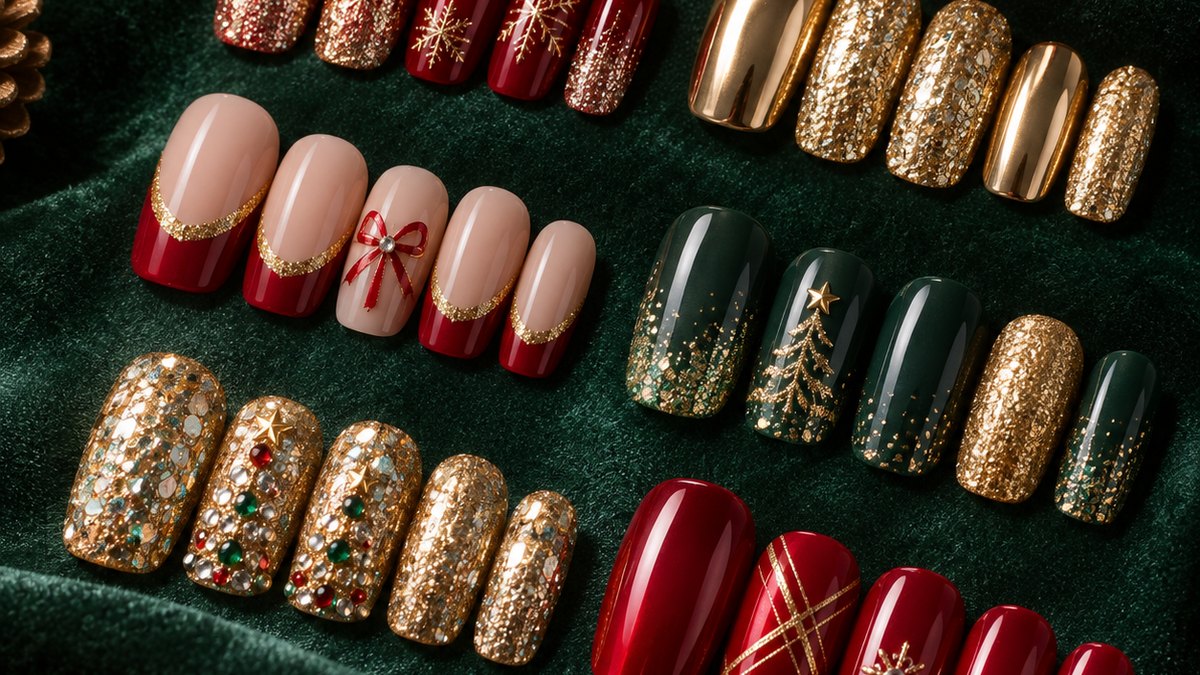
Glitter lift and chrome rubbing are the two finish failures to ask about. Request wear evidence on a comparable design, not a claim about weeks, and ask how the top seal protects glitter edges and how chrome is sealed against dulling. Then have the adhesive ingredient and allergen test results confirmed by the responsible assessor.
Finish durability is a question, not a guarantee. Glitter lift and chrome rubbing are the two failures to ask about before ordering, and both are verified with wear evidence on a comparable design rather than a supplier's wear-time claim. Glitter lift happens when the top seal does not cover the glitter edges, so loose particles catch and peel. Chrome rubbing shows as dulling or loss of the mirror finish at the free edge, where the nail meets daily contact.
The adhesive is a separate sensitivity point. Request the adhesive ingredient list and any allergen test results, then have the responsible safety assessor for the target market confirm what applies.7 Under EU cosmetics rules, a product requires a safety assessment before it is placed on the market, and that assessment confirms the ingredient and colorant choices.3 Ingredient safety evaluation follows a defined method that a safety assessor applies, rather than a supplier's assertion.6
- Ask for a wear reference on a comparable finished design, shown after normal use.
- Ask how the top seal covers glitter edges so loose particles do not lift.
- Ask how chrome is sealed and whether dulling appears at the free edge.
- Request the adhesive ingredient list and any allergen test results.
- Have the responsible safety assessor confirm what applies to the target market.
Cosmetics are not approved by the FDA in that sense; they are FDA regulated, so a blanket approval phrase should be pushed back on.4
- Answers finish questions with a photo and a price only.
- Quotes a wear-time guarantee without evidence from a comparable design.
- Treats the adhesive as an afterthought with no ingredient or allergen records.
How should I read finish cost when comparing designs?
Finish cost moves with material and labor, not just the color. Dense glitter and chrome plating sit higher in a supplier's range because they need more material and more careful application, while a flat creme red or a single festive French sits lower. Read finish as a cost lever you control at the design stage.
Finish cost moves with material and labor, not just color. Dense glitter and chrome plating sit higher in a supplier's range because they need more material and more careful application, while a flat creme red or a single festive French sits lower. A buyer reads finish as a cost lever that can be tuned at the design stage: substituting a finer glitter or a single gold accent in place of full chrome pulls a design down the range without losing the Christmas signal.
Pricing itself, including bundle and promotion planning, is a separate decision covered in the guide to Christmas press-on nail pricing and promotion. Keep finish as the design-side lever and leave the numbers there.
Frequently Asked Questions
- Which Christmas finish sells best for press-on nails? Glitter and chrome lead because they read on a screen and signal festive, while the red-and-green with gold pairing is the safe gift default.
- Is dense glitter more expensive than fine glitter? Yes, in a qualitative sense: more material and more careful application move dense, coarse glitter higher in a supplier's range.
- What makes a press-on design gift-ready? The design must suit a recipient other than the shopper, so pair neutral-safe classics with statement finishes in the same line.
- Should I ask for wear evidence on glitter and chrome? Yes: request wear on a comparable design and ask how the top seal and chrome seal hold, rather than accepting a wear-time claim.
Conclusion
Finish is the December decision. Lead with screen-legible finishes, match each to a durability check and a gift reason, and read dense glitter and chrome as higher-cost levers a buyer can tune at the design stage. Range width and pricing are separate decisions, covered in their own guides.
Share the finish families you want, the target market, the design direction and the durability checks you still need answered. ZONO can organize the supplier questions and mark the remaining finish and compliance facts for confirmation.
Discuss your Christmas press-on brief To see how press-on nails are sourced across ready-stock, semi-custom and OEM/ODM routes, explore press-on nail sourcing.Footnotes
1. Color Additives and Cosmetics Fact Sheet, U.S. Food and Drug Administration. ↩︎
2. Prohibited & Restricted Ingredients in Cosmetics, U.S. Food and Drug Administration. ↩︎
3. Regulation (EC) No 1223/2009 of the European Parliament and of the Council on cosmetic products, EUR-Lex. ↩︎
4. FDA Authority Over Cosmetics: How Cosmetics Are Not FDA-Approved, but Are FDA-Regulated, U.S. Food and Drug Administration. ↩︎
5. ISO 22716:2007 Cosmetics — Good Manufacturing Practices (GMP), ISO. ↩︎
6. SCCS Notes of Guidance for the Testing of Cosmetic Ingredients and their Safety Evaluation (12th revision), European Commission. ↩︎
7. Allergens in Cosmetics, U.S. Food and Drug Administration. ↩︎