Eyeliner Format Decision: Liquid vs Pencil vs Gel for Private Label Buyers
A procurement guide to choosing an eyeliner format: how liquid, pencil, and gel differ in manufacturing, packaging minimum, eye-area colorant compliance, and wear-claim evidence.
An eyeliner private label order is a format decision before it is a colour decision. Liquid, pencil, and gel each carry a different manufacturing route, a different packaging minimum, and a different eye-area compliance load, so the format should be chosen for the buyer's market and price point rather than for the shade card.
Eyeliner looks like one product with three finishes. It is closer to three products that happen to share a name. The applicator, the base, and the packaging differ enough that the buyer's brief, tooling, and minimum order move with the format. Treating them as interchangeable is how first orders arrive with the wrong cost and the wrong lead time.
This guide compares the three formats from the buyer's side and marks the points where the choice changes the order rather than just the look. The same logic runs through the custom eyeshadow palette brief, where pan size and shade count fix the minimum before the colour story does.
Why does eyeliner format decide more than the finish?
Eyeliner format decides the applicator, the base chemistry, and the packaging, and those three drive tooling, minimum order, and compliance. A buyer who picks a format for the colour and discovers the packaging minimum afterwards has effectively chosen the wrong order, because the format was the order.
The finish a wearer sees is the last thing the supply chain builds. First it builds a base, fills it into a component, and seals it with an applicator or a sharpening system. Each of those steps has its own minimum and its own evidence requirement, so the format question belongs at the top of the brief.
Three consequences follow from the format choice:
- Tooling moves with format: a moulded pencil and a liquid dip-in tube are different tool sets, not the same line with a new tip.
- Minimum moves with packaging: a sharpenable pencil and an auto-pencil carry different component minimums.
- Evidence moves with base: a gel base and a liquid base ask for different stability and preservation proof.
The three formats and what each asks of the buyer
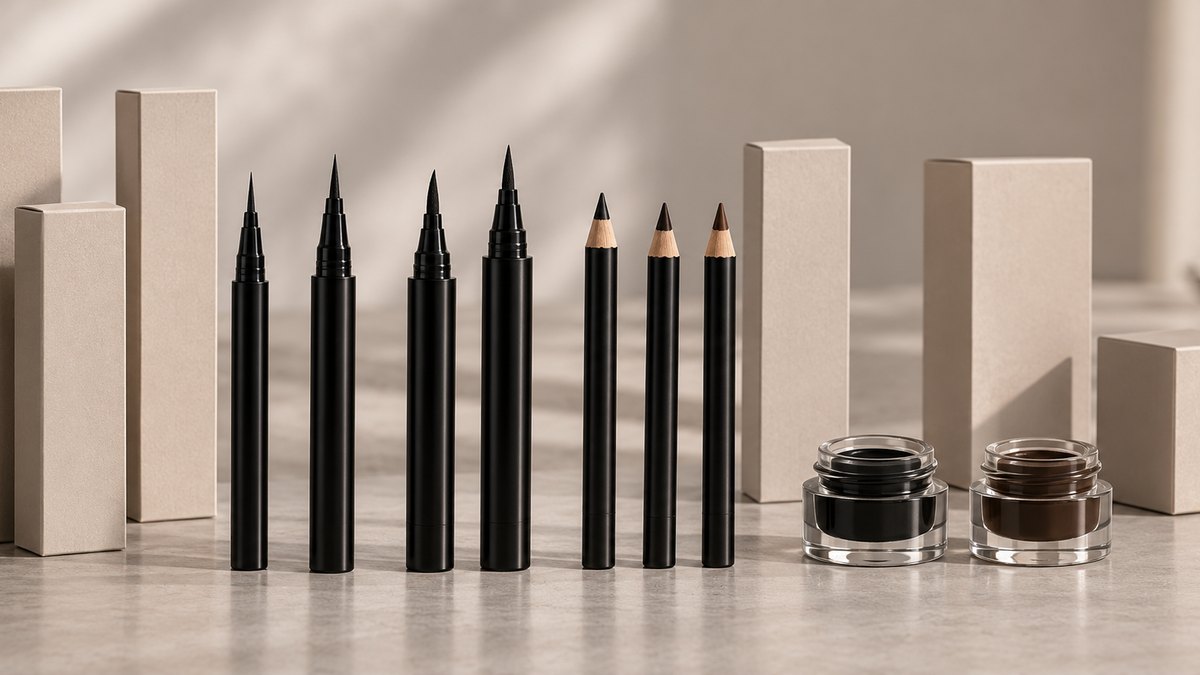
Liquid, pencil, and gel each ask the buyer for a different combination of applicator, base, and packaging commitment. Liquid needs a wand or felt tip and a sealed tube, pencil needs a wood or auto-mechanism, and gel needs a pot with its own preservation route, so the brief should name the format before the shade.
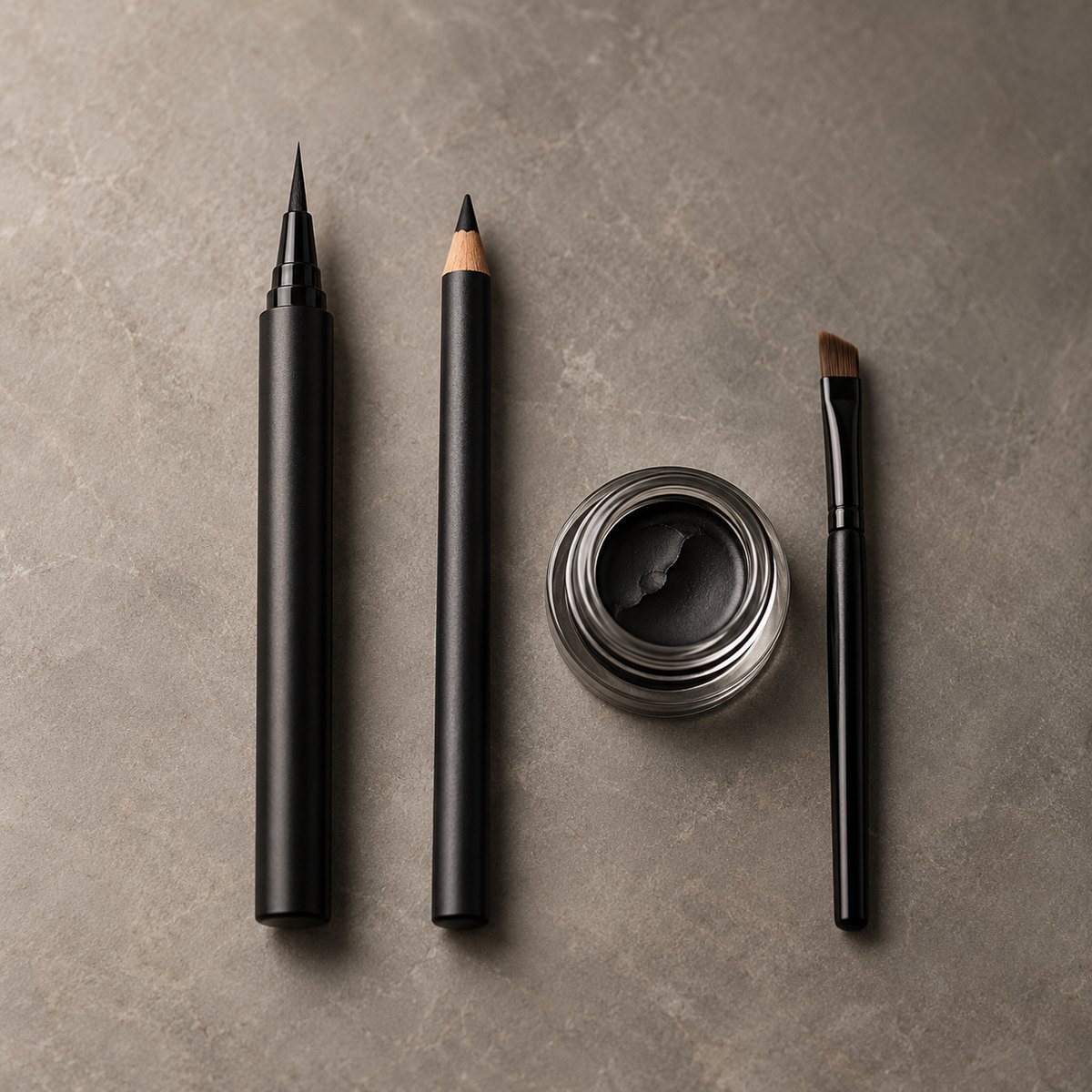
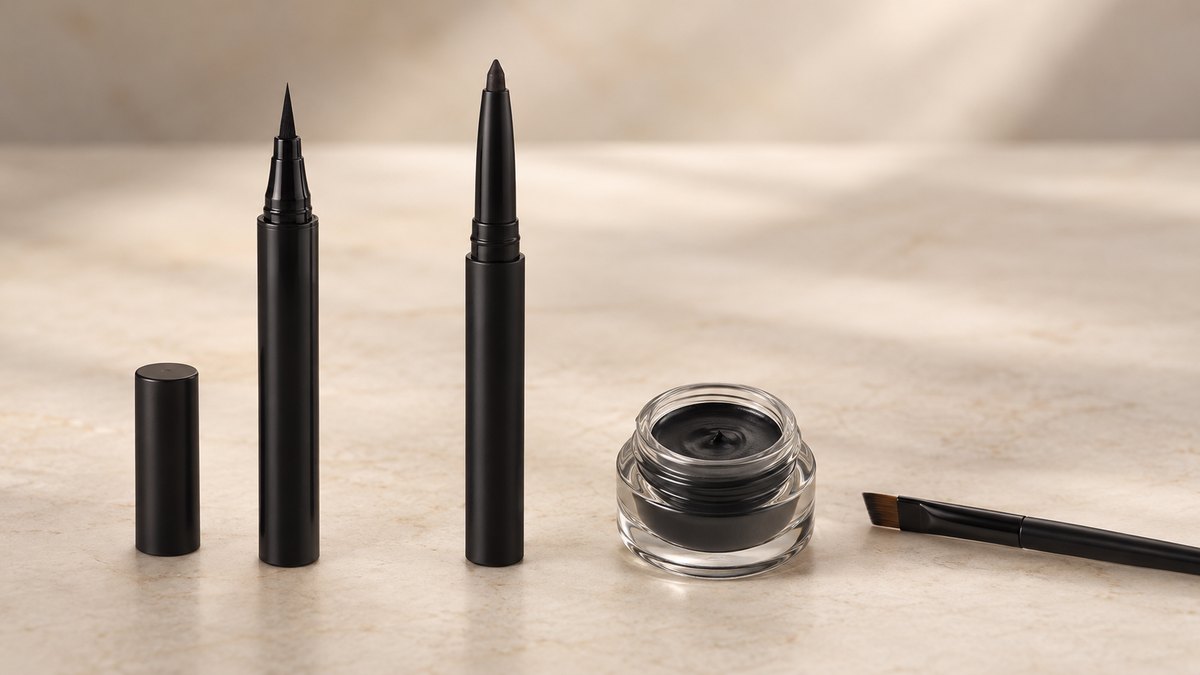
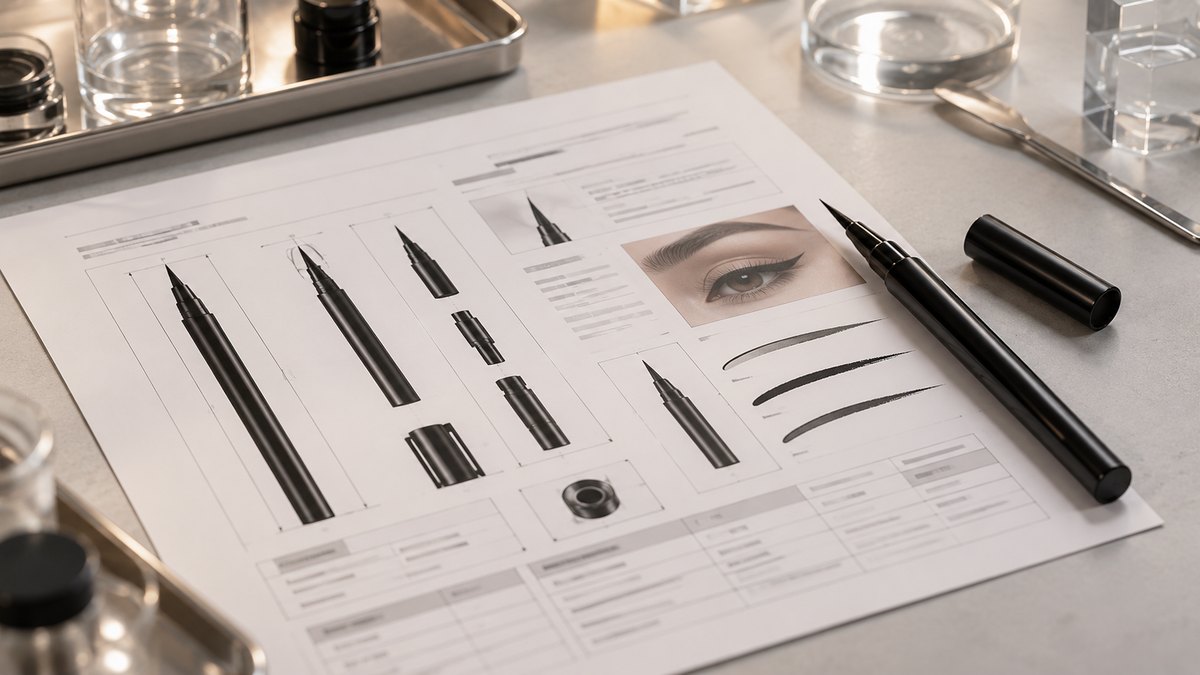
Liquid eyeliner is filled into a tube with a brush or felt tip and relies on the formula film and the tip for the line. Pencil eyeliner is extruded or moulded into a slender form, either sharpenable or in a retractable mechanism. Gel eyeliner is usually a softer base delivered in a pot, a pen, or a sharpenable crayon, and the softer base raises the preservation question.
| Format | What the buyer specifies | What to request as evidence |
|---|---|---|
| Liquid | Tip type, formula film, tube and cap | Film wear and tip-consistency validation |
| Pencil | Wood or auto mechanism, lead firmness | Lead homogeneity and breakage test |
| Gel | Pot, pen, or crayon; base softness | Preservation and stability summary |
Pick the format for the market, not the mood board
A buyer serving a market that expects a precise liquid line needs a different specification from one serving a market where a soft pencil is the everyday standard. The format should follow the destination and the price position, because the tooling each requires is not interchangeable.
Three questions help a buyer choose the format before the shade:
- Which market: the expected line and price point decide liquid, pencil, or gel.
- Which component: stock parts lower the minimum more than custom moulds.
- Which evidence: each format carries its own stability and preservation proof.
How do liquid, pencil, and gel differ in manufacturing and minimum order?
The three formats differ in fill method and component count, and that difference drives the minimum order. Liquid needs a filled tube and a tip; pencil needs an extruded or moulded lead and a casing; gel needs a base and a container, so the combined component minimum is format-specific rather than universal.
Buyers often assume one eyeliner minimum applies to all formats. It does not. A liquid line carries a tube, a cap, a wiper, and a tip; a wooden pencil carries the lead, the casing, and the sharpening assumption; an auto-pencil carries a spring mechanism. Each component carries its own run minimum, and the order minimum is the sum.
Two levers reduce the per-format commitment:
- Standardise the component: a stock tube or a stock auto-mechanism lowers the minimum versus a custom mould.
- Concentrate shades: several colours through one component cost less to commit than one colour per custom part.
- Share across the range: one tip or mechanism across shades lowers the combined tooling.
- Ask for the component minimum: in writing, because a verbal "small run" hides the real commitment.
What eye-area colorant compliance applies to eyeliner?
Eyeliner sits on the lash line, so every pigment must clear the eye-area bar in each market, and a colour allowed elsewhere is not automatically allowed there. The buyer should hold written confirmation per shade and per market before sampling, because the blend, not just the main colour, is what gets checked.
In the United States, colour additives are subject to certification and use conditions, and the listings state where each may be used, including whether eye-area use is permitted1. The official European reference is the CosIng ingredient database2. For Southeast Asia the rule is national; in Indonesia the authority is BPOM3. The U.S. guidance also warns against using a lip liner as an eye liner, because the two are not held to the same eye-area standard4.
Where do wear and waterproof claims run into trouble?
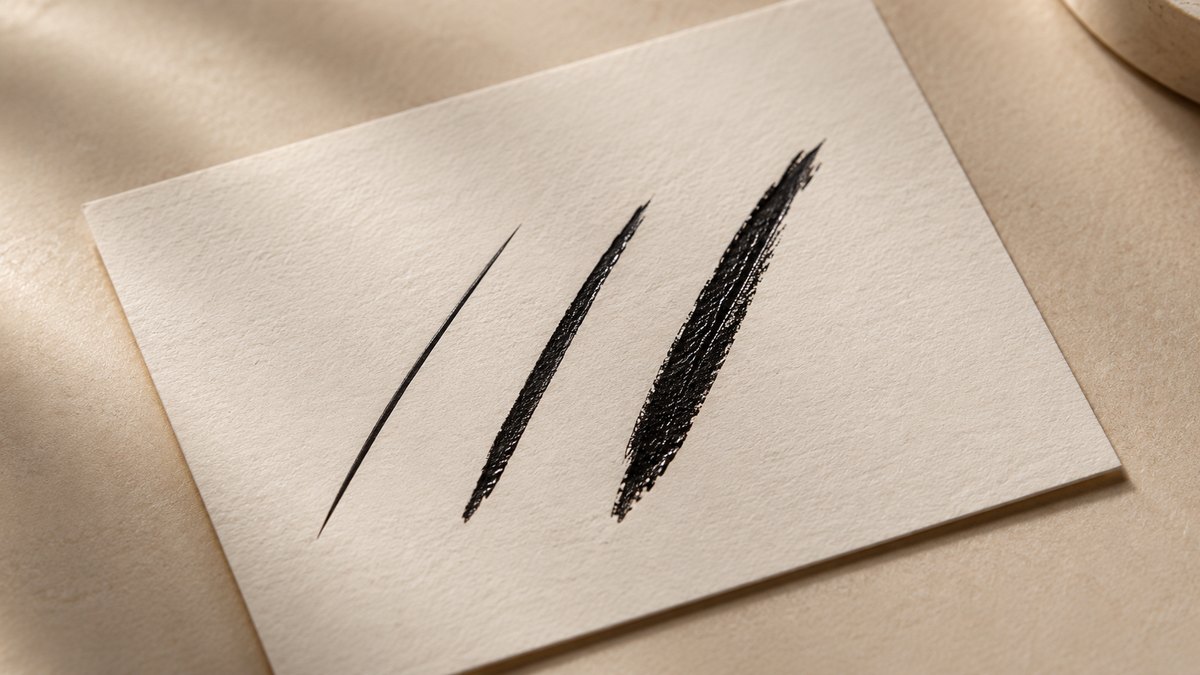
Wear and waterproof claims are where eyeliner marketing overreaches, because a claim that implies the product resists water or lasts a set time can drift into a performance promise the buyer cannot support. The brief should state the claim, the test behind it, and the market's rules for such claims.
A "long wear" statement tied to a defined test method is different from an absolute "all day" promise. The risk is that an unchecked claim becomes the buyer's responsibility once the product ships. The supplier should be able to show the method, not just the words.
Three claim rules belong in the brief:
- Name the test: a wear claim should reference a method and a condition, not a slogan.
- Separate water from wear: "water resistant" and "long wear" are different claims with different evidence.
- Check the market: some markets constrain performance claims more tightly than others.
How does packaging choice change the minimum order?
Packaging choice changes the minimum order because the component, not the colour, sets the run size. A sharpenable wooden pencil, an auto-retractable pencil, a liquid dip-in tube, and a gel pen each carry a different component minimum, so the packaging decision is also a volume decision.
Buyers sometimes choose packaging for the shelf look and learn the minimum afterwards. The component with the highest individual run size becomes the constraint for the whole order, so the packaging should be chosen with the volume in mind, not afterwards.
| Packaging option | Component minimum driver | Buyer question |
|---|---|---|
| Wood pencil | Lead extrusion and casing | Is sharpening acceptable in the target market? |
| Auto pencil | Mechanism and casing | Does the mechanism minimum fit the order volume? |
| Liquid tube | Tube, cap, wiper, tip | Is the tip stock or custom, and at what minimum? |
| Gel pen or pot | Container and closure | Does the base preservation need a specific pack? |
How do you keep an eyeliner reorder consistent?
An eyeliner reorder matches the first sample only when the base, the applicator, and the packaging are all locked to referenced standards, because a tip or lead change shifts the result as much as a colour change. The retained sample must be the full assembled product, not a decanted swatch.
Line consistency is the usual reorder complaint: the second run draws differently or the shade drifts. Both are managed with a retained approved sample, written tolerances, and a drift rule, and the applicator must be part of the standard because it is where much of the performance lives.
- Agree the base, applicator, and packaging references in writing before sampling.
- Retain the full assembled product with both parties as the standard.
- Define the line-width and shade drift limits that trigger rejection.
- Repeat the same measured standard on every reorder, not a fresh description.
Which compliance questions change when eyeliner ships to several markets?
Shipping eyeliner to several markets multiplies the label and additive load, because ingredient listing, language, and permitted pigments differ by destination. The brief should name every market before the component and carton are designed, since label content is printed, not added later.
A single-market eyeliner can carry one label and one additive set. The same product bound for the United States, Indonesia, and a Latin American market may need different listing formats, languages, and pigment permissions. Discovering this after tooling is cut means a reprint and a delay the buyer pays for.
What should you ask a supplier before paying the eyeliner deposit?
Ask for the format and its evidence, the component minimum, the eye-area pigment clearance per market, the wear-claim test method, and the retained-sample agreement. A supplier who answers these in writing is quoting a reproducible product; one who answers only with a unit price is quoting a guess.
The deposit holds a production slot and cuts tooling. After it is paid, the buyer's leverage shrinks, so the technical questions belong in the exchange before payment, not in the complaint after delivery.
- Which format is proposed, and what component minimum does it carry?
- Is the tip or mechanism stock or custom, and at what commitment?
- Are all shade components cleared for the eye area in every market named?
- What test supports any wear or water-resistance claim?
- Will the full assembled product be retained as the reorder standard?
Before you request an eyeliner quote
A quote request that names only a colour and a quantity will return a price and little else. Send the format, the packaging, the target markets, and the claim you want to make, because those four facts decide whether the number is a commitment or a placeholder.
Minimum order on an eyeliner project is confirmed per project, because it depends on the format, the component minimum, the shade count, and the number of SKUs. Asking for it as a single published figure invites a number that will not survive the actual specification. The useful question is how the minimum moves when the packaging changes from stock to custom.
It is also worth asking whether one component can serve several shades. A range built on a single stock tip or mechanism usually carries a lower combined commitment than one that tools a new part for every SKU.
Conclusion: choose the format, then the colour
An eyeliner private label order is a format decision first. Lock the format, the packaging, and the eye-area pigment clearance, confirm the wear claim has a test behind it, retain the full assembled product as the reorder standard, and only then finalise the shade.
ZONO coordinates eyeliner production across ready-stock, semi-custom and full OEM and ODM routes, and is not positioned as a single factory. Ten years of experience and a ready-stock library of over 1,000 SKUs support an eyeliner programme where format discipline and shade creativity must be balanced against the same per-project minimum. The practical test of an eyeliner supplier is simple: ask for the component minimum in writing, and ask which shade components are cleared for the eye area in the markets you named.
Footnotes
1. Color Certification. FDA. ↩︎
2. Cosmetic ingredient database (CosIng). European Commission. ↩︎
3. Badan Pengawas Obat dan Makanan (Indonesian Food and Drug Authority). BPOM. ↩︎
4. Using Cosmetics Safely. FDA. ↩︎
Share the format, the packaging, the target markets, and any wear claim you want to make. ZONO can help separate the component minimum from the shade work and mark the compliance facts for confirmation.
Discuss your eyeliner brief. To see how stock, semi-custom and full OEM/ODM routes are staged across a colour cosmetics project, explore private label cosmetics.