Cosmetic Packaging Decoration Methods: How the Finish Changes the Sourcing Math
Cosmetic packaging decoration methods compared: hot stamping, silk screen, digital, and water transfer, and how the finish changes tooling, cost, and lead time.

Most packaging sourcing guides stop at MOQ and supplier structure, then treat decoration as a final checkbox. The packaging printing options run the other way: they quietly set the one-time tooling, the per-unit cost, the lead time, and how well the finish survives handling. Choose the wrong method and you pay for full-wrap capability you never use, or push a short-run brand into a plate-and-die cost built for volume.
Hot stamping, silk screen, digital, and water transfer are four decoration methods that change the sourcing math in different ways. Hot stamping buys a premium metallic finish with a one-time plate; silk screen charges per colour; digital needs no plates for short runs; water transfer wraps complex art around irregular shapes.

What are the four cosmetic packaging decoration methods?
There are four methods a packaging buyer actually chooses between: hot stamping or foil for metallic accents, silk screen printing for solid logos and marks, digital printing for short runs and multi-variant artwork, and water transfer or decals for full-wrap art on irregular shapes.
The method is not a styling choice; it is a production decision. Each one carries a different tooling model, a different setup cost, and a different answer to how much wear the finish will take on a bottle, tube, jar, or cap. Decoration is one of the cost layers that separates a stock component from a custom one; the stock-versus-custom comparison walks through the full set.
| Method | Best for | Tooling and setup | What drives cost and lead time | Watch for |
|---|---|---|---|---|
| Hot stamping / foil | Metallic logos, small accents, premium detail | One-time die or plate | Plate cost and press setup | Not for full-coverage art; foil adhesion on curved or textured surfaces |
| Silk screen printing | Solid logos and colour marks on bottles and tubes | One screen per colour | Colour count and setup per colour | Durability on handled surfaces; registration across colours |
| Digital printing | Short runs, multi-variant artwork, samples | No plates | Per-print cost and machine resolution | Colour consistency across batches; resolution on curved areas |
| Water transfer / decals | Full-wrap and complex art on irregular shapes | Printed film or decal | Extra process step and application labour | Alignment and finish quality on complex curves |
Hot stamping and foil: one plate, premium look, small accents only
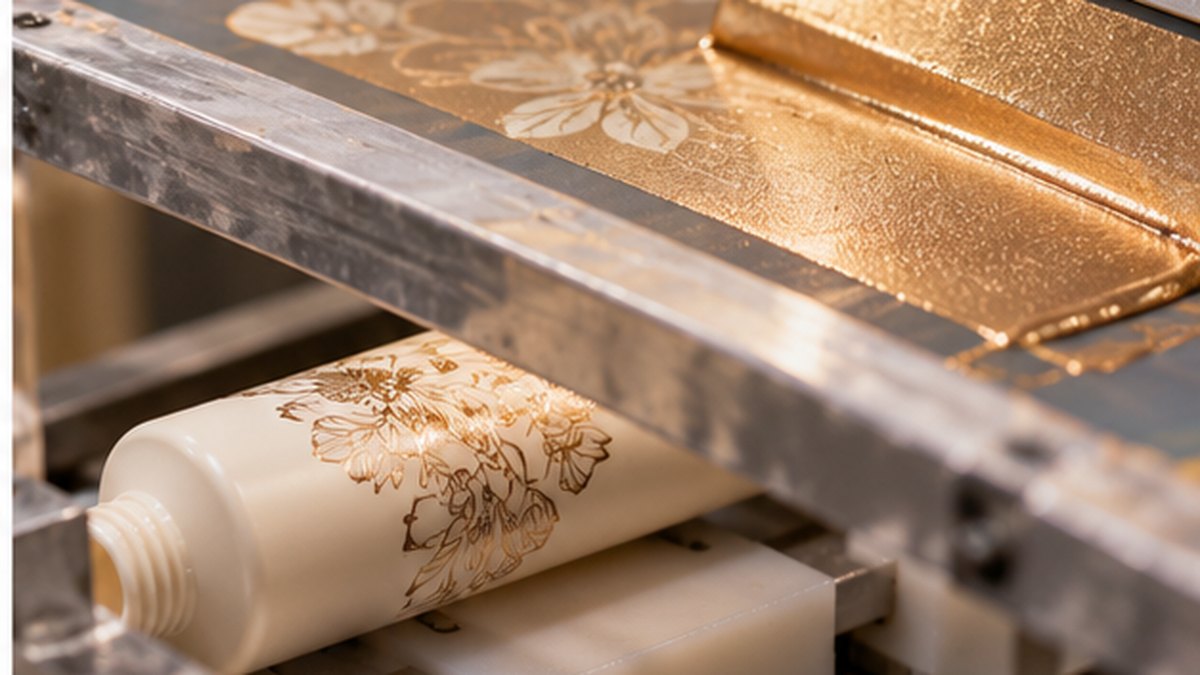
Hot stamping or foil lays a metallic film onto the component under heat and pressure using a one-time die or plate. It reads premium immediately, so it is the default for logos, borders, and small accents; it is the wrong tool for large or full-coverage artwork.
Hot stamping cosmetic packaging reads as the most expensive finish because the customer sees reflected metal. The sourcing reality is that the reflection is bought once, with the die or plate, then repeated with the foil stock and the press time. It is economical for a small mark that stays the same across every SKU and every reorder.
- The plate or die is paid once, then reused, so it favours a logo that does not change between runs.
- Foil is best on small, flat-to-gentle-curve areas; deep curves and heavy texture make adhesion harder to hold.
- Full-coverage metallic looks come from a different route, usually a metallic coating or a foil-wrapped component, not a stamp.
Silk screen printing: the workhorse that charges per colour
Silk screen printing pushes ink through a fine mesh stencil, one screen per colour, onto bottles and tubes. It is the workhorse for logos and solid colour marks because it is durable and cheap at volume, but the colour count drives both setup and the risk of misregistration.
Each colour in the design needs its own screen and its own pass. A one-colour logo is simple; a four-colour crest is four screens, four setups, and four chances for the colours to land out of line. Colour count, not design complexity, is the real cost lever here.
Silk screen printing cosmetics stays the default on bottles and tubes that get touched, because the ink holds up on handled surfaces better than some finer processes. The ink still sits on the surface, so a component that gets rubbed, squeezed, or exposed to oils and solvents needs an adhesion and wear check after filling. A decoration step can also carry its own minimum, above the formula fill, which is why packaging MOQ runs higher than formula MOQ in some projects.
Digital printing: no plates, built for short runs and variants
Digital printing puts the artwork straight onto the component or label without plates or screens, so setup is minimal and short runs and multi-variant artwork become economical. The trade-offs are resolution on curved areas and colour consistency from one batch to the next.
Because there is no plate to amortise, digital printing flips the usual logic: it is cheaper for a few pieces and a few variants, and it lets a brand run many SKU-specific artworks without paying for a screen or die each time. That makes it the natural home for samples, short runs, and seasonal or market-specific artwork.
- Confirm the resolution the machine holds, especially across a curved shoulder or a narrow neck.
- Lock a colour reference and ask how colour is matched from one production batch to the next.
- Check how the printed surface survives rubbing and filling, since some digital inks sit differently than a baked screen print.
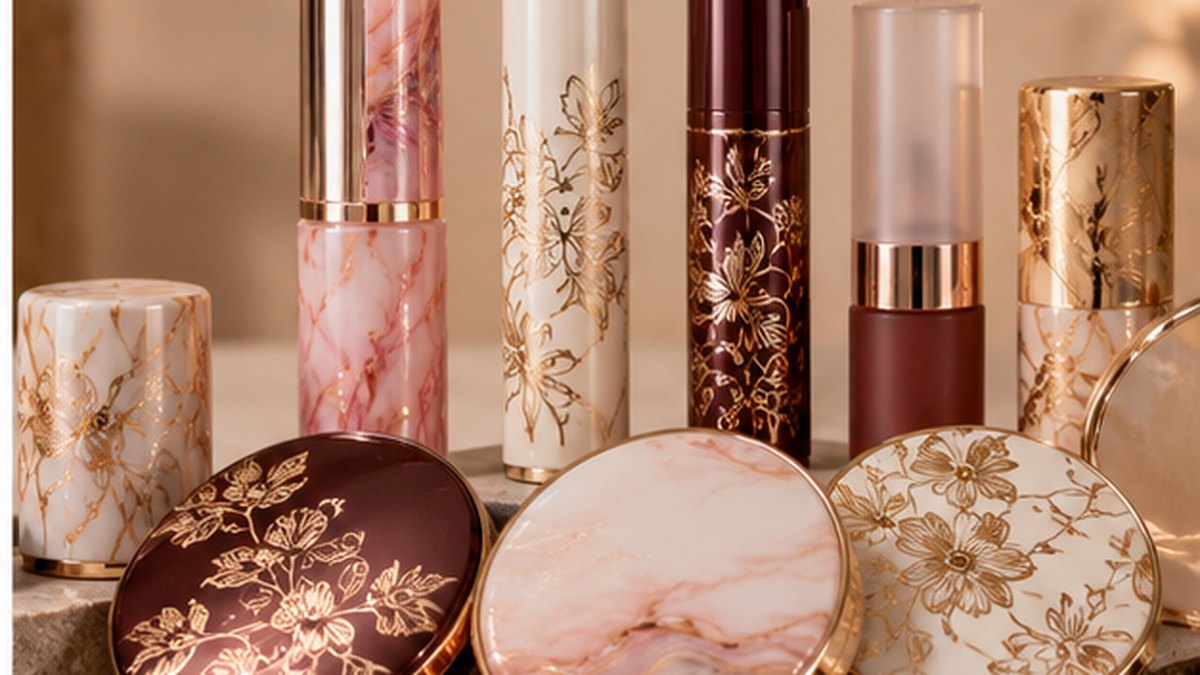
Water transfer and decals: full-wrap art that adds a process step
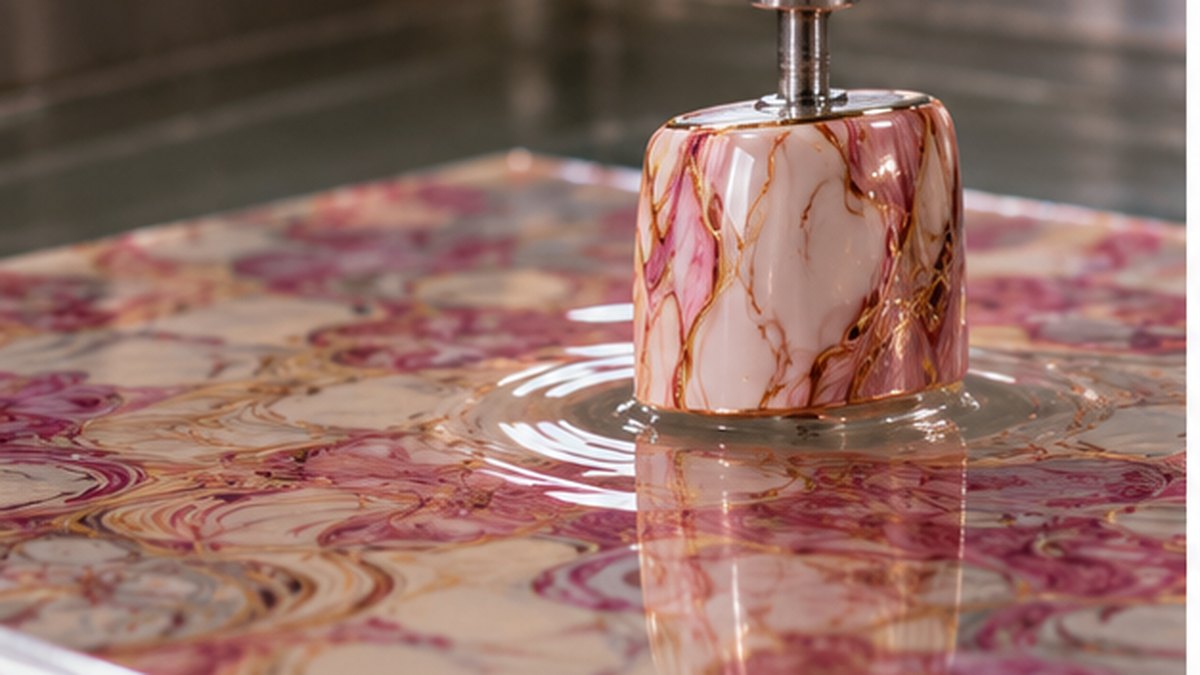
Water transfer printing and decals let artwork wrap fully around complex, curved, or irregular shapes that a flat screen or plate cannot reach. The cost is a second process step: the printed film or decal must be applied, positioned, and finished, which adds labour and failure points.
Water transfer is the answer when the design has to flow around a bottle shoulder, a tapered jar, or a contoured compact without distortion. It handles photographic and gradient art that would break apart in screen separation. The trade-off is that it adds a step after the component is made, and every added step adds labour, alignment risk, and time.
- The artwork is printed onto a film or decal substrate first.
- The film or decal is applied and positioned onto the component, usually by hand or semi-automated placement.
- A top coat or finish seals it, which is where durability is won or lost.
Which decoration method fits my first run?
Work the five selectors in order: artwork complexity, colour count, surface material, expected handling wear, and run size. Match each to a method before looking at price, because a method that scores well on one selector usually trades off against another.
These five selectors are not a formula; they are a filter that tells you which methods are still in contention before any supplier sends a quote.
| Selector | What to ask | Method it points to |
|---|---|---|
| Artwork complexity | Is it a logo, a pattern, or a photographic wrap? | Logo and marks: screen or foil; photographic wrap: water transfer or digital |
| Colour count | How many solid colours are in the mark? | One or two: screen or foil; many colours or gradients: digital or water transfer |
| Surface material | Glass, plastic, metal, or a soft tube? How curved? | Flat and rigid: any; deep curves or irregular: water transfer or digital |
| Handling wear | How much rubbing, squeezing, oil, or solvent will it meet? | High wear: screen or a well-sealed transfer; low wear: digital |
| Run size | Is this a sample, a short run, or a reorder at volume? | Short or variant-heavy: digital; steady large run: screen or foil |
- Define the artwork honestly: logo, pattern, or photographic wrap.
- Count the solid colours and note any gradients.
- Name the surface material and its curve.
- Estimate the handling wear the finished piece will meet.
- Set the run size and how many artwork variants it must carry.
What should I confirm with a supplier for each method?
For every method, confirm three things before you pay: the artwork file format the supplier accepts, a physical sample of your artwork on your component, and an adhesion and wear check after filling. These three confirmations turn a catalogue claim into a production fact.
The artwork file format question is where decoration projects stall. A supplier that can only accept a flattened low-resolution file will not reproduce the fine detail approved on screen. Ask for the exact format, the colour profile, and the minimum line weight before artwork is treated as final.
- What artwork file format and colour profile do you need, and at what minimum line weight?
- Can I receive a physical sample of my artwork printed on my actual component, not a stock sample?
- How do you verify adhesion and wear after the component is filled, and who absorbs the cost of a failure?
- For multi-colour methods, how do you hold registration from screen to screen?
The compliance documents to request
Decoration also carries a compliance side. No decoration method is FDA-approved; cosmetics are regulated, not pre-approved, and a supplier who sells an "approved" finish is not telling you the truth.1 A finish must never obscure the information a market requires on the label, or the component becomes unsellable however good it looks.2 In the EU, the component and its decoration sit inside the product's safety framework set by Regulation (EC) 1223/2009.3 The same framework makes a responsible person accountable for the finished product, and market access runs through notification.4
For ink and material safety, request the ink and material compliance documentation and have your responsible assessor confirm it, rather than accepting a verbal "food-grade" or "safe" claim. Under a GMP framework such as ISO 22716, the materials that touch the product should be documented and traceable.5 In markets like Indonesia, confirm the decoration materials meet BPOM requirements for the finished cosmetic.6
Why does the economical method change as the batch grows?
A method that is economical at one run size is often wasteful at another, because each method carries a different fixed setup and a different per-unit slope. The method that fits a short run on digital printing is rarely the method that fits a steady reorder on screen or foil.
The fixed part of the cost is the screen, the plate, or the film; the per-unit part is the press time, the ink, and the application labour. When a run is small, the fixed part dominates, so a no-plate method like digital wins. When a run is large, the fixed part spreads thin, and a screen or foil that is cheaper per unit takes over.
| Method | Economical at | Wasteful at |
|---|---|---|
| Hot stamping / foil | Steady reorders with an unchanged logo | One-off short runs that never reuse the plate |
| Silk screen printing | Large runs of a low-colour logo | Tiny runs or designs that change every order |
| Digital printing | Short runs and many variants | A single unchanged artwork at high volume |
| Water transfer / decals | Complex wrap art on a contoured shape | Simple one-colour marks that screen can do cheaper |
This is decoration tooling, not the full economics of a custom mould; that question belongs to the guide on private label packaging without a new mould. The point here is narrower: the same artwork, at a different quantity, can point to a different method, so do not lock the method to the design before you know the batch.
Frequently Asked Questions
- Which decoration method is cheapest? There is no single answer; it depends on run size and artwork. Digital printing is cheapest for short runs because there is no plate, while screen or foil is cheaper per unit at steady volume.
- Does hot stamping work on every surface? It works best on small, flat-to-gentle-curve areas. Deep curves and heavy texture make foil adhesion harder to hold, so confirm with a sample on your component.
- Can decoration make a component non-compliant? Yes, if it obscures required label information or uses ink whose compliance documentation is not confirmed by your responsible assessor.
Conclusion
The decoration method is not a final checkbox; it is a sourcing decision that sets tooling, per-unit cost, lead time, and durability. Match the method to the artwork, colour count, surface, wear, and run size, confirm a sample on your component, and the finish stops being a surprise.
ZONO Beauty is a private-label, OEM, and ODM cosmetics partner for beauty brand founders, indie owners, and packaging buyers, coordinating long-term manufacturing suppliers; we are not positioned as a single factory. Ten years of experience and a ready-stock library of over 1,000 SKUs, shipping from as few as 12 pieces within 48 hours, sit behind the three routes we run from Shantou, Guangdong: ready-stock, semi-custom, and full OEM/ODM. One lip oil project moved 700,000 units in 2024, a reminder that a finish has to survive filling, freight, and the customer's hand, not just the catalogue photo.
The work ends when the method is matched to the five selectors, the sample is confirmed on the actual component, and the compliance documents are on paper.
Footnotes
1. FDA Authority Over Cosmetics: How Cosmetics Are Not FDA-Approved, but Are FDA-Regulated. FDA. ↩︎
2. Cosmetics Labeling. FDA. ↩︎
3. Regulation (EC) No 1223/2009 of the European Parliament and of the Council on cosmetic products. EUR-Lex. ↩︎
4. Cosmetics legislation. European Commission. ↩︎
5. ISO 22716:2007 Cosmetics, Good Manufacturing Practices (GMP). ISO. ↩︎
6. Badan Pengawas Obat dan Makanan (BPOM). BPOM. ↩︎
Share the component, the artwork, the colour count, the surface material, the expected handling wear, and the approximate run size. ZONO can organize the supplier questions, reply within one business day, and mark the remaining facts for confirmation.
Discuss your packaging decoration briefTo see ready-stock, semi-custom, and full OEM/ODM components across a project, browse ZONO packaging and products.