How to Choose a Private Label Lip Balm Manufacturer?
Every week our sourcing team in Shantou hears the same worry: one private label lip balm manufacturer quotes half of another's price, and picking wrong could sink an entire launch.

Every week our sourcing team in Shantou hears the same worry: one private label lip balm manufacturer quotes half of another's price, and picking wrong could sink an entire launch.
Choose a private label lip balm manufacturer by verifying GMP and ISO 22716 documentation, testing physical samples for melt point and glide, confirming MOQ flexibility, reviewing packaging capability, and checking communication quality — never unit price alone. The right partner samples quickly, produces consistently, and scales with your brand.
Price is only one variable. Formula maturity, packaging match, testing documents, and lead time all decide whether your order succeeds. Below, I break the decision into four practical questions.
How do I know if a private label lip balm manufacturer is actually reliable before I commit?
A buyer once forwarded me a supplier's GMP certificate that turned out to be an expired scan from a different facility. Our document check caught it before sampling even started.
Verify reliability by requesting current GMP and ISO 22716 certificates, full INCI lists, Certificates of Analysis, and SDS documents, then confirming export history to your target market. A trustworthy supplier shares documentation before sampling begins — reluctance or expired paperwork is your clearest warning sign.

Documentation is the fastest reliability filter I know. Anyone can send a polished catalog. Far fewer suppliers can send a complete, current, and consistent paper trail. When we vet partner factories for clients, the document review always comes before any sample request, because it kills weak candidates early and cheaply.
Start with the certification paper trail
A GMP certified manufacturer working under ISO 22716 1 follows documented hygiene, batch control, and traceability procedures. If you sell into the United States, ask whether the plant operates as an FDA compliant facility 2 for cosmetics. If your positioning is ethical or vegan, ask for cruelty-free certification evidence rather than a verbal promise. For each document, check three things: the issue date, the exact facility name, and the certificate scope.
| Document | What it proves | Red flag to watch |
|---|---|---|
| GMP / ISO 22716 certificate | The facility follows cosmetic quality management standards | Expired date or a different facility name |
| INCI list | Full ingredient disclosure for labeling and compliance | Vague "proprietary blend" answers |
| Certificate of Analysis (CoA) | Each batch was tested against specifications | Only marketing sheets, no batch data |
| SDS | Safe handling and shipping data | Missing or outdated versions |
Look beyond the certificates
Paperwork alone is not the whole story. I also probe formulation depth. Ask whether the team can support lip skinification trends 3 — actives like peptides, ceramides, and hyaluronic acid inside a balm base — even if you never use them. Their answer reveals whether real R&D sits behind the catalog. Then confirm export experience for your destination, whether that is the EU, the GCC, or ASEAN, because market-specific labeling and dossier support separates seasoned exporters from domestic-only factories.
What should I ask about pricing and MOQ when comparing lip balm suppliers in China?
Low MOQ or low unit cost — buyers rarely get both. When we match clients to partner factories in China, this trade-off shapes the shortlist before any quote arrives.
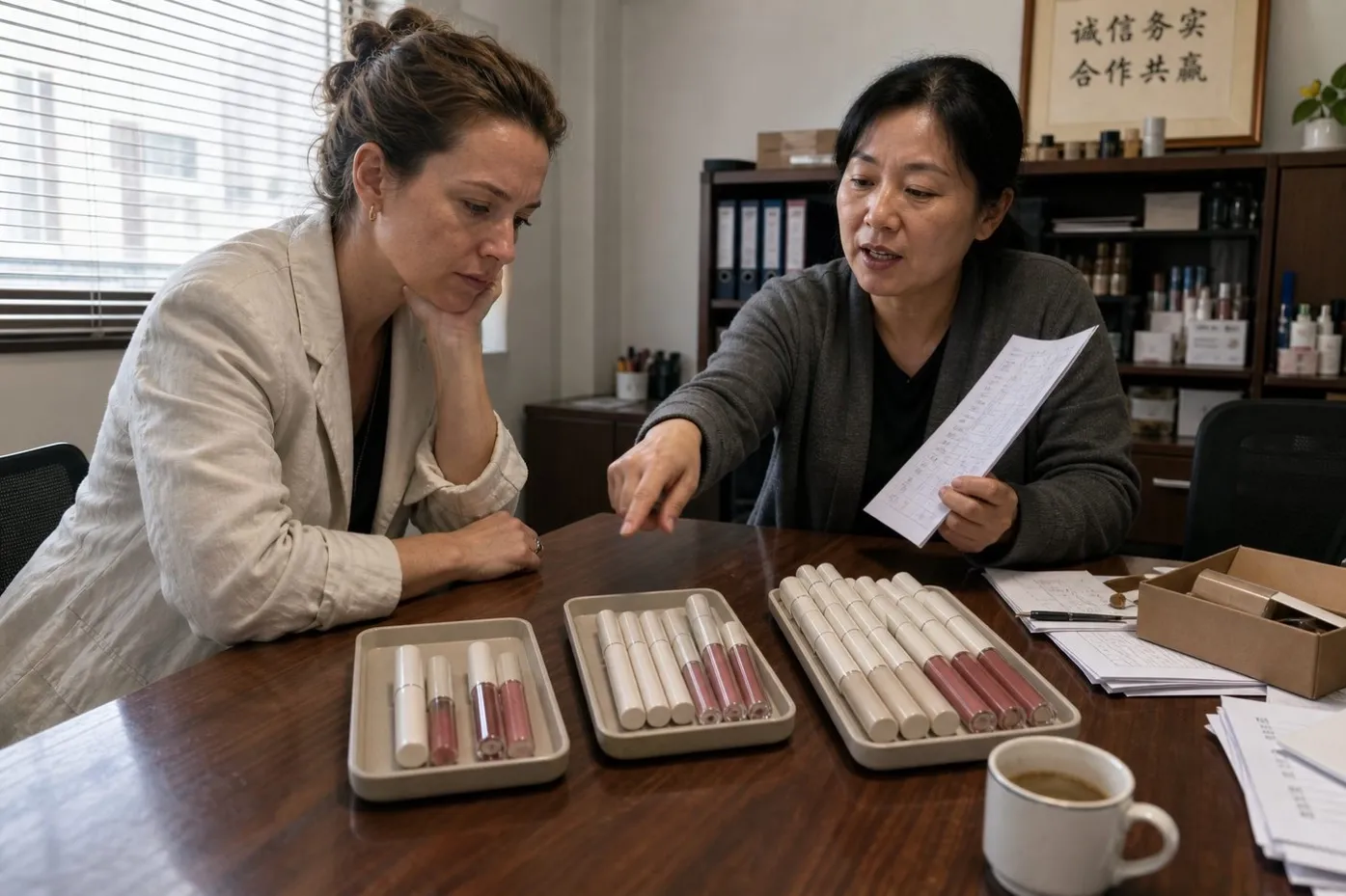
Ask for MOQ per SKU, tiered pricing by volume, exactly what the quote covers — formula, packaging, filling, labeling — plus tooling fees, payment terms, and reorder pricing. Starter MOQs commonly run 500 to 1,000 units, while larger factories may require 10,000 or more per product.

Before comparing any two quotes, get answers to these questions in writing:
- What is the Minimum Order Quantity (MOQ) per SKU, and per color or flavor variant?
- Does the price include the tube, box, filling, and labeling, or only the bulk formula?
- Are there one-time charges for plates, molds, or custom formulation services?
- How does the unit price change at two, five, and ten times the starting volume?
- What are the payment terms, and does reorder pricing stay fixed?
Understand what order size really buys you
| Order size | Unit cost impact | Best suited for |
|---|---|---|
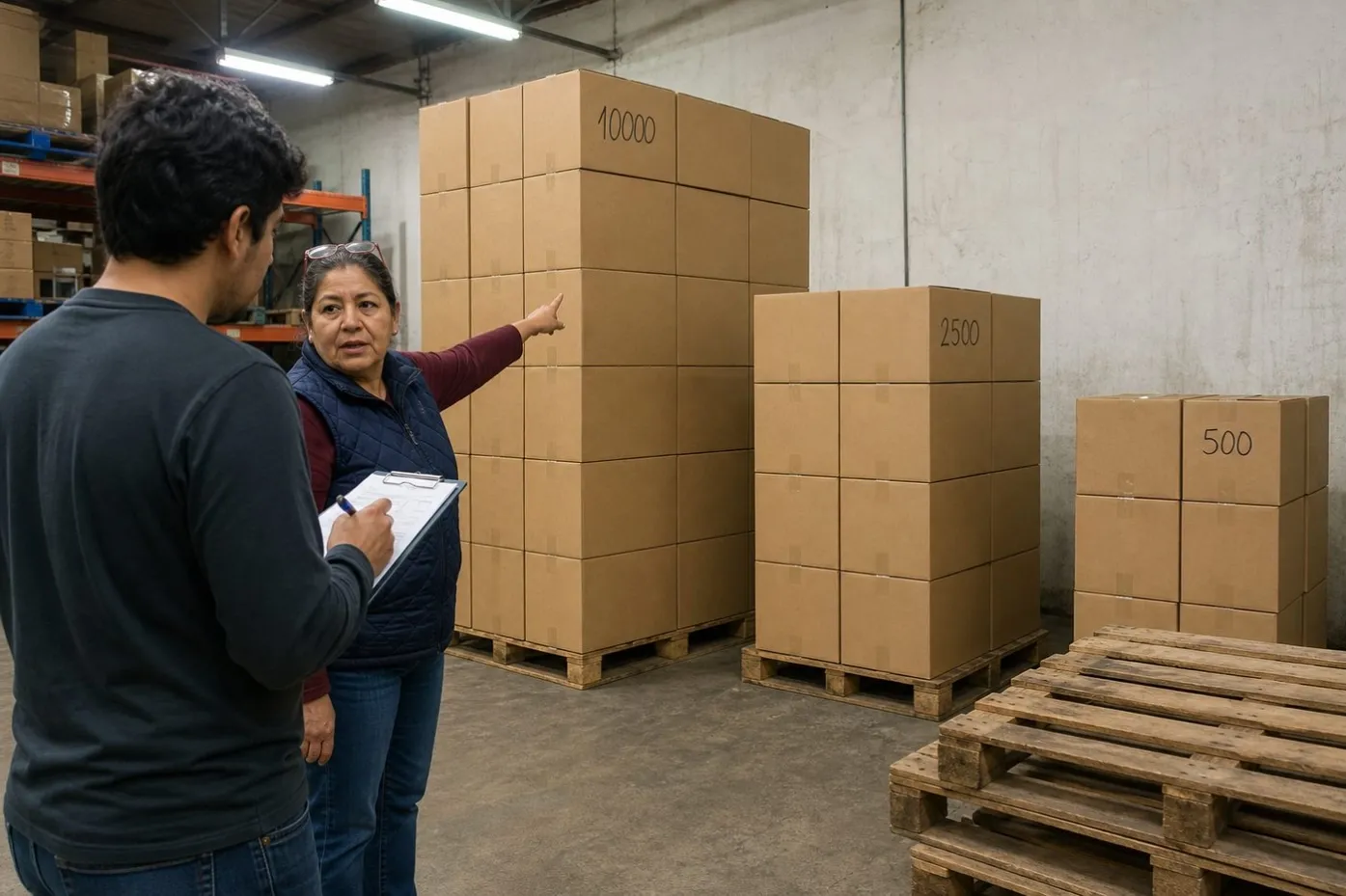
| 500–1,000 units | Highest per-unit cost, lowest risk | Market testing and first launches |
| 3,000–5,000 units | Meaningful price break | Brands with proven early sales |
| 10,000+ units | Strongest unit economics | Established SKUs and retail programs |
White label speed or custom differentiation?
Here is the objection I hear most: "Won't a stock formula make my brand generic?" My honest answer is that the first order should not customize everything. A mature catalog formula through contract manufacturing services 4 samples faster, produces more stably, and costs less to launch. You differentiate through lip balm packaging options instead — PCR materials, UV coating, hot stamping, or refillable formats — then upgrade to custom work like SPF, vegan waxes, or proprietary flavor profiles once sales justify the R&D time. Low MOQ does compress margins at launch. That is the price of testing the market safely, and it is usually worth paying.
How do I make sure my bulk lip balm order matches the sample I approved?
One client mailed me two tubes side by side: her approved sample and a bulk unit that dragged on application. The wax-to-oil ratio had drifted between batches.
Lock a golden sample with documented specifications — texture, melt point, color, scent, and packaging fit — write those specs into your purchase order, then require a pre-production sample from the actual bulk batch and a pre-shipment inspection against that reference before goods leave the factory.

Sample drift is the single most common complaint I hear from buyers who sourced alone. The fix is procedural, not emotional. Here is the sequence we run on every project we coordinate:
- Approve a golden sample. Keep two sealed units: one with you, one signed and retained by the supplier.
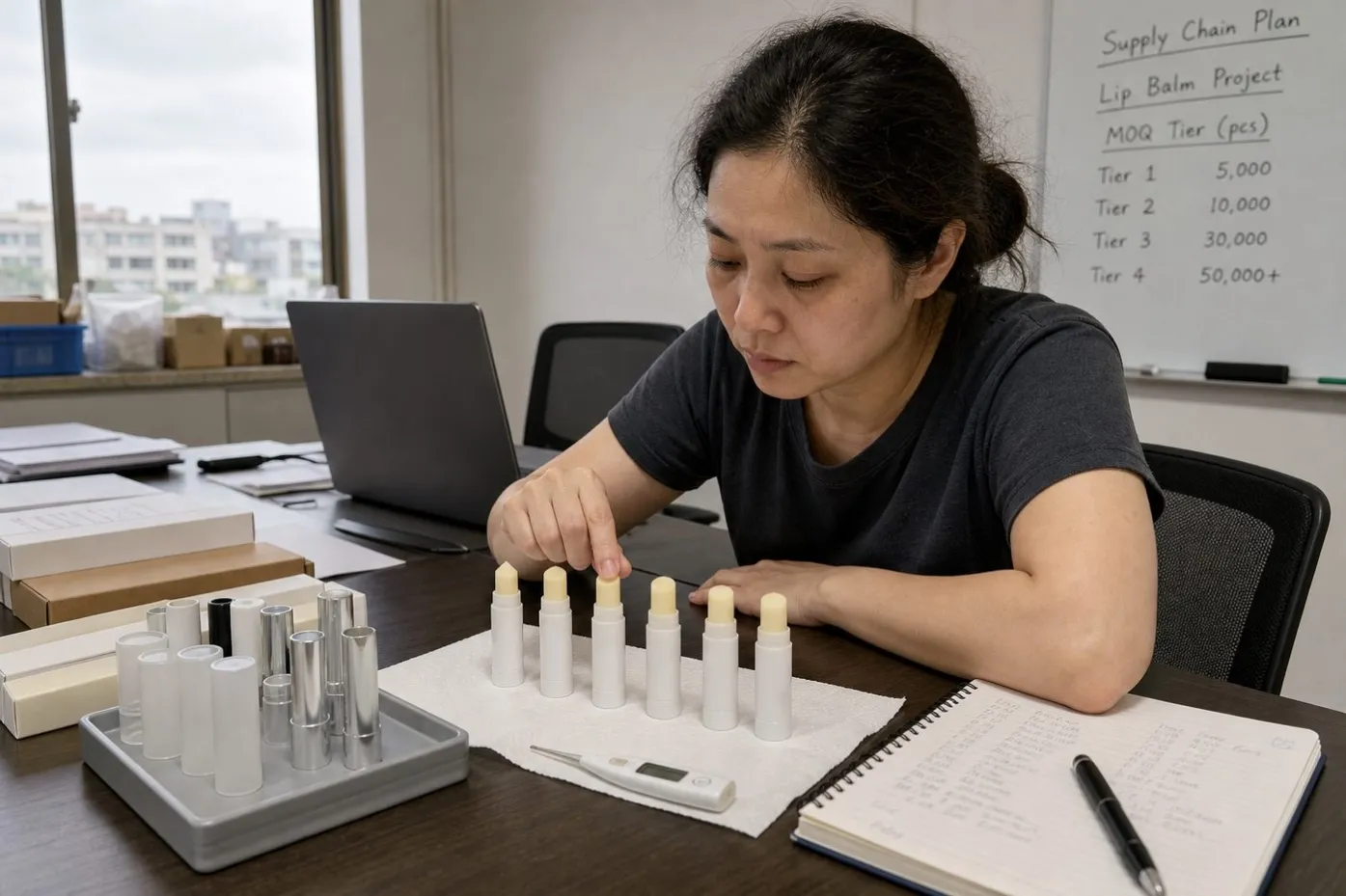
- Document the specs. Record texture, glide, tint payoff, scent, spreadability, melt point, and packaging fit in a written spec sheet attached to the purchase order.
- Request a pre-production sample. This must come from the actual bulk batch, not the lab bench.
- Run heat stability checks. Lip balm softens in transit, so accelerated stability testing alongside real-time testing confirms the stick will not melt, leak, or separate during shipping.
- Inspect before shipment. Compare finished goods against the golden sample before final payment and release.
What to check at each stage
| Checkpoint | How to verify | When |
|---|---|---|
| Texture and glide | Apply side by side with the golden sample | Pre-production and pre-shipment |
| Melt point | Warm-condition testing at elevated temperatures | Before bulk approval |
| Color and tint payoff | Swatch on skin under daylight | Every batch |
| Scent | Compare fresh against the retained sealed sample | Pre-shipment |
| Packaging fit | Twist, click, and drop tests on filled tubes | Pre-shipment |
One caution on positioning: organic lip balm ingredients and vegan wax systems market beautifully, but natural does not automatically mean stable. A clean formula still needs the same product sampling process and stability data as a conventional one. We have seen candelilla-based sticks pass a desk test and then soften in a summer container. Test the claim; never assume it.
What should I expect from a manufacturer's communication once production starts?
Silence taught me more than any delay ever did. Years ago, a supplier I coordinated went quiet for two weeks mid-production, and the problem surfaced only after the deadline slipped.
Expect a named contact person, a production schedule with milestone dates, proactive updates at material intake, filling, and packing, photo or video evidence at each stage, and immediate notification of any delay or ingredient substitution — always paired with a proposed solution, never silence.

Communication quality during production predicts reorder quality better than any sales pitch. A supplier who reports problems early gives you options. A supplier who hides them hands you a crisis with the ship date already gone. That lesson is why we built our own service around one coordination window: a single point of contact managing supplier follow-up, quality inspection, export documentation, and logistics, so nothing falls between departments.
The milestone updates worth demanding
Set these expectations in writing before you pay the deposit:
- Order confirmation with a dated production schedule.
- Raw material intake confirmation, including any substitution disclosure.
- Bulk compounding and filling updates with batch photos.
- Packing and labeling photos showing your artwork on the real product.
- Pre-shipment inspection report with findings against the golden sample.
- Shipping documents — invoice, packing list, and any market-specific export files.
Suppliers offering true turnkey cosmetic solutions treat this reporting as standard, not as a favor. A newer expectation worth raising is digital batch transparency: some partners now support QR code integration that lets end consumers trace raw ingredient origin, which doubles as an internal traceability signal for you. Finally, watch the red flags. Answers that shift between contacts, delays announced only when you ask, and refusal to share in-process photos all point to a partner who will struggle when something genuinely goes wrong. Scalability depends on this too — the second order only stays consistent if the first order's process was visible.
Conclusion
Choosing a private label lip balm manufacturer means weighing documentation, MOQ, sample fidelity, and communication together — not chasing the cheapest quote. Start with a proven formula, verify everything, then scale.
Footnotes
1. Official ISO page for the cosmetic GMP standard mentioned in the text. ↩︎
2. Official FDA landing page for cosmetic regulations and compliance. ↩︎
3. Market data regarding the global lip care industry and evolving consumer trends. ↩︎
4. Definition and overview of the contract manufacturing business model used by private labels. ↩︎