Sep 14, 2026Press-On Nails
How Do Price, MOQ & Communication Differ: China Factories vs Trading Companies for Press-On Nails?
Compare China nail factory vs trading company costs beyond headline quotes: pricing, MOQs, and communication styles that decide your real landed cost.
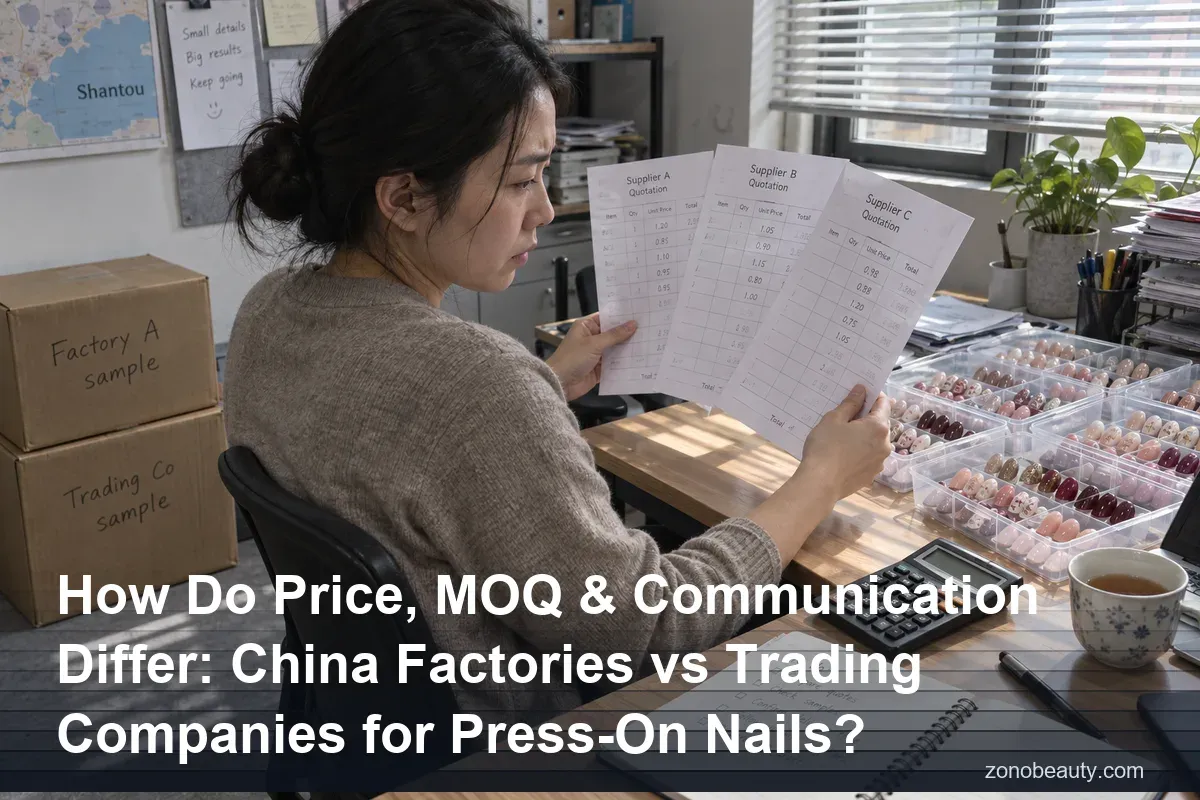

Sorting China factories vs trading companies for press-on nails once stalled a client launch on my Shantou sourcing desk; three quotes for one design varied threefold, with zero explanation.
Factories usually quote a lower per-set price but require higher minimums and technical, production-focused communication. Trading companies add a service margin yet accept smaller mixed orders and provide smoother, English-fluent support for overseas buyers.
That is the short answer. The full picture is more useful. Each supplier type wins in different situations. Below, I break down price, MOQ, and communication one by one supply chain audit transparency 1. Then I give you a decision framework you can apply to your own brand today.
ZONO confirmed terms (for reference)
- Sample sets: US$15 per set, credited against your first bulk order.
- Bulk production: around US$7 per set, quoted per design.
- Minimum order quantity: 50 sets per design.
- Compliance documentation: available upon request; final compliance responsibility rests with the brand owner.
- Markets served: Southeast Asia, North America, and South America.
Any other figures in this article are general industry context, not a ZONO quotation. Confirm current terms in writing before ordering.
Why do I see such different pricing when comparing China nail factories to trading companies?
A US nail brand founder once forwarded me three quotes for the same coffin-shape set, spread nearly three times apart—and every supplier claimed to be a factory.
Factories quote lower because buyers pay direct factory pricing with no middleman margin; basic press-on sets are quoted per volume tier. Trading companies typically add a service margin that covers sourcing agent fees, coordination, and consolidation, so the same design costs more per set.
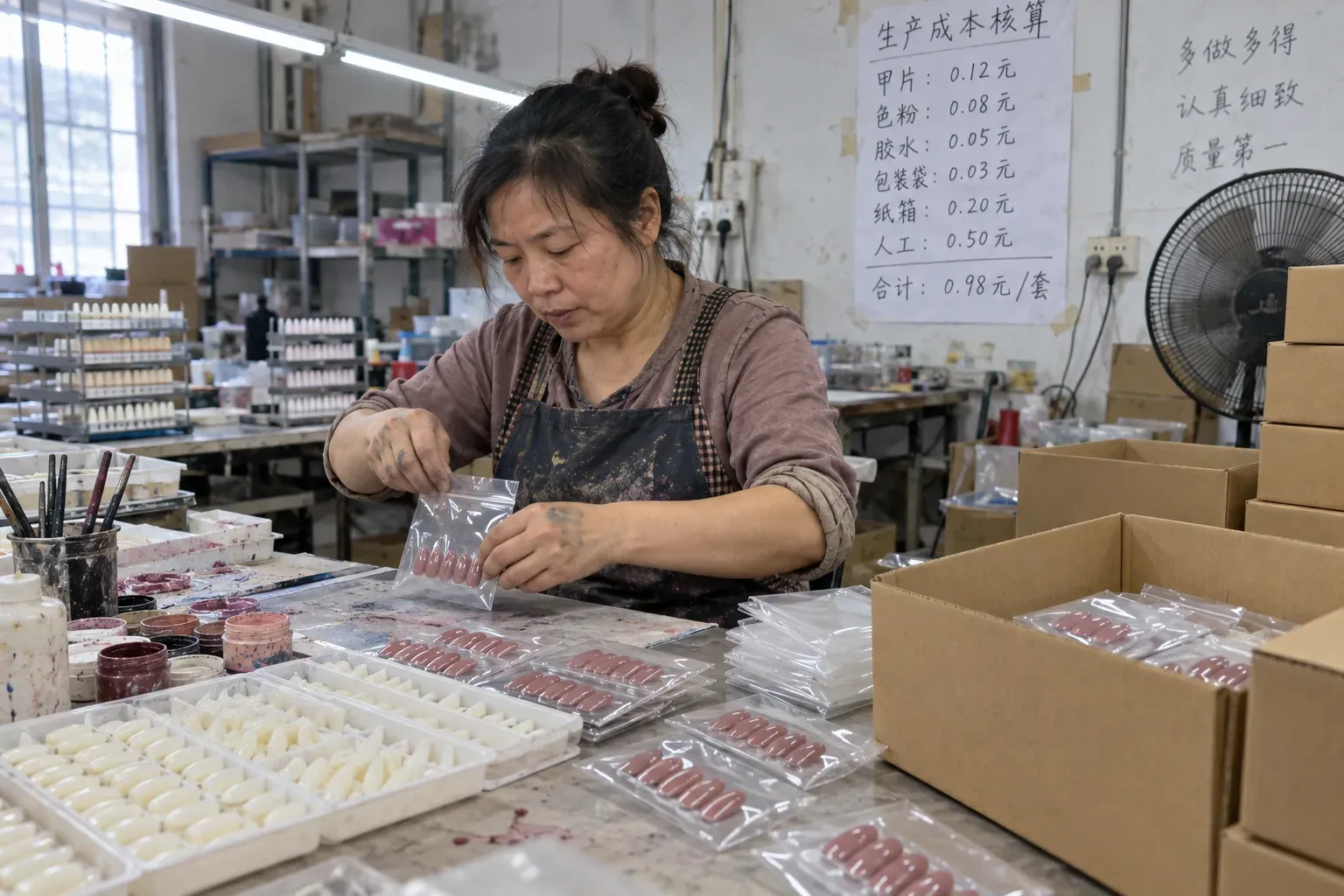
Here is the pricing picture at a glance, based on what public supplier listings actually show:
Cost factor | Factory (direct) | Trading company |
|---|---|---|
Basic solid-color sets | quoted per set — request a written quote | Base cost plus the coordinator’s service margin |
Embellished, handcrafted sets | quoted per set — request a written quote | Higher, or limited to available stock designs |
Small mixed orders | Tiered upward — request a written quote | Often competitive because of aggregated ready stock |
What the price covers | Production cost plus factory margin | Factory cost plus sourcing, inspection, and consolidation |
What a factory quote includes
A factory prices the work itself. Materials, labor, molds, and its own margin. That is why direct factory pricing looks lean. But the quote assumes you handle everything else. You manage specifications, quality control standards, and <a href="https://www.wcoomd.org/" target="_blank" rel="noopener noreferrer">export logistics and shipping</a> <sup id="ref-2"><a href="#footnote-2" class="footnote-ref">2</a></sup> on your own, or you pay someone to do it.
Why trading company quotes run higher
A trading company buys from factories, then resells to you. The service margin is not fluff. It pays for supplier comparison, <a href="https://www.intracen.org/" target="_blank" rel="noopener noreferrer">sampling coordination</a> <sup id="ref-3"><a href="#footnote-3" class="footnote-ref">3</a></sup>, independent inspection, and consolidated shipping. In my own coordination work, I have seen that layer save buyers from packaging-formula mismatches and bulk goods that drift from the approved sample.
Landed cost is the real comparison
Do not compare headline quotes. Compare landed cost per set. Add sample fees, custom packaging design, tooling, freight, customs, and the cost of mistakes. A trading company can look cheaper at 50 sets because it sells aggregated stock. A factory almost always wins at 3,000 sets. Design complexity moves the number too. Hand painting, rhinestones, and premium boxes push any quote up, no matter who sends it.
✔ A trading company's service margin pays for real services like sourcing, inspection, and shipment consolidation TrueThe markup covers supplier comparison, sampling coordination, and logistics support that a direct factory quote does not include, so it is a service fee rather than pure margin.✘ The lowest headline quote always delivers the lowest landed cost FalseSample fees, tooling, packaging, freight, customs, and the cost of specification errors can easily erase a low unit price, so landed cost per set is the only fair comparison.
How does my MOQ change if I source press-on nails directly from a factory versus a trading company?
Every small batch MOQ request lands on the same trade-off at our coordination desk: the factory wants production efficiency, while the brand wants low inventory risk.
Factory MOQs are commonly higher than trading-company minimums for stock patterns, higher again for fully customized designs, and highest for custom packing boxes. Ask for each tier in writing. Trading companies aggregate multi-factory inventory, so entry points of 30, 50, or 100 mixed sets are widely available.
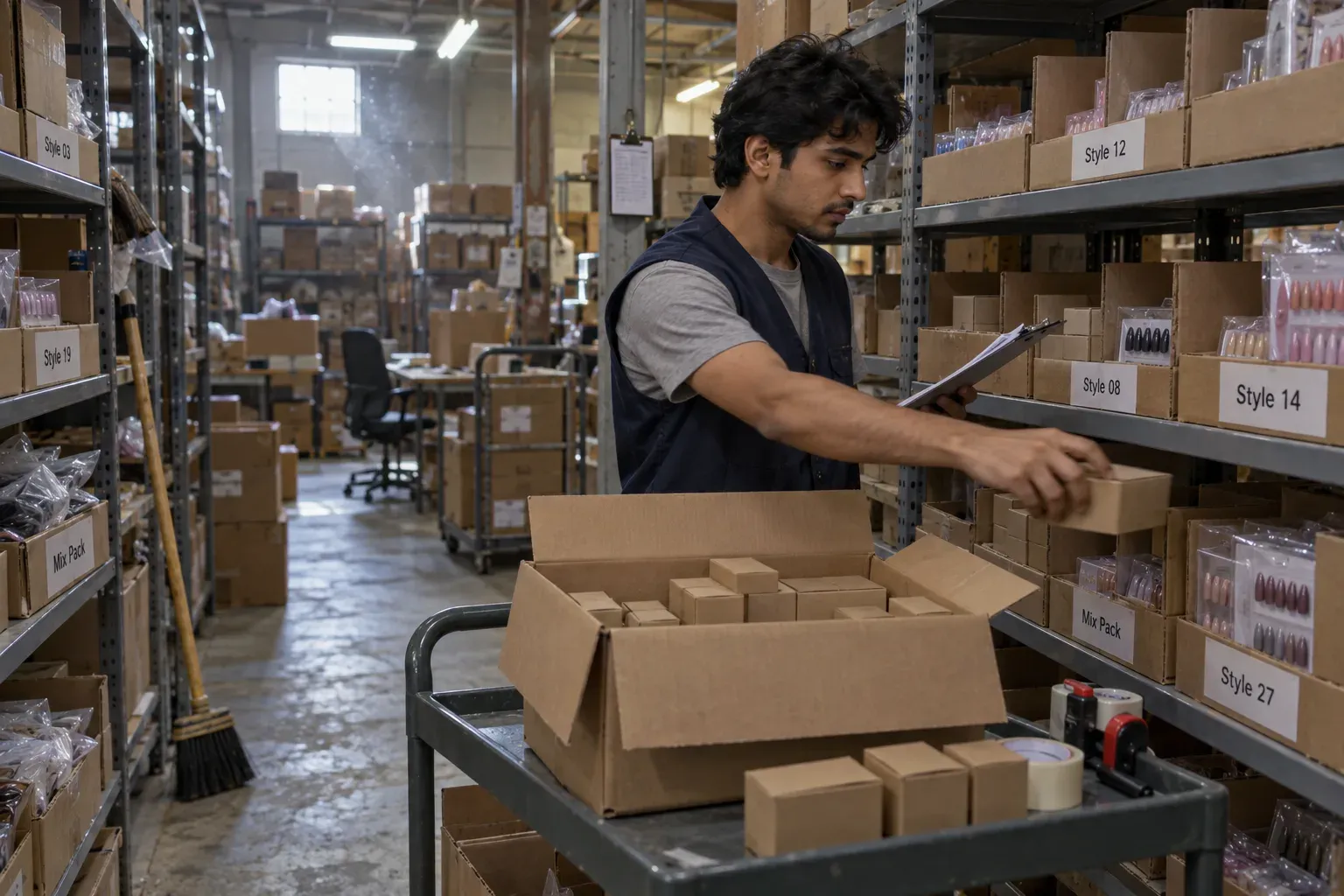
MOQ is the single biggest practical difference between the two supplier types. The table below shows how minimums shift by order type:
Order type | Typical factory MOQ | Typical trading company MOQ |
|---|---|---|
Ready stock, mixed styles | 20–300 sets on flexible wholesale tiers | 30–100 sets |
Stock pattern under your label | 100–1,000 sets per design | 50–100 sets |
Fully customized OEM design | 1,000–5,000 sets | Usually referred back to a factory |
Custom packing boxes | Up to 10,000 sets | Smaller runs via packaging partners |
Why factory MOQs climb with customization
False nail manufacturing is more labor-intensive than most buyers expect. Hand painting and rhinestone placement do not scale like injection molding. A factory needs volume to justify machine setup <sup id="ref-4"><a href="#footnote-4" class="footnote-ref">4</a></sup>, worker training, and material purchasing. That is why many factories quote 1,000–3,000 units per style as a baseline. One published factory tier makes the pattern very clear: 300 sets for a pattern design, 5,000 sets for a customized design, and 10,000 sets for custom packing boxes. Every added layer of OEM/ODM production services pushes the minimum up.
How trading companies keep minimums low
A trading company pools stock from multiple factories. It can sell you 30 sets from one workshop and 50 from another in a single shipment. For a startup testing designs, that flexibility matters more than unit price. In my experience coordinating first orders for new North American and Southeast Asian nail brands, a mixed-SKU test order also teaches you which shapes and lengths your customers actually buy—before you commit to a factory-scale run with long bulk order lead times.
✔ The same factory can quote a lower minimum for a stock pattern but a much higher one for a fully customized design TruePublished factory tiers show exactly this spread, because custom work adds mold, labor, and setup costs that only larger runs can absorb.✘ A supplier's MOQ is one fixed number that applies to every product FalseMOQ shifts with design complexity, decoration labor, packaging requirements, and SKU mix, so the same supplier may offer several different minimums on one price sheet.
What communication gaps should I expect working with a factory instead of a trading company?
One hard lesson from our early export projects: a two-line factory reply saying color OK, ship Friday—when the color was, in fact, not OK.
Expect factories to communicate through production staff using technical, specification-heavy language with slower replies. Trading companies employ dedicated bilingual sales teams, often available around the clock, but their answers pass through an extra layer, which can soften or delay news from sub-suppliers.

Communication is where most sourcing relationships quietly break. I have watched it happen from both sides of the table, and the gaps are predictable once you know where to look.
What factory communication actually looks like
Factory contacts are often production staff first and salespeople second. Their English is functional, not fluid. Their replies are short. But their information is precise. A typical manufacturer workflow asks you upfront for quantity, styles, business type, packaging needs, shipping country, and branding support requirements before confirming any price. That feels demanding. It is actually a good sign. It means the factory prices real specifications, not guesses.
Where trading companies smooth the process
Trading companies exist to translate. They compare factories for you, manage product sample development, and prepare shipping documentation. Many also act as an unofficial quality control buffer, running independent inspections that a factory might skip to protect its internal yield numbers. For a first-time buyer, that buffer has real value.
The gap nobody mentions
Faster replies do not mean faster production. A polished sales team can answer in an hour and still miss a production delay for a week, because the news has to travel from the sub-supplier first. A factory answers slowly but knows its line status in real time. My rule after years of coordinating both: judge suppliers on the precision of answers about materials, quality control standards, and cost breakpoints—not on the speed or polish of the English.
How do I decide whether a factory or a trading company is the right fit for my press-on nail brand?
Two briefs crossed my desk the same week: a startup testing a dozen viral designs, and an established brand reordering one hero set at real bulk scale.
Choose a factory for the lowest unit cost, proprietary nail molds, exclusive designs, and supply chain audit transparency at scale. Choose a trading company for small test orders, mixed styles, one-stop sourcing, and fast trend response. Many brands use both models as they grow.
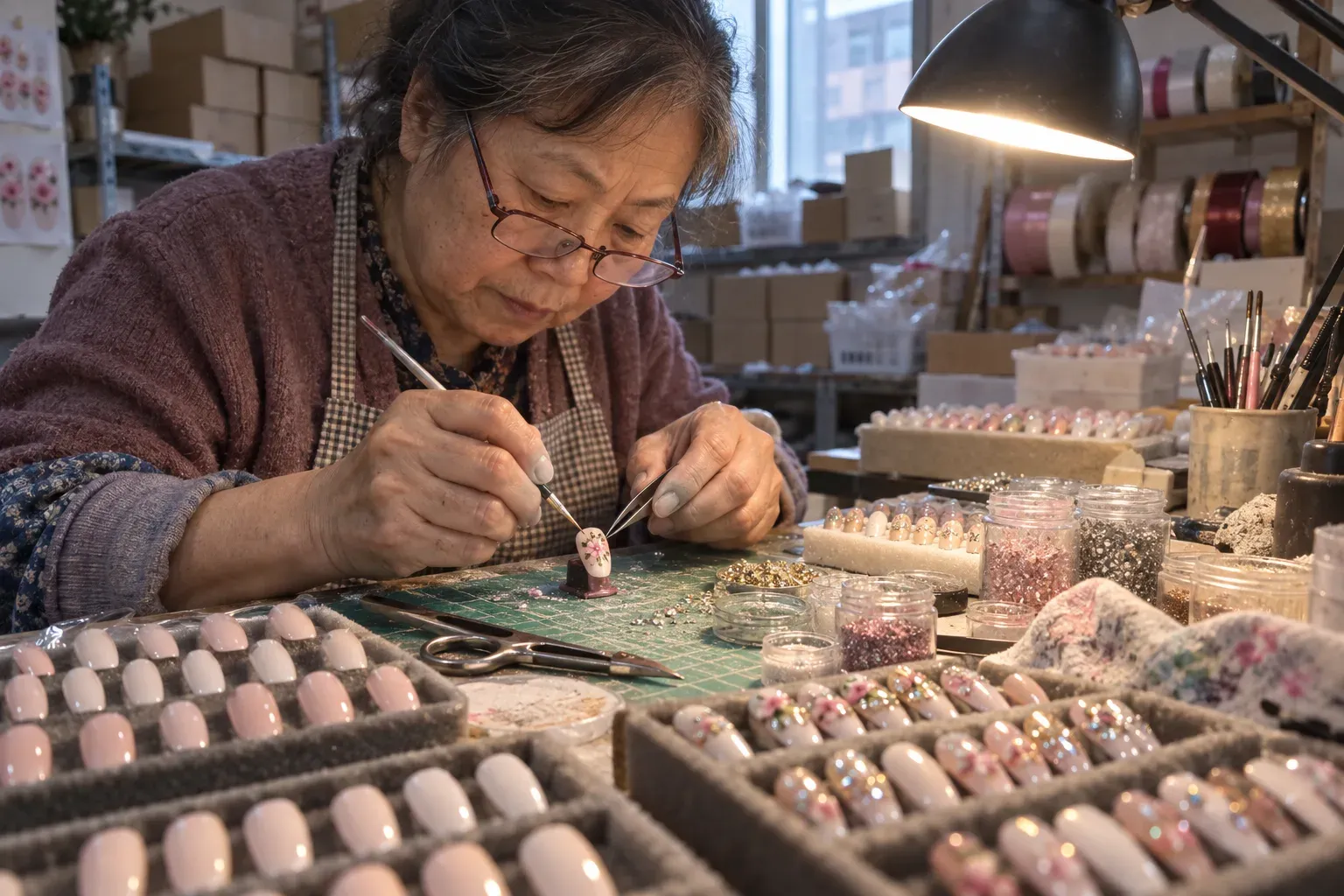
The honest answer to China factories vs trading companies for press-on nails is: it depends on your stage. Here is the decision matrix I walk clients through:
Your situation | Better fit | Why |
|---|---|---|
Testing the market with under 100 sets | Trading company | Small batch MOQ, mixed styles, ready stock |
Chasing viral TikTok designs fast | Trading company | They spot and source trending designs from small workshops weeks before large factories can retool |
Building a private label manufacturing line | Depends on depth | Surface-level white labeling suits traders; deep OEM with proprietary nail molds needs a factory |
Protecting exclusive designs | Factory | Reputable factories are more likely to honor exclusivity; traders are incentivized to resell hot designs |
Meeting ESG or social compliance audit requirements | Factory | Direct partnerships give supply chain transparency traders struggle to provide for every sub-supplier |
High-volume repeat orders | Factory | Direct factory pricing, timeline control, and consistent repeat production |
Match the supplier to your stage, not your ego
Startups often overreach toward factories too early, then sit on unsold inventory. Scaling brands often stay with traders too long, then bleed margin on every reorder. Neither mistake is fatal, but both are expensive. A growing brand usually transitions in steps: trader for testing, flexible factory for the first branded run, dedicated factory for hero SKUs.
The hybrid path most buyers overlook
You do not have to pick one model forever. In our wholesale beauty supply chain work, we often run a client's trend-driven mixed sets through aggregated stock while their core collection moves to direct factory production with verified supplier documentation. One coordination window handles both streams, from sampling through export logistics and shipping. That structure keeps unit costs falling as volume grows, without giving up the flexibility that keeps a young brand alive.
✔ Intellectual property risk is generally higher with trading companies than with reputable factories TrueTrading companies are incentivized to offer hot-selling custom designs to their other clients, while reputable factories are more likely to honor exclusive manufacturing agreements with the brand that developed the design.✘ Trading companies always deliver faster because they hold ready stock FalseReady stock ships fast, but on custom runs a trading company's sub-suppliers may prioritize larger direct-factory clients, creating delays the trader cannot control.
Conclusion
Factories win on price and control at scale; trading companies win on entry flexibility and ease. Match the supplier type to your stage—or let a coordination partner bridge both.
Sourcing handmade press-on nails and need to check MOQ against your order plan? Browse the ZONO press-on nail range for finished sets, shapes, and private-label options.
Footnotes
1. Amfori is the leading global business association for open and sustainable trade, managing a widely used social compliance audit system. ↩︎ 2. The World Customs Organization provides global standards for international trade logistics and customs procedures. ↩︎ 3. The International Trade Centre is a joint agency of the UN and WTO supporting global sourcing and trade. ↩︎ 4. The NIST Manufacturing Extension Partnership provides resources on industrial production processes and efficiency for manufacturers. ↩︎