Sep 25, 2026Startup & Private Label Guides
Lip Makeup Sample Evaluation Checklist: Texture, Shade, Wear, and Packaging
Check texture by viscosity, glide, and drag on real lips; check pigmentation by first-swipe payoff, opacity, and evenness against your color standard; chec
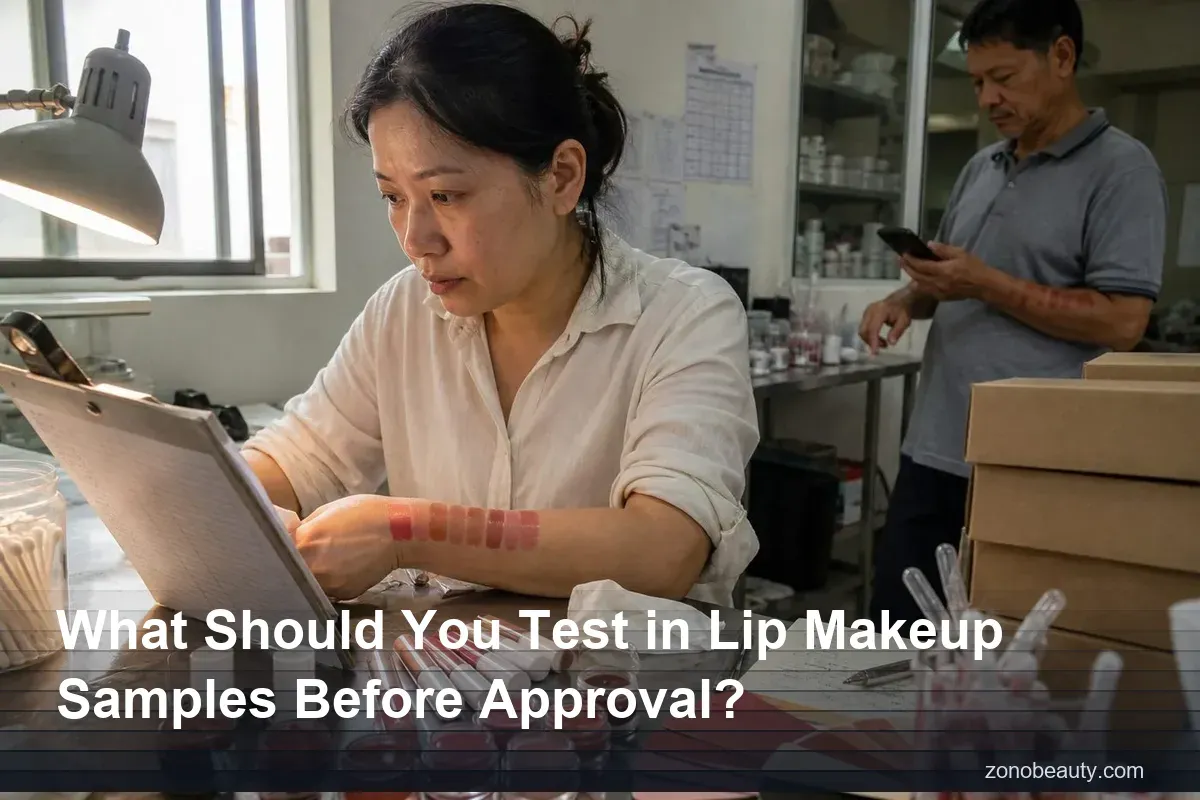
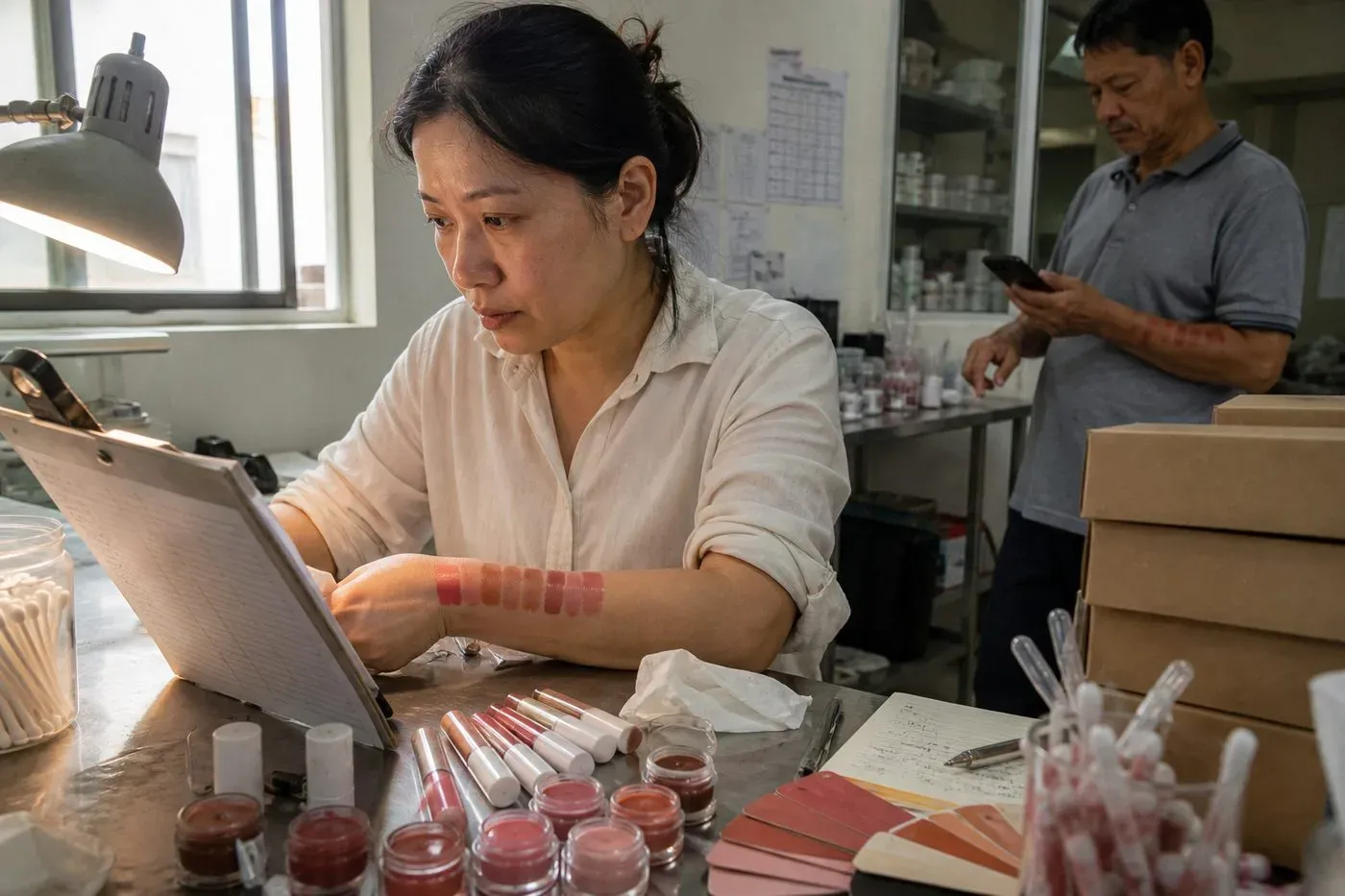
Coordinating lip projects between overseas brands and partner factories, I see the same costly mistake: lip makeup samples approved from photos, then bulk orders that feather, leak, or fade.
Before approving lip makeup samples, test shade accuracy, texture, pigmentation, wear time, transfer resistance, comfort, and removal; then confirm packaging compatibility, leakage, and applicator function; run stability testing in the final pack; and request microbiological, preservative efficacy, and heavy metal documentation before sign-off.
This article is the checklist I walk clients through before any sign-off. It covers texture, color, wear, packaging fit, bulk consistency, and documentation. Work through it item by item, and record every result in writing. An approved sample is a contract reference, not a compliment.
How do I check texture, pigmentation, and wear time in my lip makeup samples before approval?
Last month, a lip tint sample from a partner factory swatched perfectly on my hand — then faded from the lip center after one coffee. Hand swatches lie.
Check texture by viscosity, glide, and drag on real lips; check pigmentation by first-swipe payoff, opacity, and evenness against your color standard; check wear time through eating, drinking, and talking, recording feathering, transfer, fading pattern, and comfort at set intervals.
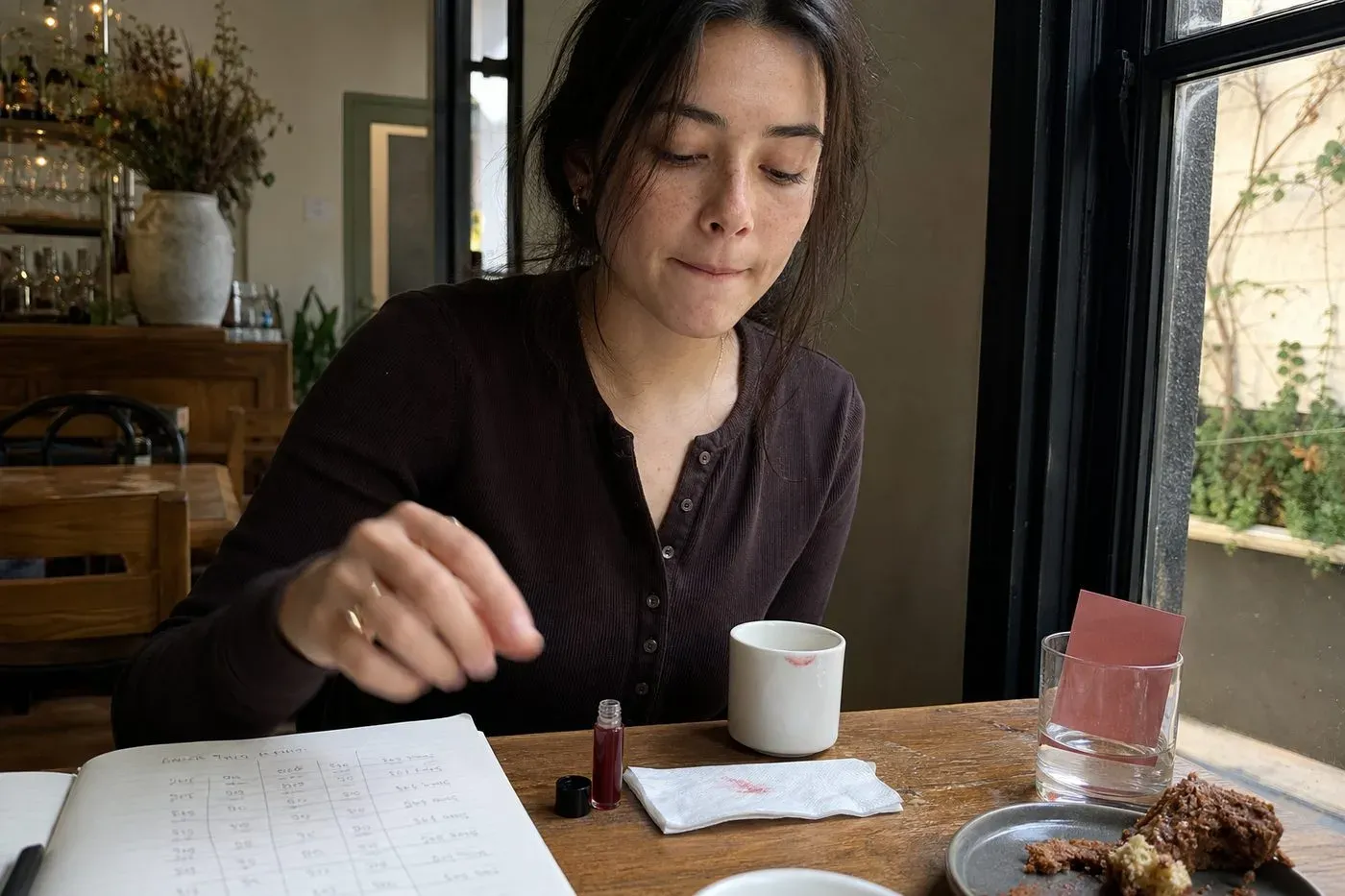
The biggest error I see is judging a lip sample in one sitting, in one light, on one surface. Lips are warm, wet, and always moving. A formula that behaves on the back of your hand can crack, migrate, or vanish on the mouth. So split your testing into bench checks and real-lip checks, and score both.
Start on the bench, not the lips
For gloss and lip oil, do a simple viscosity measurement 1 first: tilt the applicator and time the flow. Too thin means leakage risk later; too thick means poor pick-up. Then smear a stripe on white card to check pigment dispersion. Streaks, specks, or grit signal poor milling, and that never improves in bulk. Do your color matching 2 under three conditions: daylight, warm indoor light, and your phone camera. Digital color fidelity matters now — if the shade reads orange on camera, your customers will see it that way on social media before they ever see it in person.
Then run a real-lip wear protocol
Wear the sample through a normal half day: coffee, a light meal, conversation. Note feathering at the lip line, transfer resistance on a cup rim, and whether fading starts at the center. Taste and smell the product again after an hour of wear — saliva contact can degrade flavor and scent into something chemical, and that kills repeat purchases. Finally, test removal. Long-wear tints that stain or leave waxy residue create complaints too.
One objection I hear often: some founders want performance above everything, others want comfort first, and they argue the other side is wrong. My answer is simpler. Test against your own claim. A transfer-proof matte can be slightly drying; a comfort balm cannot. What fails is a sample that matches neither position.
Record it or it did not happen
Test item | How to test | Pass looks like | Fail looks like |
|---|---|---|---|
First-swipe payoff | One pass on lips | Even, opaque per claim | Patchy, needs building |
Texture and glide | Application feel | Smooth, no drag | Tugging, gritty particles |
Shade accuracy | Compare to master under 3 lights | Matches in all conditions | Shifts warm or dark |
Wear time | Timed wear with meal and drink | Even fade, intact lip line | Center fade, edge breakdown |
Transfer | Blot on tissue and cup | Minimal per claim | Heavy transfer, migration |
Scent and taste | At application and after 1 hour | Stable, faint | Chemical drift over time |
Removal | Standard cleanser | Clean, no stain | Residue, waxy film |
Score each row 1–5, photograph at set intervals, and use at least two testers. This scorecard becomes your reference when bulk arrives.
✔ Hand swatches cannot predict how a lip formula wears on lips TrueLips are warmer, wetter, and constantly moving, so wear time, feathering, and comfort only reveal themselves during a real-lip wear test through eating, drinking, and talking.✘ If the shade looks right on first swipe, the color is approved FalseShades can shift after oxidizing or sitting on the lips, so color matching must be re-checked over hours of wear and under multiple light sources, including a phone camera.
What should I look for to confirm my lip formula and packaging are actually compatible?
A UK founder came to us after sourcing tubes separately from her formula. The doe-foot picked up almost nothing, and the gloss leaked in transit. Nobody had tested them together.
Confirm compatibility by filling the actual production packaging with the actual formula, then checking leakage after inversion and temperature cycling, wiper and applicator dosage, cap torque, seal integrity, label adhesion, and any swelling, warping, or texture change over several weeks in the final pack.
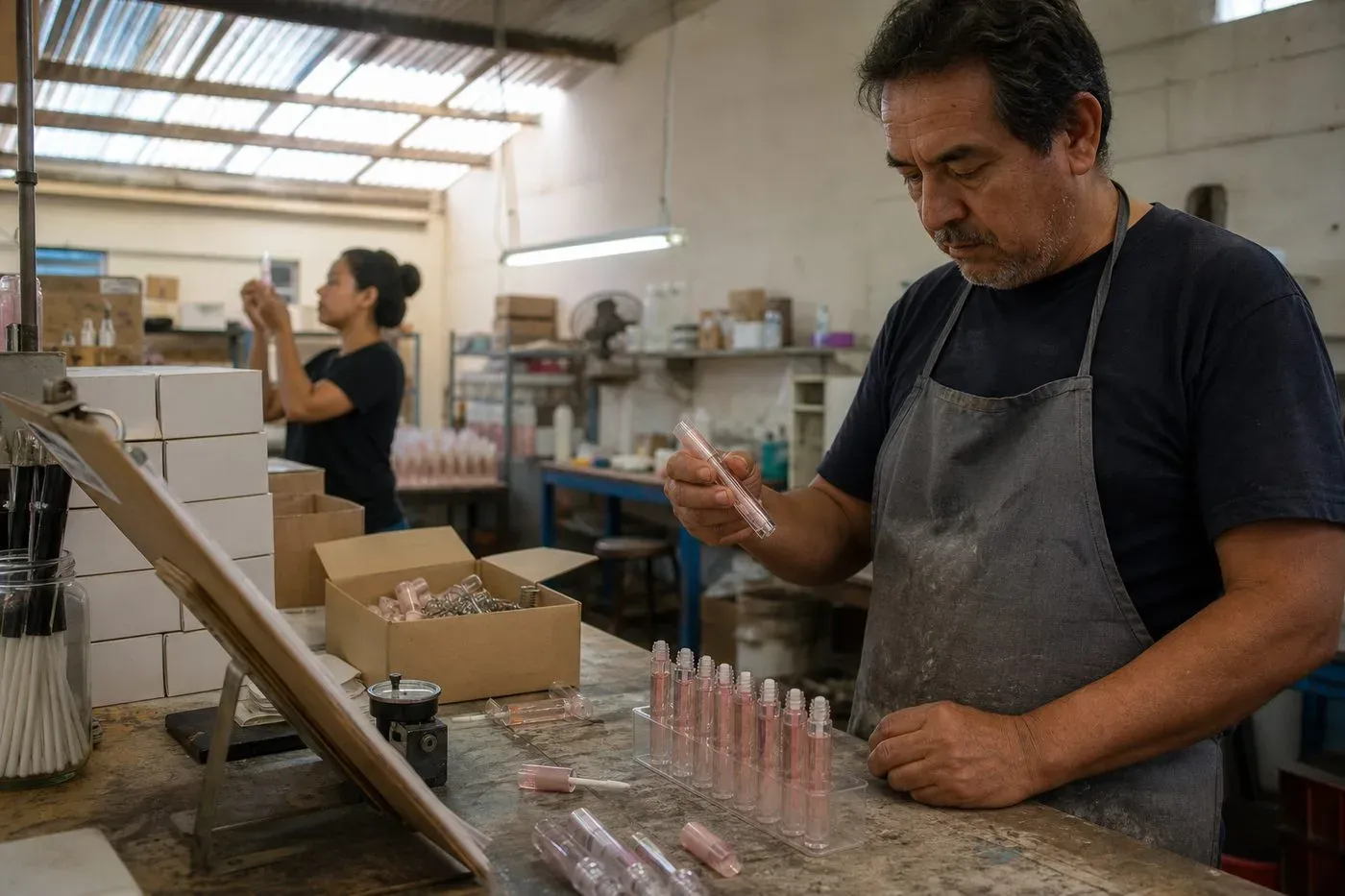
Because we coordinate both formula factories and packaging factories — often different suppliers on the same project — packaging compatibility is the check I refuse to skip. A formula approved in a lab jar tells you nothing about how it behaves inside a specific tube, against a specific wiper, under a specific cap. This is where I push back on the idea that lab tests are enough. Stability data from a glass jar does not replace weeks of real contact between your formula and your final pack.
Check every component, not just the tube
Component | What to test | Common failure |
|---|---|---|
Doe-foot applicator | Pick-up amount, even coating | Too little product, drips, streaks |
Wiper | Wipe-off consistency over repeated dips | Scrapes off shimmer, or wipes nothing |
Cap and thread | Closing torque, reopening after 48 hours inverted | Loosens in transit, or seizes shut |
Tube body | Contact with formula over several weeks | Swelling, warping, cracking, clouding |
Seal | Inversion and light pressure test | Seepage at neck or base |
Label and print | Contact with oil and gloss residue | Peeling edges, smeared print |
Metallized finish | Formula contact on inner surfaces | Corrosion, flaking, color transfer |
Run the temperature-cycling reality check
Ask the partner factory to cycle filled samples between heat and cold, then inspect again. Chemical interaction between formula and pack often hides at room temperature and appears only after stress: a lip oil that clouds, a fragrance that fades through plastic, a tube that deforms. Also re-run your viscosity measurement after cycling — a gloss that thickens in the pack will choke the wiper, and one that thins will leak. When formula and packaging come from two suppliers, someone has to own this test. In our projects, that coordination sits with us, and the results go into the approval file before anyone signs.
✔ A formula can pass every bench test and still fail in its final container TruePackaging compatibility problems such as swelling, wiper mismatch, or neck seepage only appear when the actual formula and the actual production pack are tested together over time.✘ Any standard doe-foot tube works with any gloss formula FalseViscosity, shimmer load, and wiper diameter interact directly; the wrong pairing causes poor pick-up, dripping, or leakage even when both components are individually fine.
How can I make sure my bulk production won't drift from the approved lip sample?
The hardest lesson I have learned coordinating lip projects: approval is not the finish line. Bulk drift happens quietly — a pigment batch changes, a wiper tolerance shifts, and nobody flags it.
Prevent drift by sealing multiple golden samples at approval, documenting measurable tolerances for color, viscosity, and fill, requiring a pre-production sample from the bulk batch, and inspecting production against the sealed reference — not memory — before shipment is released.
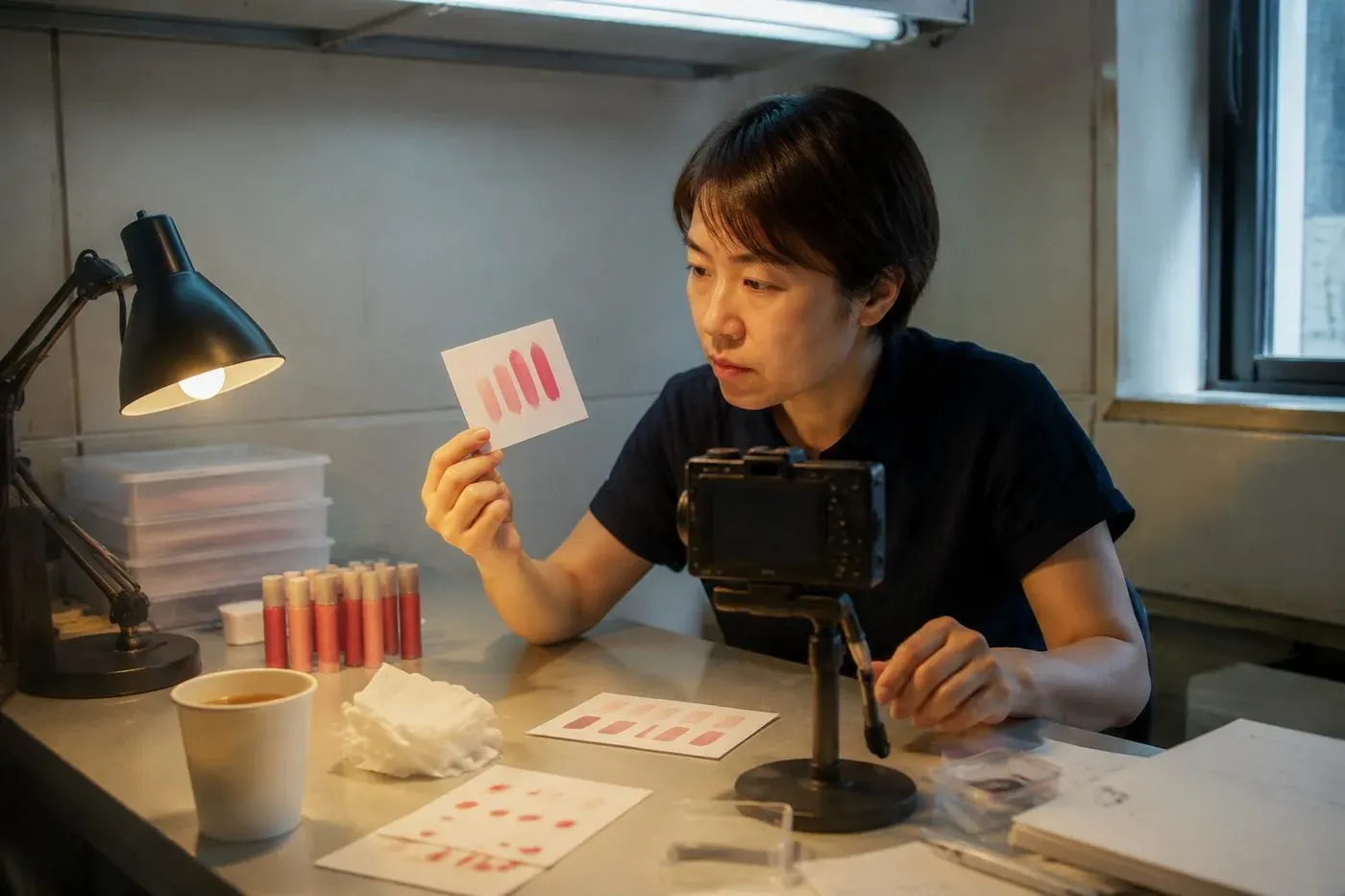
Some buyers treat sample approval as a mainly aesthetic step: the shade looks nice, the gloss feels good, sign here. I treat it as a quality gate, because the approved sample becomes the only objective standard anyone can point to three months later. If your reference is a memory or a phone photo, you have no case when bulk arrives slightly darker or slightly runnier. Here is the process I run at approval on every lip project:
- Seal several identical approved samples, each signed and dated by both sides.
- Distribute them: your brand keeps one, we keep one as coordinator, the partner factory keeps one.
- Write down measurable specifications next to the samples: shade code 3, agreed viscosity range, fill weight, gloss level, and a fragrance reference.
- Require a pre-production sample pulled from the actual bulk batch before full filling begins.
- At pre-shipment inspection, compare production units against the sealed golden sample under the same light source used at approval.
Know where drift actually comes from
Drift point | Why it happens | Control at approval |
|---|---|---|
Shade drift | New pigment lot, uneven pigment dispersion | Record pigment lot; color matching vs sealed standard |
Texture drift | Bulk mixing changes viscosity | Viscosity measurement range on file |
Applicator drift | Component tolerance change mid-run | Lock component drawings and wiper spec |
Scent drift | Fragrance substitution | Retain a sealed fragrance reference |
Fill drift | Filling line calibration | Fill weight recorded and inspected |
This is exactly why lip makeup samples deserve a written approval record. The document costs an afternoon. A drifted container of stock costs your launch.
What safety and stability documentation should I request before signing off on my lip samples?
Every week, a founder asks me which test reports matter for lip products. My answer is the same: the ones that cover what your target market regulator will ask about.
Request stability testing results, microbiological testing, a preservative efficacy test, heavy metal analysis covering lead, ingredient documentation, and any dermatological testing before sign-off. These reports are available upon request from vetted partner factories, but regulatory responsibility stays with the brand owner in the target market.
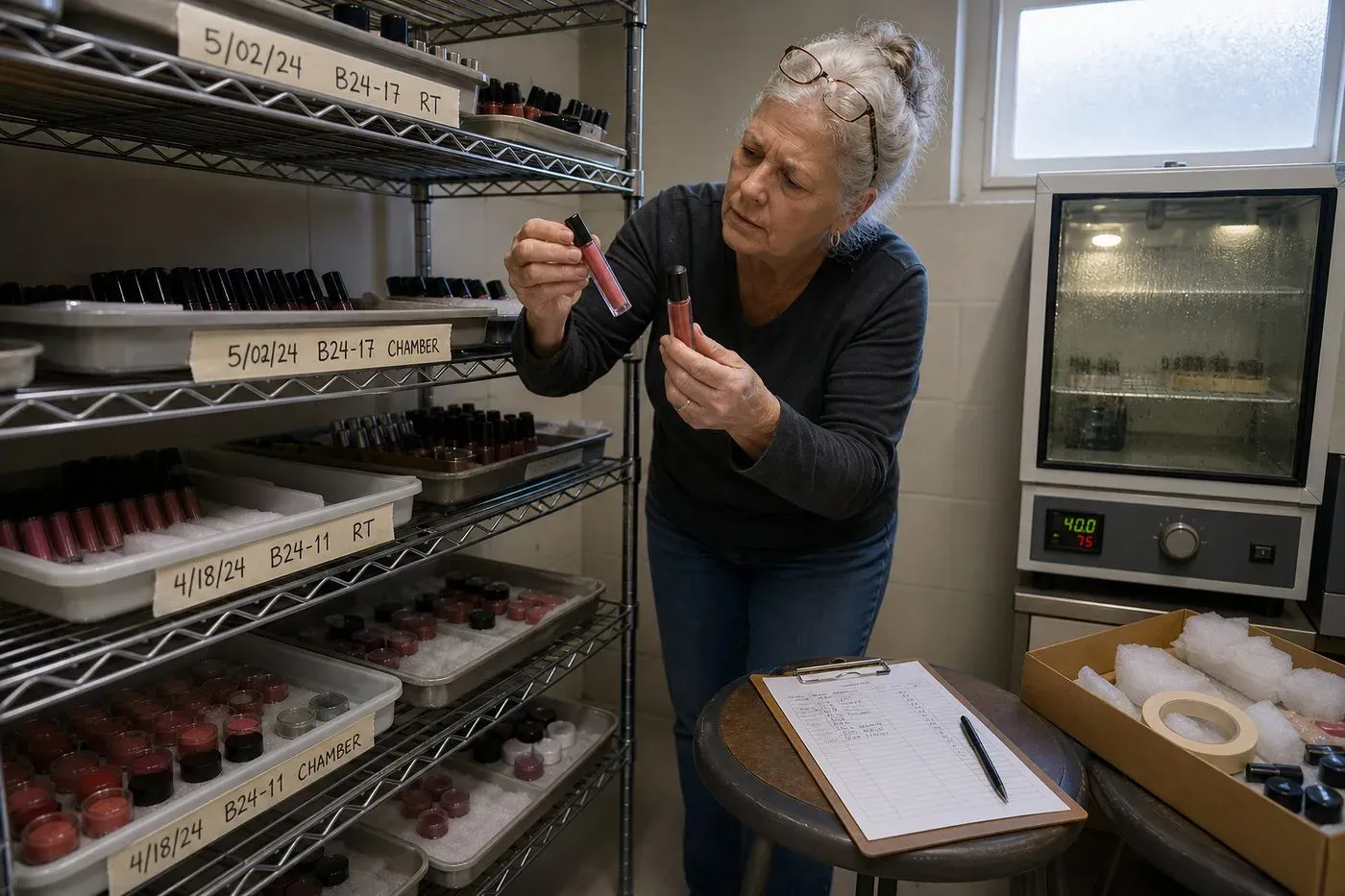
Lip products go on the mouth, so documentation carries more weight here than in almost any other makeup category. Because we do not own a manufacturing site, our role is to collect verified partner-factory documentation and check that it actually matches your project — the right formula version, the right shade set, the right market. Here is the file I assemble before any lip sample sign-off:
Document | What it tells you | Why it matters for lips |
|---|---|---|
Stability testing report | Behavior under accelerated temperature and time | Predicts separation, softening, oxidation-driven color shifting |
Shelf life evaluation | Supported PAO and expiry basis | Backs the date printed on your pack |
Microbiological testing | Microbial counts and specified organisms | Lips are a direct entry point for contamination |
Preservative efficacy test | Whether the preservative system resists challenge | Critical for water-containing tints and glosses |
Heavy metal analysis | Impurity levels including lead | FDA guidance recommends no more than 10 ppm lead as an impurity in lip products marketed in the US |
Ingredient / INCI list | Full formula disclosure | |
Dermatological testing | Skin compatibility where claims require it | Supports sensitive-lip or gentle claims |
Read the documents against your market, not in isolation
Regulatory compliance standards differ between the US, the EU, and the UK, and the safety assessment, labeling, and responsible-person obligations sit with you as the brand owner or your appointed responsible person — not with the factory, and not with us. I state that plainly in every project kickoff. And one warning from experience: if a supplier tells you their lip product is "FDA approved," walk away. That claim is not how cosmetics regulation 5 works, and it usually signals a supplier who has not been asked hard questions before. Exact document scope, sample fees, MOQ, and pricing are always confirmed against your specific project, because a clear lip tint for the EU needs a different file than a shimmer gloss for South Asia.
If you are preparing an inquiry, send me a short project brief: product type, target market, shade count, packaging direction, expected quantity, and any reference products you admire. I will come back with a realistic sampling and testing plan matched to the right partner factory.
✔ FDA guidance recommends no more than 10 ppm lead as an impurity in lip products marketed in the US TrueThis is why heavy metal analysis belongs in every lip sample approval file, especially for products headed to the US market.✘ A supplier's test report means the lip product is FDA approved FalseThe FDA does not approve cosmetic products this way; test reports support safety substantiation, and regulatory responsibility remains with the brand owner or the responsible person in the target market.
Conclusion
Test texture, wear, packaging fit, and documentation before you approve — then seal the golden sample. Send me your project brief, and we will map the testing plan together.
Footnotes
1. Global standards organization providing technical protocols and testing methods for measuring material viscosity. ↩︎
2. Technical overview of maintaining color consistency and accuracy across different lighting environments and digital devices. ↩︎
3. Standardized system for identifying and indexing pigments and colorants used in cosmetic formulations. ↩︎
4. Official EU legislation page outlining the mandatory safety assessment and regulatory requirements for cosmetic products. ↩︎
5. Primary regulatory framework and safety oversight provided by the FDA for the United States cosmetics industry. ↩︎