Sep 25, 2026Startup & Private Label Guides
The Lip Makeup Product Brief Template Manufacturers Actually Want From You
Include product type and format, target market and channel, shade count, texture and finish targets, formula direction, ingredient exclusions, packaging di

A vague lip makeup product brief is expensive. I have watched projects stall at our coordination desk for weeks because the inquiry said only "pink gloss, cute packaging, good price."
A lip makeup product brief for a manufacturer should state product type, target market, shade count, texture and finish, packaging direction, expected quantity, budget range, timeline, reference products, and documentation needs. Clear, specific fields let the factory sample accurately and quote without guesswork.
Below is the exact structure I use when I take a brief from an overseas brand into our supplier-matching process EU CPNP 1. Copy it, fill it in, and send it. Each section explains why the factory needs that field, not just what to write.
What details should I include in my lip makeup brief so a manufacturer understands my vision?
A founder in the UK once sent me a gorgeous mood board and no product type. Beautiful references, but our partner factories could not sample from a feeling.
Include product type and format, target market and channel, shade count, texture and finish targets, formula direction, ingredient exclusions, packaging direction, expected quantity per shade, budget frame, timeline, reference products, and documentation needs. These fields cover everything a manufacturer needs to sample and quote your lip product.
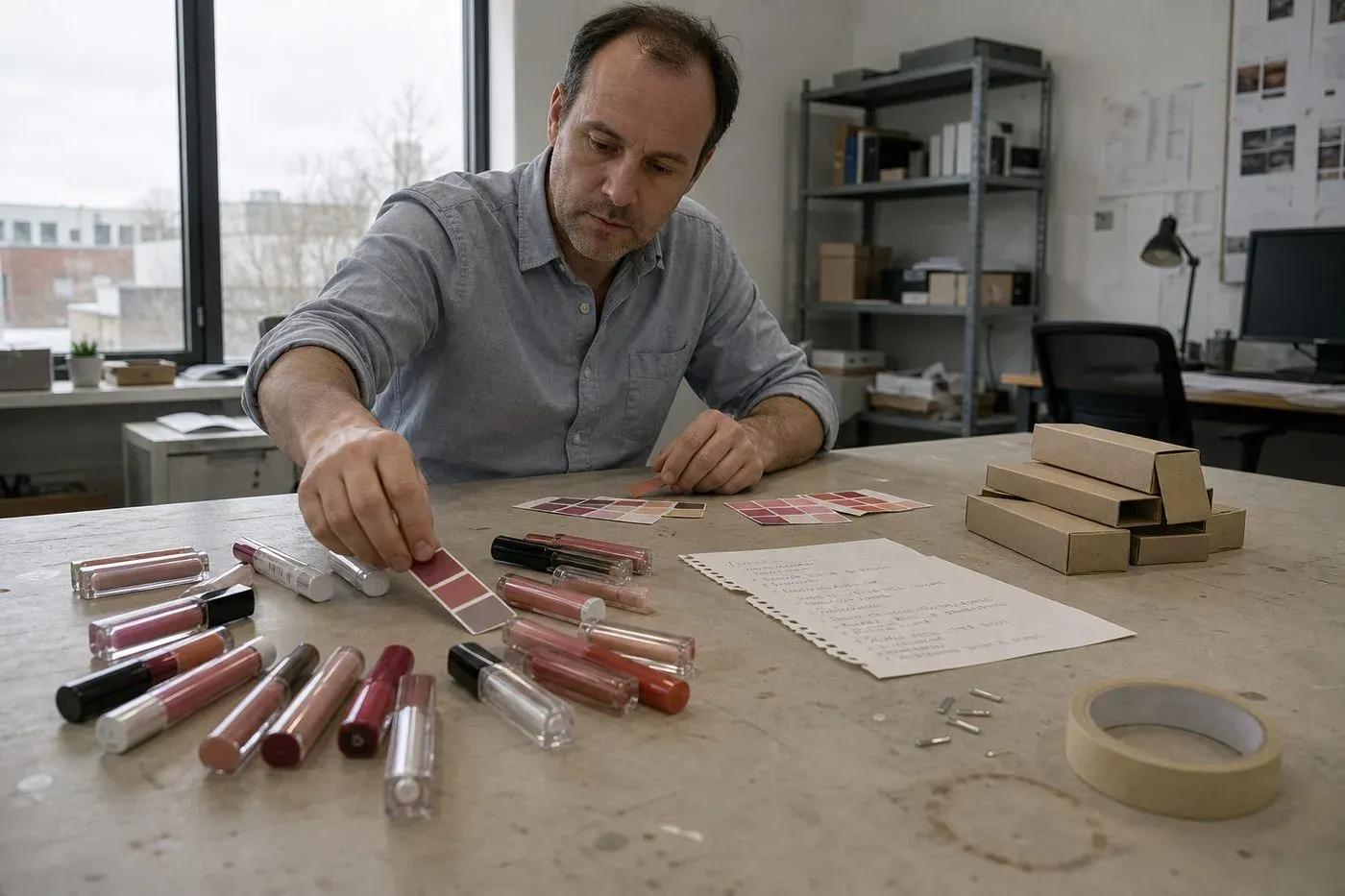
A brief is not a marketing document. It is a decision document. The factory reads it to choose a formula route, a pigment path, a packaging component, and a quote basis. Every field below removes one decision the supplier would otherwise guess at.
The Copy-Paste Brief Template
Brief field | What to write | Why the factory needs it |
|---|---|---|
Product type and format | Lip oil, gloss, tint, stain, tinted balm, or bullet lipstick | Each format implies a different base and filling line |
Target market and channel | Countries plus DTC, retail, or prestige | Sets compliance scope and cost expectations |
Shade count and range logic | Number of shades, family, core vs. trend | Shapes pigment sourcing and shade range development |
Texture and finish | Sensory words tied to a benchmark product | Decides the base formula direction |
Formula direction | Adapt a stock base or develop custom | This is the OEM vs ODM manufacturing fork |
Ingredient rules | Hero ingredients plus a hard blacklist | Prevents reformulation after sample one |
Packaging direction | Component type, applicator, artwork status | Enables compatibility checks before sampling |
Quantity and budget | Units per shade, target cost frame | Guides materials and minimum order quantity fit |
Timeline | Launch window and review dates | Sets a realistic sampling calendar |
Reference products | Named retail products to match or beat | Calibrates everyone to the same target |
Documentation needs | INCI ingredient list, COA, SDS, pigment certificates | Confirms export paperwork early, available upon request |
Fixed Fields vs. Flexible Fields
A common objection I hear: "We don't want to over-specify while we're still testing product-market fit." Fair. But the fix is not a shorter brief. The fix is labeling. Mark each field as fixed or open to proposal. A brief that says "shade count flexible, no-carmine rule fixed" is more useful than silence on both.
One compliance note I give every client. Name your jurisdictions — US MoCRA 2, EU CPNP, China NMPA — so the formula and paperwork target the strictest applicable standard. If you plan to claim vegan or cruelty-free, say so in the brief, because pigment selection changes. Cruelty-free certification paths and partner-factory test reports are available upon request, but regulatory, labeling, and safety-assessment responsibility always sits with the brand owner or the appointed responsible person in your target market.
✔ A manufacturer brief is a decision document, not a marketing document TrueThe factory uses it to pick a formula route, pigment path, packaging component, and quote basis, so every field should remove a decision the supplier would otherwise guess.✘ You should wait until every detail is final before contacting a manufacturer FalseMarking fields as fixed or open to proposal lets sampling start early; withholding the whole brief only delays supplier matching and shade development.
How specific do I need to be about texture, finish, and shade when writing my brief?
Two extra sample rounds on a liquid lipstick taught me this: matte meant powdery-dry to the lab chemist and soft velvet to the client. Same word, different formulas.
Be specific enough that two strangers would produce the same sample. Name the texture against a benchmark product, define the finish in sensory terms, state payoff expectations, and anchor every shade to a physical control sample or Pantone reference rather than a digital image.
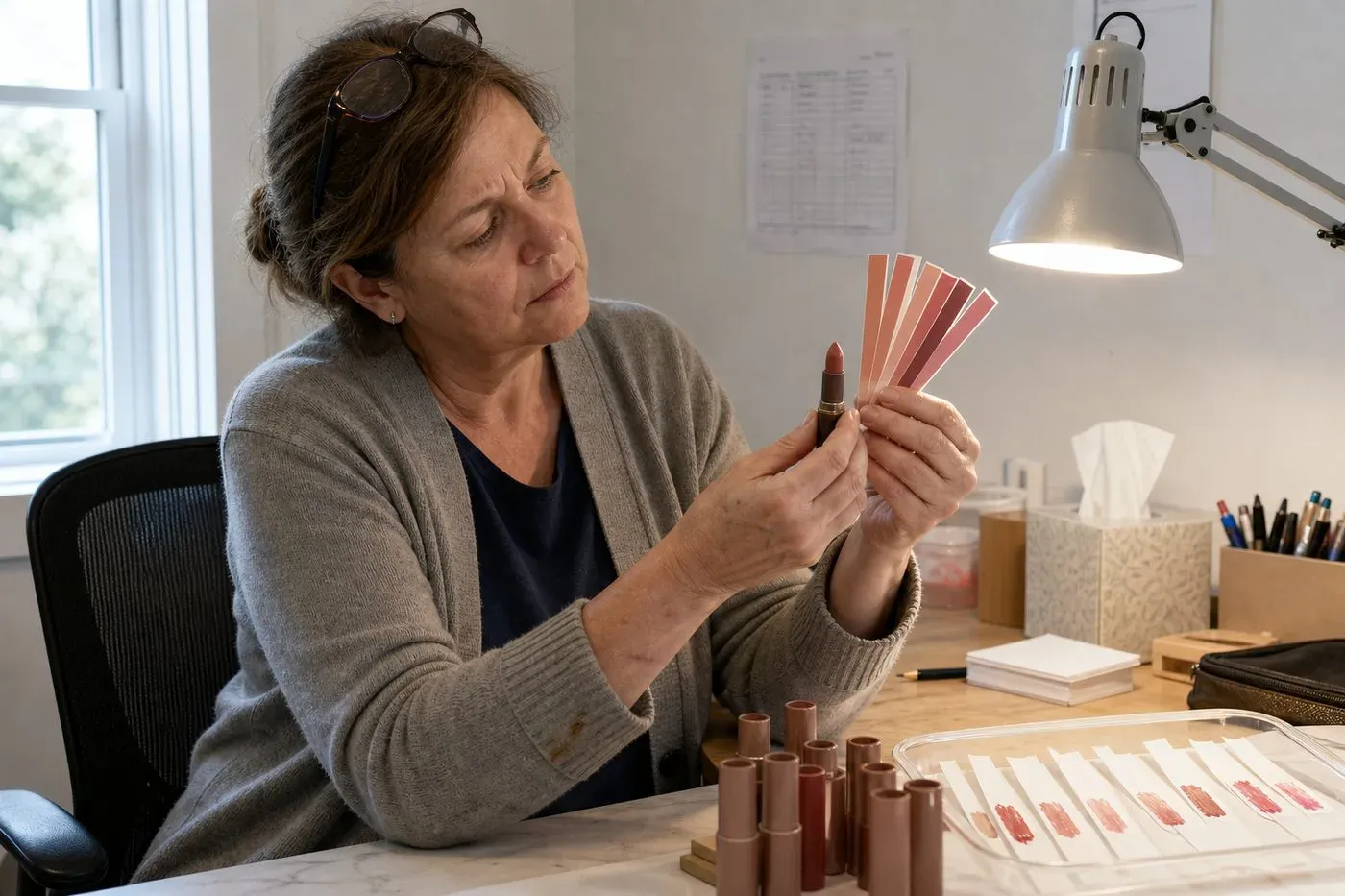
Words like matte, hydrating, and long-wear are directions, not specifications. In lipstick formulation, "matte" alone spans a powdery transfer-proof film, a soft velvet, and a blurred stain. Each one needs a different base. Your brief should pick one and prove it with a benchmark.
Define Your North Star Texture
Give the factory a named retail product and say what to keep and what to change. "Match the slip of Product A but reduce the tack" is a spec. "Make it feel luxurious" is not. Describe drag versus slip, cushion versus grip, and cooling or plumping sensations if you want them. These are the texture and finish options that decide the base before any pigment work starts.
Shade Direction That Survives Production
Screens lie. A shade approved from a phone photo will drift by the time bulk pigment dispersion 3 happens. Send physical control samples or Pantone codes, and state whether you want exact matching or inspired-by development. List colorant restrictions early — no carmine, vegan-only pigments, market-banned colorants. One newer angle I now ask every DTC client about: digital-first pigment performance. If your product sells through swatch videos, tell the lab the color must read true under ring lighting and mobile camera sensors.
Lip category | What your brief must nail | Example spec language |
|---|---|---|
Lipstick (bullet or liquid) | Shade accuracy, payoff, finish, wear feel | One-swipe opaque, velvet matte, no drag |
Lip gloss | Shine level, tack, slip | High shine, low tack, cushioned glide |
Lip oil | Nourishing slip, sheer tint | Glass-like shine, buildable sheer color |
Lip tint or stain | Longevity, fade pattern | Even fade, no ring after eating |
Tinted balm | Hydration, comfort, subtle color | Balm-first glide, whisper of pigment |
✔ Physical control samples or Pantone codes prevent color drift better than digital swatches TrueScreens render color differently across devices, so mass-production color matching needs a physical standard everyone can hold against the batch.✘ Saying "matte" is enough to define a lipstick finish FalseMatte covers powdery transfer-proof films, soft velvets, and blurred stains, and each requires a different formulation route, so the word alone guarantees a mismatch.
What packaging information should I provide to make sure it matches my lip formula?
Every week I weigh the same trade-off: a rich, high-viscosity lip oil formula against the slim tube the brand loves. If the wiper and orifice fight the formula, both lose.
Provide the component format, applicator type, capacity or fill size, closure feel, decoration method, artwork status, and secondary packaging needs. Also state whether packaging is sourced by you or the supplier, so the factory can run formula-to-packaging compatibility checks before sampling begins.

Packaging is where lip projects most often break, because the formula and the component are usually developed by different people. Since we also coordinate cosmetic packaging like lip gloss tubes, I insist the brief treats packaging specifications as part of the formula spec, not an afterthought.
Primary Packaging Fields to Specify
State the format first: wand tube, squeeze tube, bullet mechanism, stick, or pot. Then get granular on the applicator, because it changes the user experience more than most founders expect. A flocked doe-foot picks up product differently than a brush tip or a silicone spatula tip. Say which you want and why. Include target capacity or fill size if known, and be honest about artwork status — factories plan differently when logos are final versus still in design.
Format | Typical applicator | Compatibility watch-outs |
|---|---|---|
Wand tube (gloss, oil, tint) | Flocked doe-foot, brush tip | Viscosity vs. wiper size; wand pickup and drip |
Squeeze tube | Slant tip, silicone spatula tip | Orifice diameter vs. formula thickness |
Bullet or stick | Direct application | Stick hardness vs. cup grip; heat in transit |
Pot or jar | Finger or spatula | Fill shrinkage; hygiene perception |
Sensory and Sustainability Anchors
Two forward-looking asks are worth adding. First, mechanical sensory anchors: a weighted hand-feel or a magnetic click closure builds brand recognition, but it must be specified before tooling decisions. Second, refill-ready modular architecture: if you want eco-friendly refill inserts later, flag it now to avoid retooling costs. Finally, require a compatibility and stability testing round — formula sitting in the actual component — before bulk. When we coordinate this check between the formula factory and the packaging supplier, it catches wiper scrape, leakage, and color migration issues while they are still cheap to fix.
How can a clear brief help me avoid sampling delays and mismatched quotes?
My hardest lesson in supplier matching: when two quotes for the "same" lip gloss differ wildly, nobody is cheating. The suppliers were simply quoting two different imagined products.
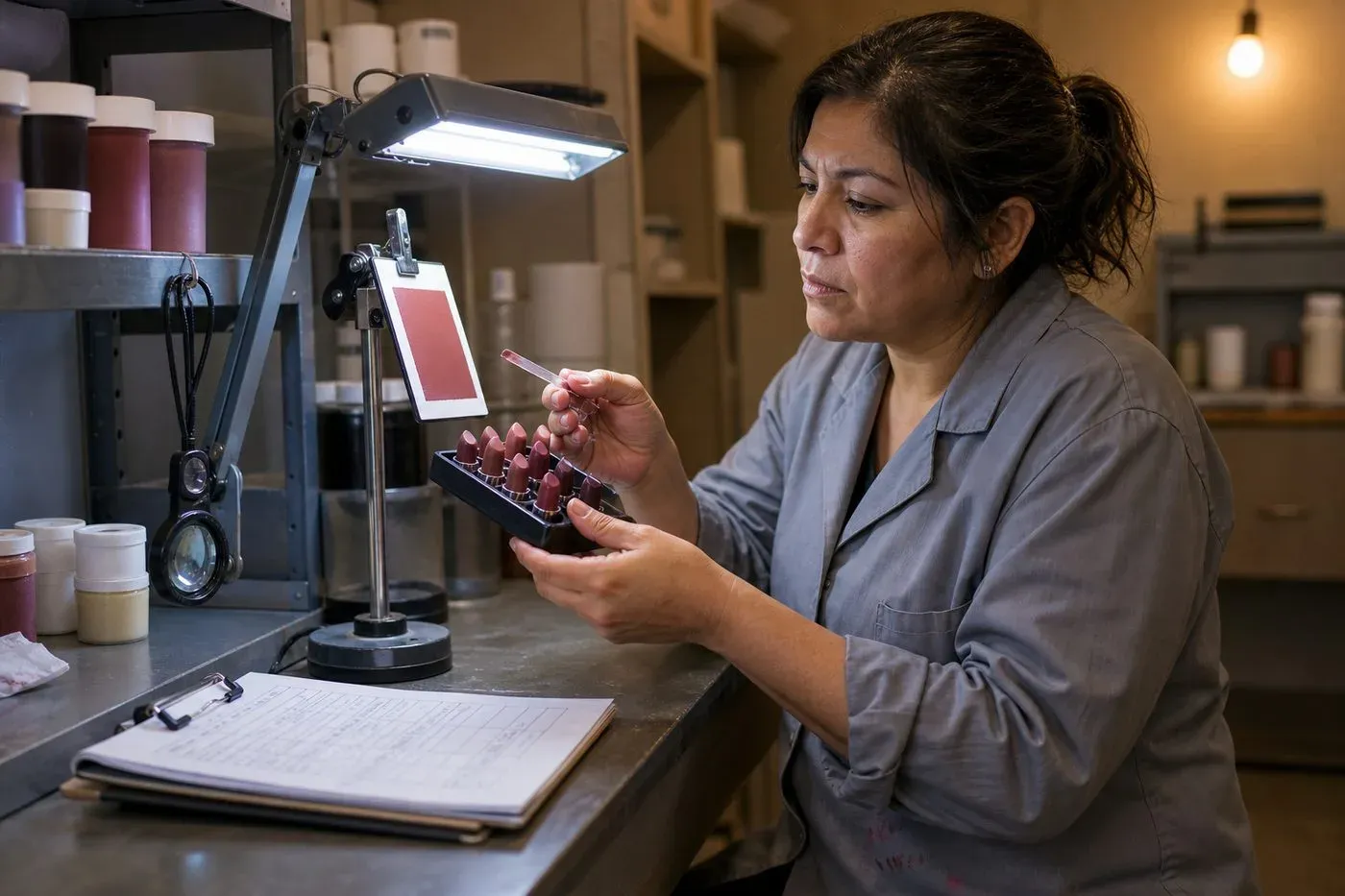
A clear brief fixes the specification before anyone quotes, so every supplier prices the same product and every sample targets the same result. That removes the two biggest delay drivers: repeated sampling rounds caused by vague feedback and quote gaps caused by mismatched assumptions.
Brief quality | Sampling outcome | Quoting outcome |
|---|---|---|
Vague ("pink gloss, nice tube") | Multiple rounds, subjective feedback | Quotes built on different assumptions, wide gaps |
Partial (type and shade, no packaging) | Formula converges, packaging reworked late | Packaging costs missing or roughly estimated |
Complete (all template fields) | Targeted first sample, measurable feedback | Comparable quotes with explainable differences |
Quotes are only comparable when the specification is fixed. When a buyer shows me a quote spread and asks which supplier is honest, the real answer is usually that one priced a stock base in a catalog tube and the other priced custom lipstick formulation 4 in a decorated component. The brief is what makes an apples-to-apples comparison possible. When I match a project to a partner factory, price differences come with an explanation — base type, pigment grade, component source — instead of a mystery.
Replace "Make It Nicer" With Acceptance Criteria
Sampling delays follow vague feedback. Your brief should pre-define what approval means: finish, coverage, glide, shade match against the control sample, and packaging fit. State how many sample rounds you expect, who approves, and your target turnaround, such as feedback within an agreed number of business days. Note that exact minimum order quantity, unit price, sample fees, and document scope are always confirmed against the specific project, so the sooner the spec is stable, the sooner those numbers are real. Emerging transparency rules are also reaching briefs — some brands now request raw-material traceability data suited to future digital product passport requirements, and that is easier to arrange at brief stage than after production. Before sending, run the six-question check that anchors the whole product development lifecycle:
- What is it?
- Who is it for?
- How should it feel?
- What must it avoid?
- Where will it be sold?
- What counts as success?
✔ Suppliers can only give comparable quotes when they price the same fixed specification TrueBase type, pigment grade, and packaging source all move the price, so quotes converge only after the brief locks those variables for every bidder.✘ A big gap between two quotes means one supplier is overcharging FalseWide gaps usually mean the suppliers assumed different formulas or components from an ambiguous brief, not that either quote is dishonest.
Conclusion
A strong lip makeup product brief tells the factory what to make, for whom, how it should feel, what it must avoid, and what success looks like.
If you are preparing an inquiry, send me your draft brief with product type, target market, shade count, packaging direction, expected quantity, and reference products. I will match it against our vetted partner factories and reply with a realistic sampling plan.
Footnotes
1. Official European Commission portal for the mandatory notification of cosmetic products in the EU market. ↩︎
2. Official FDA overview of the Modernization of Cosmetics Regulation Act (MoCRA) for regulatory compliance. ↩︎
3. ISO standard defining terminology and requirements for pigments and dispersions used in industrial manufacturing. ↩︎
4. ISO 22716 standard for Good Manufacturing Practices (GMP) ensuring quality in cosmetic product formulation. ↩︎