Sep 25, 2026Startup & Private Label Guides
How to Verify a Lip Makeup Manufacturer in China Is Reliable Before Your First Order?
A reliable lip makeup manufacturer in China shows deep lip-category specialization, offers ISO 22716 and GMPC documentation upon request, answers technical
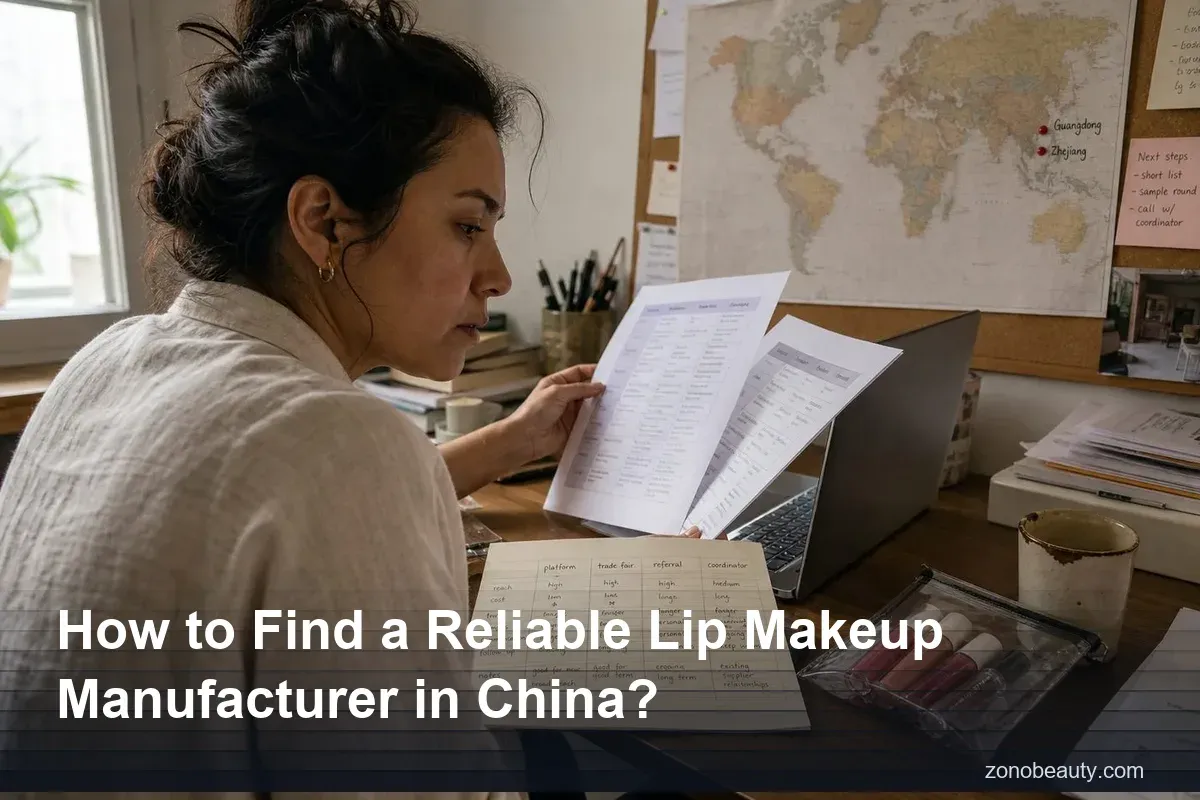

Every week, project briefs land in my coordination inbox from founders hunting a reliable lip makeup manufacturer in China — and most have already burned weeks searching the wrong channel.
To find a reliable lip makeup manufacturer in China, search across several channels — verified B2B platforms, trade shows like the Canton Fair, factory-direct sites, referrals, and coordination partners — then compare specialization, documentation available upon request, and quote transparency before sampling.
The channel you search through shapes everything that follows. It decides who answers your inquiry, how honest the quote is, and who picks up the phone when production wobbles. This article walks through each discovery path, one by one, from the coordination side of the table.
How do I tell a reliable lip makeup manufacturer in China from a risky one?
Last month a UK founder sent me five Alibaba listings 1 and asked which one was the real factory. Three were trading companies reselling the same lip gloss catalog.
A reliable lip makeup manufacturer in China shows deep lip-category specialization, offers ISO 22716 and GMPC documentation upon request, answers technical questions precisely, and quotes with clear line items. A risky one hides behind badges, vague answers, promotional top-10 lists, and prices with no breakdown.
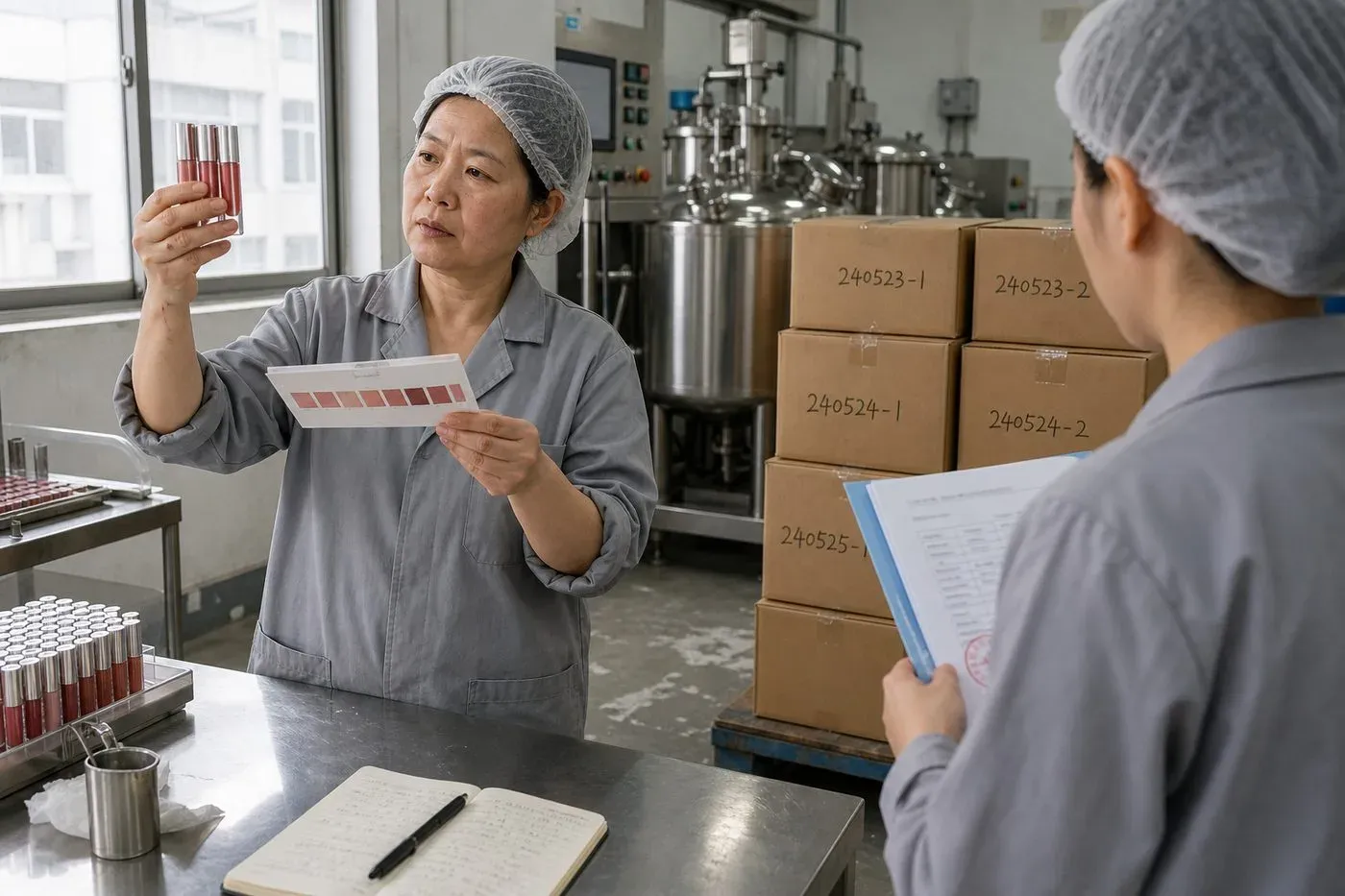
Here is the part most sourcing guides skip: reliability signals look different depending on where you found the supplier. A "Verified" badge on a platform, a business card from an expo booth, and a referral from another founder are not the same kind of evidence. So before you judge a supplier, judge the channel.
Where each discovery channel actually leads
Discovery channel | What you actually see | Quote transparency | Typical risk |
|---|---|---|---|
B2B platforms (Alibaba, Global Sources) | Storefronts, verified badges, review scores | Low to medium — headline prices are built to win clicks | Trading companies posing as factories; overlapping catalogs |
Physical samples, face-to-face conversation | Medium — indicative pricing, confirmed later by email | Booth staff turnover; slow post-show follow-up | |
Factory-direct websites | A curated capability story | Medium — depends on how well you frame your brief | Claims broader than the real product focus |
Referrals from other founders | A tested relationship with pricing history | High — honest feedback exists | The referral's product may not match yours |
Coordination partners like ZONO | Pre-vetted partner factories matched to your brief | High — line-item quotes with reasons attached | A vague brief produces a wrong match; coordination sits in the price |
On platforms, prioritize suppliers whose "Verified" status came from a third-party onsite cosmetic factory audit — but treat the badge as a filter, not a verdict. At exhibitions, the samples in your hand are real, yet the person behind the booth may be gone in three months. Factory-direct sites reward buyers who send a precise brief, because a precise brief forces a precise answer.
Hubs and specialization shape what you find
Most lip-focused production clusters sit around Guangzhou in Guangdong, Yiwu and the wider Zhejiang region, and Shanghai. Searching by hub matters because it filters generalists from specialists. A common buyer objection I hear: "a big full-category factory must be safer than a small lip specialist." Not automatically. Modern C-beauty textures like lip mud and lip clay demand specific high-shear emulsification lines that generalist plants often lack. For a single-category launch, a lip specialist with deep formula work — including cruelty-free formulation options — often outperforms a larger name where lip products are a side business. Partner-factory records such as ISO 22716 certification 3 and GMPC standards documentation are available upon request; regulatory and labeling responsibility, though, always stays with the brand owner or the appointed responsible person in your target market.
✔ A platform verification badge reflects a paid onsite check, not lip-category depth TrueBadges confirm a third party visited the registered business, which makes them useful filters. They say nothing about formula capability, texture range, or export experience in lip products specifically.✘ A supplier appearing on multiple top-10 manufacturer lists is proven reliable FalseMost of those ranking pages are promotional placements, not audits. Treat them as a starting shortlist to question, never as final proof of trustworthiness.
Why do lip product quotes from different Chinese suppliers vary so much, and what should I be comparing?
Three quotes for one lip tint brief landed on my desk in the same week. The highest was several times the lowest — for what looked like the same product.
Lip product quotes vary because each supplier quotes a different scope: formula grade, packaging quality, minimum order quantity tier, documentation, and margin layers from trading companies. Compare line-item breakdowns — base formula, packaging, decoration, testing, and export paperwork — never the headline unit price alone.
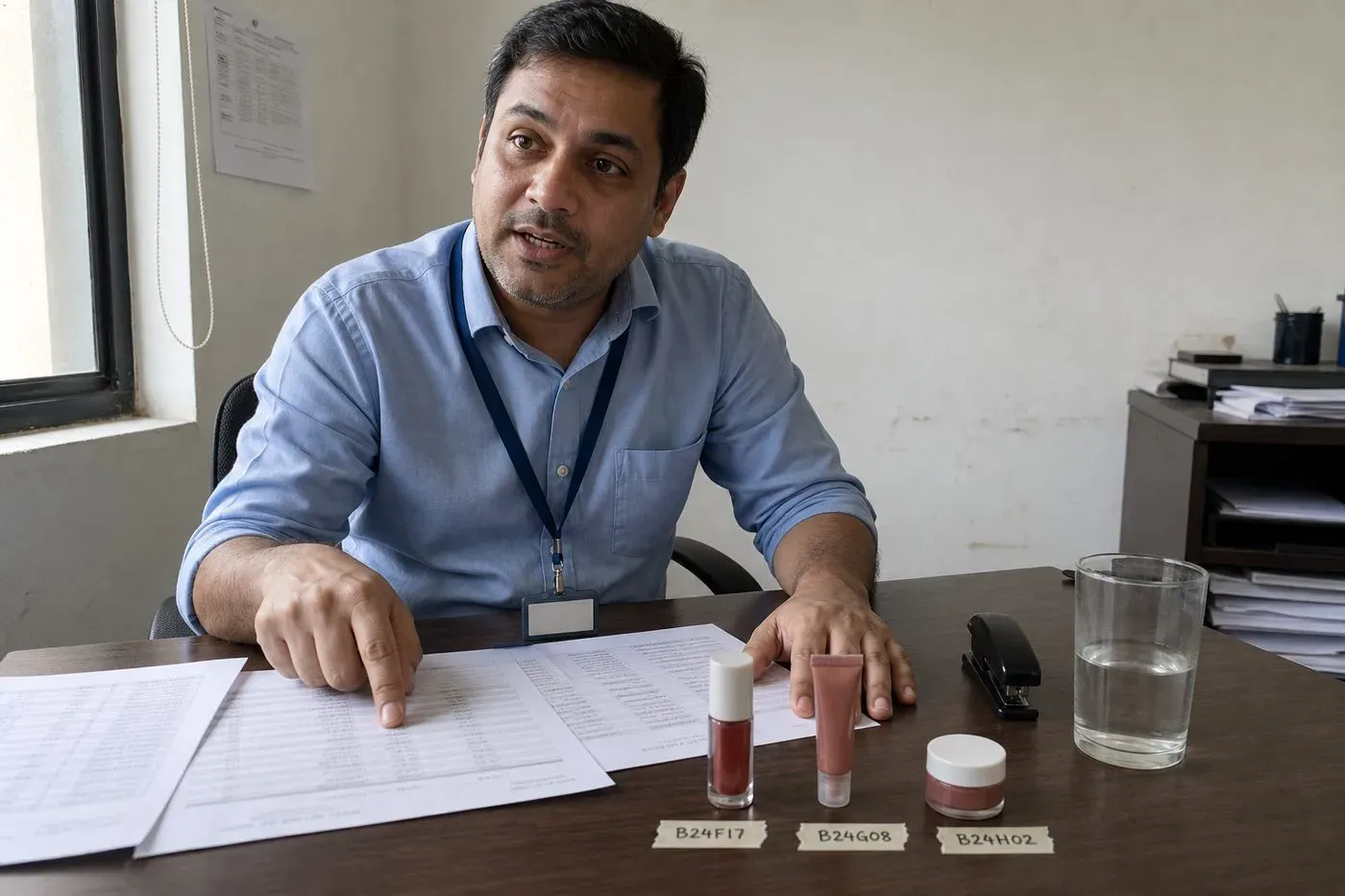
When I unpacked those three lip tint quotes, none of them described the same product. One priced a stock private label cosmetics base in a stock tube. One priced custom OEM/ODM services 4 with a tailored shade range. One was a trading company adding a margin on top of someone else's factory price. The buyer thought she was comparing prices. She was actually comparing scopes.
What sits inside a lip product quote
Quote line item | Why it varies between suppliers |
|---|---|
Base formula | Stock white-label base versus custom development; ingredient grade; vegan or cruelty-free sourcing |
Packaging | Stock component versus custom packaging design, new molds, or PCR materials |
Decoration | Silk-screen, hot-stamp, or labels — often quoted separately, sometimes quietly omitted |
MOQ tier | A factory may hold a standard minimum per shade; smaller runs carry a surcharge |
Testing and documents | COA, Material Safety Data Sheet, and stability data — included by some, billed later by others |
Export scope | EXW versus FOB, plus export paperwork handling |
Margin structure | Factory-direct pricing, trading-company layers, or a transparent coordination fee |
The discovery channel changes transparency here too. Platform quotes are lead magnets, priced low to start a chat. Exhibition quotes are indicative, spoken across a booth table and revised once the real brief arrives. Referral quotes tend to be honest because reputation is on the line. When we quote through our coordination window, every line comes with a reason, because we matched the partner factory to your formula, packaging, budget, and target market before pricing anything.
The low-MOQ trap
A common objection: "the lowest minimum order quantity is the safest way to start." Sometimes. But low-MOQ offers usually mean stock formulas, simpler packaging, and a higher unit cost. A better negotiation lever is a tiered growth plan — commit to scaling volumes across reorders, and many partner factories will soften the entry tier. One more shift worth noting: buyers are increasingly requesting ingredient transparency documentation that addresses microplastics and PFAS 5, anticipating tighter global rules on these substances in lip products. Exact MOQ, unit price, sample fees, and document scope are always confirmed against your specific project brief — anyone quoting firm numbers before reading your brief is guessing.
✔ A low headline unit price often excludes decoration, testing, and export documents TrueThese items are frequently quoted separately or added after you commit. The only fair comparison is line-item against line-item across the full scope.✘ The lowest minimum order quantity always means the lowest risk and cost FalseLow-MOQ offers typically trade away customization, packaging quality, and unit economics. A tiered growth plan often delivers better terms than chasing the smallest possible run.
How can I make sure my bulk lip gloss or lip tint order actually matches the sample I approved?
During a pre-shipment inspection near Guangzhou, our QC contact lined bulk lip gloss tubes against the signed golden sample and caught a shade drift the factory called normal variation.
Lock a signed golden sample before production, write shade, texture, viscosity, and packaging specifications into the purchase order, run formula-to-packaging compatibility checks, request pre-production and in-line photos, and commission a pre-shipment inspection that compares bulk goods directly against the approved sample.
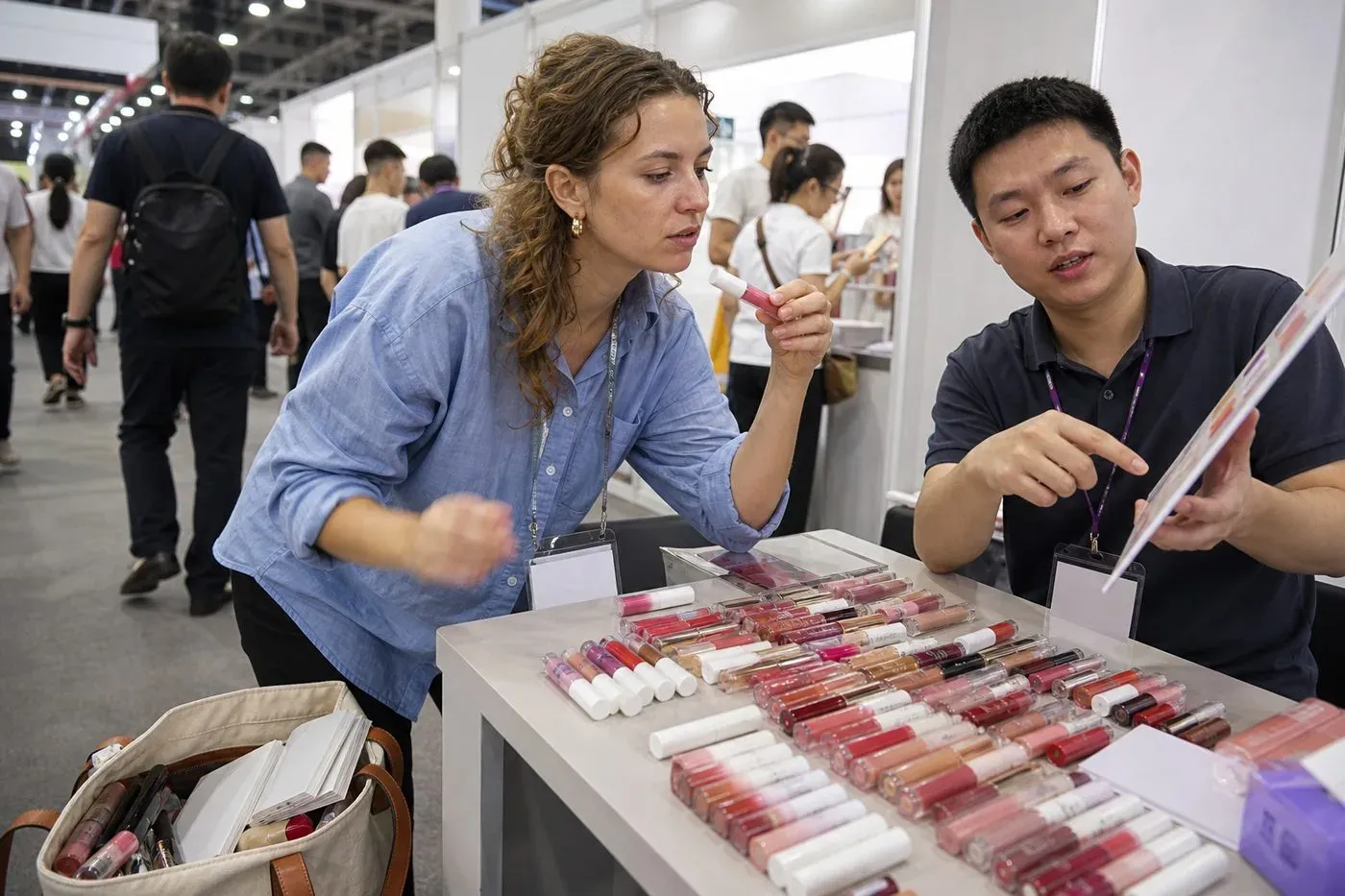
Sample-to-bulk drift is the single most common complaint I hear from founders who sourced alone. The fix is not trust. The fix is process. Here is the sequence we run on every lip project we coordinate, whether it is lip oil, lip gloss, lip tint, or bulk lipstick production for a semi-finished base.
A seven-step path from golden sample to matching bulk
- Run product sample testing across multiple iterations — payoff, comfort, transfer, wear, scent — before approving anything.
- Sign and date the final golden sample, and keep sealed duplicates on both sides.
- Convert the sample into a written spec sheet: shade code, viscosity range, gloss level, scent reference, fill weight, and component drawings.
- Run a formula-to-packaging compatibility check — a runny lip oil in the wrong wand-and-wiper setup will leak, string, or underload no matter how good the formula is.
- Approve a pre-production sample pulled from the actual bulk batch, not the lab bench.
- Collect in-line photo and video updates at filling and decoration stages; some partner factories now support live-streamed production monitoring or digital golden-sample tracking through cloud-based systems.
- Commission a pre-shipment inspection that judges bulk goods against the sealed golden sample, not against memory.
Where bulk orders usually drift
Common drift point | How to catch it |
|---|---|
Shade | Side-by-side check against the sealed golden sample under standard lighting |
Viscosity and texture | Draw-down and wand pickup test on the pre-production batch |
Scent | Compare fresh bulk against the retained duplicate sample |
Packaging fit | Wand fit, wiper pressure, and leak testing on filled units |
Decoration | Printed tubes checked against the approved artwork proof |
Batch-to-batch consistency is where the discovery channel quietly matters again. A supplier found through a one-off platform chat has little incentive to protect your second batch. A coordination partner planning your reorders does.
Who handles my order if my lip makeup supplier goes quiet during production?
Ten years of coordinating cosmetics production taught me one hard lesson: suppliers rarely announce delays. They go quiet first, and overseas buyers discover the problem weeks later.
If your lip makeup supplier goes quiet, responsibility follows your discovery channel: platforms offer limited dispute tools, exhibition contacts rarely help post-order, and factory-direct buyers chase alone. A coordination partner with on-the-ground staff owns the follow-up, escalates inside the factory, and reports back on a fixed schedule.
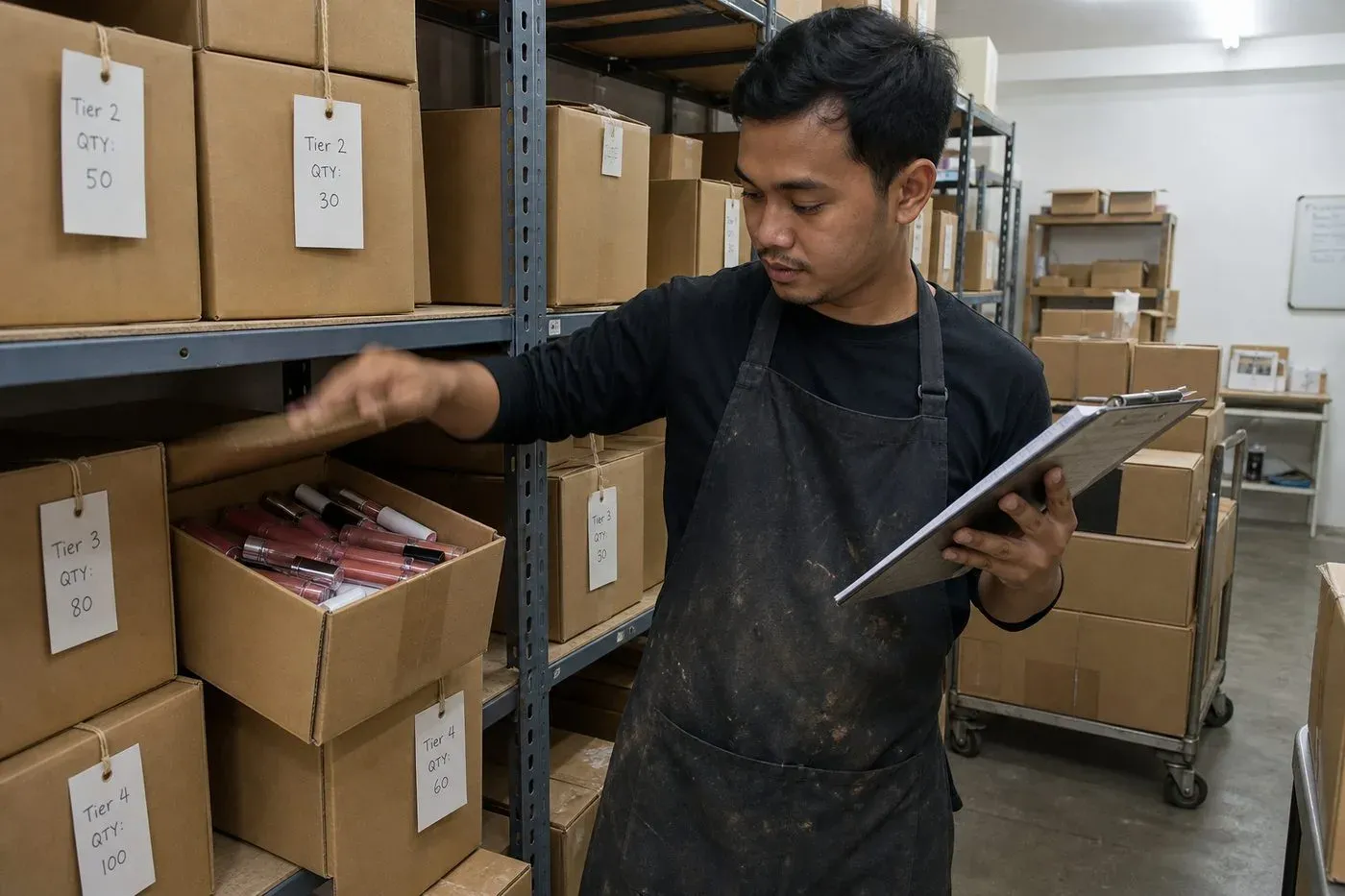
Silence is rarely fraud. In my experience coordinating projects across the US, Europe, the Middle East, and South Asia, silence usually means one of three things: your order got bumped behind a larger run during peak season, a raw material or component arrived late, or a quality issue appeared and the supplier is deciding how to tell you. None of these fix themselves, and the person who suffers is the brand with a launch date.
What each channel leaves you with when things go silent
- B2B platforms: dispute and payment-protection tools exist, but they generally only cover what was documented inside the platform's own order system. Off-platform agreements — the WeChat promises, the emailed spec changes — carry little weight.
- Exhibitions: the friendly rep from the Canton Fair booth may have changed jobs by the time your production run stalls. Booth relationships rarely survive into production follow-up.
- Factory-direct: you email across time zones into an inbox where you are one of many customers, with no one physically present to press for answers.
- Referrals: social pressure helps, but there is no structure behind it, and your referrer will not chase your order for you.
- Coordination partner: this is exactly why our coordination window runs from brief intake through supplier matching, sampling, production follow-up, quality inspection, export documentation, and shipment. When a partner factory slows down, we escalate in person, speak directly to production planning, and give you a dated recovery plan. If a line is truly unrecoverable, we re-match the project to another vetted partner factory rather than leaving you stranded.
Prevention beats chasing
The cheapest escalation is the one you never need. Before any deposit, write a communication cadence and milestone checkpoints into the purchase order: material readiness, filling start, decoration complete, inspection date. A supplier who resists agreeing to checkpoints before the order is telling you something important about how they will behave during it.
✔ Platform payment protection generally only covers terms documented inside the platform's order system TrueAgreements made over chat apps or email usually fall outside the dispute scope. Keeping specifications and milestones inside formal documents is what preserves your leverage.✘ A supplier going quiet during production means you are being scammed FalseFar more often, silence means your order was deprioritized behind larger runs or a delay the supplier is reluctant to report. It needs structured escalation, not panic — but it does need someone on the ground to act.
Conclusion
Finding a reliable lip makeup manufacturer in China starts with choosing the right discovery channel, then comparing scope-matched quotes, locking a golden sample, and securing one accountable coordination window.
If you are preparing an inquiry, send us a short project brief with your product type, target market, shade count, packaging direction, expected quantity, and any reference products. We will match it against our vetted partner factories and come back with a line-item path from sample to shipment.
Footnotes
2. Background context on the major trade exhibition repeatedly referenced as a discovery channel. ↩︎
3. Official ISO standard reference for cosmetics Good Manufacturing Practices cited in the article. ↩︎
5. EPA is the authoritative source on PFAS regulation relevant to cosmetics ingredient transparency. ↩︎