How Do I Verify a Supplier's Lip Makeup Products Meet My Specs?
A buyer framework for linking lip makeup specifications, approved references, project evidence and inspection criteria before bulk approval.

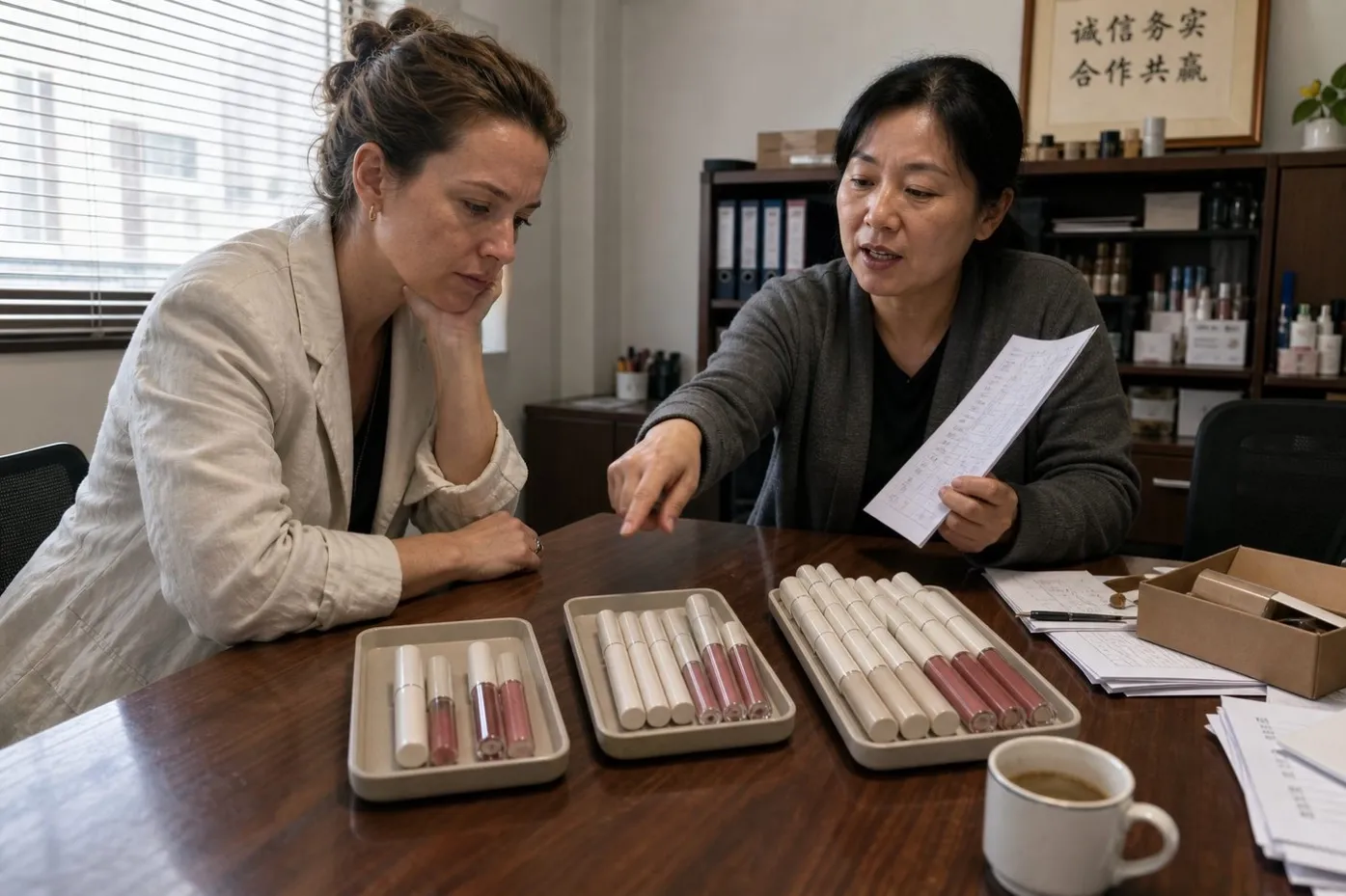
An approved sample alone may not capture every bulk-production or transport risk. A buyer needs a written way to verify that the supplier's lip makeup products match the agreed specifications before bulk approval.
To verify a supplier's lip makeup products against your specifications, first define the agreed formula, packaging, sample, and acceptance criteria. Then ask the supplier what batch-specific records and applicable technical evidence it can provide, and have the target-market regulatory or quality adviser confirm what is relevant.
Before reviewing documents, separate the specifications that must be met exactly from those that may be discussed during sampling. Ask the supplier whether an existing formula can be assessed against your priority requirements or whether custom development needs to be scoped. The questions below walk through the verification in layers.
What Should I Ask a Supplier to Confirm My Lip Formula Matches the Approved Sample?
A detailed spec sheet still needs a priority order. Without one, a supplier may not know which requirements are non-negotiable and which can be discussed during sampling.
Ask the supplier to confirm the approved shade, odor, texture, full INCI list, and any measurement method or condition stated in the specification. Request the production, retention, and pre-production evidence that is relevant to the selected project before release.

Treat the approved sample as one reference within the written commercial specification. Ask how the supplier will link any relevant batch, pre-production sample, and acceptance evidence to that reference before bulk approval.
Separate Must-Match Specs From Adjustable Ones
Sort the spec sheet before approaching a supplier. This helps clarify whether an existing formula might be assessed for the project or whether custom development needs to be discussed. Use the table as a project-scoping prompt, not as a universal test protocol:
| Spec item | Decision to record | Question for the supplier or adviser | Method or evidence to agree |
|---|---|---|---|
| Shade and finish | Is this fixed to an approved reference or open to sampling? | What comparison method is appropriate for the selected shade, finish, and formula? | Approved visual reference and, if applicable and agreed, an instrumental method under stated conditions |
| Ingredient exclusions | Which exclusions are buyer requirements, market requirements, or preferences? | What formula and material information can be provided for review? | Applicable ingredient information reviewed against the confirmed exclusion scope by the responsible party |
| Viscosity | Does viscosity need a defined comparison for this product? | What method, condition, tolerance, and sample scope are relevant, if any? | Project-specific method and condition only if applicable and agreed |
| Odor or flavor | Is the reference fixed, adjustable, or not part of the approval? | Who will evaluate it, under what conditions, and against which reference? | Agreed sensory reference and evaluation conditions, if applicable |
| Gloss level and tackiness | Which sensory outcomes matter to the buyer and target user? | What reference, evaluator, application method, and observation period will be used? | Project-specific sensory comparison only if applicable and agreed |
| Packaging format | Which component version, decoration, and function points are fixed? | What formula-to-component evidence is relevant to the exact combination? | Agreed component version and applicable compatibility or functional evidence |
How to Compare the Sample Against Bulk Production
Where colour needs an objective comparison, ask the supplier what matching method or records it can provide for the selected formula and shade. Combine that information with the buyer's agreed visual approval process; do not treat one method as a complete substitute for the written specification.
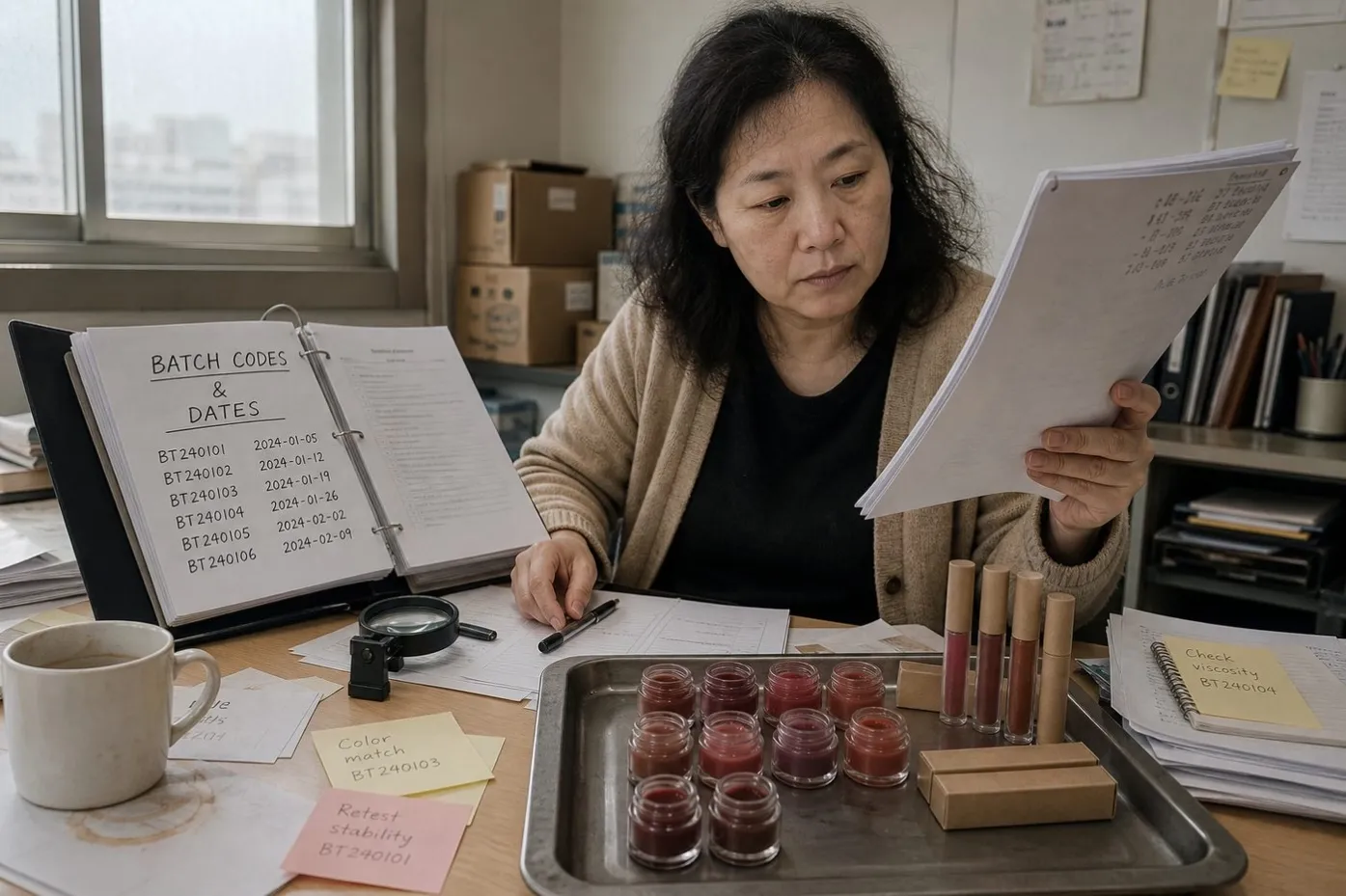
Ask whether the supplier can share appropriate production-batch and retention-sample evidence for a comparable formula, subject to confidentiality. Clarify what the records show, the formula version they relate to, and whether they are relevant to your proposed product.
How Do I Check That My Lip Product Packaging Won't React With the Formula Inside?
A sample can look acceptable while a formula-to-component issue appears later in the process. Ask the supplier what compatibility evidence is available for the proposed formula, applicator, wiper, and tube before committing to bulk production.
Request documentation for the selected formula-and-component combination. Ask what compatibility or stability evidence is available, what conditions and component version were used, and which checks are appropriate for the route and target market before bulk approval.

Formula and packaging should be evaluated together, not as isolated purchase decisions. Treat formula-to-packaging compatibility as a documented review gate: ask what was tested, against which component version, under what conditions, and what evidence can be shared.
Turn a Packaging Concern Into a Project Question
A formula, applicator, wiper, tube, closure, transport route, and storage condition can create project-specific compatibility questions. A buyer should not infer a result from an empty component or a visual sample. Ask what evidence exists for the actual formula and component version, and ask the responsible adviser which checks matter for the intended market.
Compatibility Evidence to Discuss Before Bulk Approval
Use this menu to ask the supplier what it can document for the selected formula and component. It is not a universal testing protocol or a promise of any product outcome.
| Test | Buyer question | Project timing to discuss |
|---|---|---|
| Fill and seal test | Does the supplier have evidence for the selected fill, closure, wiper, and component version? | Before pre-production or bulk approval, where relevant |
| Accelerated stability testing | What conditions, formula version, and observations are covered by the available evidence? | During sampling or development, if the project scope calls for it |
| Component immersion | Has the actual formula been assessed with the wand, wiper, gasket, or other relevant component? | When the formula or component changes, if applicable |
| Drop and transit simulation | What transport or handling evidence is available for the proposed pack-out and route? | Before shipment, if the order risk or route warrants it |
| Real-time aging on retention sample | What retention or monitoring approach is appropriate for the formula and project? | As defined in the buyer's product-control plan |
If the product may face particular storage or transport conditions, ask the supplier and the responsible adviser whether those conditions should be represented in the evidence request. Do not assume a standard test protocol covers every route or market.
What Project Evidence Should I Ask About Before Bulk Approval?
Do not treat a generic specification sheet as complete safety or compliance evidence. Ask what batch-level records are available and confirm their relevance to the intended market with the responsible adviser.
After the target-market scope is confirmed, ask the supplier which batch records, formula or material documents, stability or compatibility evidence, and quality-system documentation are available for the project. Confirm with the responsible regulatory or quality adviser which evidence is applicable and what it does and does not prove.

Documentation should match the product, target market, and responsible party. Use a written evidence request so the buyer can see which documents are available, which are missing, and which need expert review.
Project Document and Verification Menu
Buyers may ask a prospective supplier for relevant business licenses, manufacturing permits, quality-system documentation, COA, SDS and, where applicable, GMP or ISO 22716 documentation. The required documents vary by product, supplier type, destination market, and project. Use the following menu to ask what is available, then check its issuing body, company name, scope, date, and relevance with the responsible adviser.
| Document | Project question | What to check if it is provided |
|---|---|---|
| Batch-specific Certificate of Analysis | Is a batch-specific COA available for the proposed finished lot and agreed acceptance criteria? | Match the lot, date, product version, method, and acceptance criteria to the project. |
| Microbiological testing report | Is microbiological evidence applicable to this formula and target market, and who should assess it? | Check the original laboratory, report date, formula or batch linkage, scope, and market relevance. |
| Heavy metal analysis | Is relevant material or finished-product evidence needed for the target market? | Check the provider, product linkage, test scope, and the applicable market requirements with an adviser. |
| ISO 22716 certification | Does a quality-system document apply to the facility and the scope relevant to this project? | Check the issuing body, company name, facility address, scope, and validity period where relevant. |
| Material Safety Data Sheet | Is a safety-data or material document relevant to the product and the buyer's responsibilities? | Check the product version, provider, date, scope, and whether the document addresses the intended use. |
| Toxicology risk assessment or CPSR | Does the target market require a specified safety assessment, and which responsible party owns it? | Check the named assessor, target market, product version, date, and project scope with the responsible adviser. |
| Raw material COAs | Which input-material records, if any, are appropriate for this product and market? | Check material identity, supplier or provider, lot linkage, date, and relevance to the final product. |
| Traceability records | Can the supplier explain how the finished lot links to relevant production and labeling records? | Ask what records are available, who maintains them, and whether the linkage fits the agreed project scope. |
How to Spot a Recycled Report
For each report, ask the responsible adviser what makes it fit for purpose: the laboratory or provider, the relevant formula and component version, the report date, and the linkage to the supplied batch. Do not treat a document as complete evidence until its relevance to the project has been checked.
How Should I Review the Pre-Shipment Inspection Scope?
Every inspection budget involves a trade-off. Decide what independent review, supplier QC evidence, or third-party inspection is appropriate for the product and order risk.
Define the inspection evidence before production starts. Depending on product and order risk, ask about the supplier's inspection plan, relevant records, equipment-control evidence, and whether an independent inspection adds value against the agreed specification.

A supplier statement about quality control is not a substitute for project evidence. Ask for the proof points relevant to the product, order risk, target market, and agreed acceptance criteria:
-
Scope an audit to the project. When an on-site, third-party, or virtual review is appropriate, agree the audit scope in advance and ask which controls, records, or areas are relevant to the product and order.
-
Ask what process-control records are available. Identify the measurements or records that matter to the approved specification, then ask how the supplier documents them for the relevant batch.
-
Review the inspection plan before production starts. Ask which sampling approach, defect definitions, acceptance criteria, and records are proposed for this order. Put the agreed scope in writing.
-
Consider independent review where appropriate. Discuss whether third-party inspection or laboratory testing is appropriate for the first batch, the target market, and the agreed specifications. Define the scope before placing the order.
-
Plan post-launch monitoring. Consider periodically buying your own product from retail channels and using appropriate independent checks where needed. Define in advance which specifications and batch records you will compare over time.
Conclusion
Do not approve bulk production until the commercial specification, evidence request, and acceptance criteria are documented. Sort non-negotiable requirements from adjustable ones, then verify the selected project evidence before release.
Next step: Start with a controlled supplier specification, then bring the completed specification and evidence questions to a supplier conversation. When you are ready to compare routes, send ZONO your product type, target market, references, packaging direction, and quantity range To see the product routes these checks apply to, compare private label makeup options..