Handmade Press-On Nails: Factories vs Artisan Studios — How to Weigh MOQ, Design Speed, Quality?
Handmade press-on nails sit at a crossroads. Every week, brand founders ask our sourcing team the same question: studio or factory? Choose wrong, and your cash gets buried in unsold inventory.

Handmade press-on nails sit at a crossroads. Every week, brand founders ask our sourcing team the same question: studio or factory? Choose wrong, and your cash gets buried in unsold inventory.
Choose an artisan studio when you need low MOQs, fast design iteration, and hand-painted uniqueness for testing or premium drops. Choose a factory when you need repeatable quality, lower unit costs, and scalable volume. Most successful press-on nail brands start with studios, then move proven designs to factories.
That short answer hides a lot of detail. MOQ shapes your cash flow. Design speed shapes your trend response. Quality checks decide whether bulk orders match your samples. Let me walk through each one, using what I see across the projects we coordinate between overseas brands and vetted partner workshops in China.
How do I decide between a factory and an artisan studio for my press-on nail line?
Every quote we prepare weighs the same trade-off: a studio's flexibility against a factory's economics. Neither wins outright. The right answer depends on where your brand sits today.
Decide based on launch stage, sales channel, and design complexity. Pick an artisan studio for unproven concepts, bespoke art, and premium positioning. Pick a factory for proven bestsellers, retail distribution, and price-sensitive channels. Many brands run both models in parallel.

The clearest way to frame this decision is a side-by-side view of the five points that actually move the outcome.
| Decision point | Artisan studio | Factory |
|---|---|---|
| MOQ | 50–500 sets; samples from 1–20 | 5,000–50,000+ sets at large scale |
| Design turnaround | 24–48 hours for viral trend replication | 4–8 weeks for new molds and approvals |
| Finish consistency | Varies set to set | Uniform and repeatable |
| Customization depth | Hand-painted nail art, 3D texture, bespoke fit | Curated, print-friendly designs |
| Unit economics | Higher cost per set | Lower cost via bulk pricing tiers |
| Typical positioning | Luxury, bridal, wearable art | Mass DTC, drugstore, private label press-ons |
Match the model to your launch stage
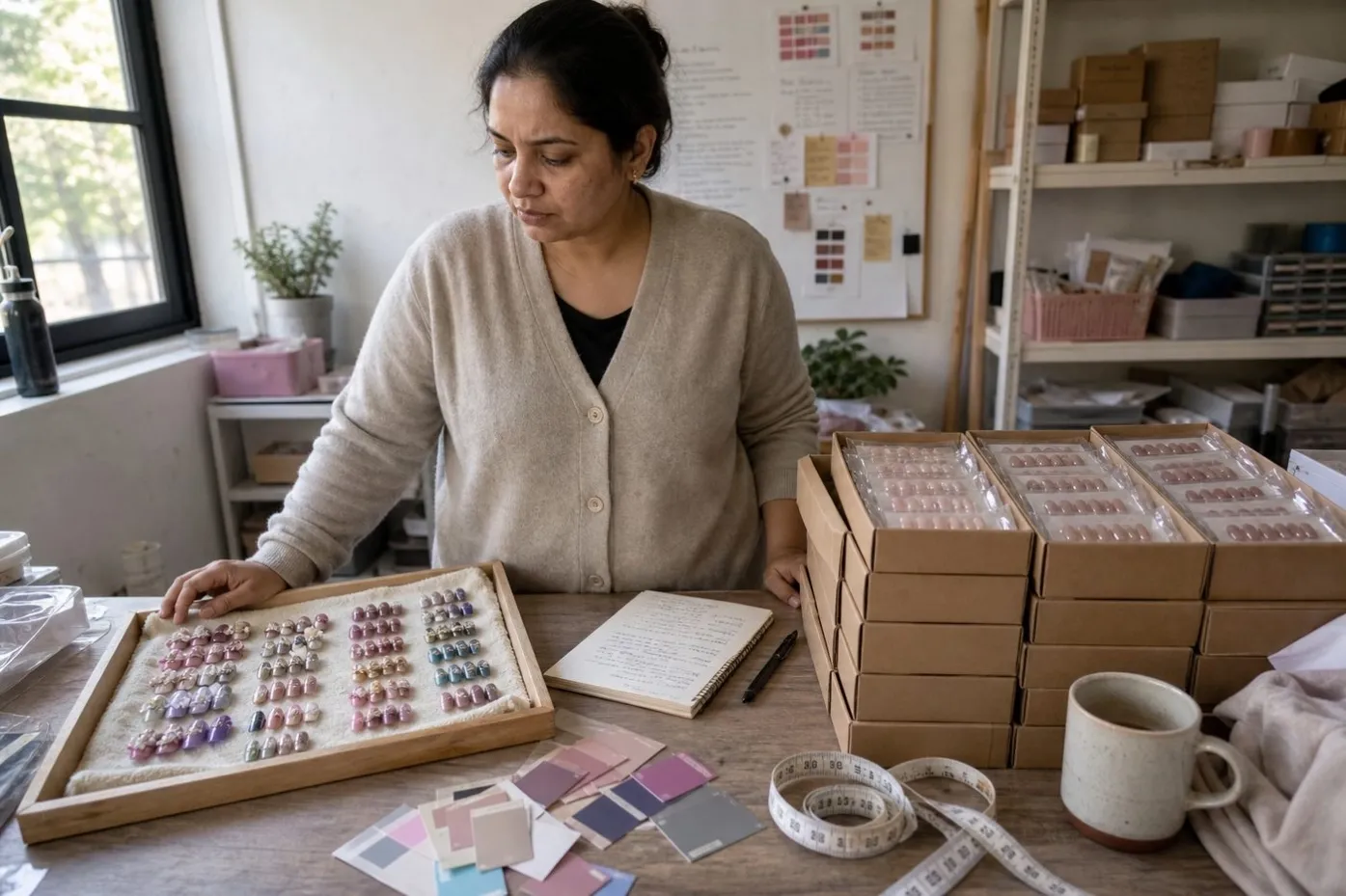
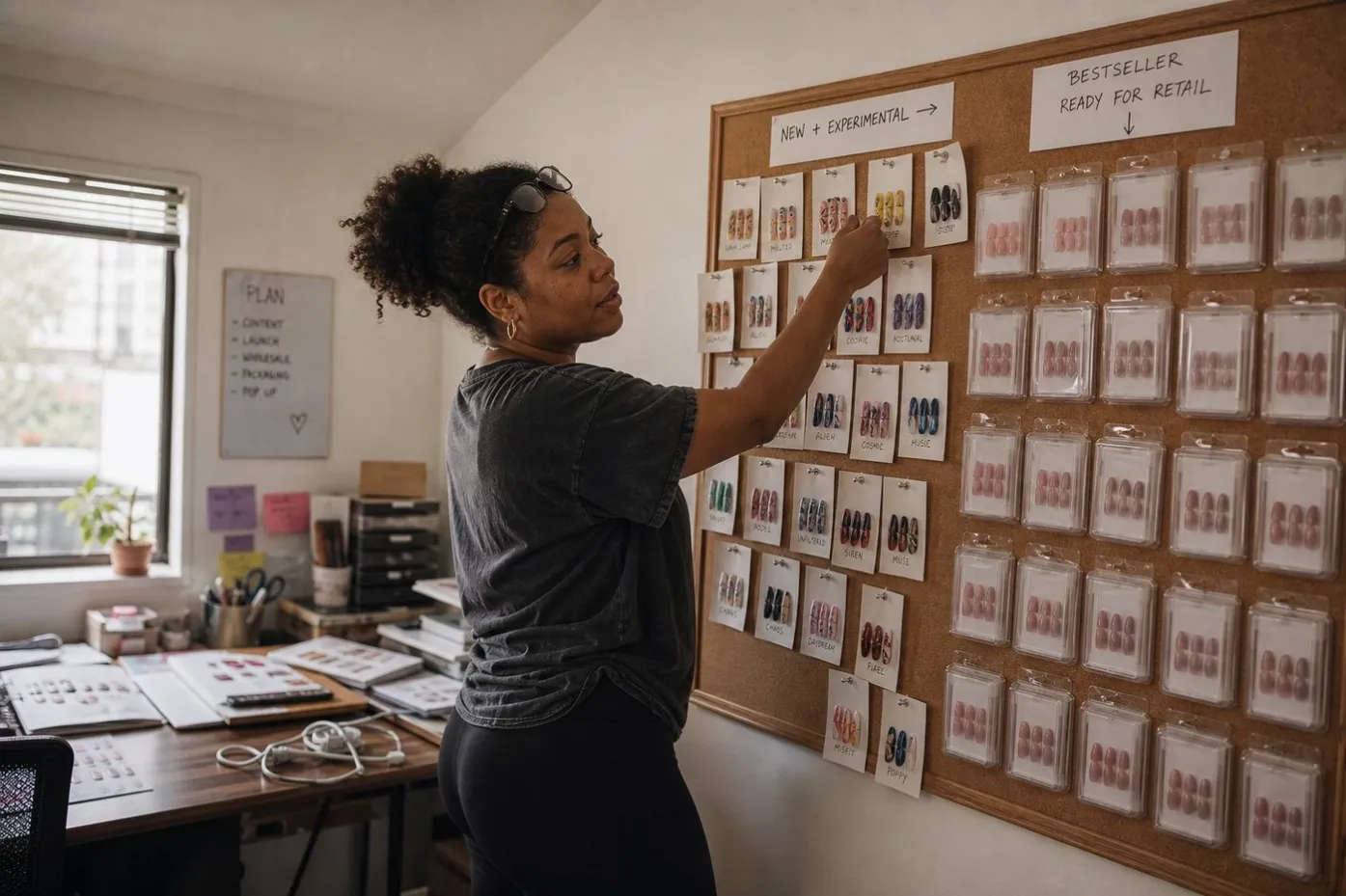
If you are still testing which designs sell, the studio route protects you. Small runs mean small mistakes. If you already have a bestseller that reorders every month, a factory or established wholesale nail suppliers make more sense. Repeatable SKUs reward repeatable production.
Two kinds of premium
Here is a nuance many buyers miss. Both models can read as premium to consumers, just for different reasons. Studio work looks premium in photos because of hand detail. Factory work feels premium in reliability because every set fits the same way. One survey found 54% of frequent users wear press-ons for special events rather than weekly use. That event-driven buyer often pays for artistry. The everyday repurchaser pays for consistency. The category itself is clearly growing, though I would caution you not to anchor on any single market-size number 1, because published reports measure different segments and geographies and their totals conflict. Plan around demand signals you can verify in your own channel, not headline forecasts.
What MOQ can I realistically expect from artisan studios versus factory production runs?
A founder we advised had budget for 12 designs, but the factory quote she brought us required 1,000 sets per design. That one email shows why MOQ shapes everything downstream.
Artisan studios typically accept 50–500 sets, with samples as low as 1–20 custom sets. Mid-size OEM manufacturers usually require 200–5,000 sets, while large factories demand 5,000–50,000+ sets. Standard custom production commonly runs 300–1,000 sets per design.

MOQ is not a production detail. It is the hidden business model behind your whole line. Here is how the tiers break down in practice.
| Supplier type | Typical MOQ | Typical samples | Typical production lead times |
|---|---|---|---|
| Boutique studio / local maker | 50–500 sets | 1–20 custom sets | Often days for small runs |
| Mid-size OEM manufacturer | 200–5,000 sets | 10–50 sets | Roughly 10–30 days |
| Large factory | 5,000–50,000+ sets | 10–50 sets | Roughly 14–45 days |
Why MOQ decides your variant count
Do the math on that founder's brief. Twelve designs at 1,000 sets each means 12,000 sets of inventory risk 2 before a single sale. The same budget through small batch manufacturing 3 could fund 12 designs at 100 sets each, with real market feedback before any large commitment. That matters even more now that consumers build "nail wardrobes," collecting multiple sets for different looks and occasions. Wardrobe buyers reward breadth. High MOQs punish breadth.
The factory-first objection
Some buyers push back: factories are cheaper per unit, so why not start there? The unit price is real, but it is not the whole cost. Cash locked in slow-moving stock has a cost. Markdowns on designs that miss have a cost. And a catalog built only from mold-friendly designs can flatten your brand's identity. In our coordination work, the brands that scale smoothly usually validate through low-MOQ runs first, then negotiate bulk pricing tiers on the two or three designs that proved themselves.
How do I compare design turnaround speed when choosing between studios and factories?
Last spring, a chrome trend went viral almost overnight. The studio partners we work with in Shantou turned matching samples around in days, while the factory route needed new tooling first.
Artisan studios can replicate viral trends in 24–48 hours because hand-painted work skips tooling. Factories typically need 4–8 weeks for new mold production and design approval. Compare partners on revision cycles allowed, not just days to first sample.

Speed has two layers. The first is calendar time to a sample. The second, which buyers underestimate, is how many revision cycles you can afford before launch. A factory that delivers a sample in three weeks but charges for every artwork change is slower, in practice, than a studio that iterates twice a week. When I audit a new partner's speed for a client, I run this five-step check:
- Ask for total calendar time from written brief to approved sample, including custom design prototyping.
- Count the revision rounds included in the quote, and the cost of each extra round.
- Ask which changes trigger re-tooling versus a simple artwork swap. Mold changes reset the clock.
- Confirm production lead times after sample approval: mid-size OEM runs sit around 10–30 days, large factories around 14–45 days.
- Send a mock brief based on a live trend and time the response honestly.
Hybrid production is closing the gap
The line between studio and factory speed is blurring. Digital UV printing and 3D-printed custom designs now let some suppliers produce high-resolution, custom-fit art at scale. Advanced studios print base patterns on desktop UV printers, then hand-finish 3D details. That hybrid model keeps the handmade look and price premium while raising output. For a brand, the practical play is sequencing: launch trend-reactive designs through a studio, watch what sells, then migrate the winners to factory production once the artwork is stable enough to justify tooling.
What quality checks should I run before scaling from a studio sample to factory bulk production?
One bulk order taught us a hard lesson: the approved sample was perfect, but production drifted on C-curve fit. Since then, we inspect every scaling project against a fixed checklist.
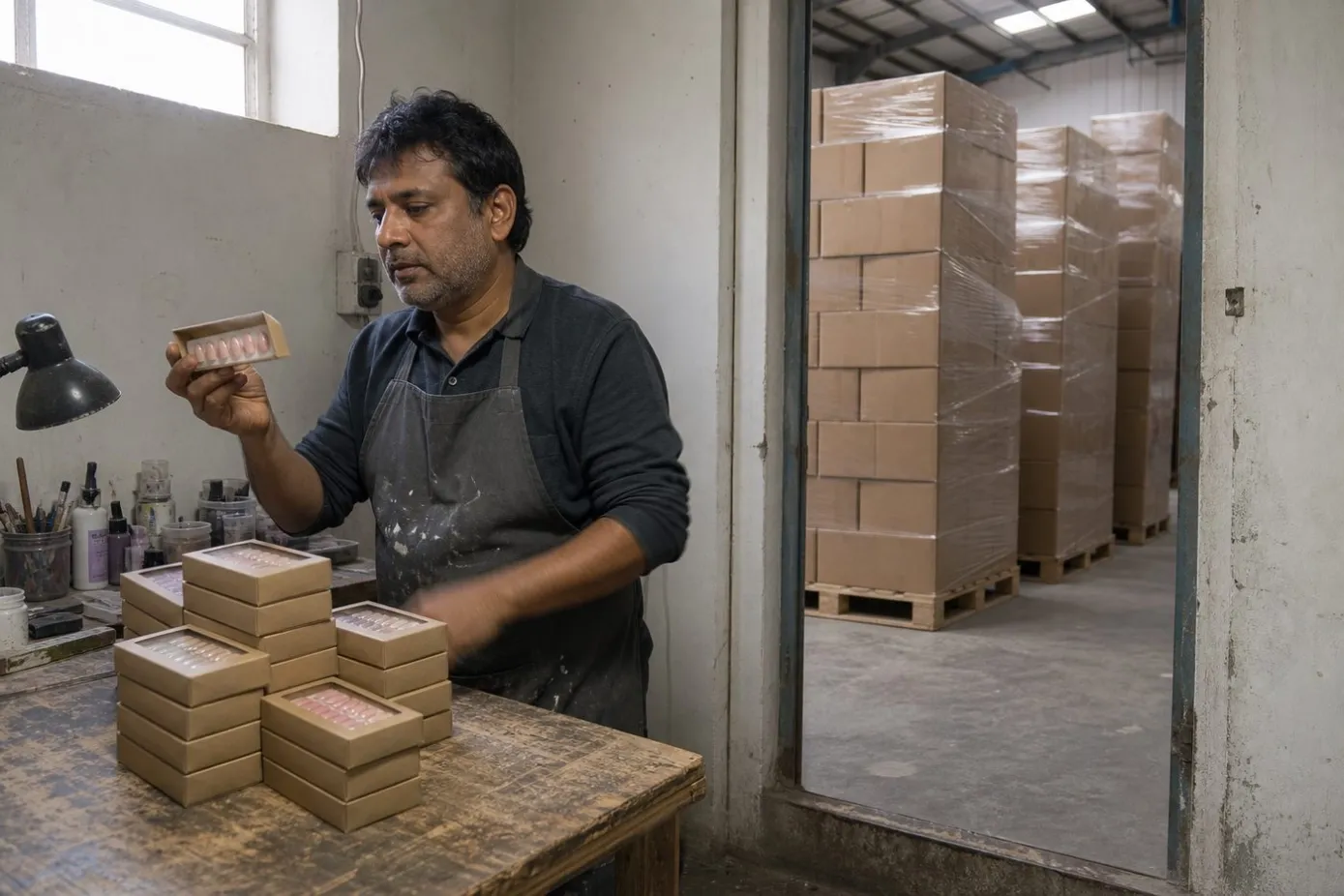
Before scaling, verify five things: C-curve fit against the approved sample, material construction, wear time across 5–10 uses, color and finish consistency between batches, and packaging compatibility. Run a small pilot batch and inspect it before releasing full production.

Quality is not one thing. Break it into visual finish, fit, wear time, and repeatability, and check each separately. A studio sample and a factory unit can look identical in a photo and still behave very differently on a customer's hand.
| Check | What to compare | Red flag |
|---|---|---|
| Material construction | Multi-layered gel versus thin injection-molded ABS with a printed topcoat | Bulk units feel thinner or flatter than the sample |
| Fit and C-curve | Curvature against the approved sample; support with custom sizing kits | Edge lifting during wear tests |
| Wear and reuse | Structural gel sets survive 3–4 reuses and weeks of total wear | Chipping or warping after first removal |
| 3D detail reproduction | Raised, tactile gel elements versus flat 2D printing | Printed imitation of dimensional art |
| Batch consistency | Color, gloss, and sizing across multiple cartons | Visible carton-to-carton variation |
| Packaging | Market-ready packaging, adhesive system, tray fit | Inserts that no longer hold the new nail curve |
Finish quality versus production consistency
Here is the distinction that saves scaling projects. Studios usually win on finish: layered gel builds, similar in construction to full-cover soft gel tips used for Gel-X extensions, give depth and flexibility that thin ABS blanks cannot match. Factories usually win on consistency: uniform sizing and repeatable output, which retail and subscription reorders demand. Your job is to keep enough of the first while gaining the second.
This matters commercially, not just cosmetically. Reusable press-on nails that survive 5–10 wears can command 30–50% price premiums over single-use kits. If bulk production quietly downgrades construction, you lose the reuse claim and the premium with it. Raised 3D texture is another watch point, since standard 2D factory printing cannot accurately clone tactile gel elements. In our own workflow, we hold a pilot batch to the approved sample under documented quality control standards 4, and we inspect goods before they ship. Whoever you source through, insist on that pilot gate. It is the cheapest quality check you will ever run.
Conclusion
Handmade press-on nails reward brands that match the model to the moment: studios for testing and artistry, factories for scale. Sequence both well, and your line grows without inventory regret.
Footnotes
1. Statista provides comprehensive data on the global beauty and personal care market segments. ↩︎
2. The International Trade Centre helps small businesses navigate supply chain and inventory challenges in global trade. ↩︎
3. NIST's Manufacturing Extension Partnership supports small-scale and batch manufacturing efficiency and growth. ↩︎
4. ISO 9001 is the global benchmark for quality management and consistency in manufacturing. ↩︎