Cosmetic Packaging and Shipping Temperature: What to Review Before You Approve
No universal safe temperature exists for a cosmetic package. Put the known conditions on the table and give each layer - formula, component, decoration, carton - its own review question.

No single shipping temperature keeps every private label cosmetic safe, so the useful question is not which number to trust. It is which conditions your product, components, decoration and cartons will actually meet, and which approval questions each layer needs answered before you sign off.
Buyers moving liquid lip gloss, foundation or serum-style makeup across the sea rarely get a straight answer to "will it survive the trip?" The honest answer is conditional — it depends on the formula, the component, the decoration, the carton and the route. This article gives no universal limit. It shows how to put the conditions you know on the table and give each layer of risk a question, an owner and a piece of evidence.
Our position is simple. ZONO works as a coordination partner in Shantou with ten years of product development experience and more than 1,000 SKUs in ready stock, and we are not positioned as a single factory. That role shapes this guide: we will not promise how any package behaves in transit, and we will not hand over a temperature number we cannot stand behind. We will show what to ask, what to record and when to push a question upstream.
Put the Known Conditions on the Table First
Two buyers can order similar-looking lip glosses and face completely different transit realities. One books direct freight in a single season; the other sends mixed pallets through several transfers and a monsoon-season port. The package that suits one lane can be wrong for the other, which is why conditions come before conclusions.
Before any packaging decision, list the conditions you already know: the product format, the component direction, the destination market and the likely logistics path. Whatever is still unknown becomes an open question in the brief, not an assumption quietly baked into the order.
- Product format: a lip gloss, a liquid foundation or a cushion raises different questions from an empty component discussion.
- Closure and applicator direction: wands, droppers, pumps and compacts seal in different ways.
- Destination market: documentation and registration expectations differ from the EU to the United States to Indonesia.
- Logistics path: direct freight, multi-leg transfers and long warehouse dwell each add exposure.
- Known concerns: heat, freezing conditions, humidity or stacking pressure that the buyer has already heard about.
- Decoration and carton features: foil, printing and retail-ready cartons that must arrive presentable.
A brief written this way travels well. Suppliers answer specific questions faster than vague worries, and the answers become comparable across quotes instead of buried in marketing reassurance.
What Can Prolonged Heat, Freezing and Humid Routes Change?
Once the conditions are named, one big worry becomes four smaller ones. A cosmetic package is a system: the filled formula, the component that seals it, the decoration on its surface and the outer carton that carries the load. Each layer fails differently, so each layer needs its own question.
Heat, cold and humidity never act on "the packaging" as one thing. Prolonged heat stresses both formula and seal, freezing conditions stress elasticity, and humid routes stress decoration and cartons. Reviewing the four layers separately turns a vague fear into questions a supplier can actually answer.
The formula layer
A liquid lip product can separate, shift color or develop odor after rough storage; whether that happens depends on the formula's own stability, not on optimism. This is the layer where the deciding evidence sits with the supplier — stability documentation, storage guidance and honest statements about what has and has not been tested. Ask which storage conditions that evidence assumes, rather than hoping the filling hall stayed comfortable.
The component and seal layer
Sealing parts are mechanical things. Materials expand in heat and contract in cold; gaskets and liners soften or stiffen; torque that felt right on the bench can loosen after a long transit. Nobody can read this off a product photo. What a buyer can do is ask which seal type is specified, how closure fit was verified on the approved sample, and whether bulk production will use the same closure lot standards.
The decoration layer
Hot-foil stamping, printing and coatings carry their own tolerances. On routes that combine heat and humidity, the common failures are dulling, blocking or scuffing where printed surfaces rest against each other. The review question is short: which decoration details are non-negotiable for the brand, and what does the decoration supplier say about exposure during warehousing and transport?
The outer carton layer
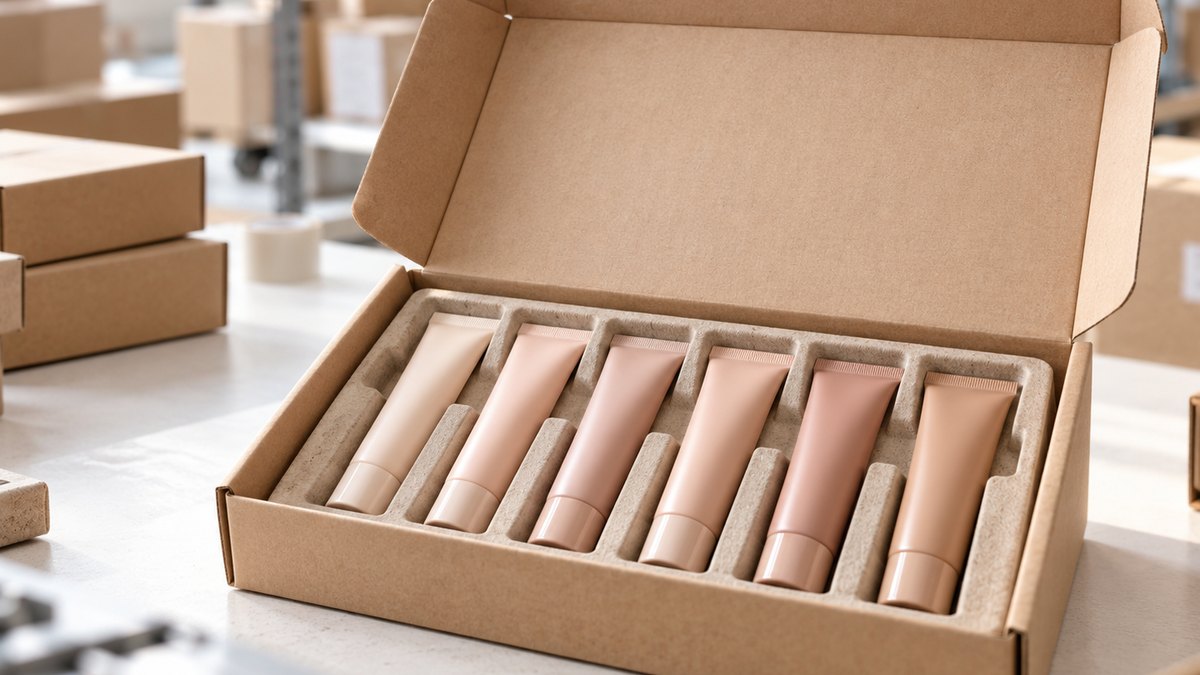
Cartons fail in transit for two unglamorous reasons — compression and moisture. Stacked pallets, repeated handling and damp containers all press on the weakest box in the stack. Corrugate grade, inner dividers and pallet wrapping are logistics decisions as much as packaging ones, and they deserve the same scrutiny as the pretty part of the package.
Each condition presses on each layer differently, which is why a single yes-or-no answer misleads:
| Transit condition | Formula | Component and seal | Decoration | Outer carton |
|---|---|---|---|---|
| Prolonged heat | Ask what the stability evidence assumes; watch for separation, color shift, odor | Seal materials soften; re-verify fit and torque on the sample | Foil and coatings can dull or shift | Rarely the sole cause; worse when combined with stacking |
| Freezing conditions | Some emulsions handle cold worse than heat; ask, never guess | Contraction can loosen closures; elasticity matters most | Usually stable; check rigid coatings for cracking | Boards turn brittle in cold handling |
| Humid routes | Indirect: condensation as cartons open | Liners can take up moisture | Printing can block, scuff or lift | The main enemy: moisture uptake, then crushing |
| Long multi-leg route with stacking | Longer exposure to whatever the lane brings | More handling cycles on every closure | More surface-to-surface contact | Compression accumulates across each transfer |

What Evidence Should Sit Behind the Formula Layer?
The formula layer is where buyers most need to resist reassurance. "It will be fine" is not evidence, and it cannot be approved against. What counts is documentation: the stability work behind the formula, the storage and transport conditions that work assumes, and who in the chain is responsible for keeping conditions controlled.
Ask for the evidence path, not a promise: what stability documentation exists for this exact formula and component pairing, what conditions it assumes, and who confirms those conditions hold between filling and delivery. Reassurance without records is not something to approve against.
Regulation shapes who answers, too. Under EU Regulation (EC) No 1223/2009, a cosmetic product placed on the EU market needs a responsible person and a product information file, which is where formulation and safety documentation lives2. Good manufacturing practice under ISO 22716 includes storage and transport among the areas it addresses, so "were conditions controlled" is a GMP question rather than a favor1. In the United States, cosmetics are regulated under modernized law including MoCRA3, but they are not FDA-approved before sale4; no approval stamp anywhere replaces the stability question above.
- Which stability or compatibility documentation exists for this formula and component combination?
- Which storage and transport conditions does that documentation assume?
- Who between filling, warehousing and delivery confirms those conditions actually held?
- If the formula, component or decoration changes, who re-opens the evidence file?
Other markets add their own gates; Indonesia's BPOM, for instance, operates national notification requirements for cosmetics5. None of these rules names a safe transit temperature, but they all reward the buyer who asks for records before the order instead of after the complaint.
What Should My Sample Approval Record Capture?
A sample review that lives in scattered email threads cannot protect a buyer later. When a shipment arrives with softened gloss or scuffed foil, the useful artifact is a record of what was reviewed, under what assumptions, and what was deliberately left open.
A strong approval record states what was reviewed and what was not: product and component references, visible sample condition, closure observations, artwork version, carton direction, review date and every open question with an owner. It keeps later conversations anchored to one agreed sample.
Six fields cover most disputes before they start:
| Record field | What to write | Why it matters later |
|---|---|---|
| Product and component reference | The exact formula direction and component codes reviewed | Prevents "different sample version" disputes |
| Visible condition notes | How the sample looked at approval, including the closure area | Baseline for any later comparison |
| Closure observations | Seal type, fit and torque feel as reviewed | Separates approval from transit-behavior questions |
| Artwork and decoration version | Artwork file version plus foil and print details | Ties any decoration claim to a version |
| Carton and packing direction | Carton spec, dividers and pallet plan as discussed | Assigns responsibility for the outer box |
| Open questions | What was not reviewed, who answers, by when | Turns silence into owned action items |
Keep the record with the project brief and update it whenever the inputs move. A prior approval does not carry over automatically; if bulk production has to match the approved sample, that continuity must be managed on purpose rather than assumed.
Update the record at three moments rather than waiting for a dispute:
- The formula or shade direction changes, invalidating earlier stability assumptions.
- The component, seal or applicator changes, resetting the fit and closure observations.
- The artwork, decoration or carton direction changes, moving the visual baseline.
Match the Review to the Sourcing Route
The depth of review should follow the route the project takes. A ready-stock item from a range of more than 1,000 SKUs already has its formulation history; a semi-custom project changes components or shades mid-way; a full OEM·ODM project writes the formula and the package at the same time.
The more a project changes the original formula or component, the more the transit review must lean on fresh evidence instead of history. Ready stock inherits a track record; semi-custom inherits part of one; full OEM·ODM inherits none, so its stability and compatibility questions come first.
- Ready stock: confirm the lane conditions against the item's existing record, and focus the review on decoration and cartons.
- Semi-custom: carry over what still applies, and flag every changed component as a fresh seal-and-fit question.
- Full OEM·ODM: treat stability and compatibility documentation as a gating item before any transit conversation starts.
Each route also stretches or compresses the calendar differently, which is easiest to see when the review is slotted into the wider project timeline from inquiry to delivery rather than bolted on at the end.
When Should You Escalate the Question Upstream?
Some questions belong with the supplier's technical side, some with the filling plant, and some with a logistics partner. Escalate when the answer would change a commercial decision, when the product or the lane is unusual, or when nobody in the chain has actually claimed the question.
Escalation is not distrust; it is how coordination earns its keep. Name the open question, name who must answer it and name the evidence that settles it. A question with an owner gets resolved; a worry passed between inboxes does not.
- Which exact product and component version does this question refer to?
- Which lane conditions (heat, cold, humidity, stacking) should the answer cover?
- What documentation or test evidence already exists, and who holds it?
- Which party is qualified to answer: the supplier's technical side or the logistics partner?
- If the formula, component or artwork changes, who re-confirms that the earlier answer still applies?

Frequently Asked Questions
- Does this article give a universal safe shipping temperature for cosmetics? No, and no honest source can. Limits depend on the specific formula, component, decoration, carton and route, so none should be copied from a general article into a commercial commitment.
- Can an empty component be approved without the intended product? An empty component can be reviewed, but that review is not a full product approval. Record what stays open until the intended formula, decoration and destination are confirmed.
- What should I send to start this kind of review? The product format, component direction, target market, known logistics concerns, packaging and artwork status, and the specific questions that must be answered before the next decision.
Conclusion
There is no universal temperature number to approve against, and chasing one wastes the question. Put the known conditions on the table, walk the four layers one by one, demand evidence behind the formula, record what the sample review covered and escalate whatever nobody owns. Done in that order, the transit conversation becomes manageable before the order is placed, not after the complaint arrives.
Footnotes
1. ISO 22716, Cosmetics — Good Manufacturing Practices (GMP), International Organization for Standardization. iso.org/standard/36437.html ↩︎
2. Regulation (EC) No 1223/2009 of the European Parliament and of the Council on cosmetic products, EUR-Lex. eur-lex.europa.eu ↩︎
3. Cosmetics: U.S. Law and Regulation (MoCRA), U.S. Food and Drug Administration. fda.gov/cosmetics-us-law ↩︎
4. FDA Authority Over Cosmetics: How Cosmetics Are Not FDA-Approved but Are FDA-Regulated, U.S. Food and Drug Administration. fda.gov/fda-authority-over-cosmetics ↩︎
5. Badan POM (BPOM), Indonesia's food and drug authority. pom.go.id ↩︎
Send the product format, component direction, target market, known logistics concerns and the open questions you need answered. ZONO replies within one business day; ready-stock orders from 12 pieces ship within 48 hours, and for semi-custom or full OEM·ODM projects we organize the supplier and factory questions from Shantou.
Send your packaging brief To see how these routes run across a private label project, explore private label makeup development.