Sep 14, 2026Startup & Private Label Guides
How to Confirm Shade, Texture, and Packaging Details with Lip Makeup Suppliers?
Use a supplier-facing approval framework to document shade, texture and packaging before bulk production.
A phrase such as "close enough" is not an approval standard. Confirming details with lip makeup suppliers should not rest on chat messages alone.
To confirm shade, texture, and packaging details with lip makeup suppliers, approve physical samples—never photos—lock each element separately, label every sample version, and sign off one master sample plus a written specification sheet that becomes the binding benchmark for bulk production and quality control.
Use three separate approval gates for formula body, color, and packaging. Lock one gate before moving to the next, and keep two documents for each: the reference standard and the final confirmed version. This structure helps prevent a casual "looks fine" from becoming the bulk standard.
How do I make sure the lip shade I approve in a sample matches what actually ships in bulk?
An approved sample and bulk goods can differ in undertone if the agreed color standard and acceptance process are unclear. Make the reference, measurement method, tolerance, and approval record explicit before bulk production.
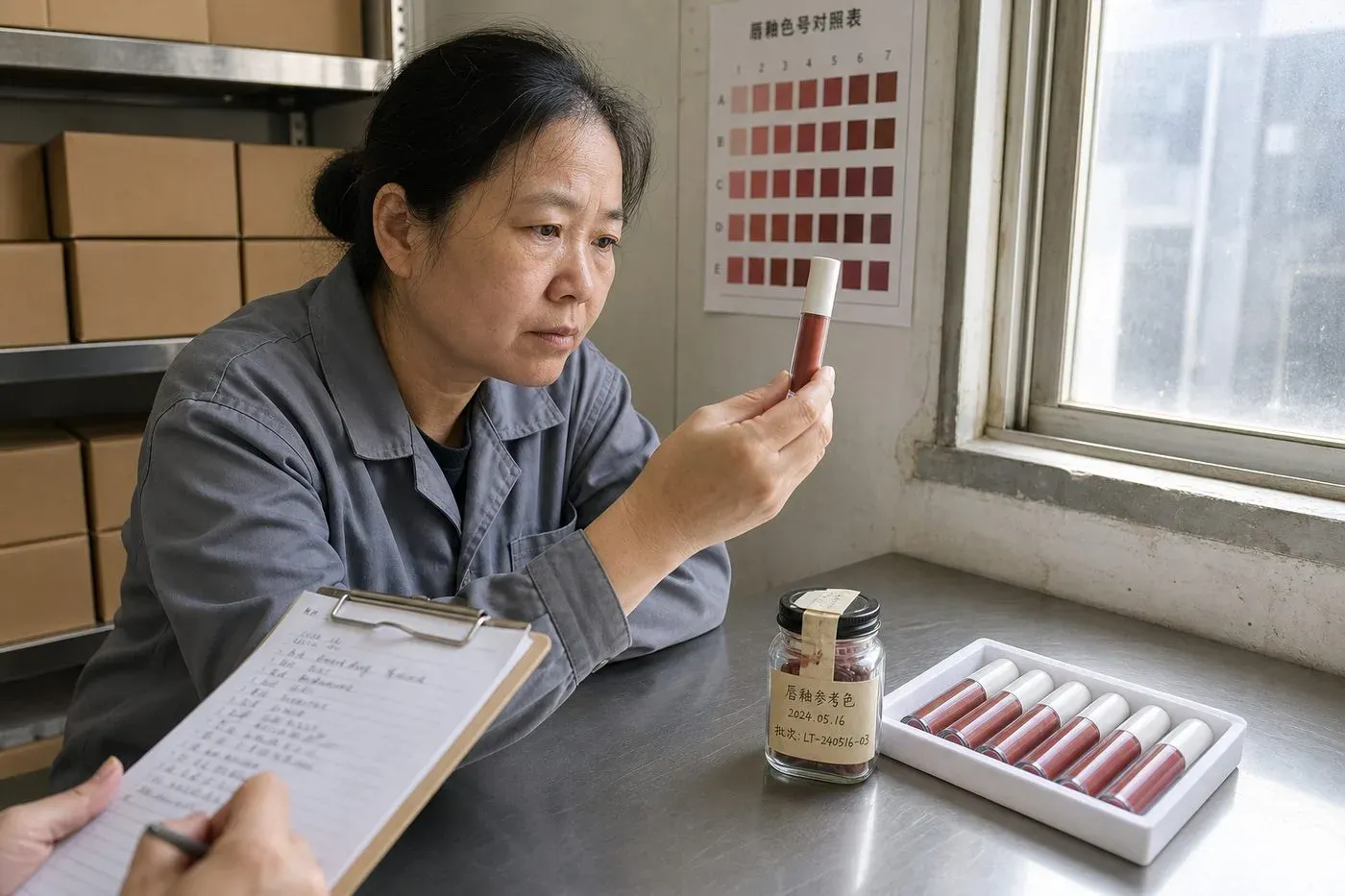
Approve a physical master sample under daylight, request Pantone color matching plus L*a*b* spectrophotometer readings, set an acceptable color tolerance in writing, and ask the supplier how the retained master sample will be used for batch comparison before filling.
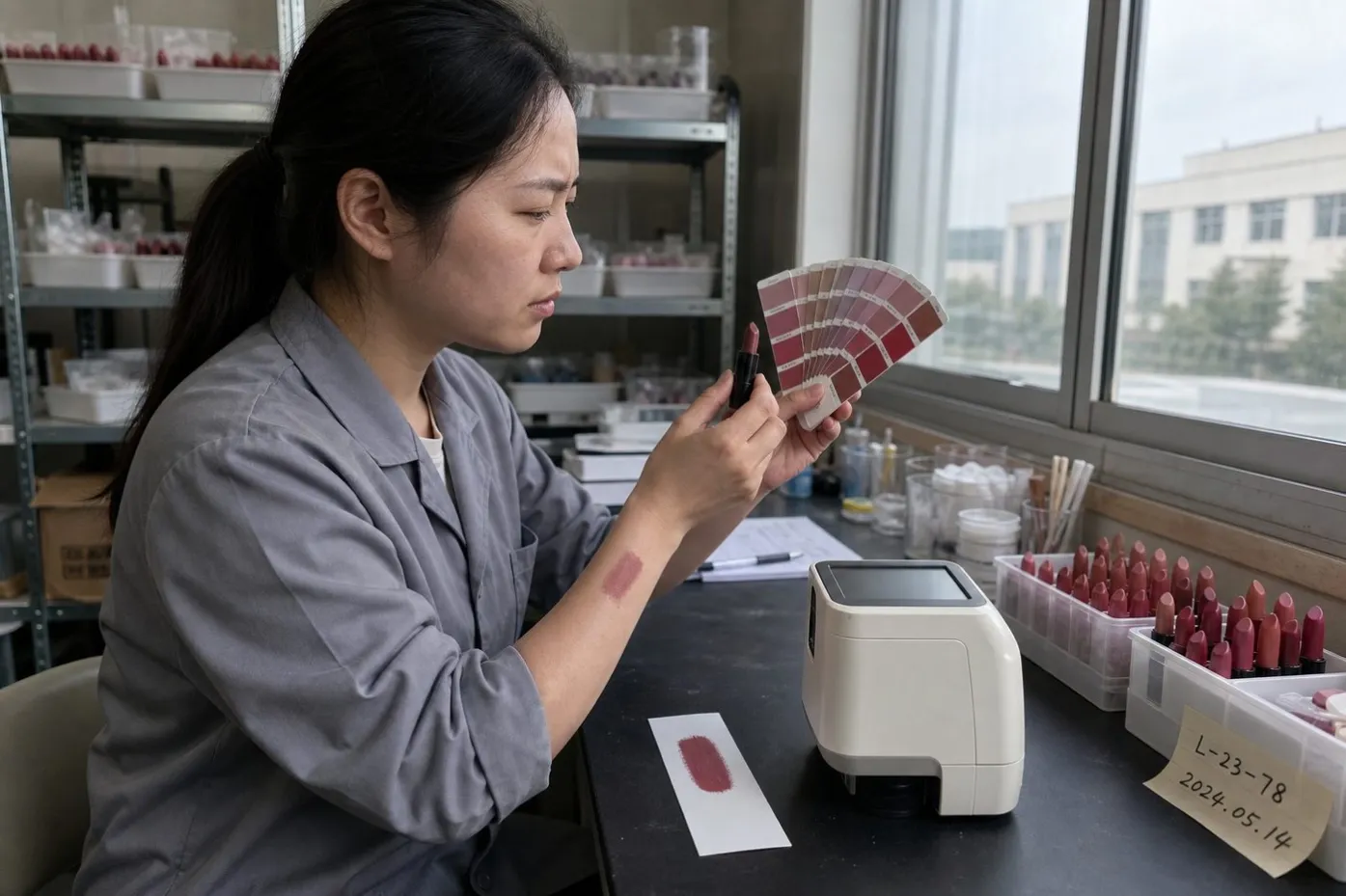
Treat shade as its own sign-off gate. Keep shade feedback separate from texture or packaging feedback 2 in the written approval record. One topic, one confirmation, then lock it.
Start with a clear shade brief
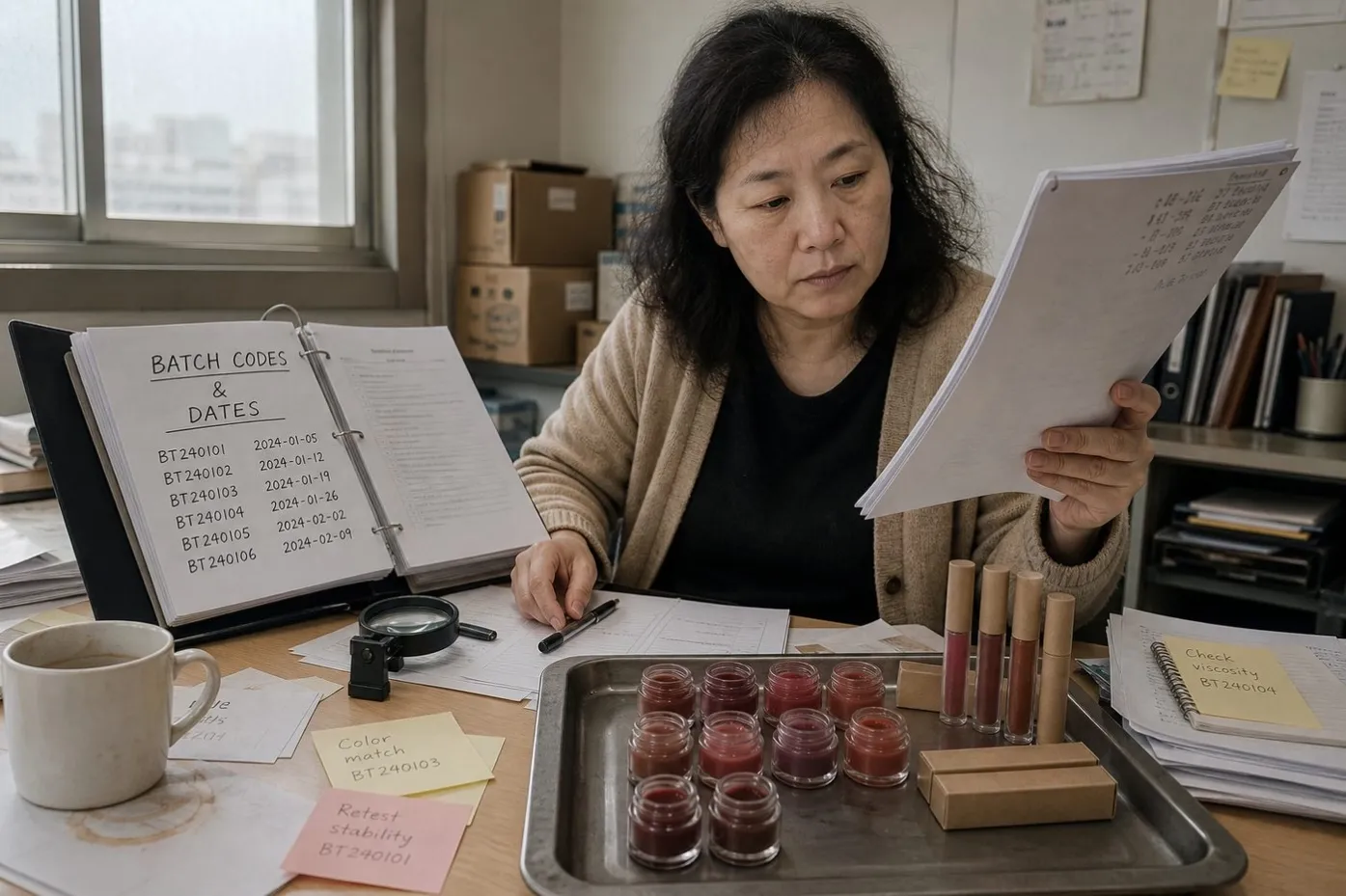
Before any lab sample is made, the supplier needs to know what "correct" means. A vague direction like "warm nude" invites interpretation. A useful shade brief includes the target shade family, the finish, the market it sells into, and the reference type. A reference can be a physical competitor sample, an approved photo, a Pantone direction, or an existing SKU. Shade references can be interpreted differently across target markets and skin tones, so the brief should name the target consumer too.
Approve under daylight, not office light
Evaluate shade samples under an agreed lighting condition and record the comparison method. For objective backup, ask whether L*a*b* color space data 3 from a spectrophotometer is available. Use measurement alongside a physical reference rather than relying only on a screen image.
Shade confirmation element | What to lock in writing |
|---|---|
Reference source | Physical sample, Pantone code, or existing SKU |
Lighting standard | Daylight or specified light box condition |
Objective data | L*a*b* readings with agreed tolerance |
Master sample | One retained physical benchmark, signed and dated |
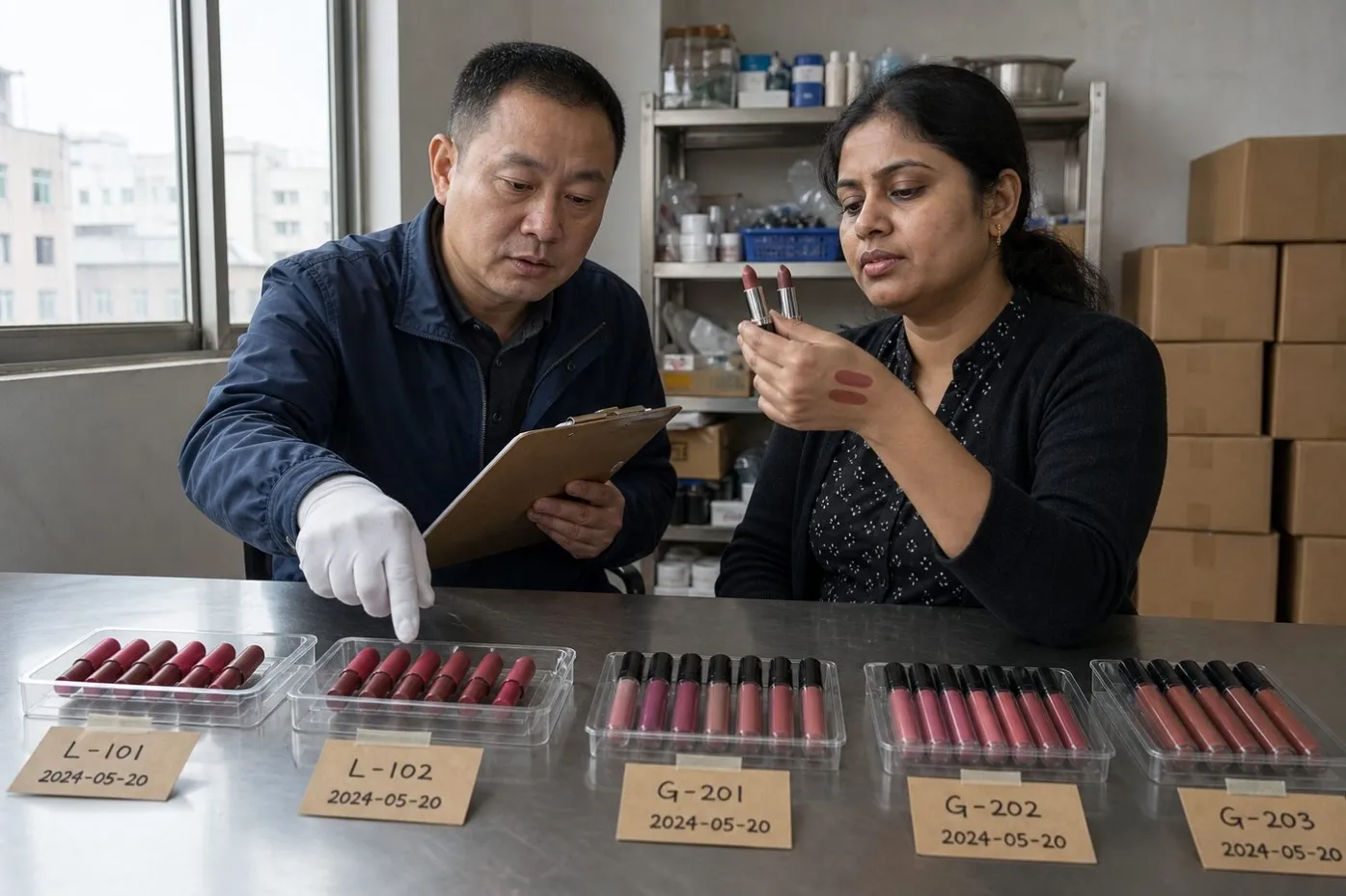
Sample labeling | Formula version, shade code, packaging version, filling date |
That last row is shade-code discipline. When every sample carries its version, code, and date, revisions never get mixed up, and batch consistency in bulk can be checked against a known anchor instead of memory.
✔ Lip shade approval should happen under daylight or standardized lighting TrueLip color visibly shifts under warm indoor light and on different skin tones, so daylight or a specified light-box condition is a more consistent basis for comparing samples to a reference.✘ A well-lit photo is an acceptable substitute for a physical shade sample FalseScreens, cameras, and lighting all distort color, so photo-only approval can leave color differences unresolved; a physical reference and any available measurement record provide an additional comparison point.
What should I ask my supplier to confirm lip gloss or lip tint texture before production starts?
A useful comparison brief can name the reference product, the preferred sensory direction, and the conditions under which it should be assessed. This gives the supplier a clearer starting point than a broad adjective alone.
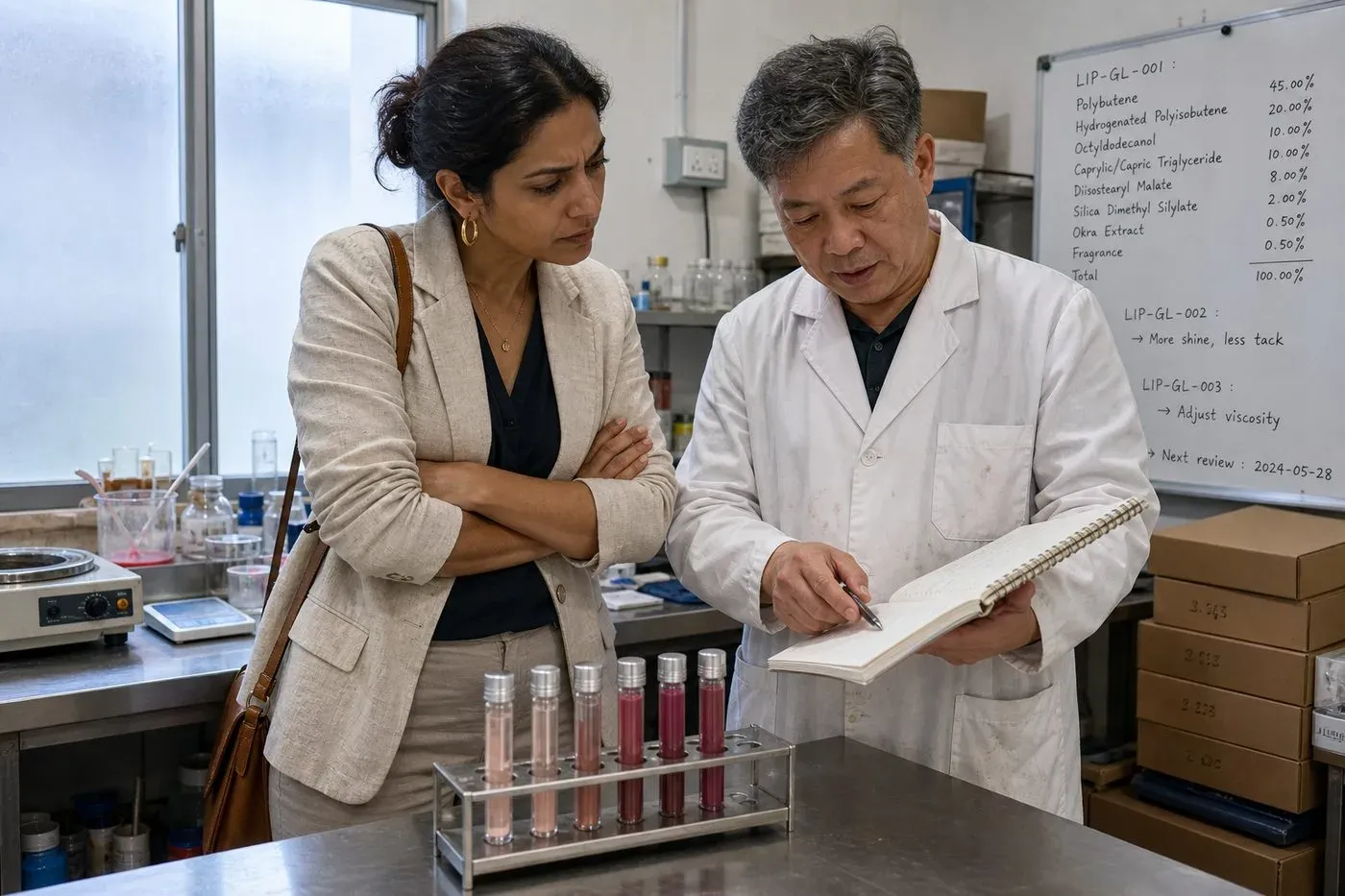
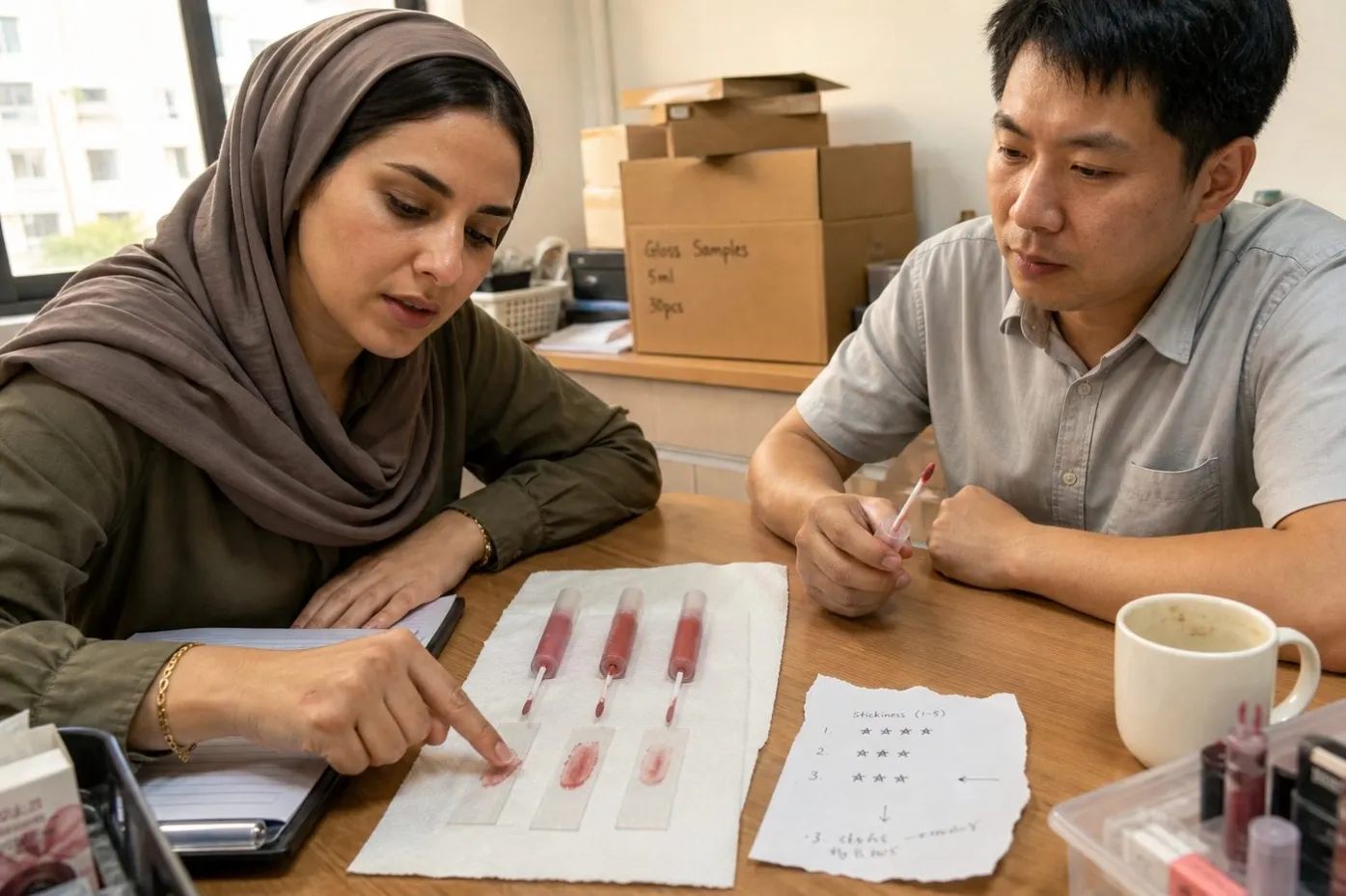
Ask the supplier to define texture in two layers: sensory checks—glide, payoff, stickiness, scent, and wear feel tested on lips—and technical checks—viscosity, bullet hardness, and formula stability testing across hot, cold, and freeze-thaw conditions—before you approve pre-production samples.
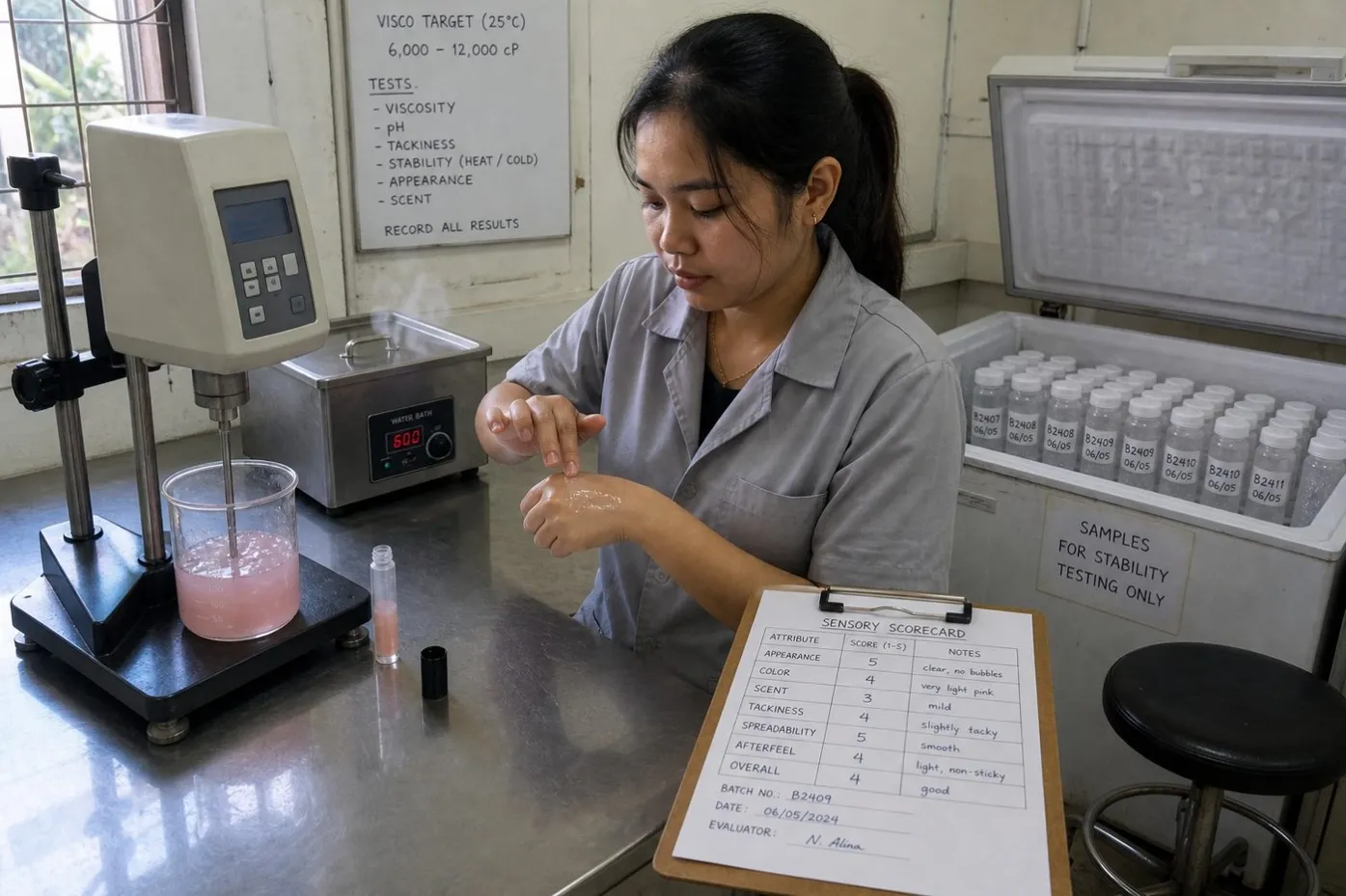
Texture can be difficult to describe in words. "Not sticky" may mean different things to different teams, so treat texture as its own confirmation gate, separate from shade, using this sequence:
- Send a texture reference. A physical competitor product beats any description. It gives the lab a real target for slip and tack.
- Test on lips, not on hands. Glide, drag, payoff, softness, scent, and wear feel over several hours all behave differently on lips.
- Score it. A simple sensory profile scorecard—rating slip, tack, cushion, and shine from 1 to 5 against the reference—turns "feels off" into feedback a lab can act on.
- Request relevant technical evidence. Sensory feel is only half of texture. Ask the supplier what stability and compatibility evidence is available for the formula under the storage and transport conditions relevant to your route. A gloss that feels good at room temperature may still need additional evidence before bulk approval.
Different lip products need different checks, so match the test to the product type:
Product type | Key sensory checks | Key technical checks |
|---|---|---|
Lipstick | Glide, payoff, comfort | Bullet firm but not brittle, breakage risk |
Lip gloss | Non-sticky feel, shine, cushion | Viscosity range, applicator pickup |
Lip tint | Even payoff, stain longevity | Pigment dispersion, separation over time |
Lip oil / balm | Comfort, clarity | Leakage resistance, temperature behavior |
A shade that looks right may still need a separate comfort or stability review. Visual match and wear performance are separate approvals; do not use one as evidence for the other.
✔ Texture confirmation includes both sensory feel and technical stability TrueA formula must pass lip-feel checks like glide and stickiness and technical checks like viscosity, hardness, and freeze-thaw stability, because either one can fail independently in bulk.✘ If the shade is approved, the texture is automatically confirmed too FalseShade and texture are produced by different formula variables, so a color-perfect sample can still drag, feel sticky, or break down under temperature stress if texture is never tested separately.
How do I avoid packaging and formula mismatches when working with a lip makeup supplier?
Every packaging decision can involve a trade-off: a custom tube shape may support a distinct brand presentation, while each new component can add compatibility questions between wiper, applicator, and formula.
Test the filled product, not empty components: run upside-down leakage checks, wiper-to-applicator tension tests, cap torque checks, and transit simulation on filled units, and approve formula and packaging together in one pre-production sample rather than signing off each separately.
A formula and a tube can each appear acceptable on their own while the combination still needs compatibility evidence. Treat packaging as a separate approval gate and give the supplier the packaging reference up front: tube size, bullet shape, wiper fit, and closure requirements should be considered with the formula.
Primary packaging components come first
Ask the supplier what compatibility checks use the actual formula with the actual tube, wiper, applicator, cap, or bottle version. A low-viscosity lip oil 4 and a thick gloss may require different component considerations. Use the supplier's evidence for the selected filled unit before approving it:
Test | What it catches |
|---|---|
Upside-down leakage check | Seepage past wiper or cap thread |
Wiper-to-applicator tension | Excess pickup, scraping, or messy application |
Cap torque check | Caps that loosen in transit or crack when tightened |
ISTA 3A transit simulation | Breakage and leaks under e-commerce shipping vibration |
Decoration adhesion | Logo or coating rub-off during handling |
Outer packaging is a separate confirmation
The carton is not decoration; it is protection and shelf presence. Confirm material, finish, logo placement, barcode area, and drop protection separately from the primary component. If you are claiming recycled content, ask for chain-of-custody documentation such as GRS certification for the actual PCR plastic used, not a verbal assurance.
Extra sample rounds can cost time and money. Decide the required checks from the formula, packaging, route, and target market rather than treating a visual sample as complete evidence.
What details should I get in writing to prevent my bulk order from drifting from the approved sample?
Verbal approvals can be difficult to trace. Put each material decision, reference, version, and acceptance point in the written project record before bulk approval.
Get a signed technical specification sheet covering shade codes with tolerances, texture benchmarks, packaging drawings, artwork files, cap torque, quality control standards, sample version history, and the rule that any formula or component change triggers a new numbered sample for re-approval.

For each of the three gates - shade, texture, and packaging - keep two artifacts on file: the original reference standard and the final confirmed version. A "close enough" message in a chat window is not a sufficient approval record.
In private label cosmetics manufacturing, use the technical specification sheet as a reference document for the quality requirements you want to confirm before bulk approval:
- Technical specification sheet. Shade code with L*a*b* tolerance, product finish specifications, net fill weight, component drawings, artwork placement, and cap torque values.
- Retained master sample. One physical benchmark, signed and dated, held by both sides. Bulk QC compares against this sample, not against memory.
- Sample version log. Every lab sample and pre-production sample numbered with formula version, shade code, packaging version, and filling date.
- Compliance documentation. Ask which formula and material documents are available, then have an appropriate regulatory or quality adviser verify their relevance to your target market. Do not assume a supplier document alone confirms market compliance.
- Change-trigger clause. Any change to pigment source, formula, mold, or component supplier requires a new numbered sample and fresh approval. This single clause catches most silent substitutions.
Then ask your supplier five direct questions: What reference do you use for shade matching? Which sample is the master standard? How do you test packaging fit and leakage? What changes trigger a new sample version? What QC checks run before bulk ships? A supplier who answers these in writing is a supplier you can scale with.
✔ A signed specification sheet plus a retained master sample is the strongest defense against bulk drift TrueWritten tolerances give both sides an objective standard, and the physical master sample gives bulk QC a real benchmark to compare against instead of relying on memory or chat history.✘ Chat approvals and shared photos are enough documentation for a bulk order FalseChat threads lack version control, tolerances, and signatures, so a casual "close enough" message can quietly become the production standard with no way to hold the supplier to the original sample.
Conclusion
A lip product is only confirmed when the shade is right, the texture feels right, and the packaging works. Lock each gate in writing, and bulk orders stop drifting.
Footnotes
1. ISO provides the international standards for quality management and Good Manufacturing Practices in cosmetic production. ↩︎
3. Pantone is the global authority on color standards and technical color space data for manufacturing. ↩︎
4. The European Chemicals Agency oversees REACH compliance for chemical substances used in cosmetic formulas. ↩︎
23:["$","$L2c",null,{"defaultValues":{"title":"H