Christmas Press-On Nail Designs: Which Motifs Should a Wholesale Range Carry?
Which Christmas press-on nail designs sell? The motif families, the search words buyers actually filter by, how to build a range without 30 SKUs, and what decorated nails change for QC.

Every Christmas press-on range is built from the same handful of decisions, and the motif is the one buyers get wrong first. Pick too few and the shelf looks thin; pick too many and half the range never finds its buyer before the season ends. This guide covers the design directions that carry a December range, the words shoppers actually filter by, and how to build a range that still makes sense in January.
What Are the Main Christmas Press-On Nail Design Directions?
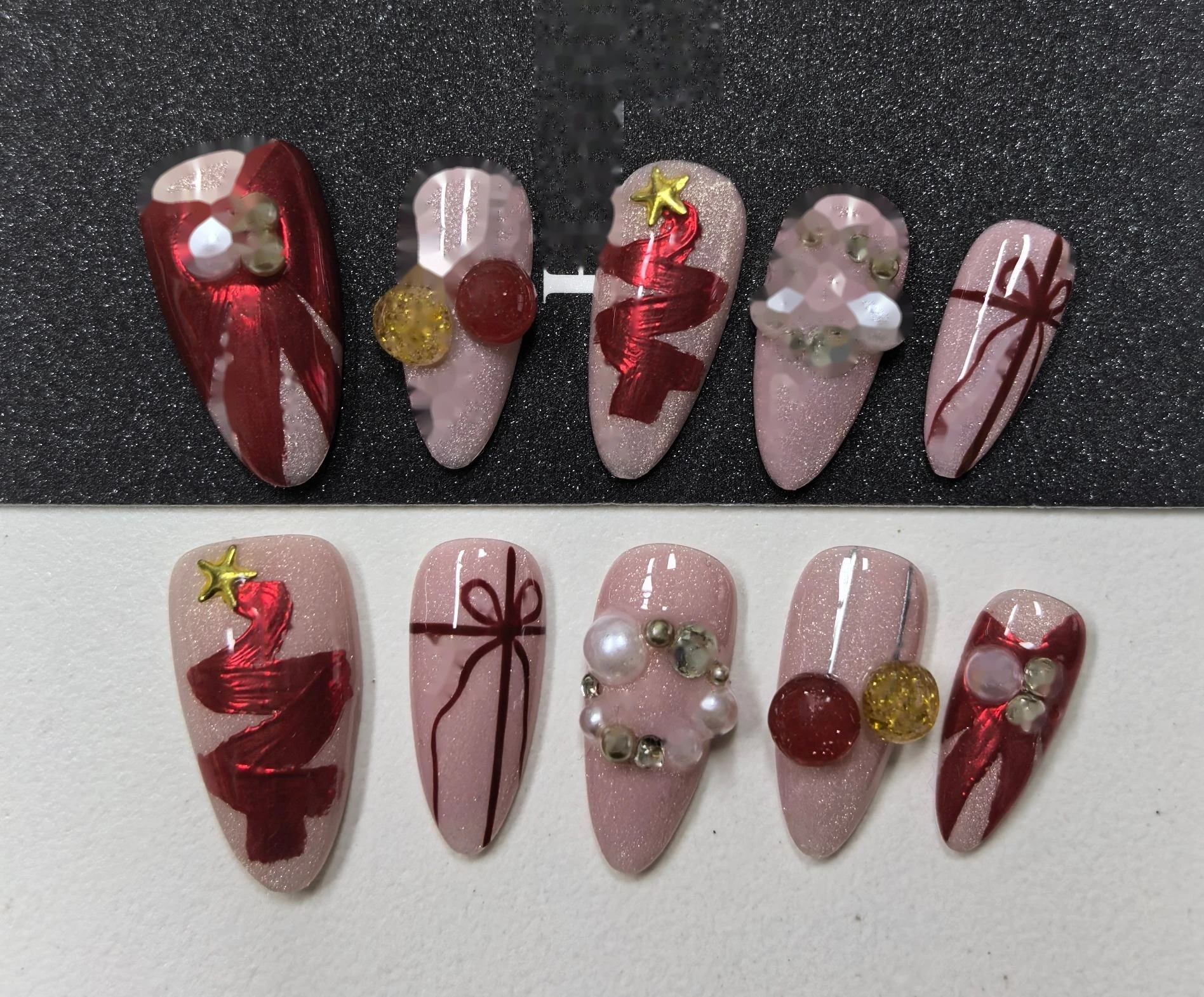
Five design directions do most of the December work: motif-led designs such as snowman, reindeer and gingerbread; colour-led designs built on red and white or burgundy; finish-led designs in glitter, chrome or velvet; shape-led designs around the classic French tip and the almond form; and 3D art designs that carry a physical charm or sculpted element.
The important point is that these are not competing options. They are different jobs on the same shelf, and a December range that only fills one of them leaves money in the other four.
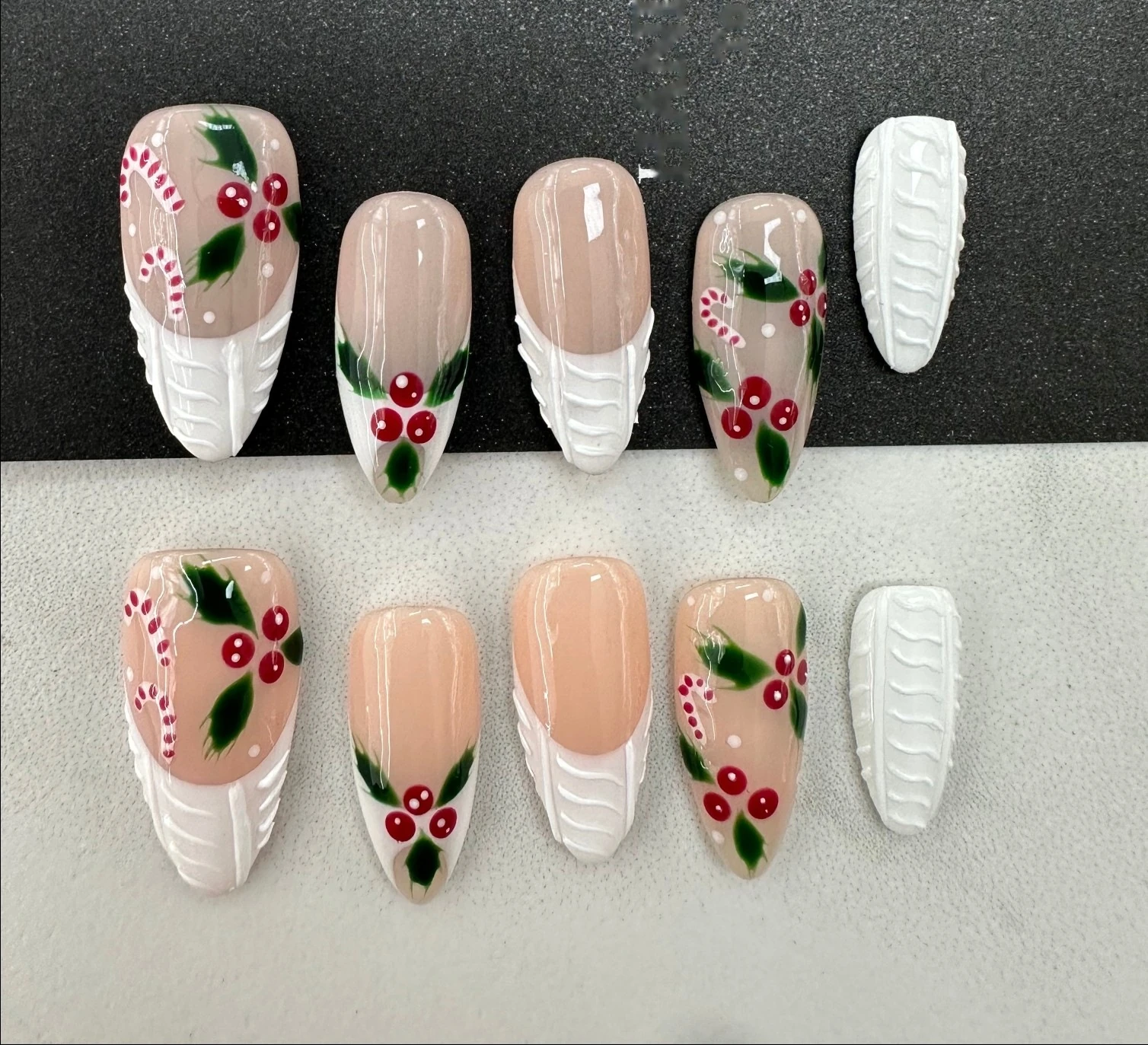
Motif-led designs carry the story. A snowman, a reindeer or a gingerbread house tells the shopper what season it is without a single word of copy. These are the designs that get photographed, shared and searched by name.
Colour-led designs carry the volume. A red and white scheme, a burgundy set or a navy snowflake design sells to the shopper who wants the season without the novelty. Colour is also the cheapest variation to run, because it changes a fill rather than a mould.
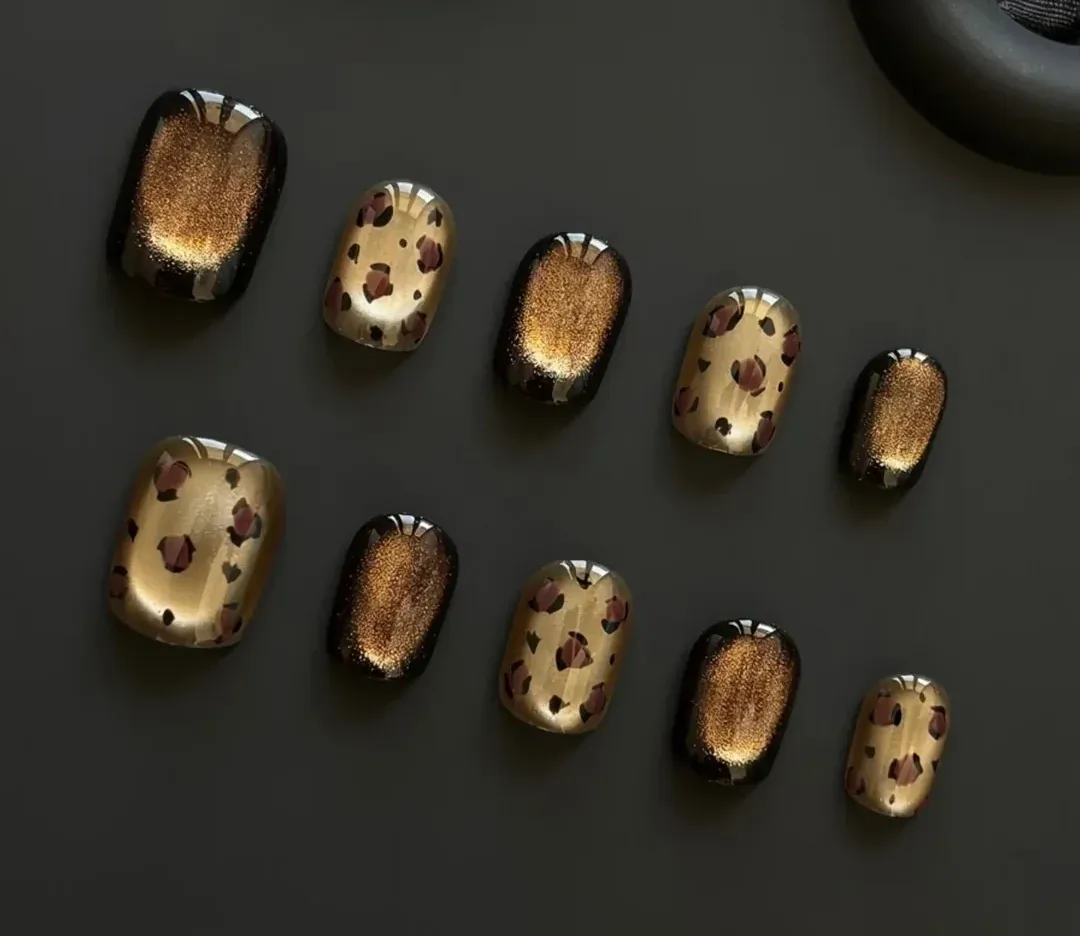
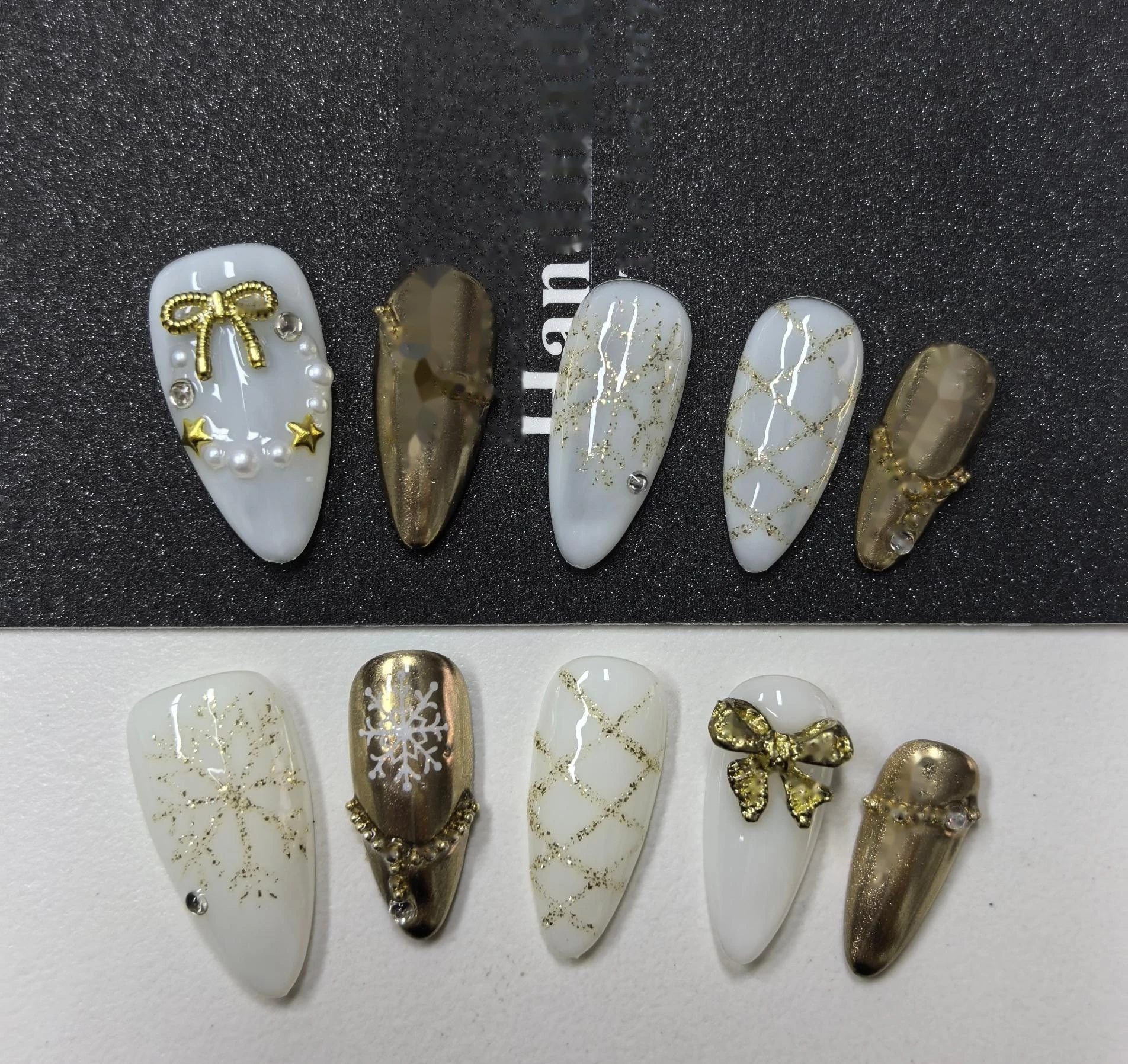
Finish-led designs carry the price point. Glitter reads festive from across a room, chrome reads modern, and velvet reads expensive. The same motif in two finishes can sit at two different price positions on the same shelf.
Shape-led designs carry repeat purchase. The French tip and the almond form are two of the most familiar silhouettes in this category, and a shopper who already wears one of them is not being asked to change how the nail feels.1
3D art designs carry the premium end. A sculpted charm or a raised element gives a design a physical presence that a printed pattern cannot match, which is what justifies a higher retail price.
Why Do Motif Words Matter More Than Colour Words in Search?
Because shoppers filter by the thing they already have in mind. The filter words a large handmade marketplace publishes for this category are Snowman, Reindeer, Gingerbread House, Pink, Pastel, Red & White, Almond, French Tip and 3D — mostly motifs and forms rather than colours. A design that cannot be described with one of those words is harder to find, however good it looks.
That list is worth reading twice, because it is not a style guide. It is a set of demand dimensions declared by the platform itself.2 When a platform surfaces those words as filters, it is telling you what shoppers type and what they expect to be able to narrow down to.
Two things follow from that. The first is that motif words deserve a place in the product title, because a title is what a search matches against. The second is that colour words work better in the description than the title, where they help a shopper confirm what they are looking at rather than helping them find it.
The 2026 colour story is still worth planning around, because it decides what the motif sits on. This season's palette runs to candy apple red and forest green for the classic read, champagne gold for the party read, and then the two shifts that matter most for a range that wants to look current: midnight navy replacing dark green in the snow and ice family, and burgundy overtaking bright red in the premium segment. Frost white holds the French tip and snowflake designs.
That is a six-colour palette, and it is enough. A range does not need twenty colours; it needs the two that shifted this year plus the four that always sell.
Which Technique Words Belong in a 2026 Range?
The technique words named across 2026 Christmas coverage are velvet (a magnetic velvet effect), aura (an airbrushed halo), glazed or chrome (sugar-glaze full coverage), cat eye, jelly translucence, tartan plaid, celestial stars, half-moon and ombre ice. They describe how a design is finished rather than what it shows, and they are what separates a 2026 range from a 2019 one.
A technique word earns its place when your production can actually deliver it and your photography can actually show it.3 Glitter is the safest of the group, because it photographs bright and survives a phone screen. Chrome and glazed finishes are strong but punish a bad photo, so they need a controlled shoot.
Velvet is the season's biggest texture shift, and it is the one most likely to be missing from a range that was planned a year ago. If your current line has no velvet, no aura and no plaid, that is the gap a competitor fills first, because those are the words buyers have already read in trend coverage.
The practical test is simple: take your range list, and mark which technique word each design carries. If most designs carry none, the range is organised by colour alone, and colour alone does not hold a price.
How Do You Build a Christmas Range Without Thirty SKUs?
Give every design a role before you count it. A workable December range is one or two hero motifs that carry the season, three or four supporters that tell the shelf story, and a small test allocation you can drop without loss. Width is a budget decision, and the budget is better spent on depth in the heroes.
The role method keeps a range honest. Heroes are the designs you would put on the front of the catalogue; they get the depth, the production attention and the best photography. Supporters exist to complete a palette or a shape story, and they can run shallower. The test allocation is where you try the technique of the year without betting the season on it.
A mix set is the other way to widen the shelf without widening the SKU count. Four coordinated designs in one box sell four looks through one line item, so a distributor gets variety without four separate minimums. The trade-off is that the box is one decision for the buyer rather than four, so the four designs inside it have to read as a set.
| Role | How many | What it is for | Depth |
|---|---|---|---|
| Hero motif | 1–2 designs | Carries the season and the catalogue image | Deepest |
| Colour or finish supporter | 3–4 designs | Completes the palette and the shelf story | Medium |
| Shape supporter | 1–2 designs | Holds the French tip and almond demand | Medium |
| Test allocation | 1–2 designs | Trials this year's new technique | Shallow |
| Mix-set box | 1 SKU | Widens the shelf on one line item | Case buy |
Order quantities against the four tiers — 20, 50, 100 and volume — and put the depth where the evidence is. Exact quantities per tier and lead time we confirm per project, because the split depends on your channel and your on-shelf date.
Which Designs Survive Past Christmas?
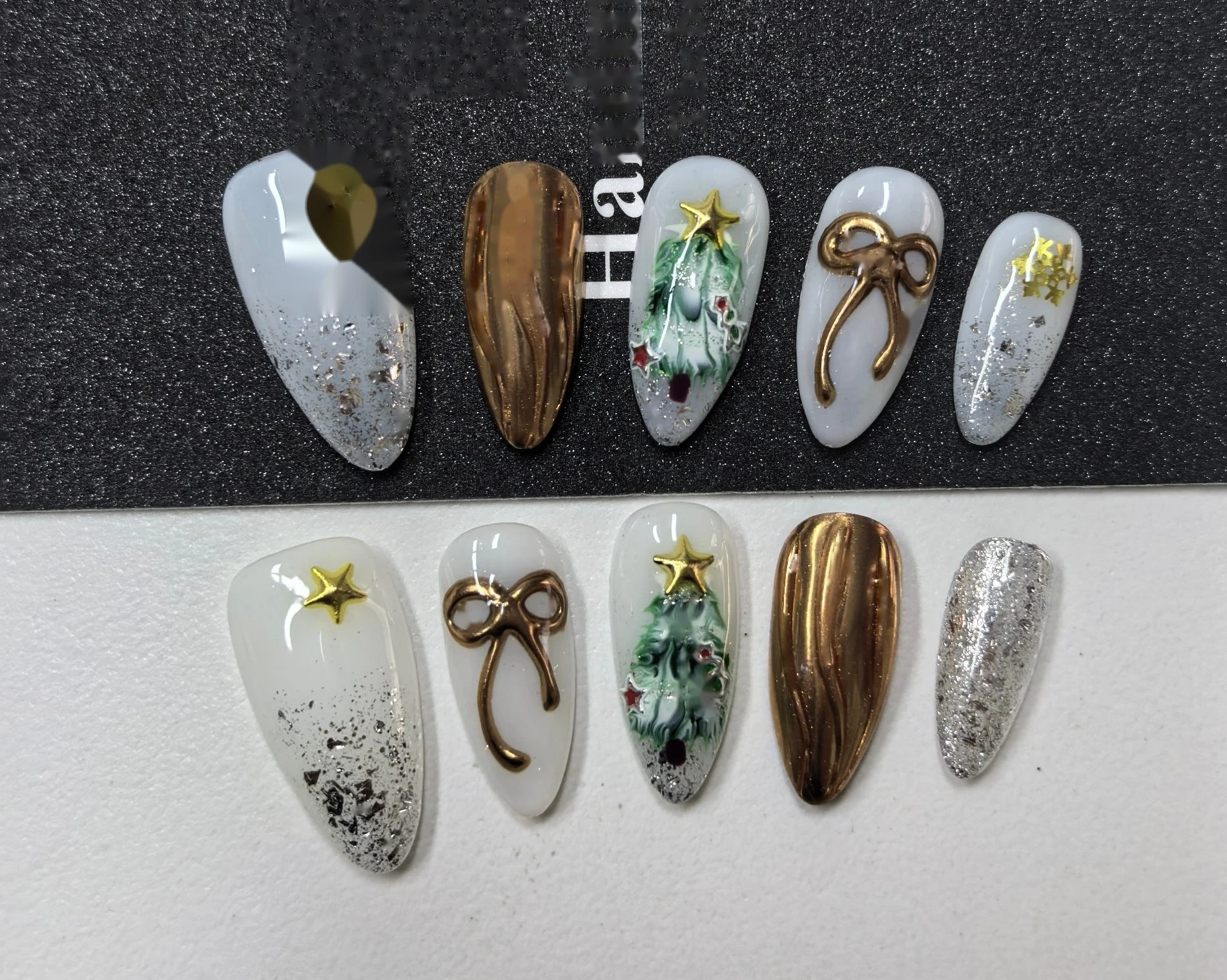
Classify every design before you order it. If the seasonal signal can be removed or reduced — a charm, a tip line, a printed motif — the design has a second life after December. If the whole surface depends on a dated motif, it is a one-season design and should be sized accordingly.
This is the difference between a range that clears in January and a range that becomes dead stock. A velvet burgundy or a midnight navy reads as winter rather than Christmas, so it keeps selling into the new year. A gingerbread house does not; it is Christmas and nothing else.
So the allocation question has a second half. Once you have decided what each design is for, decide what happens to it on 26 December. The designs that can be re-framed get the deeper buy, because their shelf life extends past the season. The designs that cannot get sized against the Christmas window alone.
That reasoning also decides which designs belong in a gift box, because a box sold as a gift has to be photographed and merchandised differently from a set sold to be worn.
What Do Decorated and 3D Designs Change for Compliance and QC?
A decorated set has more parts than a painted one, and every added part is a chance to fail. A charm has an attachment to test, a raised element has a depth to check, and a motif has a print or foil that can lift. The design decision is also an inspection decision, so the QC plan has to name the parts, not just the design.
Three checks belong in the plan for any set carrying a physical element. First, attachment strength: handle the sample the way a courier would and see whether the charm or the raised element holds. Second, surface consistency: a foil or a print on a curved nail fails differently from one on a flat surface, so check it under the light your buyers will see. Third, the tolerance on the decorative element itself, because a charm that varies in size across a run shows up as an inconsistent set.
There is a market side to this as well. Any claim on a listing has to be one you can support, whether it is a finish description, a wear claim or a material statement, because listing claims are advertising claims.5 A set described as 3D should genuinely carry a raised element, and a set described as handmade should be one.
Compliance also depends on where the set is sold rather than where it is made. Some markets treat cosmetic products as carrying documentation duties,4 and nail decoration applied to the body may fall inside those rules depending on how a product is classified. Confirm the classification for your destination market before you print the pack, because the label requirement follows the classification.
Conclusion
A Christmas press-on range works when the designs are chosen by role rather than by preference. Cover the motif families that shoppers search by name, put a 2026 technique word on at least a few designs, size the heroes deeper than the tail, and know before you order which designs survive December. The trend words matter, but they only earn their place once the design they describe can be produced, photographed and inspected consistently.
One assumption worth dropping
The festive design that trends hardest is rarely the one that sells through best. Seasonal shoppers buy late and buy habit, so a safer core of classic reds and golds usually cleans up after the trend pieces stall. Stock the trend for attention and the classic for the sell-through.
Send us your motif shortlist, the shapes and finishes you want in the range, and your target quantities against the 20/50/100/volume ladder. We reply with a per-project quote, sample arrangement and lead time.
Get a Quote or message us on WhatsApp. See the live Christmas styles under handmade press-on nails, the season outlook in wholesale Christmas press-on nails 2026, and how wide to plan the range in Christmas range sizing.Footnotes
- Amazon Best Sellers, Press On False Nails category, captured September 30, 2026. ↩︎
- ZONO market snapshot, September 30, 2026, recording the filter words and price bands published for the christmas press on nails category on a major handmade marketplace. ↩︎
- 2026 Christmas trend coverage published August–September 2026, naming velvet, aura, glazed chrome, cat eye, jelly, tartan plaid, celestial stars, half-moon and ombre ice finishes. ↩︎
- Cosmetics in the EU, European Commission, covering product notification, safety assessment and responsible-person duties. ↩︎
- Advertising FAQs: A Guide for Small Business, U.S. Federal Trade Commission. ↩︎