Sep 14, 2026Press-On Nails
OEM vs ODM for Handmade Press-On Nails: How to Balance Timeline and Investment?
OEM vs ODM for handmade press-on nails: learn how each model shapes timeline, cost, and design control so you can launch smarter and scale faster.
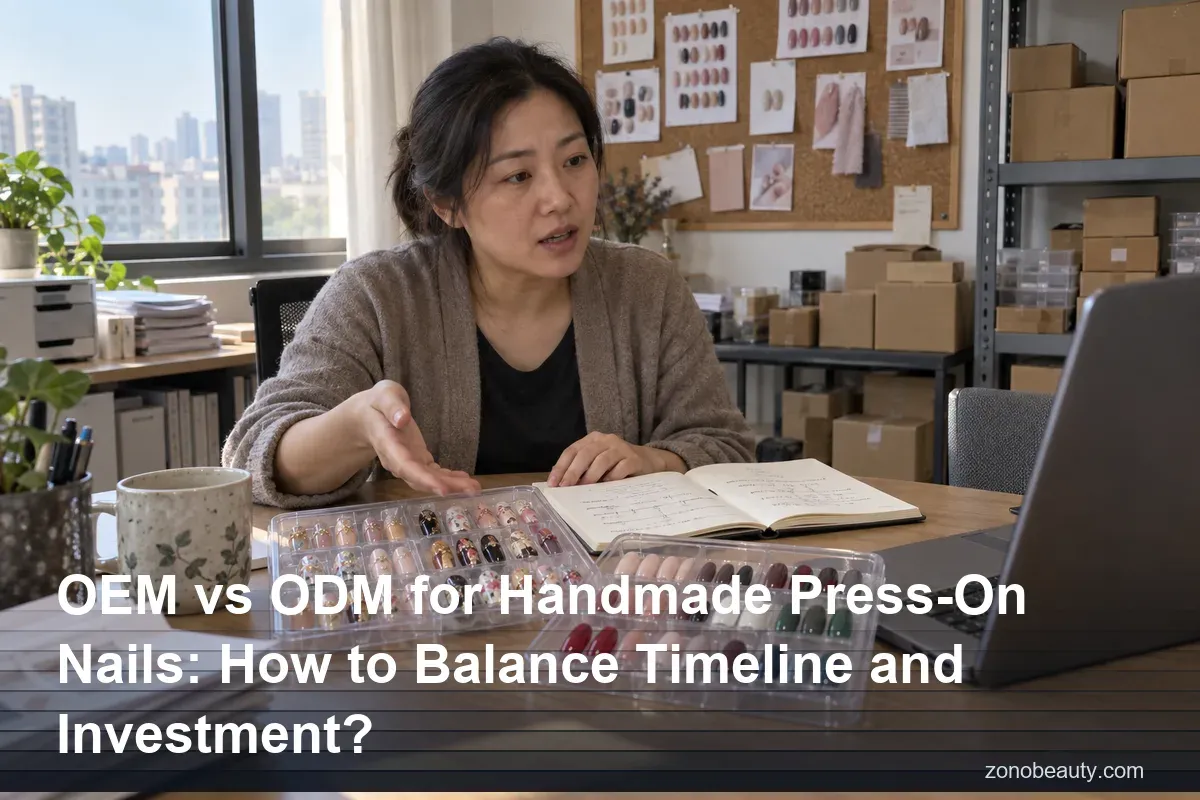
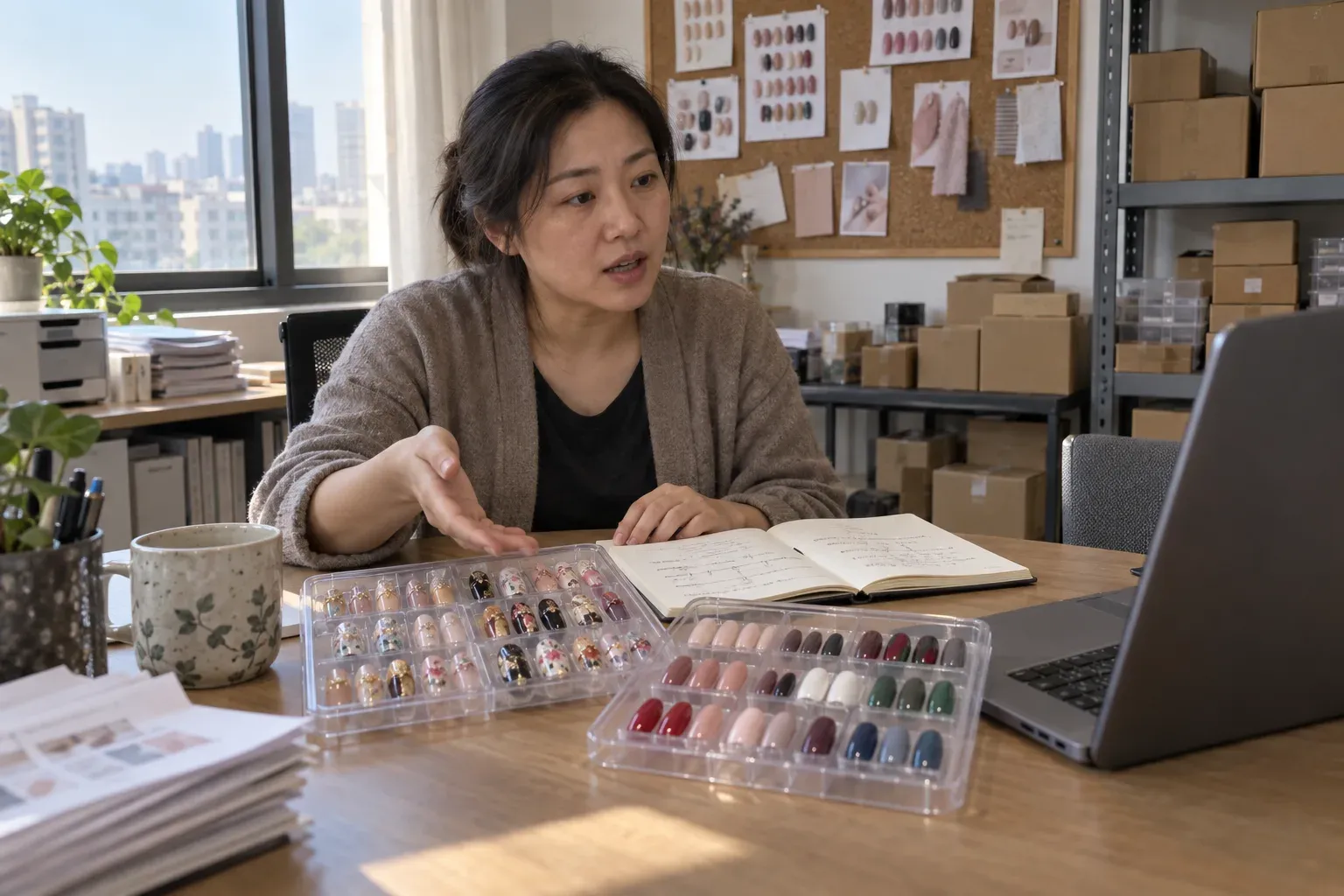
The OEM vs ODM question for handmade press-on nails lands on our Shantou coordination desk weekly. Founders fear picking wrong: months of burned cash, or a launch that looks generic.
ODM gets handmade press-on nails to market faster with lower upfront investment, while OEM gives full design control, exclusivity, and stronger margins at scale. Most brands should validate demand through ODM first, then migrate proven bestsellers into OEM once repeat orders justify the development cost.
That short answer hides a lot of moving parts. Timelines, sampling costs, minimum order quantities 1, and design ownership all shift depending on which path you choose. Let me walk you through each factor, the same way I would in a project scoping call.
ZONO confirmed terms (for reference)
- Sample sets: US$15 per set, credited against your first bulk order.
- Bulk production: around US$7 per set, quoted per design.
- Minimum order quantity: 50 sets per design.
- Compliance documentation: available upon request; final compliance responsibility rests with the brand owner.
- Markets served: Southeast Asia, North America, and South America.
Any other figures in this article are general industry context, not a ZONO quotation. Confirm current terms in writing before ordering.
What's the real difference between OEM and ODM when I'm sourcing handmade press-on nails?
A US nail brand founder asked our team why two quotes for identical designs differed threefold. The answer came down to scope: OEM versus ODM.
With OEM, you supply the complete specification—shape, sizing, art, adhesive setup, and packaging—and the factory manufactures to your exact brief. With ODM, the factory offers pre-developed handmade designs that you select, adjust, and brand. OEM buys ownership and exclusivity; ODM buys speed and lower technical complexity.
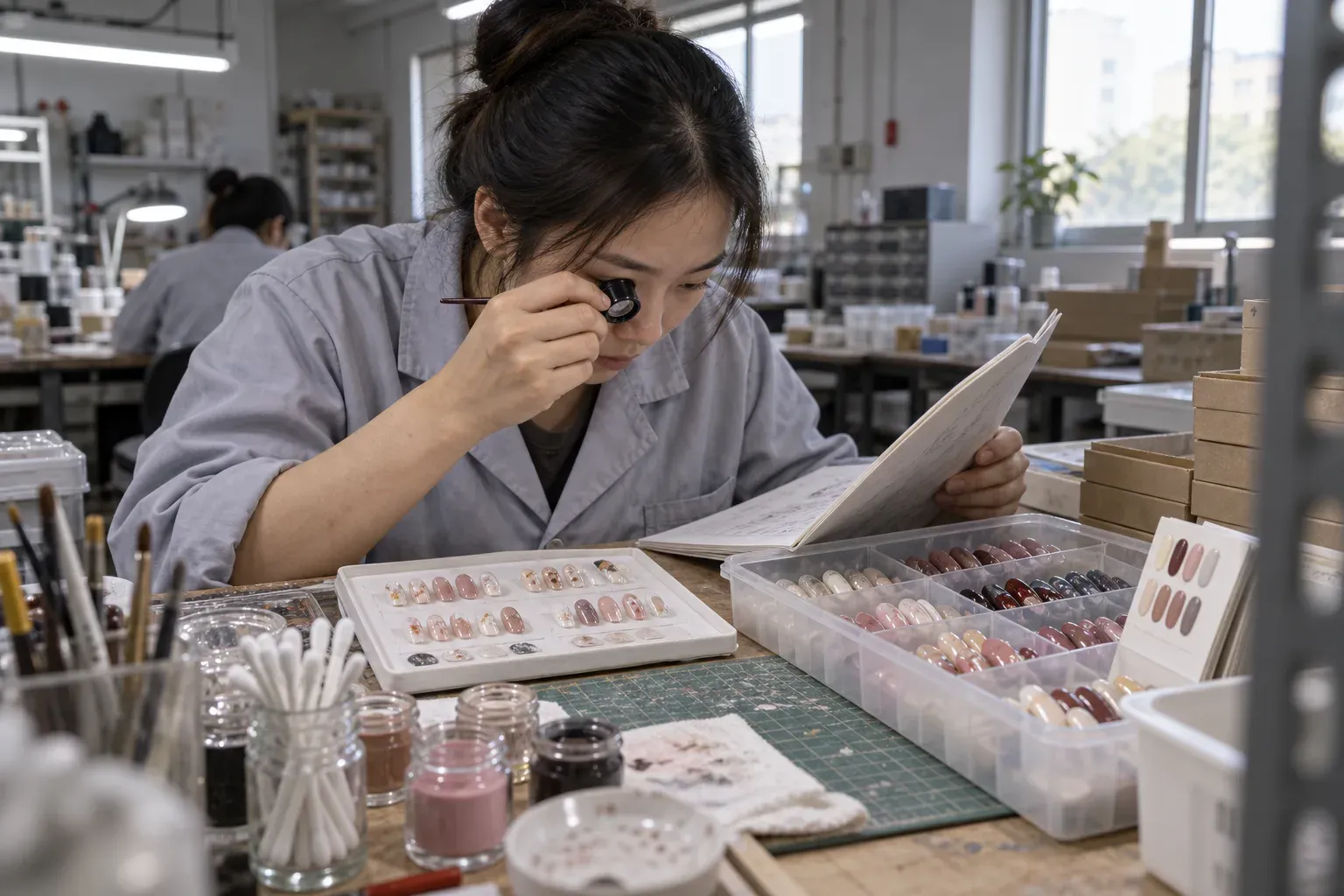
The confusion is understandable, because many suppliers now market both OEM and ODM together on the same page. That is not sloppy marketing. It reflects what buyers actually want: an "enter now, customize later" workflow instead of a single rigid model. Here is how I break down the three terms for clients.
OEM, ODM, and Private Label in Plain English
Model | Who develops the design | Who owns the design | Typical fit |
|---|---|---|---|
OEM | Your brand, via full design files and specs | You, with exclusive rights | Brands with a signature identity and validated sales |
ODM | The factory, from its catalog or your brief | The factory; designs may be shared across sellers | New brands and trend-driven launches |
Private label | The factory, finished stock designs | The factory | Fastest branding layer, lowest complexity |
Private label manufacturing 2 is really a lighter layer on top of ODM: you put your logo and box on a finished product and go. Intellectual property protection 3 is where the models truly split. OEM grants your brand exclusive rights to unique nail architecture and art. ODM designs, by contrast, are often sold to multiple sellers, which is exactly why they cost less.
Why Handmade Changes the Equation
In machine-made or UV-printed press-on nails, the packaging carries much of the differentiation. In handmade press-on nails, the hand-painted art, finish quality, and sizing accuracy are the product's perceived value. That raises the stakes on whichever model you pick. It also created a useful middle path: semi-custom ODM, where your unique hand-painted patterns are applied to standard ODM nail shapes. In our project work, this bridge option gives small brands real identity without OEM-level investment.
✔ OEM gives your brand exclusive rights to the nail designs you develop, while ODM catalog designs can appear under multiple competing labels TrueIn OEM, you supply the specification and own the resulting design, so the factory cannot resell it. ODM designs belong to the factory and are commonly offered to many buyers.✘ Choosing ODM means the factory gains rights over your brand name and logo FalseYour trademark and branding always remain yours in an ODM arrangement. Only the underlying nail designs and molds belong to the factory, not your brand identity.
How does choosing OEM versus ODM affect my upfront investment and per-unit costs?
When we scope handmade press-on nail projects, one trade-off comes up constantly: pay more now for ownership, or pay more per unit for flexibility. Neither answer is automatically wrong.
ODM requires lower upfront investment because designs, molds, and processes already exist, though per-unit costs stay higher and margins thinner. OEM demands more capital for prototyping, sampling rounds, and larger minimum order quantities, but delivers stronger unit economics once production is locked and repeatable.
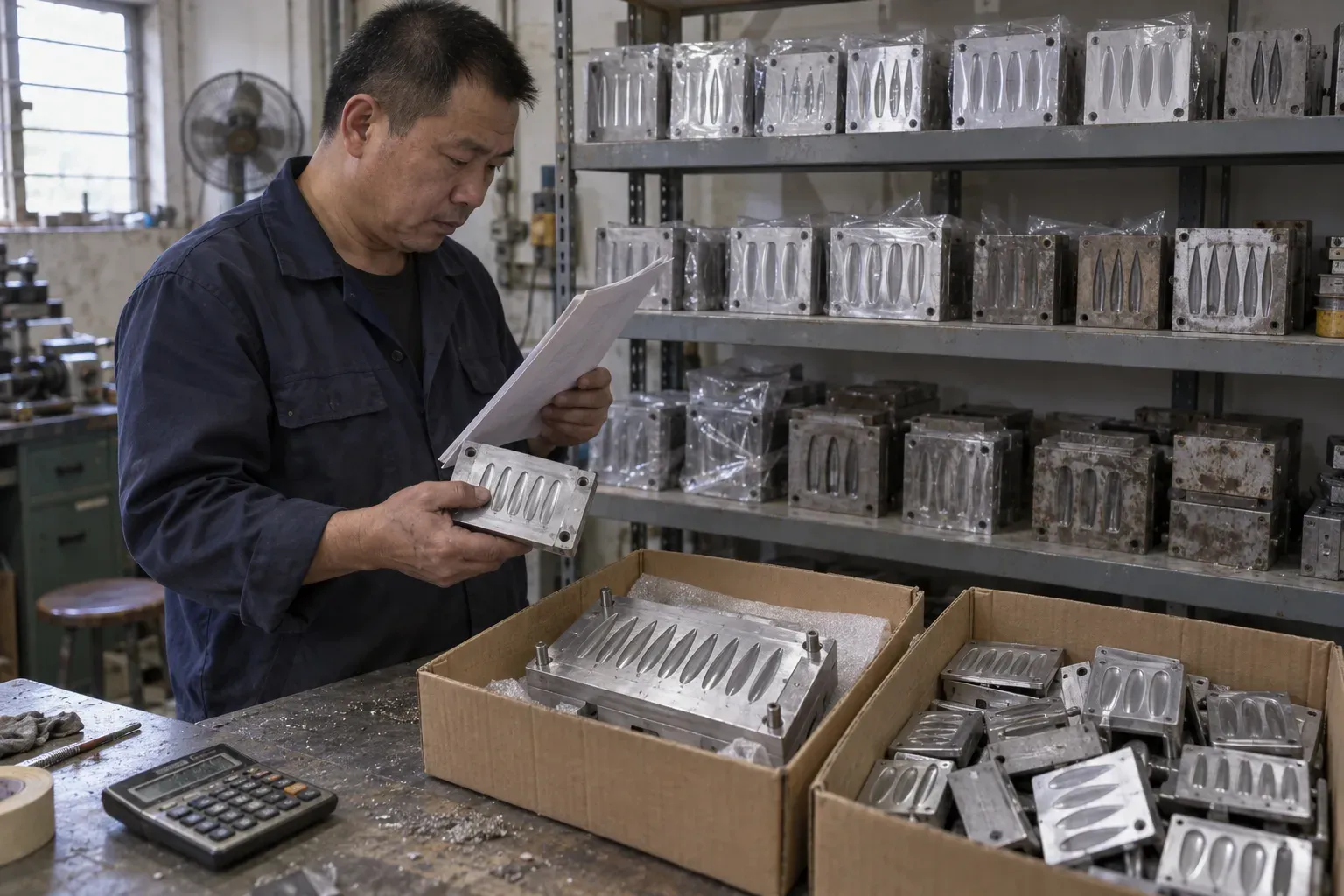
Money flows very differently in the two models, and I find most sticker shock comes from buyers comparing an OEM quote against an ODM quote without realizing they are looking at two different scopes of work.
Where the Upfront Cash Goes
Cost component | OEM | ODM |
|---|---|---|
Design development | Paid by your brand | Absorbed by the factory |
Prototyping and sampling fees | Multiple paid rounds | Minimal, often one confirmation sample |
Molds and tooling | Custom, brand-funded | Existing, already amortized |
Custom packaging solutions | Usually full custom | Stock or semi-custom options |
Minimum order quantity | Higher per design | Lower, often mixable across styles |
Some vendors advertise MOQ thresholds of several hundred sets per custom design. Treat that as a planning reference, not a universal rule, because handmade lines vary widely by art complexity. Low-MOQ and mixed wholesale options are increasingly common on the ODM side, which is why influencers testing a capsule and salons buying seasonal assortments lean that way.
The Per-Unit Math and the Inventory Risk
OEM ties up capital twice: once in development, then again in larger inventory commitments. ODM allows a leaner, closer-to-just-in-time inventory strategy. But here is the resolution to the common objection that OEM "wastes" money on sampling: once your specification is locked, your unit production cost drops and stays predictable across reorders, which is where margin control actually lives. One forward-looking note from recent projects: brands investing in OEM molds for bio-resin materials are positioning for the consumer shift away from traditional ABS plastics, which makes that upfront spend a longer-term asset rather than a sunk cost.
Which option gets my press-on nails to market faster, OEM or ODM?
Two projects we coordinated through vetted production network last year told the story: the ODM capsule shipped before the OEM line had even cleared its second sampling round.
ODM is faster. Factory-ready designs can move from order to shipment in roughly two to four weeks, while OEM development typically spans three to six months of prototyping, sampling rounds, and approvals. Brands chasing seasonal nail trends usually cannot wait out a full OEM cycle.
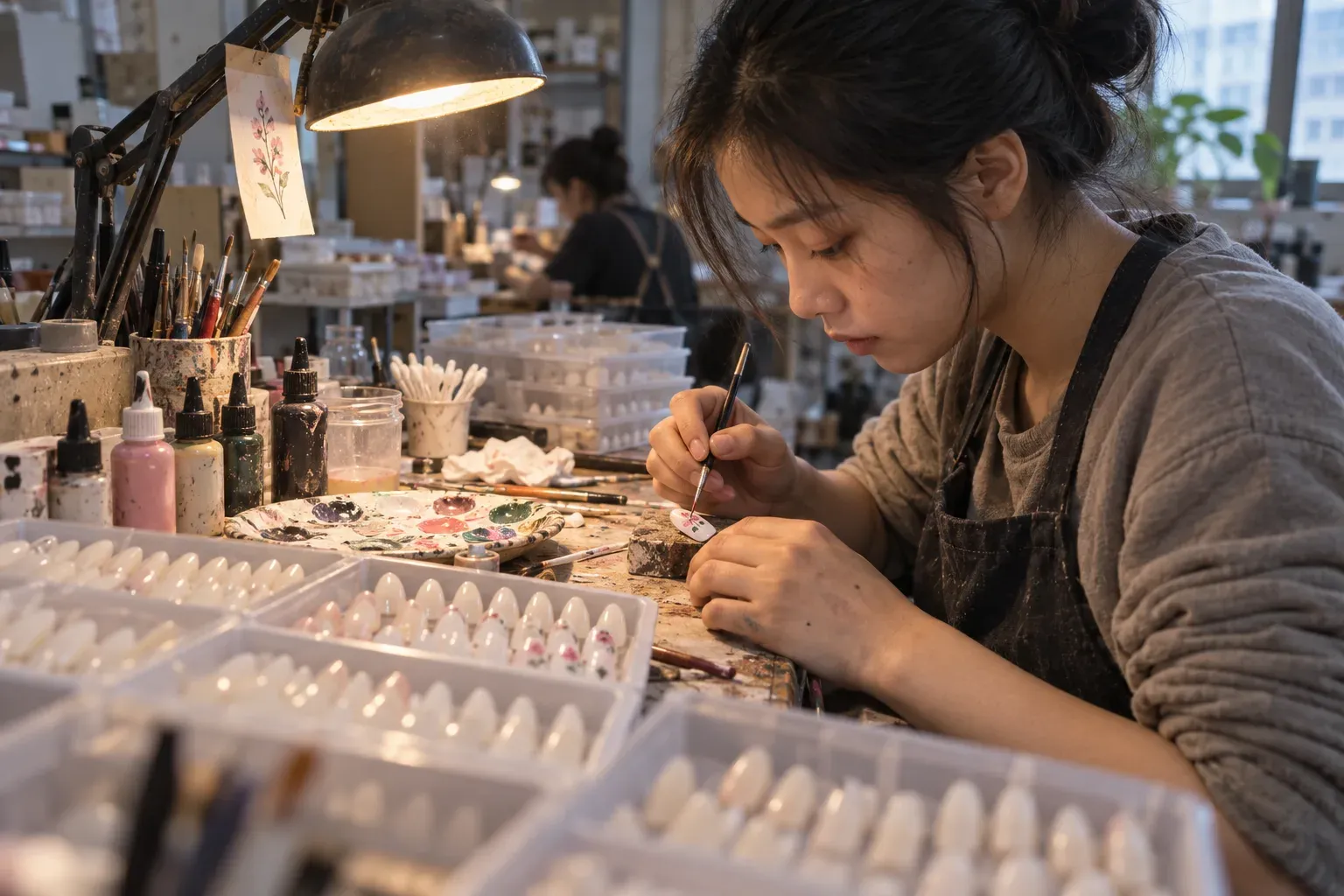
To see where the time actually goes, walk through the product development cycle stage by stage. Every handmade press-on nail project passes through the same gates. The difference is how many gates each model has to open from scratch.
- Concept and design brief
- Prototyping, digital or physical
- Sample rounds and approval
- Packaging development
- Pre-production quality setup
- Mass production, inspection, and shipment
Stage | ODM path | OEM path |
|---|---|---|
Concept | Select from validated catalog | Develop original spec from zero |
Prototyping | Already done by factory | Multiple iterative rounds |
Sample approval | One confirmation sample | Repeated fit, art, and adhesive revisions |
Packaging | Stock or light customization | Full custom development |
Production | Technicians already proficient | Team learning curve on new art |
Two points deserve emphasis. First, sample approval is a standard gate before mass production even in ODM. You still confirm fit, adhesive strength, and design accuracy; it is simply faster because the design is already proven. Second, handmade consistency is easier to hold in ODM, where nail technicians are already fluent in the designs. A new OEM design forces a learning curve across the painting team, and that calibration time is often what buyers underestimate. One genuine accelerator on the OEM side: 3D digital prototyping <sup id="ref-4"><a href="#footnote-4" class="footnote-ref">4</a></sup> before physical sampling can cut R&D costs and compress the traditional development timeline by nearly 30%. After production, supply chain logistics—inspection, export documentation, freight—add similar time to both paths, so the real gap is created entirely upstream.
✔ Pre-production sample approval is a standard step before mass production in both OEM and ODM workflows TrueFactories use approved samples to lock fit, adhesive strength, and design accuracy before bulk runs. ODM simply reaches this gate faster because the base design already exists.✘ ODM lets you skip sampling entirely and go straight to bulk production FalseSkipping confirmation samples is how brands end up with sizing, color, or adhesive surprises in bulk goods. Even catalog designs need a signed-off reference sample.
How do I decide between OEM and ODM based on my budget, timeline, and design control needs?
Ten years of coordinating China supply chains taught us one lesson: the brands that struggle rarely chose the wrong model. They chose the right model at the wrong stage.
Choose ODM if you need to launch within weeks, hold limited capital, or are still testing demand. Choose OEM if you have validated bestsellers, a signature design identity, and cash to fund development. Many brands stage the transition: ODM first, then OEM for proven styles.
Run through this quick checklist before you request quotes:
- Do you need product on shelves for a specific season or trend window? Lean ODM.
- Do you have sales data proving a specific shape or art style sells? Lean OEM for that style.
- Is your cash reserve thin after packaging and marketing spend? Lean ODM or private label.
- Is a signature look central to your brand promise? Budget for OEM, at least partially.
Match the Model to Your Business Type
Buyer type | Recommended starting path |
|---|---|
New e-commerce brand | ODM or private label to validate demand |
Influencer capsule launch | Semi-custom ODM with unique hand-painted art |
Salon or wholesale nail suppliers | Mixed ODM assortments with low MOQ |
Established beauty brand | OEM for hero styles, ODM for seasonal fillers |
The Staged Strategy We Recommend
Stage one: test demand fast with ODM, using custom packaging solutions to carry your branding. Stage two: refine bestsellers through semi-custom or limited OEM work, adding your own art to proven shapes. Stage three: move winning styles into full OEM once repeat orders and brand identity are proven, so sales data funds the development rather than guesswork.
Two cautions from our coordination work. First, the objection that ODM makes you look like your competitors is legitimate—resolve it through hand-painted semi-custom art and distinctive packaging, not by rushing into OEM prematurely. Second, before committing to handmade OEM, run what the industry calls a technician scalability audit: verify the factory can hold intricate art quality when scaling from 100 sets to 10,000 sets. We build that check into quality assurance protocols during supplier vetting, because a beautiful sample means little if batch fifty drifts from it.
✔ A staged path—ODM first, then OEM for proven bestsellers—lets real sales data fund your development investment TrueValidating styles through ODM removes guesswork before you commit to sampling rounds and larger inventory. Many suppliers now explicitly support this entry-now-customize-later workflow.✘ Starting with ODM locks your brand out of moving to OEM later FalseThe two models are stages, not opposing camps. Brands routinely convert best-selling ODM styles into OEM-exclusive designs once demand is proven.
Conclusion
ODM buys time; OEM buys ownership. Validate demand fast, convert bestsellers into exclusive designs, and stage your investment. That path protects both your launch timeline and your margins.
Sourcing handmade press-on nails and need to check MOQ against your order plan? Browse the ZONO press-on nail range for finished sets, shapes, and private-label options.
Footnotes
1. Illustrates real-world MOQ practices common across global sourcing and wholesale platforms. ↩︎ 2. Background on the private label branding model referenced alongside OEM and ODM. ↩︎ 3. Explains the legal ownership concept underlying OEM design exclusivity versus ODM. ↩︎ 4. Authoritative technology body covering digital prototyping methods used in product development. ↩︎