Sep 14, 2026Press-On Nails
Free Samples or Paid Prototype: How to Evaluate a New Press-On Nails Supplier?
Free samples reveal a press-on nails supplier's baseline quality fast, but a paid prototype confirms they can execute your exact design before you commit to bulk.
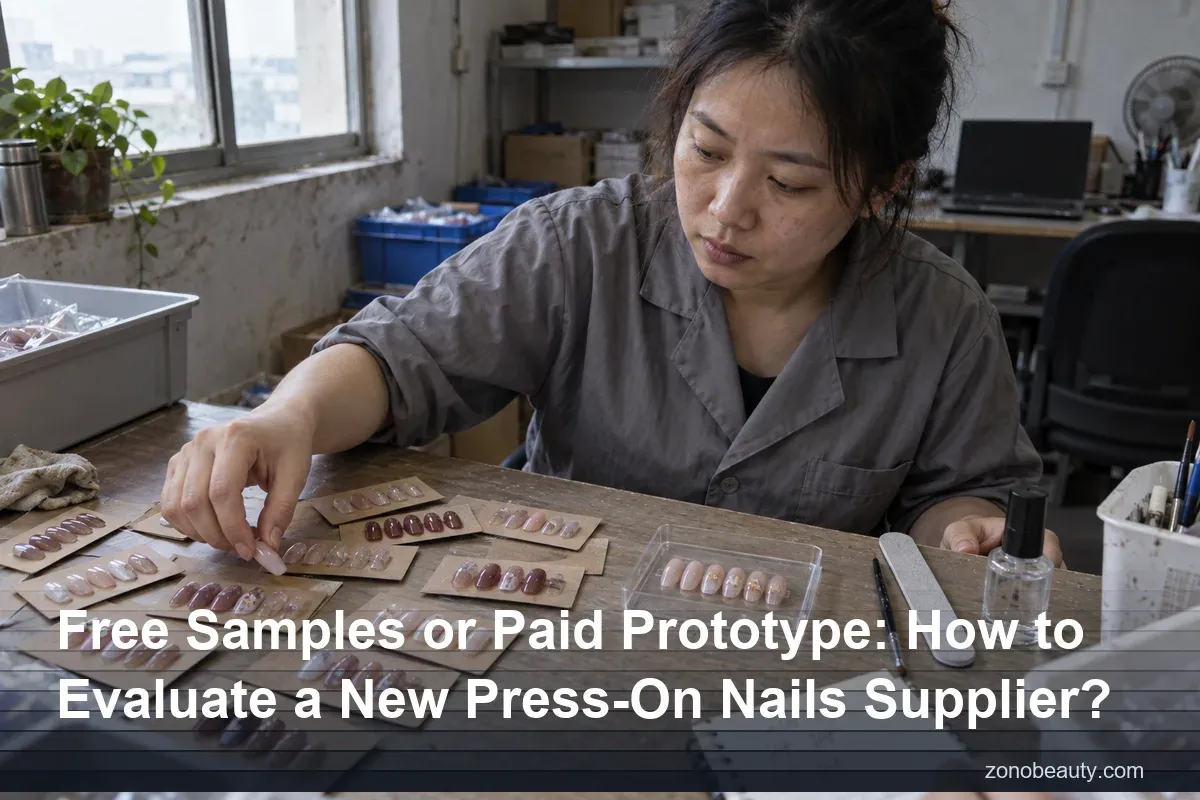
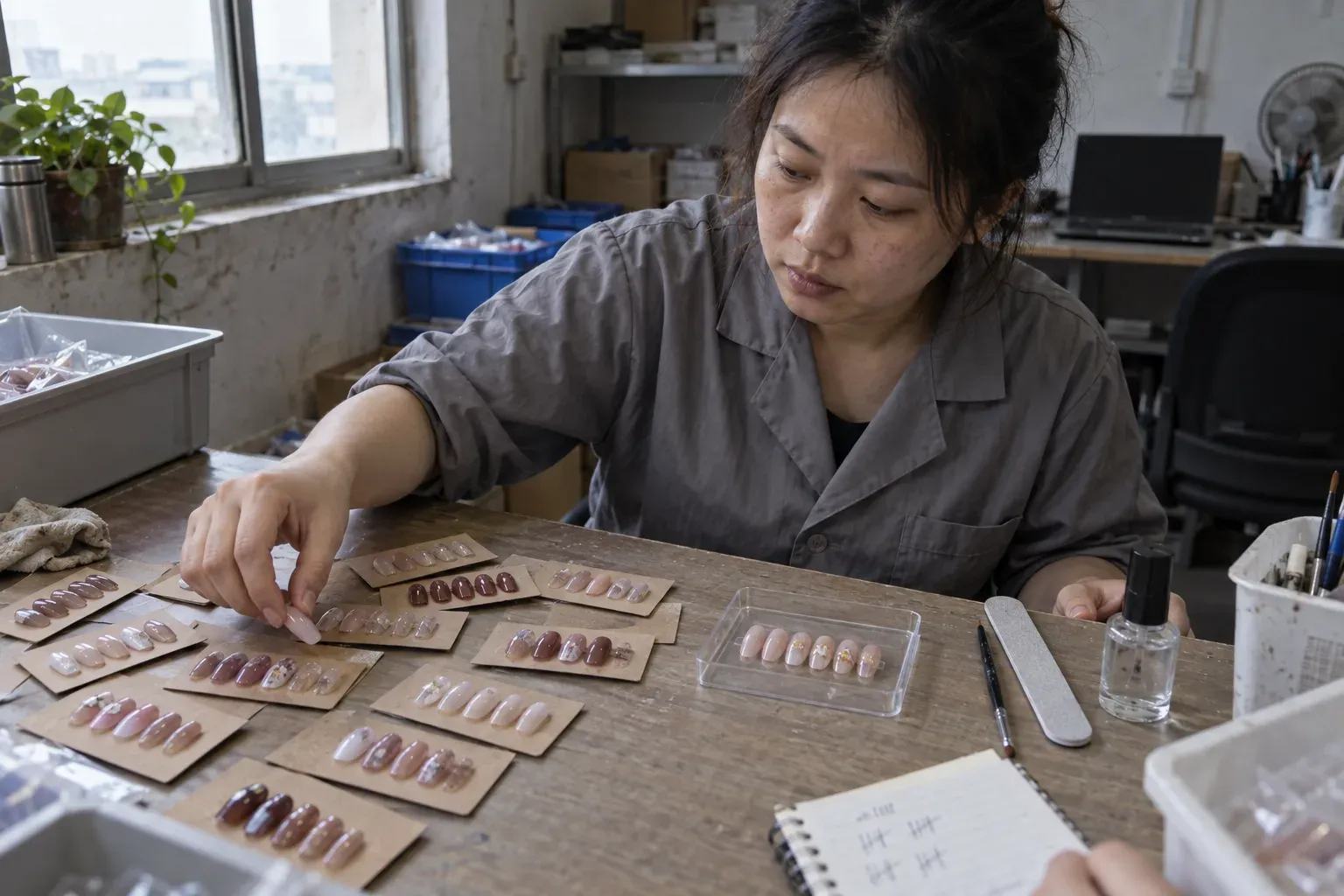
Choosing a press-on nails supplier feels like gambling. We have coordinated enough sampling rounds in Shantou to know one wrong pick turns a launch into dead inventory and refund emails.
Use free samples from a press-on nails supplier to screen basic quality, then pay for a custom prototype before any bulk order. Free samples filter out weak vendors quickly; paid prototypes prove the factory can execute your exact design, packaging, sizing, and compliance requirements at production scale.
That two-step sequence sounds simple. But most buyers skip one of the steps, and that is where losses start. In this article, I will walk through when to use each tool, what to test at the sample stage, how to stop bulk drift, and which questions expose a weak supplier before money moves.
ZONO confirmed terms (for reference)
- Sample sets: US$15 per set, credited against your first bulk order.
- Bulk production: around US$7 per set, quoted per design.
- Minimum order quantity: 50 sets per design.
- Compliance documentation: available upon request; final compliance responsibility rests with the brand owner.
- Markets served: Southeast Asia, North America, and South America.
Any other figures in this article are general industry context, not a ZONO quotation. Confirm current terms in writing before ordering.
Should I Pay for a Prototype or Ask for a Free Sample From a Press-On Nails Supplier?
A nail brand founder once asked me why we quoted a fee for her custom prototype after sending free stock samples. That question sits at the heart of supplier evaluation.
Ask for free samples first to compare shortlisted press-on nails suppliers, then pay for one custom prototype tied to your exact design brief. Free samples show baseline finish and fit; paid prototypes reveal revision speed, customization skill, and whether the supplier takes your project seriously.
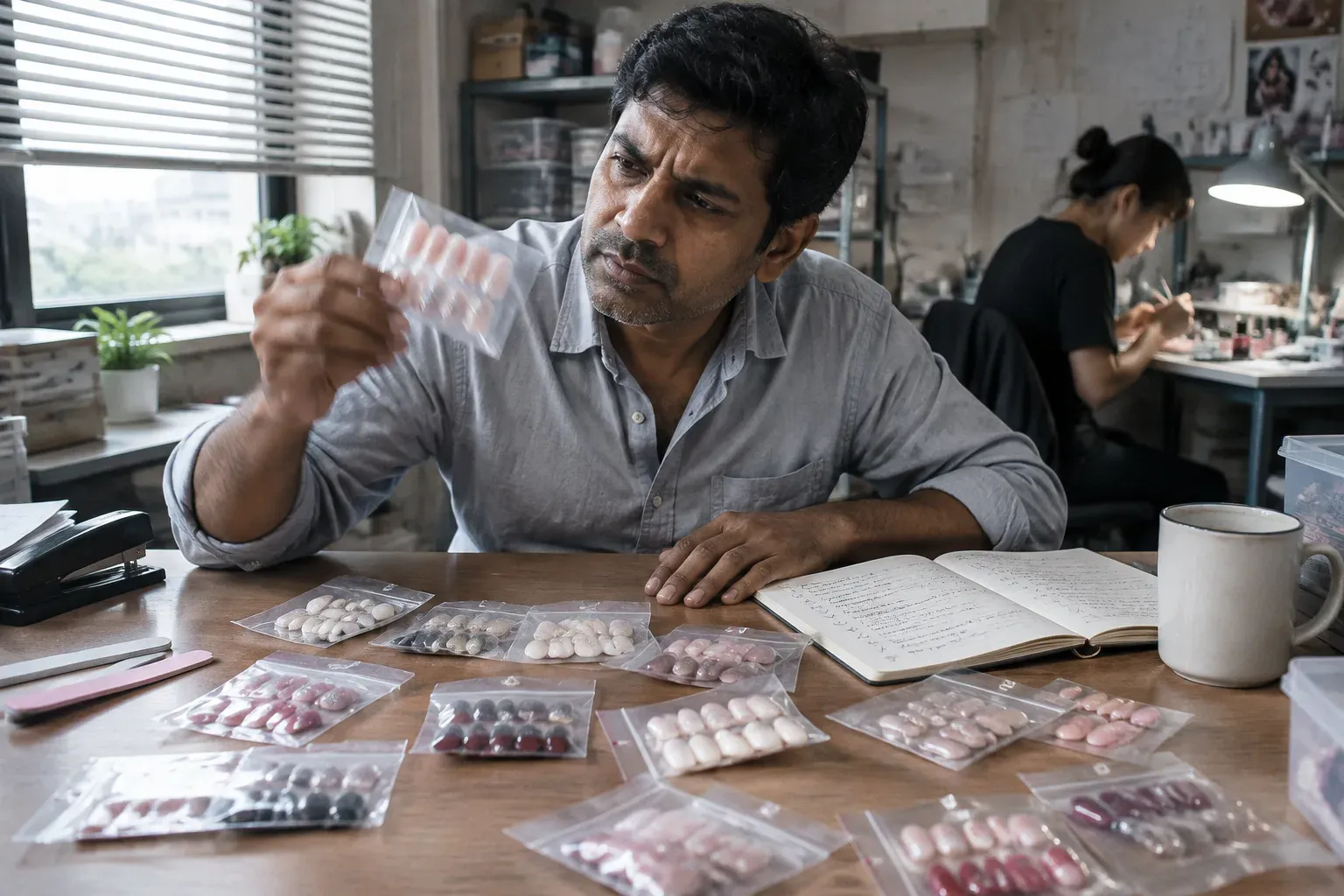
Free samples and paid prototypes answer different questions. Treating them as interchangeable is the most common sourcing mistake I see. Here is how they actually compare:
Factor | Free Sample | Paid Prototype |
|---|---|---|
What it shows | Baseline finish, stock quality | Your exact design, sizing, packaging |
Who it screens | Many suppliers, fast | One serious manufacturing partner |
Typical origin | Pre-made stock sets | Built from your design brief |
Risk if skipped | You waste prototype fees on weak vendors | You approve generic quality that bulk never matches |
Typical turnaround | Days, often from shelf stock | Roughly 3–15 days depending on complexity |
Some buyers push back on paying at all. Their argument: free samples cost nothing, so why not compare ten vendors for free? That logic works only for standard, off-the-shelf sets. The moment your project involves <a href="https://www.statista.com/topics/1188/cosmetics-market-in-china/" target="_blank" rel="noopener noreferrer">private label manufacturing</a> <sup id="ref-1"><a href="#footnote-1" class="footnote-ref">1</a></sup>, custom artwork, or a specific almond apex height, a free stock sample tells you almost nothing. It may even mislead you, because a factory's showcase sets are often their best work, not their average work.
From the supplier side, sample fees cover real development cost. Cutting a new shape, matching a Pantone color, and hand-finishing decoration takes labor. A supplier who works for free on speculative custom projects is often a supplier who cuts corners elsewhere.
Why Speed Changes the Math in 2026
Trend cycles in press-on nails have compressed to a few weeks from design to market. Manufacturers advertise short sample lead times and longer mass-production windows depending on complexity and order size. A paid prototype round doubles as a speed test: if a supplier takes a month to revise one set, they cannot support trend-driven launches. Some of our clients also use 3D-rendered digital prototypes to finalize shape and apex height before any physical sample ships, which cuts international shipping cycles out of the early rounds entirely.
✔ Paid prototypes filter out unserious suppliers and produce a test unit that reflects your real specification TrueA custom prototype forces the supplier to execute your exact design, sizing, and packaging brief, exposing their revision speed and precision before you commit to bulk production.✘ A high-quality free sample proves a factory is ready for your bulk order FalseFree samples are often pre-made showcase sets that hide mass-production inconsistency, so they should never be treated as proof of factory readiness for your specific design.
What Should I Check in a Press-On Nails Sample Before I Trust a New Supplier?
During one quality inspection before shipment, our team bent a glossy almond set against its C-curve. A white stress line appeared instantly. That whole batch never left the warehouse.
Check flexibility without stress marks, sizing consistency across the set, top-coat scratch resistance, adhesive performance, and wear durability through a hot water stress test. Also verify packaging print quality and request MSDS or equivalent safety documentation (available upon request) before trusting a new press-on nails supplier.
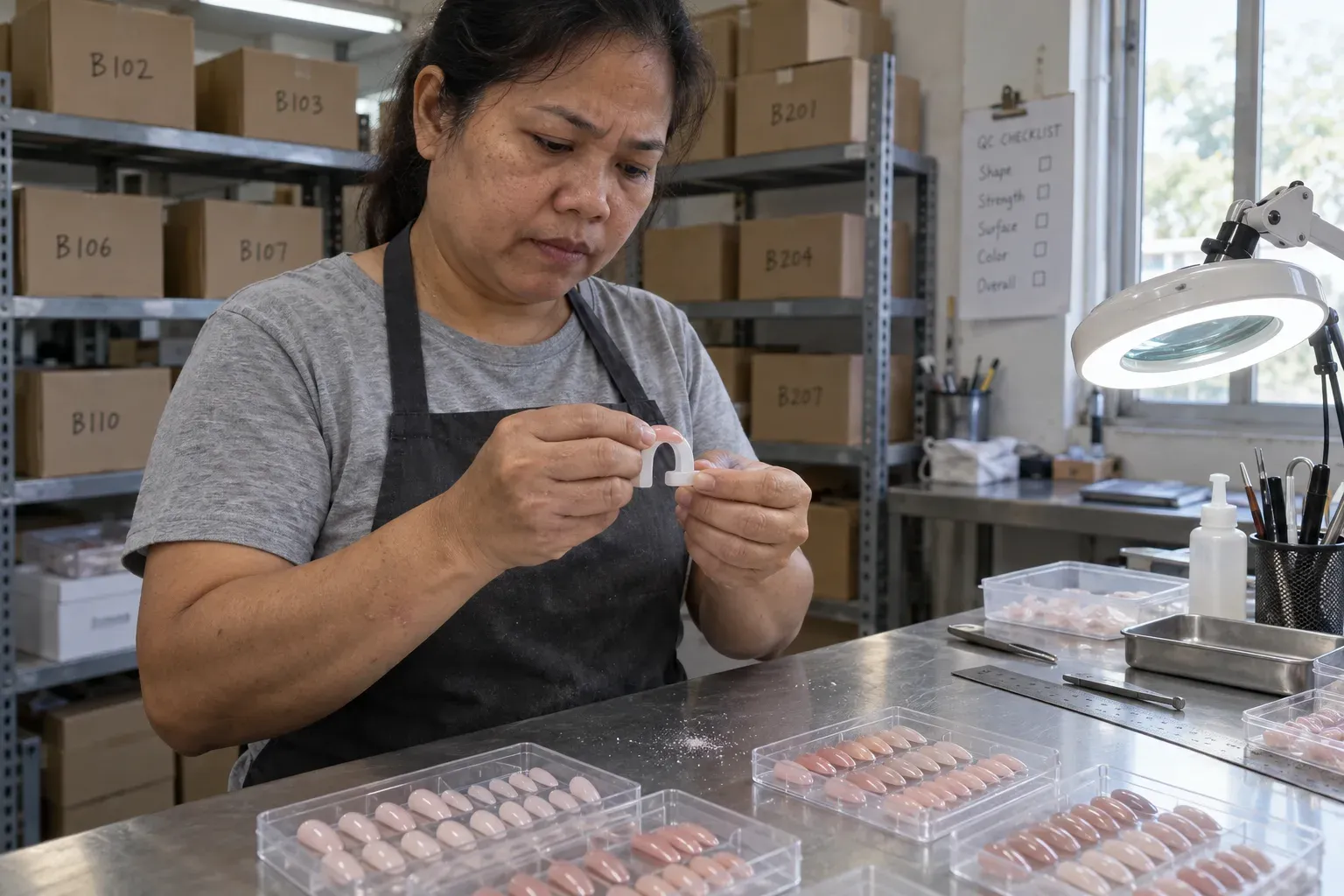
A sample is only useful if you test it like a skeptic. I recommend running every check on this table before you sign off on anything:
Test | How to Run It | Pass Criteria |
|---|---|---|
Flex and memory | Bend the nail to match a natural C-curve | No cracks, no white stress marks |
Sizing consistency | Measure the width of each nail in the set | Widths align with standard industry sizing, no random gaps |
Scratch test | Rub the design, glitter, or matte texture firmly | No peeling, fading, or lifted decoration |
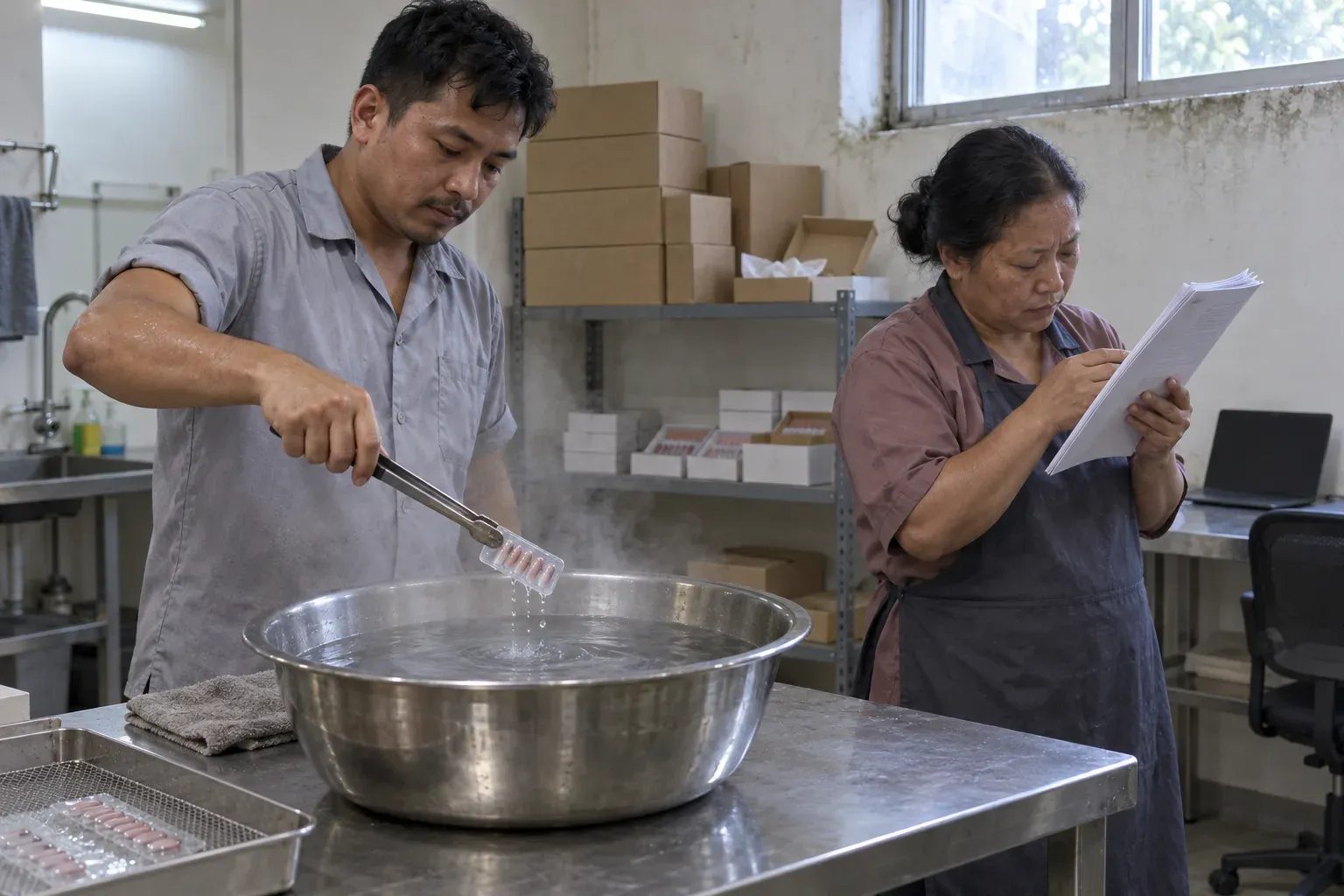
Hot water stress test | Soak worn nails in hot water repeatedly | Adhesive and material integrity hold under heat and moisture |
Real wear test | Wear one set for a full week of daily tasks | No lifting, breakage, or edge chipping |
Packaging review | Inspect box print, inserts, and labels | Print quality matches the premium feel of the nails |
Material, Fit, and Inclusivity
Most quality sets use ABS plastic material <sup id="ref-2"><a href="#footnote-2" class="footnote-ref">2</a></sup>, and the grade matters. Cheap ABS turns brittle and snaps at the sidewall. Good ABS flexes and returns to shape. Also check whether the sizing range covers wider nail beds. Inclusive sizing is a 2026 design expectation, not a bonus, and sizing consistency across repeat sets is the first thing salons complain about when it slips.
Adhesive Tabs vs Glue
Compare pre-applied adhesive tabs against bottled glue on the same set. Tabs win on easy removal; glue wins on multi-day wear. Your target customer decides which balance is right, so run product durability testing with the exact application method you plan to sell.
Compliance Paperwork
Request <a href="https://www.osha.gov/hazard-communication" target="_blank" rel="noopener noreferrer">Material Safety Data Sheets</a> <sup id="ref-3"><a href="#footnote-3" class="footnote-ref">3</a></sup> to confirm the resins and pigments meet your market's safety requirements. For regulated markets, ask for the applicable safety and compliance documentation (available upon request). In our coordination work, we only pass along supplier documents we have actually verified, and I suggest you hold every supplier to that same standard.
✔ Bending a press-on nail to the natural C-curve reveals material quality instantly TrueLow-grade ABS shows white stress marks or cracks when flexed, so this simple bend test exposes weak material before any wear testing begins.✘ If a sample looks flawless out of the box, wear testing is unnecessary FalseSurface finish says nothing about adhesive strength or heat resistance; only real wear and a hot water stress test show how the product survives daily use.
How Do I Make Sure My Bulk Order Won't Drift From the Approved Press-On Nails Sample?
The hardest lesson from ten years in China supply chain work: approval day is not the finish line. We built our single-window coordination model around exactly this drift problem.
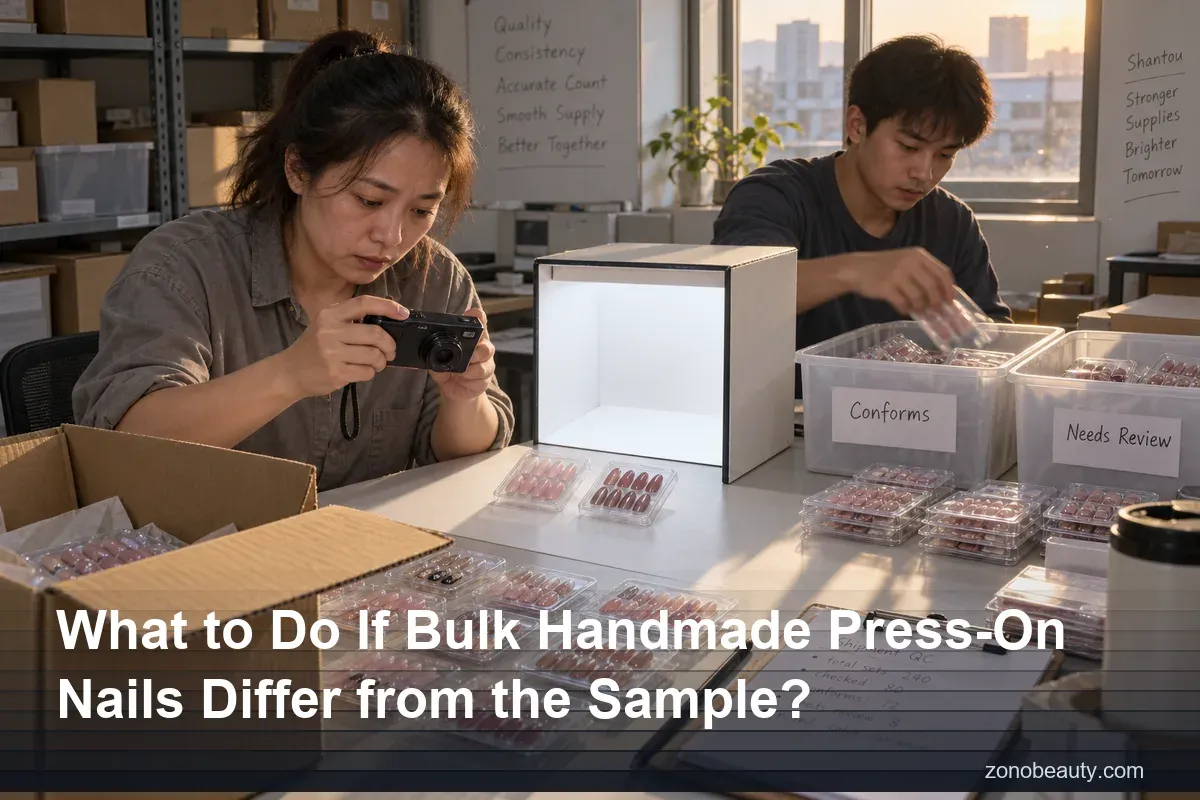
Lock a signed golden sample, write measurable specs into the purchase order, require pre-production and mid-production photo checks, and book a third-party or coordinated quality control inspection before shipment. Comparing sealed reference sets against random bulk pulls keeps color, finish, and packaging from drifting.
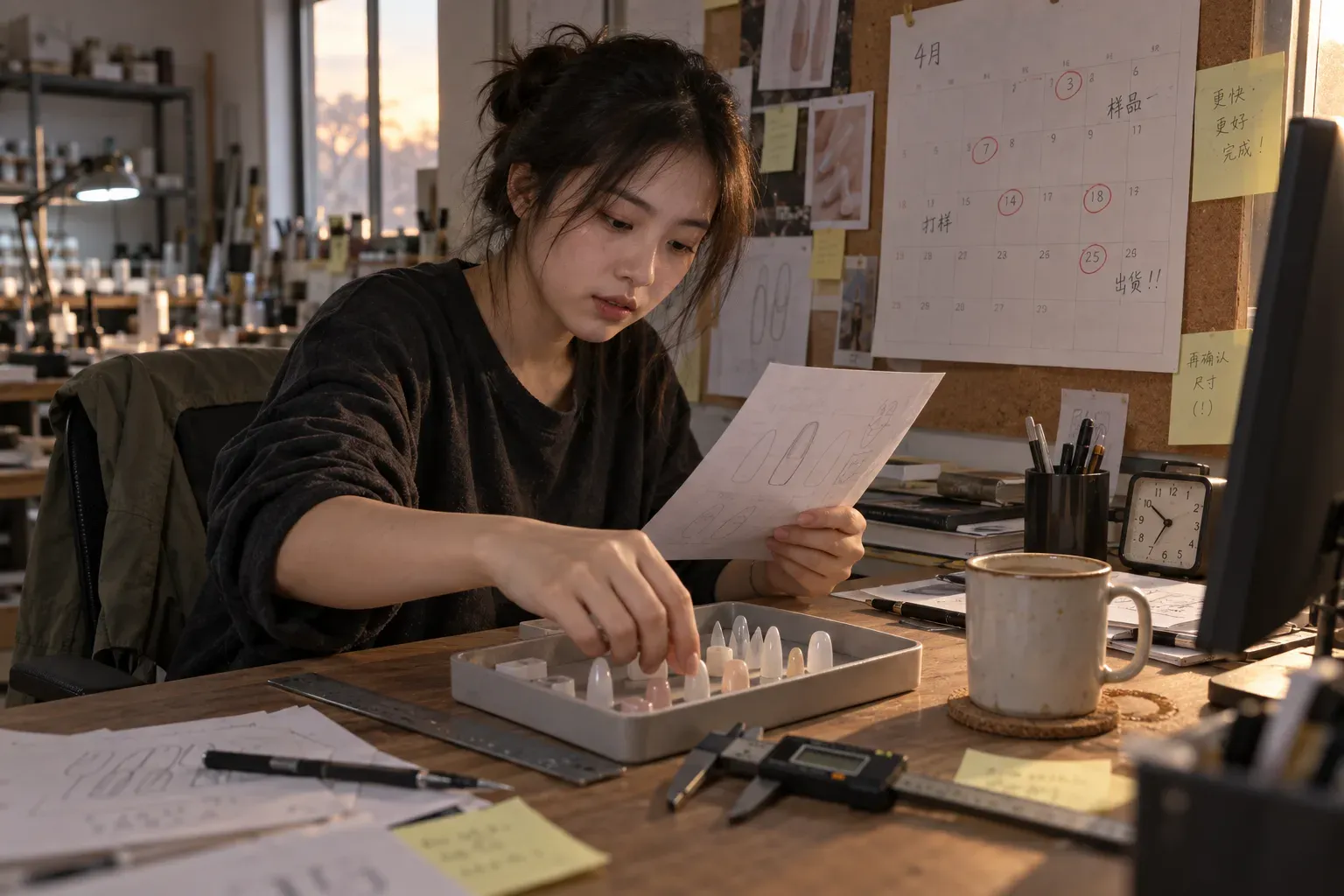
Drift rarely comes from bad intent. It comes from small substitutions: a different top coat batch, a cheaper glitter, a rushed packaging print run. The fix is process, not trust. Here is the sequence I run on every project we coordinate:
- Seal a golden sample. Both sides sign and date two identical approved sets. The supplier keeps one; you keep one. Every future dispute gets settled against these, not against memory.
- Convert the sample into a written spec. Record nail widths, shape, apex height, color codes, finish type, adhesive method, and the custom packaging design details. Vague purchase orders invite vague production.
- Request a pre-production sample from bulk materials. This confirms the factory is using the same resin, pigments, and decoration as the prototype, not leftover stock.
- Ask for mid-production photos or video. Five minutes of footage catches substitutions weeks before cartons seal.
- Run a final quality control inspection. Pull random sets from random cartons and compare them directly against the golden sample. Check labels, inserts, and box print alongside the nails themselves. This is the exact step where our team catches most color and packaging mismatches before goods ship.
One more layer helps for larger commitments: a factory audit <sup id="ref-4"><a href="#footnote-4" class="footnote-ref">4</a></sup> before the first bulk order. Even a basic remote audit confirms whether you are dealing with a real production site or a broker who will subcontract your job to an unknown workshop. Suppliers who resist inline checks or inspection access are telling you something. Listen to it.
What Questions Should I Ask a Press-On Nails Supplier Before I Place My First Order?
Every quote we prepare balances the same tension: lower unit price against consistency risk. The questions you ask before ordering decide which side of that trade-off you land on.
Ask about Minimum Order Quantity, wholesale pricing tiers, sample and mass-production lead times, revision policy, private label and custom packaging capability, compliance documentation, sustainable material options, and whether you are dealing with a factory or trading company. Written answers reveal seriousness before money changes hands.
Context matters here. Most handmade press-on nail capacity sits in Asia, so you will almost certainly be comparing several vendors who all claim the same capabilities. Questions separate them. Use this list:
Question | What the Answer Reveals |
|---|---|
What is your Minimum Order Quantity per SKU? | Whether short-run, trend-driven launches are realistic |
Can you show wholesale pricing tiers and bulk order discounts in writing? | Whether your margin survives packaging and marketing costs |
What are your sample and mass-production lead times? | Whether they fit compressed trend windows of 15–45 days |
How many free revisions come with a paid prototype? | How they handle mistakes and communication |
Do you offer private label manufacturing with custom packaging? | Whether box print quality matches your brand positioning |
Can you provide MSDS or equivalent safety documentation on request? | Readiness for regulated markets |
Do you offer recycled ABS, bio-sourced resins, or water-based adhesives? | Capability for premium eco-positioned launches |
Are you a factory or a trading company? | Who actually controls your quality and schedule |
Judge the Answers, Not Just the Claims
A supplier who answers with specifics, documents, and reasonable caveats is worth a prototype fee. A supplier who answers everything with "yes, no problem" is worth nothing but caution. In our sourcing work for nail brands across North America, Southeast Asia, and South America, the vendors who explain why a price sits where it sits have consistently outperformed the ones who simply quote lowest. Also probe design capability against 2026 trends: minimalist luxury, micro-art, negative space, textured finishes, and modular wearability. A supplier who cannot discuss these fluently will struggle to sample them.
✔ Asking whether a vendor is a factory or trading company changes how you manage the relationship TrueA factory controls production directly, while a trading company or coordinator manages partner sites, so each requires different audit, inspection, and communication expectations.✘ The supplier with the lowest quote and highest bulk order discounts is the safest first choice FalseRock-bottom pricing usually signals material substitutions or skipped quality control, which cost far more in failed inventory than the savings on the initial quote.
Conclusion
Free samples screen; paid prototypes prove. Test hard, document everything, and lock your golden sample before bulk. Sequence both tools and your press-on nails supplier choice stops being a gamble.
Sourcing handmade press-on nails and need to check MOQ against your order plan? Browse the ZONO press-on nail range for finished sets, shapes, and private-label options.
Footnotes
1. Authoritative market data on China's dominant role in the global cosmetics and beauty export industry. ↩︎ 2. Official regulatory information regarding the safety and compliance of materials used in nail care products. ↩︎ 3. Official guidance on chemical safety documentation for consumer products. ↩︎ 4. International standard for quality management systems ensuring product consistency and manufacturing excellence. ↩︎