Case Study: How We Solved a Color-Changing Lip Oil Leakage Problem
See how ZONO solved a color-changing lip oil leakage problem by re-testing the formula, bottle, wiper, wand, applicator, and cap as one system.
A color-changing lip oil project coordinated by ZONO developed a serious problem after production: the product began leaking from the bottle mouth while sitting still.
The solution was not one formula adjustment or one quick packaging change. ZONO had to review the formula, bottle, wiper, wand, applicator, and cap as one complete product system, then coordinate new component matching and repeated compatibility testing.
This case shows why packaging that looks suitable—or has worked for another product—cannot be assumed to be compatible with a new lip oil formula.
Case Study at a Glance
Item
What happened
Product
Color-changing lip oil
Initial situation
Packaging looked suitable, the price was workable, and early checks showed no obvious issue
Problem
Lip oil later leaked from the bottle mouth during static storage
Root cause
The complete formula-and-packaging system did not fit together well enough
Components reviewed
Formula, bottle, wiper, wand, applicator, and cap
Testing direction
Temperature, storage position, leakage, product pickup, and component fit
Decisive change
The packaging supplier changed the cap and the full component combination was re-matched
Result
Static leakage was resolved and the client continued placing orders
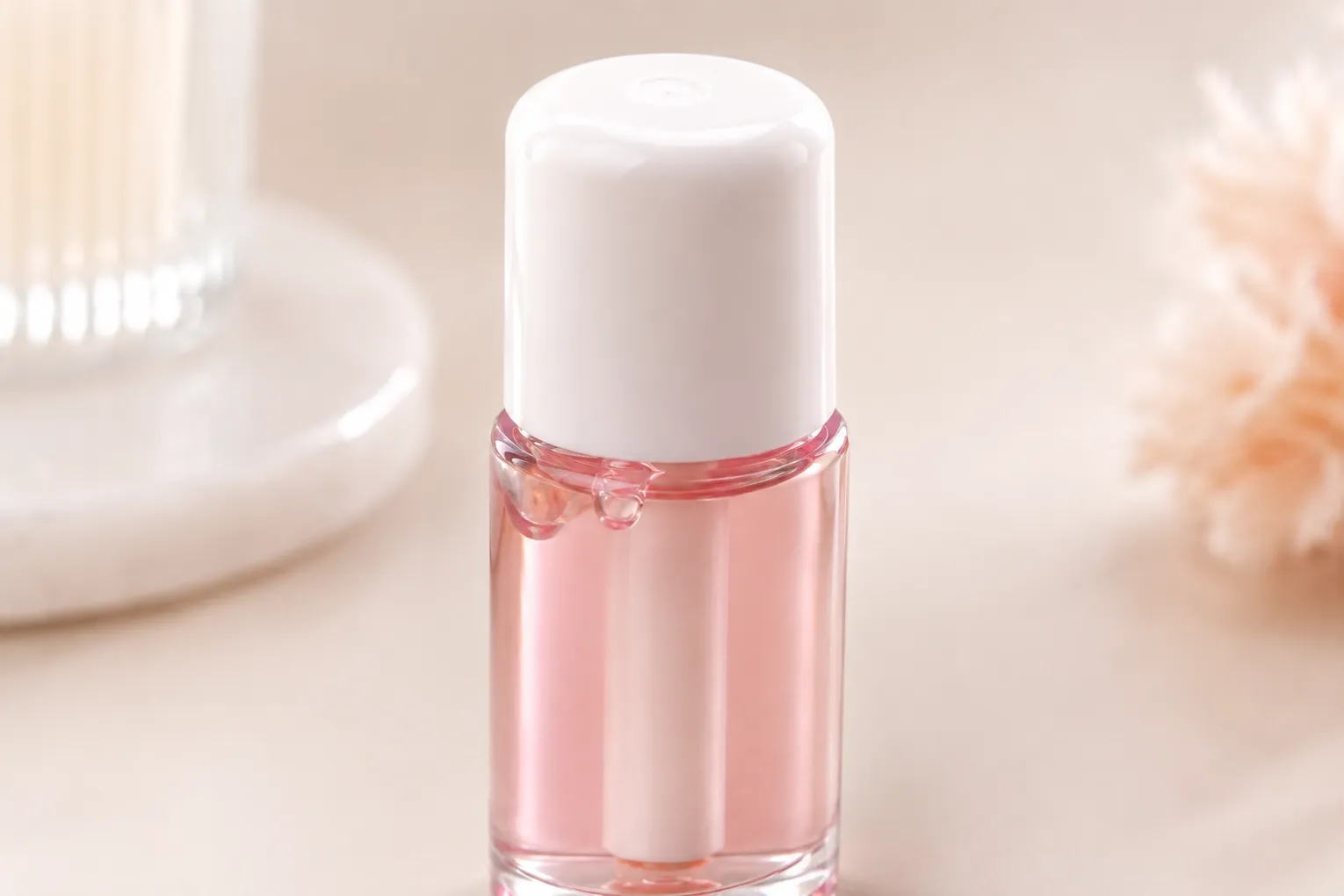
Color-changing lip oil leaking from the bottle mouth during static storage evaluation
The Challenge: Leakage Appeared After Early Checks
The packaging came from a partner supplier. Its appearance suited the product concept, and its cost fit the commercial plan. Early checks did not reveal an obvious problem, so the project moved forward.
The client later reported that the lip oil was leaking from the bottle mouth while the product remained in static storage.
This type of issue is difficult because the bottle may look normal when inspected quickly. Leakage can appear only after the formula has remained in contact with the complete packaging system for a longer period or under a different storage position.
The product therefore had to be evaluated again—not only as a formula inside a bottle, but as a finished system made up of several interacting parts.
Why the Lip Oil Leaked
The inner formula was different from formulas previously used with similar packaging, and it included a color-changing effect.
That did not prove that the formula alone caused the leakage. It meant that previous experience with the packaging could no longer be treated as proof of compatibility.
For a lip oil, performance depends on the interaction between:
The inner formula
The bottle
The wiper
The wand
The applicator
The cap
The way the finished product is stored and transported
A lightweight or highly fluid lip oil can collect around the bottle opening when the wiper or closure is too loose. Cap fit, wand dimensions, wiper tightness, and bottle-neck structure can also affect whether the product remains clean and sealed during upright, side, or upside-down storage.
The main lesson from the investigation was clear:
The problem could not be solved by evaluating the formula or the bottle separately.
How ZONO Investigated the Full Packaging System
ZONO coordinated a new review of the packaging combination using the actual color-changing lip oil.
The evaluation covered the product under different conditions and positions, including:
High-temperature conditions
Low-temperature conditions
Room-temperature conditions
Upright storage
Side storage
Upside-down storage
Static storage
Visible leakage
Product accumulation around the bottle opening
Applicator product pickup
Wiper tightness
Wand and cap fit
Formula contact with the packaging
These checks were important because one package can behave differently when the formula viscosity, ingredients, scent, function, or special effect changes.
A component that performs well with one lip oil is not automatically suitable for another.
Technician testing color-changing lip oil with bottles, wipers, wands, applicators, and caps
Why One Packaging Adjustment Was Not Enough
The first objective was not to replace every component. It was to identify which part of the system was preventing the package from working reliably with the new formula.
ZONO re-matched the packaging combination and coordinated repeated adjustments with the packaging supplier.
During this process, the team reviewed how the parts worked together:
Bottle and wiper
The wiper helps control how much product stays on the applicator and how much returns to the bottle. If it is too loose, a fluid lip oil may accumulate around the opening. If it is too tight, product pickup and application can suffer.
Wand and applicator
The wand length and applicator size affect insertion, withdrawal, product pickup, and contact with the wiper. A combination that is slightly mismatched can create an untidy opening or inconsistent user experience.
Cap and closure
The cap must work with the bottle neck, wand, and internal components to create a reliable closure. In this project, the supplier ultimately changed the cap as part of the revised packaging combination.
Formula
Because the formula included a different composition and a color-changing effect, the final component set had to be tested with the actual formula—not with water, an older formula, or an empty package.
The Solution: A Better-Matched Cap and Packaging Set
After repeated evaluation, the packaging supplier changed the cap.
The revised cap worked better with the bottle, wiper, wand, applicator, and inner formula. Once the complete packaging system was re-matched and tested again, the static leakage problem was resolved.
The important point is that the cap was not treated as an isolated replacement.
The solution came from improving the fit of the whole packaging set with the actual lip oil formula.
The Result
After the revised packaging combination resolved the static leakage issue, the client continued placing orders and later order volume grew substantially.
For ZONO, the result was not only a corrected package. The project also created a more reliable reference for future batches and reinforced a repeatable product-development rule:
Whenever the formula changes, compatibility must be confirmed again—even when the package has been used before.
Alt:Color-changing lip oil moving through filling and packing after packaging approval
What Beauty Brands Should Learn From This Case
1. Do not approve packaging only by appearance and price
Appearance and commercial cost matter, but neither proves that a package will work with the selected formula.
2. Treat formula and packaging as one product system
The formula, bottle, wiper, wand, applicator, and cap affect one another. Testing only the formula or only the empty package leaves important risks unchecked.
3. Re-test packaging whenever the formula changes
A change in viscosity, ingredients, scent, function, or color-changing effect can change the way the product interacts with the package.
4. Include storage direction in compatibility testing
A product that appears stable while upright may behave differently when stored on its side or upside down. Packing and transportation direction should also be considered.
5. Plan time for investigation and adjustment
A real compatibility problem may require component comparison, supplier coordination, new samples, and repeated testing. This time should be treated as risk control—not as unnecessary delay.
A Practical Lip Oil Packaging Checklist
Before approving a lip oil package for mass production, review:
Has the actual formula been filled into the intended bottle?
Has the package been checked at high, low, and room temperatures?
Has it been stored upright, on its side, and upside down?
Is there visible leakage during static storage?
Does product collect around the bottle opening?
Is the wiper too loose or too tight?
Does the applicator carry an appropriate amount of product?
Do the wand and cap fit correctly?
Does the closure remain reliable after repeated use?
Has the final package been tested again after formula changes?
Have packing and shipping positions been considered?
Is the approved sample retained as a reference for future batches?
Frequently Asked Questions
Can a package that worked before still leak with a new formula?
Yes. A change in viscosity, ingredients, fragrance, special effects, or product function can change how the formula interacts with the bottle, wiper, wand, applicator, and cap.
Is lip oil leakage always caused by the bottle?
No. Leakage may involve the complete packaging system, including the wiper, wand, cap, bottle neck, formula flow, storage direction, or the way the components fit together.
What should be tested before approving lip oil packaging?
Testing may include high, low, and room temperatures; upright, side, upside-down, and static storage; visible leakage; product accumulation; applicator pickup; wiper tightness; wand fit; cap fit; and formula contact with the package.
Can one short test guarantee that a lip oil will never leak?
No single short test can eliminate every possible risk. Compatibility should be evaluated using the actual formula and intended packaging under conditions relevant to production, storage, transportation, and use.
Planning a Lip Oil Project?
Do not select the formula and packaging as separate decisions.
ZONO Beauty can help coordinate formula direction, packaging selection, compatibility testing, sample approval, component adjustments, production preparation, and inspection requirements for private label lip products.
Learn why Indonesian beauty brands need a product-by-product INCI and formula package before BPOM notification—and how shade and fragrance names should align with labels and production.